

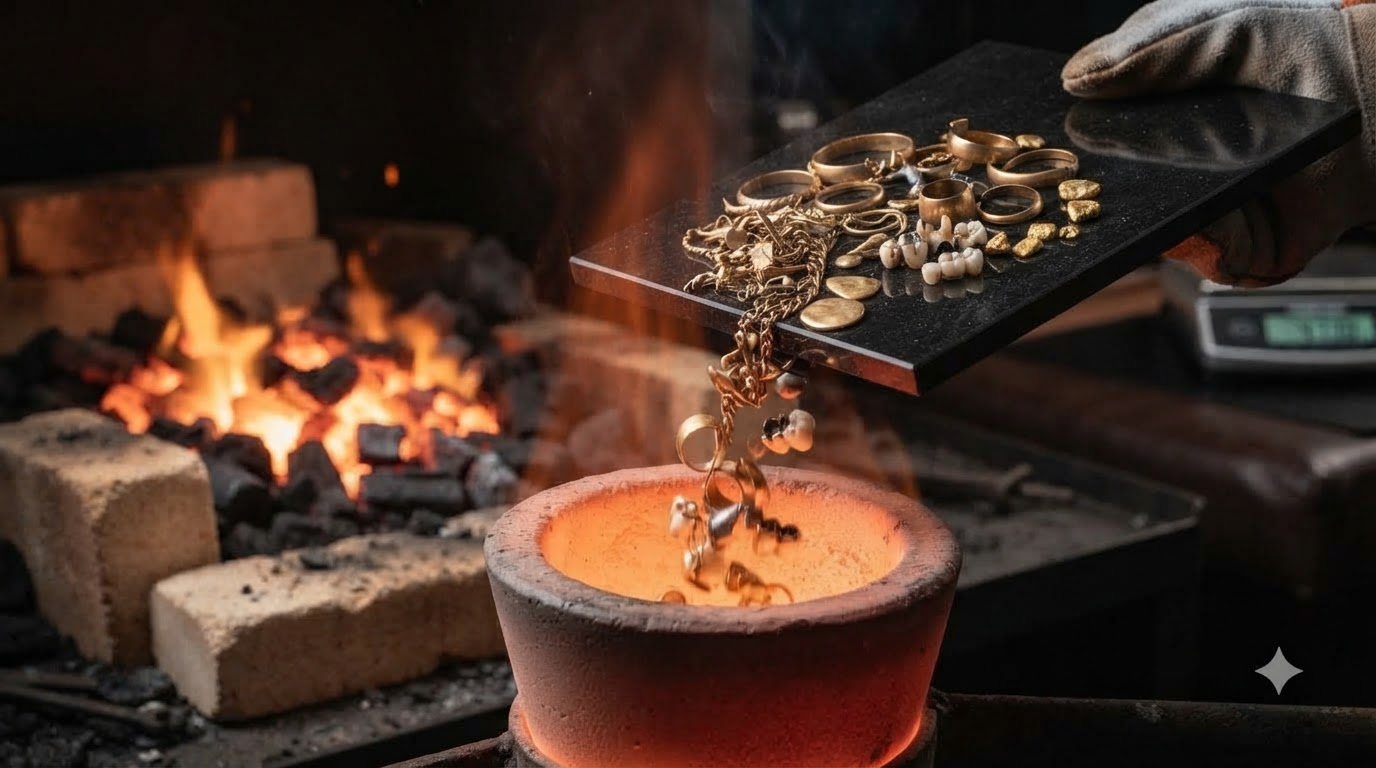
When selling an old gold ring, necklace, bracelet, or broken jewelry, one of the biggest misconceptions is assuming that the value stamped on the item is the amount you will receive. A gold item marked 18K, 22K, or 24K tells you something important about its purity, but it does not automatically determine its final selling price. The actual payout depends on several factors, including the current gold market price, the item's weight, gold purity, testing results, refining costs, and the buyer's margin.
Understanding how much is scrap gold worth requires separating four different concepts: market price, melt value, scrap value, and the final buyer payout. For example, a piece of 18K jewelry contains less pure gold than the same-weight 24K item, while stones, clasps, coatings, and other non-gold components can further reduce the payable gold weight.
What Determines the Value of Scrap Gold?
Several factors determine scrap gold value, not just the item's original price.
Gold Purity and Karat
Karat shows the percentage of pure gold:
- 24K: 99.9% gold
- 18K: 75% gold
- 14K: 58.5% gold
- 10K: 41.7% gold
Higher-karat gold contains more pure gold, so the same weight generally has a higher scrap value.
Weight of the Gold
Gold is commonly measured in grams, kilograms, and troy ounces. Buyers calculate value based on the actual gold content, not the jewelry's retail price. Stones and non-gold parts may be excluded from the payable weight.
Current Gold Market Price
Gold prices change based on investment demand, interest rates, inflation, currency movements, and global economic conditions. The spot price is a market benchmark, while a scrap buyer's offer is usually lower.
Buyer Fees, Refining Costs, and Margins
The final payout can be affected by:
- Refining and processing costs
- Gold testing or assay costs
- Transportation and handling
- Buyer profit margin
- Material quality and quantity
- Current local market conditions
Simple formula:
Scrap Gold Value = Weight × Purity × Gold Price per Gram
How Much Is Scrap Gold Worth Per Gram?
The value of scrap gold per gram depends mainly on gold purity and the current market price. A quick calculation can help you estimate the theoretical melt value before comparing offers from buyers.
Basic Scrap Gold Value Formula
Estimated Melt Value = Gold Weight × Purity × Current Gold Price per Gram
For example, 18K gold is approximately 75% pure, so only 75% of its weight is pure gold.
The actual amount you receive may be lower than the theoretical melt value because buyers may deduct refining, testing, processing, and handling costs, along with their profit margin.
Worked Example: 10 Grams of 18K Gold
Suppose you have 10 grams of 18K gold:
- Weight: 10g
- Purity: 75%
- Pure gold content: 10 × 75% = 7.5g
- If the current gold price is $100 per gram, melt value = 7.5 × $100 = $750
If a buyer pays 90% of the theoretical melt value:
$750 × 90% = $675
So, the estimated melt value is $750, while the hypothetical buyer payout is $675. Actual offers will vary based on purity, testing results, market conditions, and buyer terms.
Scrap Gold Karat and Purity Explained
Karat tells you how much pure gold is contained in a gold item. The higher the karat, the greater the gold content and, generally, the higher the scrap value.
| Karat | Approx. Gold Purity | Gold Content |
|---|---|---|
| 24K | 99.9% | Almost pure gold |
| 22K | 91.7% | 91.7% gold |
| 18K | 75.0% | 75% gold |
| 14K | 58.5% | 58.5% gold |
| 10K | 41.7% | 41.7% gold |
How to Calculate Pure Gold Content
Use this simple formula:
Pure Gold Content = Weight × Purity
For example, if you have 10g of 18K gold:
10g × 75% = 7.5g of pure gold
This means the remaining 2.5g consists mainly of other metals used to create the gold alloy.
Similarly, 10g of 14K gold contains:
10g × 58.5% = 5.85g of pure gold
So, 10g of 14K gold is not equivalent to 10g of pure gold. Its scrap value is based on approximately 5.85g of pure gold, before considering buyer deductions, refining costs, and margins.
How Is Scrap Gold Purity Tested?
Before buying scrap gold, a buyer needs to confirm its actual purity. A hallmark can provide a useful starting point, while physical testing helps verify the gold content and identify other metals in the item.
Hallmarks and Stamps
Common gold markings include:
| Marking | Typical Purity |
|---|---|
| 999 / 24K | 99.9% |
| 916 / 22K | 91.6–91.7% |
| 750 / 18K | 75.0% |
| 585 / 14K | 58.5% |
| 417 / 10K | 41.7% |
These markings are helpful for identifying the approximate karat, but they should not automatically be treated as proof of purity. Stamps can be worn, damaged, incorrect, or altered, so professional buyers normally verify the material before calculating its value.
Acid Testing
Acid testing is a traditional method used to estimate gold purity. A small sample or mark from the item is tested with acids designed for different karat levels. The reaction helps the buyer determine which purity the gold most closely matches.
Advantages: It is relatively quick, affordable, and widely used.
Limitations: It can be less precise than advanced testing methods and may only provide an estimate. Testing should therefore be performed by an experienced gold buyer or professional to avoid damaging the item or misinterpreting the results.
XRF Testing
X-ray fluorescence (XRF) testing uses X-rays to analyze the metals present in a gold item. It can provide a more detailed composition analysis and help identify the percentages of gold and other metals in the material.
For a deeper explanation of how XRF testing works and its role in precious-metal recycling, see our precious-metal-scrap guide.
Why You May Get Less Than the Gold Market Price
Seeing a high gold market price does not necessarily mean you will receive that same amount when selling scrap gold. The market price is a benchmark for pure gold, while a scrap buyer must consider the material's purity, processing requirements, operating costs, and business margin.
Spot Price Is Not the Same as Scrap Buyer Price
The spot price of gold represents the current market benchmark, usually quoted for pure gold per troy ounce. A scrap buyer's offer is different because the buyer is purchasing gold-bearing material rather than refined investment-grade gold.
Your actual offer may therefore be below the spot-equivalent value of the gold because costs and risks must be accounted for before the material can be refined and resold.
Refining and Processing Costs
Scrap gold may require several steps before its recoverable gold can be sold:
- Sorting: Separating different karat levels and materials.
- Testing: Verifying purity and composition.
- Melting: Consolidating suitable material for processing.
- Refining: Separating gold from other metals.
- Recovery losses: Some material may be lost during processing.
These expenses reduce the amount a buyer can reasonably pay upfront.
Buyer Margin
A legitimate scrap gold buyer needs a commercial margin between the purchase price and the eventual value recovered through refining or resale. This margin helps cover operating expenses, price fluctuations, financing, and transaction risks.
Therefore, a lower offer does not automatically mean the buyer is underpaying. However, comparing multiple offers can help sellers understand whether the proposed payout is competitive.
Quantity and Material Quality
The quantity and quality of scrap can also affect commercial terms. Larger quantities of consistent, accurately identified material may qualify for different pricing because processing becomes more efficient.
By contrast, mixed, contaminated, damaged, or uncertain material may require additional testing and sorting, increasing the buyer's costs and potentially reducing the offer.
What Is Scrap Gold Going for in 2026?
There is no single universal scrap gold price today. The value of scrap gold changes with the global gold market and depends on the purity, weight, and condition of the material being sold. Gold prices can also vary by country, currency, and local market conditions.
Scrap Gold Price vs. Gold Spot Price
The gold spot price is a market benchmark for gold, while a scrap buyer's price is the amount the buyer is actually willing to pay for your gold-bearing material. The buyer must account for testing, processing, refining, operating costs, and margin.
For example, if 10 grams of 18K gold contains approximately 7.5 grams of pure gold, its theoretical value can be estimated using the current pure-gold market price. The actual offer may be lower after buyer deductions.
What Affects the 2026 Scrap Gold Price?
Your actual scrap gold offer can depend on:
- Karat/purity: 24K is worth more per gram than 18K or 14K.
- Weight: More recoverable gold generally means a higher total payout.
- Testing results: The buyer may verify the stated karat before making an offer.
- Location: Local gold markets, currency exchange rates, and demand can affect pricing.
- Buyer: Different buyers may use different margins and processing arrangements.
- Transaction terms: Quantity, payment method, and material condition can influence the final offer.
What About ScrapTrade?
ScrapTrade provides scrap-market information and pricing tools for supported recyclable materials, but gold and silver are not currently part of ScrapTrade's 24-material live-price list. Therefore, this guide should not be interpreted as a live ScrapTrade gold-price quote or gold-price feed.
For scrap gold, the best approach is to calculate the theoretical melt value using the current gold market benchmark and then compare actual offers from qualified buyers.
Where ScrapTrade Fits Into Scrap Gold Selling
ScrapTrade can support the selling and buyer-discovery side of scrap transactions, but it is important to understand what the platform does and does not currently provide for gold.
ScrapTrade Is Not a Live Gold Price Calculator
Gold is not currently included in ScrapTrade's live 24-material price list. Therefore, users should not expect ScrapTrade to provide a real-time gold price or a live scrap gold valuation.
For gold, sellers should independently check the applicable market benchmark, determine the item's purity and weight, and then compare offers from qualified buyers.
The Value of a Verified Buyer Network
A marketplace model can make the selling process more transparent by helping sellers:
- Connect with verified buyers
- Compare different offers
- Discuss pricing and transaction terms
- Understand buyer requirements
- Reduce uncertainty when dealing with unfamiliar buyers
For higher-value scrap transactions, having access to multiple potential buyers can make it easier to evaluate whether an offer is competitive.
Escrow and Transaction Security
For higher-value transactions, escrow can potentially provide an additional layer of transaction security by holding funds according to agreed transaction conditions before releasing them to the appropriate party.
However, escrow terms, eligibility, fees, and transaction protections depend on the specific marketplace and agreement. Sellers and buyers should review the applicable terms carefully before completing a transaction.
FAQs
How much is scrap gold worth per gram?
Scrap gold value depends mainly on purity, weight, and the current gold market price. Higher-karat gold generally has a higher value per gram because it contains more pure gold. However, the actual buyer payout may be lower than the theoretical melt value because of testing, refining, processing costs, and buyer margins.
Is 18K gold worth more than 14K gold?
Yes. Assuming the same weight, 18K gold is generally worth more than 14K gold because 18K contains approximately 75% pure gold, while 14K contains about 58.5% gold. For example, 10g of 18K contains approximately 7.5g of pure gold, compared with about 5.85g in 10g of 14K.
How do I calculate the melt value of scrap gold?
Use this simple formula:
Melt Value = Weight × Purity × Gold Price per Gram
For example, 10g of 18K gold contains approximately 7.5g of pure gold. Multiply those 7.5 grams by the current market price per gram to estimate the theoretical melt value.
Why don't scrap gold buyers pay the full gold spot price?
Scrap buyers typically pay less than the spot-equivalent value because they must cover testing, sorting, melting, refining, processing, operating costs, and recovery losses. They also need a reasonable business margin to account for market and transaction risks.
Conclusion
The value of scrap gold is primarily determined by three factors: purity, weight, and the current gold market price. Higher-karat gold contains more pure gold, while greater weight generally means more recoverable gold.
Remember that the gold spot price is not the same as the final scrap buyer payout. Testing, refining, processing, operating costs, and buyer margins can all affect the offer you receive.
Before selling, verify the gold's purity, calculate its approximate melt value, and compare offers rather than accepting the first price you receive. For sellers looking to connect with verified buyers and explore more secure transaction processes, ScrapTrade can provide a marketplace option without representing itself as a live gold-price source.