

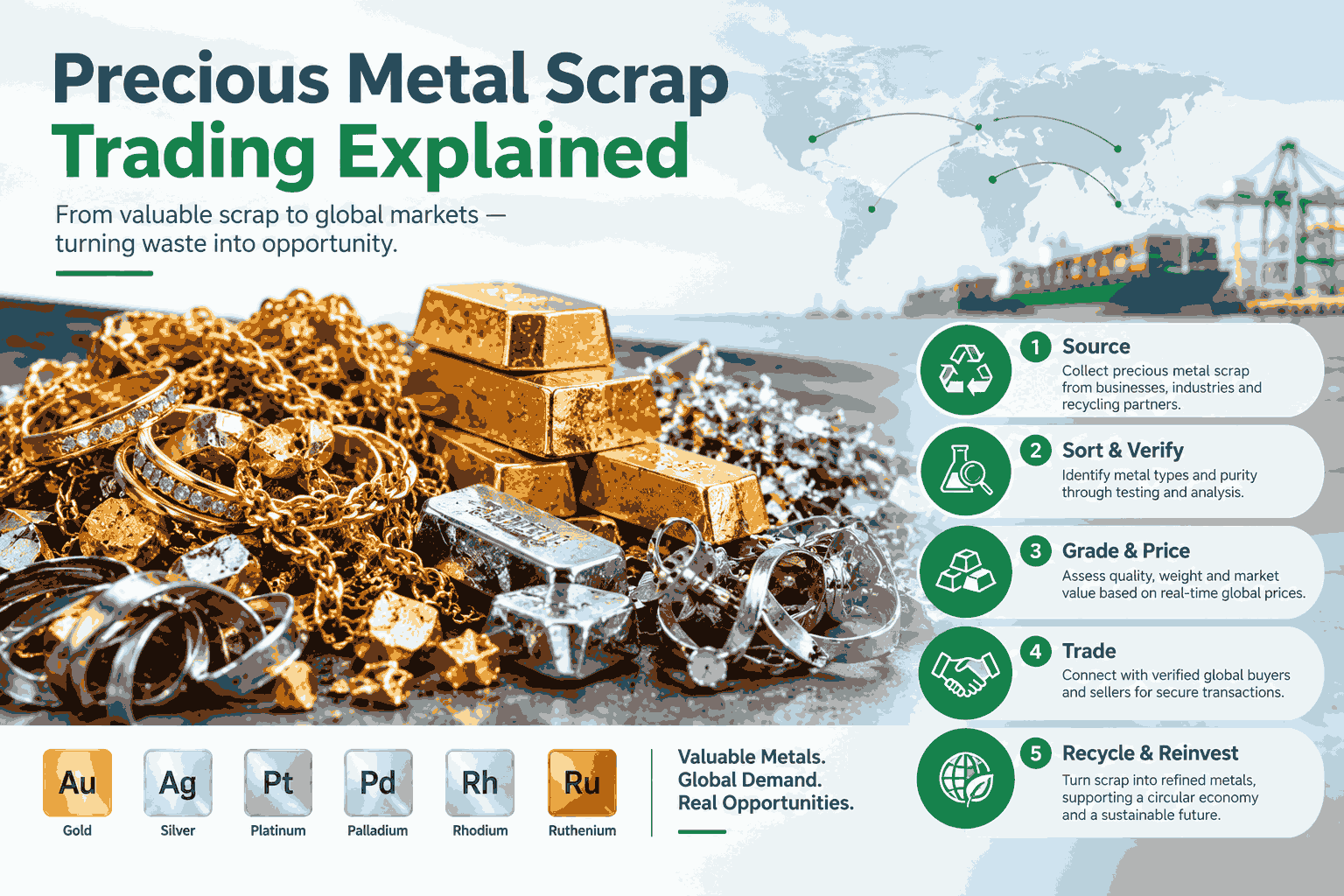
Precious metal scrap is an important material stream within the recycling and industrial recovery industries. Gold, silver, platinum, palladium, and other platinum group metals (PGMs) can be found in a range of discarded products, including electronic components, jewellery, industrial equipment, and vehicle catalytic converters.
Unlike many bulk scrap materials, precious metal scrap can contain valuable metals in small, dispersed, or difficult-to-identify quantities. Its commercial value therefore depends on more than the apparent weight or appearance of the material. Buyers may need to establish its origin, composition, condition, and suitability for specialist processing before agreeing on a transaction.
For sellers, understanding the material and providing reliable documentation can help make negotiations more transparent. For buyers, supplier checks, appropriate testing, and clear acceptance terms are essential to managing quality and transaction risks.
This guide explains common types of precious metal scrap, how metal content is assessed, why verification matters, and how businesses can approach these transactions through an online marketplace.
What Counts as Precious Metal Scrap?
Precious metal scrap refers to discarded products, components, residues, or manufacturing materials that contain precious metals and may be suitable for recovery or recycling.
The main categories include gold scrap, silver scrap, and platinum group metals scrap. These materials come from different industries and require different approaches to identification, testing, handling, and processing.
Gold scrap can include jewellery, manufacturing offcuts, certain electronic components, and other gold-bearing materials. Its composition may vary depending on the product, alloy, coatings, and manufacturing process.
Silver scrap can originate from jewellery, silverware, electrical components, industrial applications, and selected manufacturing residues. Not every silver-coloured item contains silver, so visual appearance alone is not reliable proof of composition.
Platinum group metals (PGMs) include platinum, palladium, rhodium, ruthenium, iridium, and osmium. In scrap trading, platinum and palladium are particularly relevant to certain automotive and industrial recycling streams. The presence and concentration of individual metals depend on the source material.
Precious metal scrap may be traded as identifiable items, separated components, manufacturing residues, or mixed metal-bearing material. These forms are not interchangeable: an item that potentially contains precious metals is not necessarily ready for direct sale to a refiner.
The seller should describe what is actually available, distinguish confirmed information from estimates, and avoid claiming a specific precious metal content without suitable evidence
Common Sources of Precious Metal Scrap
Precious metals are recovered from a variety of commercial and industrial sources. The most suitable trading route depends on the material's origin, condition, quantity, and the capabilities of the intended buyer or processor.
Catalytic Converters
Catalytic converters are components in vehicle exhaust systems designed to help reduce certain harmful emissions. Depending on their type, they may contain platinum group metals such as platinum, palladium, and rhodium.
Scrap catalytic converters are commonly sourced from vehicle dismantlers, automotive repair operations, end-of-life vehicle processors, and specialist recycling businesses.
Their precious metal content can vary considerably by converter design, vehicle application, manufacturer, age, and other factors. The exterior appearance or size of a converter does not reliably establish its recoverable metal content.
Buyers may assess converters using identification information, documented sourcing, specialist testing, or processing arrangements appropriate to the material. Sellers should record available part numbers and source details, where possible, and confirm that they have the right to sell the components.
Catalytic converters should not be opened or processed using improvised methods to estimate their contents. Specialist handling and assessment are more appropriate for material whose internal composition cannot be reliably determined visually.
For more information about this material stream, see the catalytic converter scrap trading guide.
Electronics and Circuit Boards
Electronic waste can contain precious metals in selected circuit boards, connectors, contacts, and other components. Gold and silver may be used in certain electrical contacts and conductive applications, while other components may contain different recoverable metals.
However, electronic scrap varies significantly. A circuit board's appearance, size, or colour does not establish its precious metal content. Different boards can have different designs, component populations, coatings, and material compositions.
Businesses collecting electronic scrap should separate material according to the buyer's requirements and avoid mixing unrelated electronic waste streams when classification matters. Documenting the equipment source and providing clear photographs can help a buyer determine whether further inspection is needed.
Some electronic scrap requires specialist dismantling, testing, or processing. Sellers should not assume that every circuit board or electronic device is suitable for the same recovery route.
Industrial and Jewellery Scrap
Jewellery and precious metal manufacturing can generate scrap in the form of damaged items, offcuts, rejected pieces, filings, and other production residues. Depending on the source, these materials may contain gold, silver, platinum, or combinations of metals.
Industrial applications can also produce precious metal-bearing scrap through the use of specialised components, contacts, catalysts, coatings, and manufacturing materials.
These streams require careful identification because two items that look similar may have different compositions. Jewellery may contain alloys, stones, solder, or non-precious components, while industrial residues may require specialised testing to establish what they contain.
Sellers should retain available product descriptions, purchase or production records, and other relevant documentation. Where the composition is uncertain, describe the material as unverified rather than presenting an assumption as a confirmed grade.
How Precious Metal Content Is Assessed
Precious metal scrap is evaluated using methods suited to the material and the level of certainty required. The appropriate assessment depends on whether the material is an identifiable item, a mixed component stream, a solid metal object, or a residue intended for specialist processing.
Visual inspection and identification: Buyers may begin by examining the item's condition, markings, part numbers, source, and apparent material type. This helps establish an initial classification but does not necessarily confirm precious metal content.
Document review: Product records, manufacturing specifications, supplier information, and previous testing reports can provide useful context. Their reliability depends on whether they relate to the actual material being offered.
Instrument-based testing: Suitable analytical equipment may help identify elements or assess material composition. Different testing methods have different capabilities and limitations, so one test may not provide a complete assessment for every material.
Laboratory analysis or specialist assay: Where precise composition is commercially important, a qualified laboratory or appropriate specialist may be needed. The sampling method, preparation process, and test scope should match the material and the intended transaction.
Processing and settlement terms: Some materials are purchased through arrangements in which final settlement depends on subsequent processing and assessment. In these cases, the parties should agree in advance how the material will be evaluated and how the results affect payment.
No single assessment method should be assumed suitable for all precious metal scrap. Sellers should ask what evidence the buyer requires and clarify whether an initial indication or estimate is subject to later testing.
Precious metal content should not be inferred from the gross weight of a mixed load. Non-precious components, coatings, contaminants, and other materials may contribute to total weight without contributing equivalent recoverable precious metal.
Why Verification and Documentation Matter More Here
Precious metal scrap can involve high-value materials, complex composition, and supply chains that require careful scrutiny. Verification is therefore important for both the material and the parties involved in a transaction.
Material verification helps establish whether the offered item or load matches its description. Photographs, product identification, test results, and inspection records can support the assessment, although each form of evidence has limitations.
Supplier verification helps buyers understand who they are dealing with and whether the counterparty appears to be a legitimate business. Depending on the transaction, checks may include business identity, contact details, relevant licences or authorisations, and the seller's right to dispose of the material.
Source documentation can help explain where the scrap came from and support a traceable transaction history. This is particularly relevant for items such as catalytic converters, electronic components, and industrial materials where the source may need additional clarification.
Clear commercial terms establish how quality, weighing, inspection, testing, deductions, transport, and final settlement will be handled. Written terms are especially useful when the final composition is not confirmed before delivery.
Why Verification and Documentation Matter More Here
Precious metal scrap can involve high-value materials, complex composition, and supply chains that require careful scrutiny. Verification is therefore important for both the material and the parties involved in a transaction.
Material verification helps establish whether the offered item or load matches its description. Photographs, product identification, test results, and inspection records can support the assessment, although each form of evidence has limitations.
Supplier verification helps buyers understand who they are dealing with and whether the counterparty appears to be a legitimate business. Depending on the transaction, checks may include business identity, contact details, relevant licences or authorisations, and the seller's right to dispose of the material.
Source documentation can help explain where the scrap came from and support a traceable transaction history. This is particularly relevant for items such as catalytic converters, electronic components, and industrial materials where the source may need additional clarification.
Clear commercial terms establish how quality, weighing, inspection, testing, deductions, transport, and final settlement will be handled. Written terms are especially useful when the final composition is not confirmed before delivery.
Responsible sourcing is also relevant to precious metal supply chains. The London Bullion Market Association (LBMA) publishes guidance on responsible sourcing for gold and silver refiners, including risk assessment and due diligence processes. Its guidance is intended for the relevant industry participants and should not be treated as a universal legal checklist for every scrap seller. Read the LBMA responsible sourcing guidance for further information.
Legal requirements vary by country, material, business activity, and transaction. Businesses should check the rules that apply to their operations rather than assuming that one procedure meets every jurisdiction's requirements.
Risks and Red Flags for Sellers and Buyers
Precious metal scrap requires careful commercial judgement. Several warning signs deserve attention before a buyer or seller commits to a transaction.
Unsupported content claims: Be cautious when a seller claims a precise metal content without reliable testing or documentation. Equally, buyers should explain the basis of their assessment rather than relying on unexplained deductions.
Unclear source or ownership: A counterparty who cannot reasonably explain where material came from or establish their right to sell it may require additional checks. Do not proceed if the available information raises unresolved concerns about ownership or lawful sourcing.
Pressure to bypass verification: Requests to avoid ordinary business checks, omit transaction records, or proceed without agreed inspection terms can increase risk. High-value deals should not depend solely on verbal assurances.
Unclear payment arrangements: Confirm the payment method, timing, conditions, and any requirements that must be met before funds are released. Be cautious about unexpected fees, last-minute changes to payment instructions, and requests to transfer funds to unrelated parties.
Unrealistic offers: An unusually attractive offer without a clear explanation of the material specification, testing process, or settlement terms should prompt further questions.
Inconsistent documentation: Differences between business details, material descriptions, photographs, invoices, and shipment records should be resolved before the deal progresses.
Buyers and sellers should keep relevant communications, inspection records, transaction documents, and payment evidence. If information cannot be verified to a reasonable standard, pausing or declining the transaction may be safer than proceeding under pressure.
How Precious Metal Scrap Fits into a ScrapTrade Deal
ScrapTrade is a global online marketplace that connects scrap buyers and sellers. Businesses dealing in precious metal-bearing scrap can use the platform to present material details, reach potential counterparties, and discuss transaction requirements.
Because these materials can require specialist assessment, a listing should be as precise as the available evidence allows. Identify the material category, describe its source where known, provide the estimated quantity, specify its condition, and include clear photographs.
If testing or documentation is available, explain what it covers and whether it applies to the entire lot or only a sample. Do not describe untested material as having a confirmed precious metal content.
Before accepting an offer, buyers and sellers should discuss verification requirements, inspection arrangements, weighing methods, transport, payment conditions, and the process for resolving differences in test results. For materials that require further analysis, clarify whether the initial offer is provisional and how final settlement will be calculated.
ScrapTrade does not take ownership of the material or act as a broker. The parties remain responsible for confirming the material's identity, completing appropriate checks, and agreeing on the terms of their transaction.
For precious metal scrap, a well-documented listing and a clear verification process can help establish more realistic expectations before the material changes hands.
FAQs
What is precious metal scrap?
Precious metal scrap includes discarded products, components, and manufacturing materials that contain metals such as gold, silver, platinum, and palladium and may be suitable for recovery or recycling.
Which scrap materials may contain platinum group metals?
Certain catalytic converters, industrial components, catalysts, and specialised manufacturing materials may contain PGMs. The metals present depend on the product and its composition, so testing or reliable identification may be necessary.
Can precious metal content be identified by appearance alone?
No. Appearance and markings may help with initial identification, but they do not reliably establish the exact composition or recoverable content of every material. Suitable testing or specialist analysis may be required.
What documents should sellers keep when trading precious metal scrap?
Depending on the transaction, useful records may include business details, source or ownership documentation, material descriptions, photographs, inspection or test reports, invoices, shipment records, and written payment terms. Requirements vary by jurisdiction and material.
Conclusion
Precious metal scrap trading involves more than identifying an item that may contain gold, silver, platinum, or palladium. The material's source, composition, condition, documentation, and suitability for specialist processing all influence how a transaction should be evaluated.
Sellers can prepare by documenting the source where possible, describing the material accurately, retaining relevant records, and avoiding unsupported claims about precious metal content. Buyers should establish appropriate inspection and testing procedures, verify counterparties, and agree on settlement terms before committing to a deal.
For both sides, transparent documentation and proportionate due diligence are essential to managing risk. ScrapTrade provides an online marketplace where businesses can present material and connect with potential trading partners, while buyers and sellers remain responsible for verifying the material and agreeing on their transaction.