

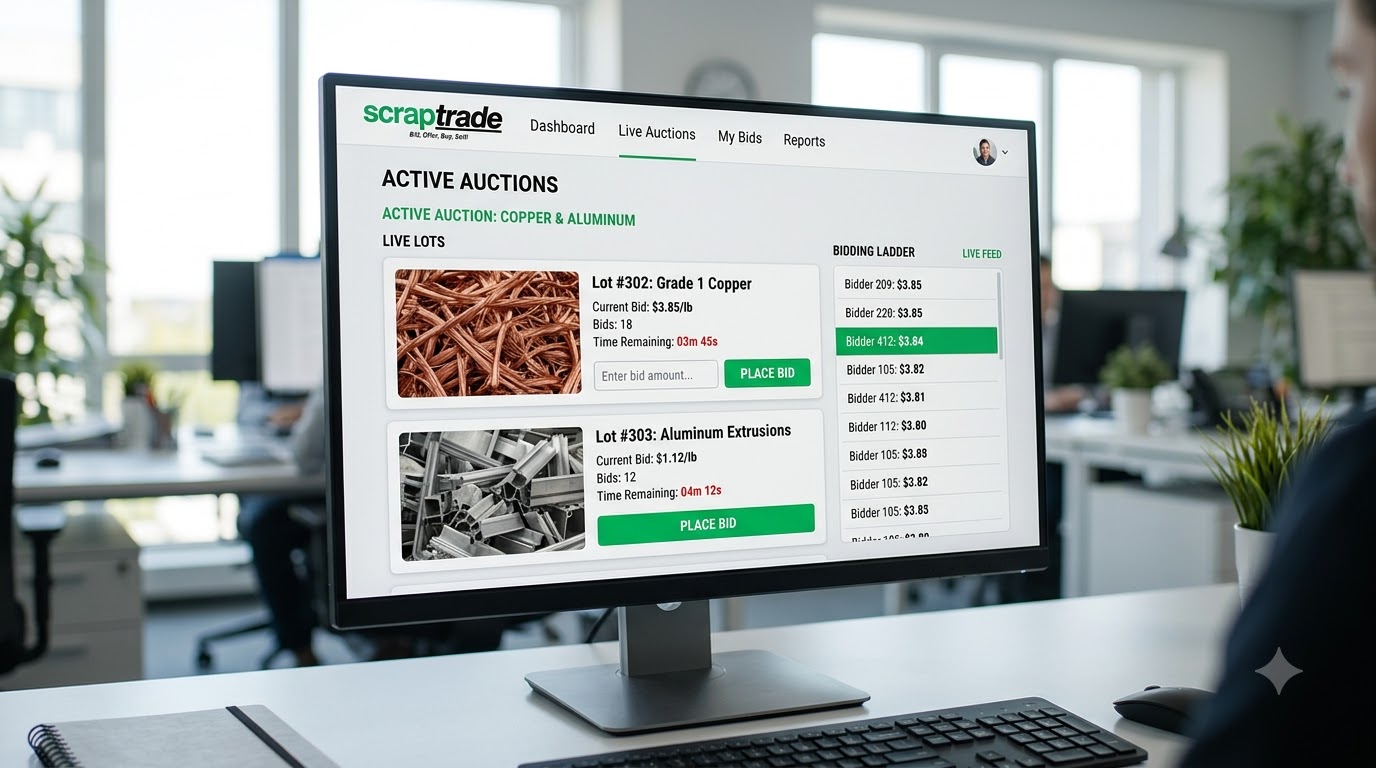
Scrap metal buyers and sellers need efficient ways to negotiate prices, evaluate material quality, and agree on transactions. Traditional scrap trading often relies on direct negotiations, phone calls, and established business relationships. For some transactions, however, a structured bidding process can help sellers compare competing offers and help buyers identify available material that meets their requirements.
Scrap metal auction software provides digital tools for organising bidding activities, managing scrap lots, recording offers, and communicating auction outcomes. Depending on the platform, it may support forward auctions, reverse bidding, reserve prices, minimum bids, bidder registration, and auction records.
These features can be useful for scrap yards, recyclers, industrial businesses, metal processors, and companies selling surplus materials in bulk. However, not every scrap marketplace operates as an auction. Some platforms focus on direct listings and buyer-seller negotiations, while others provide specific bidding features.
This guide explains how online scrap auctions work, the differences between bidding models, and what buyers and sellers should consider when choosing scrap auction software.
How Online Scrap Auctions Work
An online scrap auction is a digital process in which eligible participants submit bids or offers for a defined quantity of scrap under specified conditions. The platform records bidding activity and supports the process established by the seller or auction organiser.
The exact workflow depends on the auction model and the software being used.
1. Creating a scrap lot
The seller or auction organiser creates a lot describing the material available. A listing may include the material category, grade, estimated or confirmed quantity, location, photographs, condition, collection arrangements, and applicable inspection requirements.
For example, a scrap yard might offer a lot of steel offcuts, while an industrial facility might list surplus aluminium scrap from its manufacturing operations.
Clear descriptions are important because bidders need to understand what they are offering to buy. If the grade or weight is not confirmed, that uncertainty should be disclosed.
2. Setting bidding conditions
Before bidding begins, the organiser establishes the rules for the lot. These may include the opening bid, reserve price, minimum bid increment, bidding deadline, payment terms, inspection arrangements, and collection requirements.
Not every platform supports all these settings. Some bidding processes use fixed deadlines, while others may use different closing rules.
The terms should explain how bids are submitted, whether they can be revised or withdrawn, and what happens when bidding closes.
3. Registering and evaluating bidders
Depending on the platform, participants may need to create accounts, provide business details, or complete verification before placing bids.
Buyers should review the lot information and assess the material's suitability before submitting an offer. If inspection is permitted, they should understand the inspection schedule and what evidence is available.
4. Reviewing the outcome
When bidding ends, the result is handled according to the published rules. The highest valid bid may win a forward auction if it meets the applicable conditions, but a reserve price or other eligibility requirements can affect the outcome.
The parties may then need to confirm the final terms, execute the relevant documentation, arrange weighing or inspection, and coordinate payment and collection.
An auction result does not eliminate the need for a clear agreement. Both parties should understand what has been accepted and what obligations remain before the material is dispatched.
Traditional Auctions vs Online Bidding
Traditional scrap auctions may take place at a physical location or through an auctioneer who manages the bidding process. Online bidding moves the relevant activities into a digital environment, allowing eligible participants to review listings and submit bids remotely when the platform supports it.
Both approaches can be useful, depending on the material, market, and transaction requirements.
| Feature | Traditional auction | Online bidding |
|---|---|---|
| Participation | Often tied to a physical venue or organiser | May allow remote participation |
| Lot information | Catalogues, documents, and in-person inspection | Digital listings, photographs, and supporting information |
| Bid submission | In-person or through an auctioneer | Through the platform's bidding tools |
| Recordkeeping | Auction records and supporting documents | Digital bid records where supported |
| Buyer reach | Depends on the auction's audience and location | May reach participants across wider markets |
| Inspection | Often arranged around the physical lot | May require scheduled site visits or other inspection arrangements |
Online bidding can make participation more convenient, but the quality of the process depends on the platform's features and the information provided by the seller.
For scrap materials, physical inspection can remain important. Photographs alone may not reveal hidden contamination, mixed grades, moisture, or differences between estimated and actual quantities.
Online tools should therefore support informed bidding rather than replace appropriate material checks and due diligence.
Forward Auctions and Reverse Bidding
The terms forward auction and reverse bidding describe different approaches to price competition. Understanding the distinction is essential when choosing scrap bidding software.
Forward auctions
In a forward auction, a seller offers a lot and buyers compete by submitting bids. Depending on the auction rules, the price may increase as participants compete for the material.
For example, a seller offering a defined quantity of steel scrap may invite eligible buyers to bid during a specified period. The seller can use the published rules to determine whether the winning bid meets the required conditions.
Forward auctions can be useful when a seller wants to compare competing bids for a particular lot. Their effectiveness depends on the availability of interested buyers and the quality of the lot information.
Reverse bidding
Reverse bidding generally involves buyers seeking material or a service and suppliers competing to provide it under the buyer's requirements. In a price-based reverse auction, suppliers may compete by lowering their offers.
For example, a manufacturer seeking a recurring supply of a particular scrap material might invite qualified suppliers to submit offers against defined quantity, grade, and delivery requirements.
However, reverse bidding does not always mean that the lowest price automatically wins. Buyers may also consider quality, reliability, logistics, compliance, and other published criteria.
The exact bidding structure varies by platform. Some scrap marketplaces offer reverse bidding or other competitive offer features, while others support only direct negotiations or conventional listings.
Businesses should confirm the platform's actual bidding model before assuming that a particular feature is available.
Setting Reserve Prices, Minimum Bids and Lot Quantities
Bidding rules influence how buyers participate and how sellers evaluate the results. Auction management software may provide settings that help organisers define these rules in advance.
Reserve prices
A reserve price is the minimum amount a seller is willing to accept under the auction's rules. If the bidding does not reach that threshold, the seller may not be obligated to complete the sale, depending on the published conditions.
A reserve price can help a seller establish a minimum acceptable outcome. However, setting it too high relative to buyer expectations may reduce the likelihood of a successful auction.
Sellers should consider the material's condition, current market references, quantity, location, preparation costs, and expected demand when determining their reserve.
Minimum bids and bid increments
An opening or minimum bid establishes where bidding begins. A minimum bid increment determines how much a new bid must exceed a previous bid in auction formats that use incremental bidding.
These settings can influence the pace and competitiveness of an auction. The appropriate structure depends on the material, likely buyer interest, and platform capabilities.
A minimum bid should not be confused with a guaranteed final selling price. The auction may close without a qualifying offer.
Lot quantities
Lot size is another important consideration in scrap auction management.
A seller might offer all available material as one lot or divide it into several lots based on material type, grade, location, or collection schedule. Separating lots can help buyers target the quantities they need, but it may also increase administration and handling requirements.
For bulk scrap, the lot description should clarify whether the stated weight is estimated or confirmed, whether the material can be inspected, and whether the buyer must accept the entire lot.
Sellers should also specify whether partial bids are allowed. Buyers need to know whether they are bidding for the whole quantity or only a permitted portion.
Clear lot definitions help avoid misunderstandings when bidding ends.
Buyer Verification and Bid Management
A bidding platform needs clear rules for participation and reliable records of the offers submitted. These controls can help auction organisers manage the process and provide participants with a consistent set of expectations.
Buyer registration and verification
Depending on the transaction, the platform or seller may request business details, identity information, relevant licences, or other documentation before allowing a participant to bid.
The level of verification varies by platform. Businesses should not assume that registration alone confirms a buyer's financial capacity, suitability, or reliability.
Sellers should carry out appropriate checks before committing high-value or regulated materials. Buyers should also verify the seller, the material description, and the seller's authority to offer the goods.
Bid records and transparency
Useful auction software may record bid amounts, submission times, bidder information available under the platform's rules, and the status of each lot.
These records can help organisers review the outcome and investigate questions about the bidding process.
Participants should understand whether bids are visible to other bidders, whether bidder identities remain confidential, and how the platform handles late bids or technical issues.
The platform's published rules should explain how bidding disputes and irregularities are addressed.
Notifications and auction status
Notifications can help participants track lot availability, bidding deadlines, changes in auction status, and outcomes. Organisers may also need tools for managing enquiries and communicating with successful bidders.
These features are particularly useful when a business manages multiple lots or recurring sales.
Nevertheless, a digital record is only as reliable as the process that generates it. Clear auction rules, accurate lot information, suitable verification, and consistent administration remain essential.
Comparing Offers Beyond the Highest Price
The highest bid can be attractive to a seller, but it may not always represent the most suitable transaction. Buyers and sellers should evaluate the complete terms before confirming a deal.
For example, two buyers may submit different bids for the same scrap lot but propose different collection arrangements, inspection conditions, or payment schedules. The seller should consider these terms alongside the offered price.
Important factors include:
- Material acceptance: Does the buyer accept the stated grade and condition?
- Quantity and weighing: How will the final accepted weight be determined?
- Collection and transport: Who arranges loading, collection, and delivery?
- Payment terms: When is payment due, and what conditions apply?
- Inspection and deductions: How will contamination or grade differences be handled?
- Business reliability: Has the counterparty completed appropriate verification?
- Contract requirements: Are the proposed terms clear and acceptable to both parties?
Buyers should also evaluate the total acquisition cost, including relevant freight, handling, processing, and other agreed expenses. A lower bid for a supplier's material does not necessarily mean a lower total cost for the buyer if additional charges differ.
For reverse bidding, buyers should avoid selecting a supplier solely because it submits the lowest price. Material quality, delivery capability, consistency of supply, and compliance requirements may be equally important.
The objective is to secure a workable transaction rather than simply optimise one number.
FAQs
What is scrap metal auction software?
Scrap metal auction software is a digital system used to organise scrap auctions or bidding activities. Depending on its features, it may support lot listings, bidder registration, reserve prices, bid tracking, auction deadlines, and outcome records.
What is the difference between a scrap auction and reverse bidding?
In a forward auction, buyers typically compete to purchase a seller's lot by submitting bids. In reverse bidding, suppliers typically compete to fulfil a buyer's requirement, often by offering lower prices. The precise rules depend on the platform and transaction.
Does every scrap marketplace use auctions?
No. Some platforms provide formal auctions, while others focus on direct listings, buyer enquiries, offers, or negotiations. Businesses should confirm which bidding models a platform actually supports.
How should sellers set a reserve price for scrap?
Sellers should consider material grade, condition, quantity, location, preparation and transport costs, relevant market references, and likely buyer demand. A reserve price should reflect the seller's commercial requirements without assuming that an auction will necessarily attract a qualifying bid.
Conclusion
Scrap metal auction software can help businesses structure competitive bidding, manage scrap lots, record offers, and establish clear rules for buyers and sellers. Features such as reserve prices, bid management, bidder verification, and auction records can support a more organised process when formal bidding is appropriate.
However, bidding is only one method of buying and selling scrap. Forward auctions may suit sellers seeking competing bids, while reverse bidding can help buyers compare supplier offers. Direct negotiation remains useful for transactions requiring tailored specifications, detailed discussions, or ongoing supply arrangements.
Before choosing a platform, businesses should evaluate its actual bidding capabilities, verification process, recordkeeping tools, and transaction terms. They should also compare offers based on material quality, logistics, payment conditions, and counterparty reliability rather than price alone.
For businesses seeking a broader way to discover trading opportunities, ScrapTrade's global scrap trading marketplace connects scrap buyers and sellers through online listings and trading opportunities. Explore the platform to find potential counterparties and discuss terms that suit your business.