

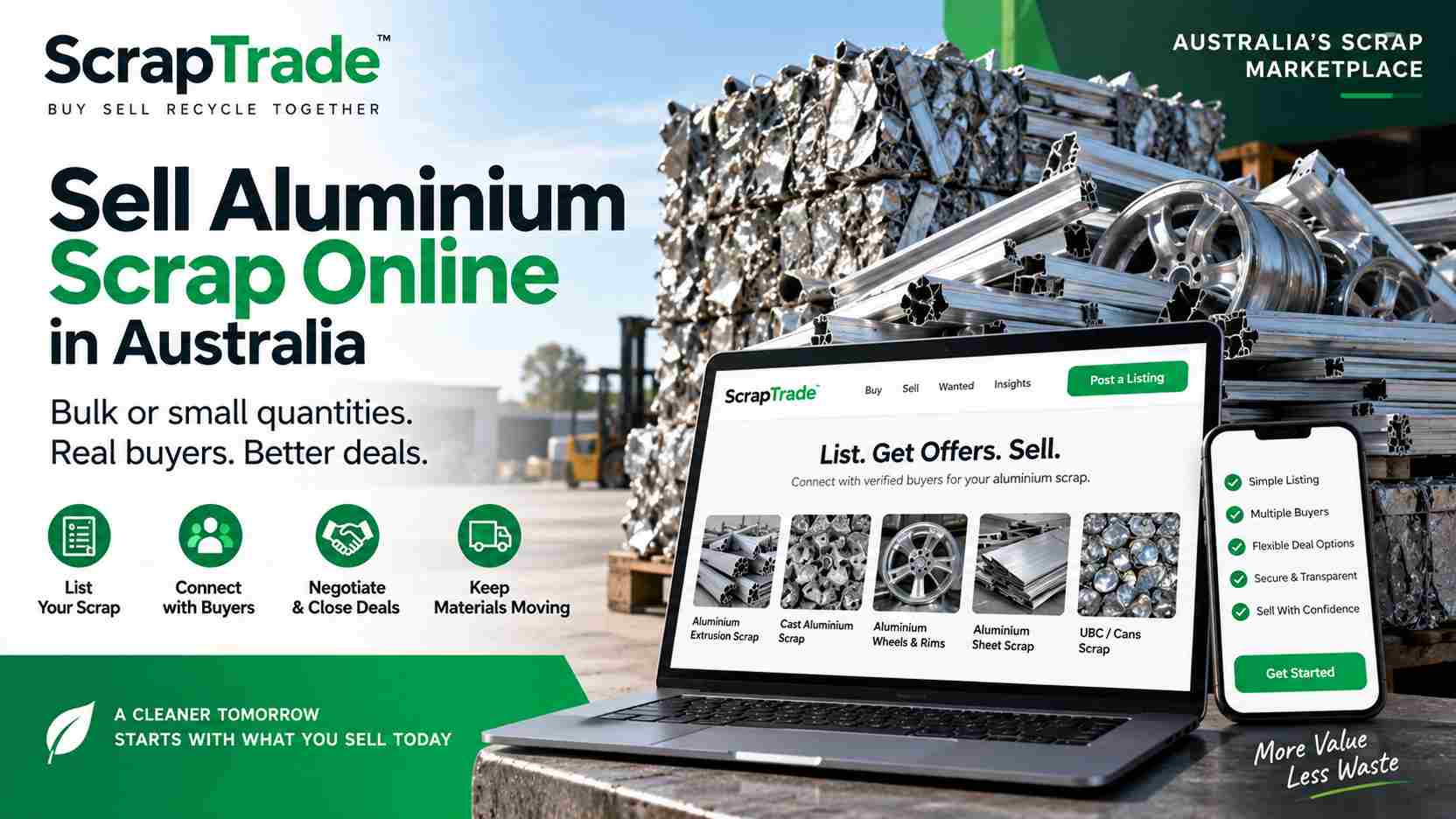
Sell Aluminium Scrap Online: Where to Sell Bulk & Small Quantities in Australia
Selling aluminium scrap shouldn't mean calling one local scrap yard, accepting the first price you hear and hoping you got a fair deal. Whether you have a few kilograms of aluminium offcuts or several tonnes of industrial scrap, the real challenge is finding the right buyer for the material you actually have.
Sell aluminium scrap online through ScrapTrade and put your material in front of buyers looking for specific types, quantities and locations. Instead of treating every load as generic "aluminium scrap", you can provide details about the grade, condition, quantity and location so buyers can make informed decisions.
This guide explains where to sell aluminium scrap in Australia, how to prepare your material for sale, what affects its value and how online scrap marketplaces can make the process easier for both small sellers and bulk suppliers.
How to Sell Aluminium Scrap Online in Australia
The traditional way to sell scrap aluminium is straightforward: take your material to a local scrap yard or contact a recycler, have the material assessed and receive a price.
That approach can work, particularly when convenience is the priority. But it isn't the only option.
Selling aluminium scrap online gives sellers another way to reach potential buyers. Instead of relying entirely on buyers who happen to operate nearby, you can create a detailed listing describing exactly what you have.
A good aluminium scrap listing should include:
- Type of aluminium: extrusion, cast aluminium, wheels, sheet, cans, offcuts or mixed aluminium
- Quantity: kilograms, tonnes or metric tonnes
- Location: where the material is stored or available for collection
- Condition: clean, sorted, mixed, painted, coated or contaminated
- Photos: clear images showing the actual material
- Video: useful for demonstrating the size and condition of a larger load
- Collection or delivery: explain the available logistics
- Selling preference: fixed price, auction or negotiation
The more useful information you provide, the easier it becomes for a serious buyer to assess whether your material fits their requirements.
Why the Type of Aluminium Matters
One of the biggest mistakes sellers make is treating all aluminium scrap as the same material.
It isn't.
Aluminium extrusion scrap, cast aluminium, aluminium wheels, sheet scrap and used beverage cans can have different characteristics and buyer requirements. Sorting your material and accurately describing it can therefore make your listing much more useful.
The Australian Aluminium Council explains that aluminium scrap is sorted during the recycling process, including separating coated and uncoated aluminium and removing paper, plastic and other non-aluminium materials.
That matters before you even start negotiating a sale.
Where Can You Sell Aluminium Scrap?
If you have aluminium scrap to sell, there are several routes available.
Local Scrap Yards
A local scrap yard can be convenient when you want to move material quickly. You can take the aluminium to the yard, have it assessed and receive an offer.
The downside is that you're generally negotiating with one buyer at a time. Your options may also be limited by the types and quantities of material that buyer wants.
Aluminium Recyclers
Specialist recyclers may accept particular grades and quantities of aluminium scrap. This can be a good option for businesses generating consistent volumes of material.
However, you'll still need to find recyclers that want your specific material and determine whether their collection, delivery and pricing arrangements suit your business.
Direct Buyers
For larger quantities, sellers may choose to approach manufacturers, processors, traders or other businesses that use aluminium scrap as a feedstock.
This can potentially create valuable long-term relationships, particularly when the seller has a consistent supply.
Online Scrap Marketplaces
An online marketplace creates another option: list your aluminium scrap and allow interested buyers to discover it.
With ScrapTrade, sellers can create listings for scrap materials and connect with buyers through a dedicated marketplace.
This is particularly useful when you're not simply trying to "get rid of scrap" but are looking for the right commercial buyer for a specific material and quantity.
Can You Sell Small Quantities of Aluminium Scrap?
Yes. Not every aluminium seller has a truckload sitting in a yard.
Small quantities can come from:
- Workshops
- Fabrication businesses
- Construction projects
- Renovation work
- Manufacturing offcuts
- Automotive businesses
- Demolition projects
- Aluminium processing
- General commercial operations
The important point is to be realistic about the economics of the transaction.
For smaller quantities, transport and handling costs can have a significant impact on the final deal. A buyer may be interested in the material but unable to justify collection unless the quantity, location and value make commercial sense.
That's why a clear listing matters.
Instead of simply writing:
"Aluminium scrap for sale."
Give buyers enough information to decide whether the opportunity works for them.
For example:
Clean aluminium extrusion offcuts — 850 kg — Sydney, NSW — sorted — ready for collection.
That immediately tells a buyer far more about the opportunity.
Can You Sell Bulk Aluminium Scrap?
Absolutely. Bulk aluminium scrap can be particularly suitable for an online marketplace because buyers can assess the quantity, material and location before entering negotiations.
Bulk listings can include:
- 1 tonne or more
- Multiple tonnes
- Full truckloads
- Manufacturing scrap
- Regular production offcuts
- Demolition aluminium
- Automotive aluminium
- Aluminium recycling feedstock
For larger transactions, the listing should be treated almost like a commercial sales proposal.
Include accurate weights, clear photographs, material specifications, location, availability and logistics information.
The objective isn't simply to attract more enquiries.
It's to attract better-qualified enquiries.
Why Aluminium Scrap Is Worth Recycling
Aluminium has a strong recycling value because it can be recycled repeatedly without losing its fundamental properties. The Australian Aluminium Council says recycling aluminium uses around 5% of the energy required to produce primary aluminium.
That makes scrap aluminium more than waste. It is a recoverable material that can re-enter the aluminium supply chain.
For businesses generating aluminium scrap, that creates an opportunity to turn an unwanted by-product, production offcut or end-of-life material into a saleable commodity.
The challenge is finding the right route to market.
That's where online trading can make the process more efficient.
What Types of Aluminium Scrap Can You Sell?
Not all aluminium scrap is the same, and that matters when you're preparing material for sale. Buyers may be looking for a specific grade, form, quantity or level of cleanliness rather than simply "aluminium".
If you're planning to sell aluminium scrap online, identifying the material correctly can help buyers understand exactly what you're offering and make it easier to compare your listing with their requirements.
Common types of aluminium scrap include extrusion, cast aluminium, wheels and rims, sheet, cans, offcuts and mixed aluminium.
Aluminium Extrusion Scrap
Aluminium extrusion scrap is commonly generated from construction, manufacturing, fabrication and window or door production.
It can include aluminium profiles, frames, sections and offcuts. Clean, separated extrusion is generally much easier for buyers to assess than material mixed with steel, plastic, rubber or other components.
When listing extrusion scrap on ScrapTrade, include:
- Approximate weight or quantity
- Whether the material is clean and sorted
- Whether it is painted or coated
- Whether other materials are attached
- Photos showing the actual profiles
- Location of the material
The more accurately you describe the extrusion, the easier it is for a buyer to determine whether it fits their requirements.
Cast Aluminium Scrap
Cast aluminium comes from components manufactured using casting processes and can be found in automotive, engineering, machinery and industrial applications.
Cast aluminium scrap may contain different alloys, attachments or non-aluminium components, so sellers should avoid assuming that every cast aluminium load will receive the same price.
A strong listing should clearly identify the material as cast aluminium and provide photographs that allow buyers to inspect the load.
Aluminium Wheels and Rims
Old aluminium wheels and rims are another common source of aluminium scrap, particularly for automotive businesses, dismantlers, workshops and recyclers.
Before listing aluminium wheels, explain whether they are:
- Complete wheels
- Stripped wheels
- Mixed with tyres
- Free from steel components
- Clean or contaminated
- Sorted by type
If tyres or other non-aluminium components are still attached, make this clear in the listing. Buyers need accurate information to estimate handling, processing and transport requirements.
Aluminium Sheet Scrap
Aluminium sheet scrap can come from fabrication, manufacturing, construction and industrial operations.
It may consist of clean sheet offcuts, production remnants or mixed sheet material.
When selling aluminium sheet scrap, specify whether it is:
- Clean sheet
- Painted sheet
- Coated sheet
- Mixed material
- Offcuts
- Bundled or loose
Clear photographs are particularly useful because buyers can often identify the condition and form of the material more easily from images than from a short description.
Aluminium Cans and UBC Scrap
Used beverage containers, commonly referred to as UBC scrap, are another major category of recyclable aluminium.
Businesses and recycling operators may generate significant quantities of aluminium cans, particularly when material is collected, sorted and baled.
For UBC listings, include the approximate weight, whether the cans are loose or baled, the location and any relevant information about contamination or other materials.
Aluminium Offcuts
Manufacturing and fabrication businesses can generate aluminium offcuts on a regular basis.
These materials can include leftover profiles, sheet pieces, machining offcuts and other production scrap.
For businesses generating aluminium offcuts continuously, ScrapTrade can also provide an opportunity to present the material as a recurring supply rather than treating every load as a one-off sale.
Mixed Aluminium Scrap
Mixed aluminium can include different forms, grades or components in the same load.
While mixed material can still have value, the lack of separation can make it harder for buyers to assess the exact composition and processing requirements.
If your aluminium is mixed, don't try to make the listing sound cleaner than it is.
Be specific.
A transparent listing describing the material as "mixed aluminium scrap" is far more useful to a serious buyer than an inaccurate claim that the load is clean extrusion.
How to Create a Better Aluminium Scrap Listing
Once you've identified the material, the next step is creating a listing that gives buyers enough information to make a decision.
Think of your ScrapTrade listing as a digital sales sheet for your scrap.
A buyer should be able to understand what you're selling, how much you have, where it is and what condition it's in without having to send five messages just to get the basics.
Start With the Correct Material Type
Don't simply title your listing "Aluminium Scrap".
Be more specific wherever possible.
For example:
Clean Aluminium Extrusion Offcuts – 5 MT – Sydney NSW
is considerably more useful than:
Aluminium Scrap for Sale
A specific title helps the right buyers understand the opportunity immediately.
Include the Exact or Estimated Quantity
Quantity is one of the most important details in a commercial scrap listing.
State whether you're selling:
- 100 kg
- 500 kg
- 1 tonne
- 5 tonnes
- 20+ tonnes
- Multiple truckloads
- Regular monthly supply
If the final weight is estimated, say so. Accurate information builds confidence and helps buyers calculate whether collection or freight makes commercial sense.
Tell Buyers Where the Material Is Located
Location matters because aluminium scrap is heavy and transport can significantly affect the economics of a transaction.
Include the city, state and, where appropriate, the pickup area.
For example:
Smithfield, NSW — Pickup Available
This immediately gives potential buyers a better understanding of the logistics involved.
Show the Actual Material
Photos shouldn't be an afterthought.
Upload clear images showing:
- The full load
- Close-ups of the material
- Different sections of the load
- Any contamination
- Packaging or bundles
- Storage conditions
- Weighing information where appropriate
For larger quantities, video can provide buyers with an even better understanding of the actual material available.
Be Honest About Contamination
This is one area where sellers should never try to oversell their material.
If the aluminium contains:
- Plastic
- Steel
- Rubber
- Dirt
- Paint
- Insulation
- Other metals
- Other non-aluminium components
say so.
An accurate description may attract fewer casual enquiries, but it can generate better enquiries from buyers who actually want the material.
Explain Your Preferred Deal Type
Different sellers have different objectives.
You may already know the price you want. You may want buyers to compete for the load. Or you may prefer to negotiate privately.
ScrapTrade gives sellers the opportunity to structure their listing around different ways of closing a deal, including fixed price, live auction or private negotiation.
That gives you more flexibility than simply accepting a single buyer's first offer.
What Makes a High-Converting ScrapTrade Listing?
A strong listing doesn't need to be complicated.
It needs to be specific, transparent and commercially useful.
For example:
Material: Clean Aluminium Extrusion Scrap
Quantity: 12 MT
Location: Sydney, NSW
Condition: Clean and sorted
Packaging: Bundled
Photos: Available
Video: Available
Pickup: Buyer collection
Deal Type: Auction / Negotiation
Compare that with:
"12 tonnes aluminium scrap for sale. Good price. Contact me."
The first listing gives buyers information they can actually work with.
The second creates questions.
For sellers, the goal isn't simply to generate messages. It's to make it easier for the right aluminium scrap buyers to understand the opportunity and make a serious offer.
Bulk or Small Quantity? List What You Have
You don't necessarily need a full truckload to participate in an online scrap marketplace.
A seller may have a few hundred kilograms of aluminium offcuts, while another business may have dozens of tonnes available.
The important thing is to accurately describe the material and quantity.
Whether you're selling small quantities of aluminium scrap, several tonnes or a regular industrial supply, a clear listing gives buyers the information they need to determine whether the material suits them.
How to Get a Better Price When Selling Aluminium Scrap
Knowing what type of aluminium scrap you have is only the first step. The next question is what you can do to make the material more attractive to buyers.
There is no magic formula that guarantees the highest price. However, sellers can often improve their position by presenting clean, accurately described and well-documented material.
Whether you're selling a small load or several tonnes, the same principle applies: make it easy for buyers to understand exactly what they're being offered.
Sort Aluminium Scrap Where Practical
Mixed loads can be harder for buyers to evaluate because they may contain different aluminium grades, alloys or non-aluminium materials.
Where practical, separate different types of aluminium before listing them.
For example, keep:
- Aluminium extrusion
- Cast aluminium
- Aluminium wheels
- Aluminium sheet
- UBC and cans
- Clean aluminium offcuts
- Mixed aluminium
in separate groups.
Sorting doesn't automatically mean you'll receive a higher price, but it can make the material easier for buyers to assess and may increase the number of buyers who can use it.
Remove Unnecessary Contamination
Plastic, rubber, steel, dirt and other non-aluminium materials can affect the value and usability of scrap.
If you're preparing material for sale, remove easily separable contaminants where it is commercially practical to do so.
For example, aluminium profiles with large amounts of attached plastic or steel components may be less attractive than clean, separated extrusion.
However, don't spend more money processing low-value material than the improvement in the sale price justifies.
Always consider the economics of preparation.
Provide Accurate Weight
A buyer needs to know how much material is actually available.
For small quantities, kilograms may be sufficient. For commercial loads, tonnes or metric tonnes are usually more practical.
If you're providing an estimated weight, clearly label it as an estimate.
For larger loads, useful supporting information can include:
- Weighbridge information
- Individual load weights
- Number of bundles
- Number of pallets
- Estimated truckloads
- Historical quantities for recurring supply
The more reliable the quantity information, the easier it is for buyers to calculate the potential transaction.
Use High-Quality Photos
A good photograph can answer questions that a paragraph cannot.
When photographing aluminium scrap, avoid taking one distant photograph of the entire pile and leaving it at that.
Instead, show the material from multiple angles.
A strong photo set might include:
- Full load
- Close-up of the material
- Different sections of the load
- Any contamination
- Bundles or packaging
- Storage area
- Weight information where appropriate
The objective is transparency.
A buyer should feel that they understand what they're considering before contacting you.
Add Video for Larger Loads
Video can be particularly useful when selling bulk aluminium scrap.
A short walkthrough can show:
- The overall volume
- Material consistency
- Condition
- How the material is stored
- Bundling or baling
- Accessibility for loading
- Surrounding logistics
For a buyer considering several tonnes of material, this additional visual information can make the listing substantially more useful.
Be Transparent About the Material
Don't describe mixed aluminium as clean extrusion.
Don't describe an estimated weight as an exact weight.
Don't hide contamination.
That might generate an enquiry, but it can create problems later when the buyer inspects the material.
A better approach is to describe the material exactly as it is.
Accurate listings attract serious buyers.
Make the Logistics Clear
Price isn't the only consideration in a scrap transaction.
A buyer also needs to understand how the material will move.
Include information such as:
- Pickup location
- Pickup availability
- Loading facilities
- Delivery options
- Preferred collection dates
- Approximate load size
- Access restrictions
- Whether freight is included or arranged separately
For bulk aluminium scrap, logistics can have a major impact on the overall economics of a transaction.
A buyer located further away may offer a competitive material price but have higher freight costs. A nearby buyer may offer a different price because transportation is easier.
That is why sellers should consider the total deal, rather than focusing only on the advertised price per kilogram.
Compare Buyers Instead of Accepting the First Offer
One of the biggest advantages of selling through a marketplace is the ability to expose your material to more than one potential buyer.
That doesn't mean every buyer will make an offer, and it doesn't mean the highest offer will always be the best deal.
But having more relevant buyers aware of your listing can give you greater choice.
When comparing offers, consider:
- Price per kg or tonne
- Quantity being purchased
- Collection arrangements
- Freight responsibility
- Payment terms
- Inspection requirements
- Timing
- Buyer requirements
- Overall transaction convenience
A slightly lower price may sometimes make more sense if the buyer can collect quickly and provides straightforward commercial terms.
Fixed Price, Auction or Negotiation?
There isn't one correct way to sell aluminium scrap.
Your preferred selling method can depend on the material, quantity, urgency and level of buyer demand.
Fixed Price
A fixed price tells buyers exactly what you're asking.
This can work well when you already understand the market and have a clear price expectation.
Live Auction
An auction can create competition between interested buyers.
This can be particularly interesting for sellers who want the market to determine the final price rather than committing to a single fixed figure.
Private Negotiation
Negotiation gives sellers and buyers room to discuss the details of a transaction.
This can be useful for larger or more complex loads where price is only one part of the deal.
Don't Confuse Aluminium Market Prices With Your Scrap Selling Price
Searching for aluminium price per kg can give you a useful market reference, but it doesn't necessarily tell you what your specific scrap load is worth.
The value of scrap aluminium can depend on:
- Material type
- Alloy
- Purity
- Condition
- Contamination
- Quantity
- Location
- Processing requirements
- Freight
- Buyer demand
For a deeper explanation of aluminium scrap pricing and the factors that influence it, see our existing guide on scrap aluminium prices in Australia.
The important takeaway is simple:
Use market prices as a reference, not as a guaranteed payout for every kilogram of scrap aluminium.
The Goal Is a Better Deal, Not Just a Higher Number
It's tempting to focus entirely on the highest price per kilogram.
But a successful scrap transaction involves more than one number.
A better deal could mean:
- A competitive price
- A reliable buyer
- Fast collection
- Clear payment terms
- Lower freight costs
- Less handling
- Fewer disputes
- A potential recurring relationship
This is where a transparent marketplace can make a difference.
Instead of spending hours searching for individual aluminium scrap buyers, sellers can create one detailed listing and give interested buyers the information they need to decide whether the material fits their requirements.
That's the basic idea behind selling aluminium scrap through ScrapTrade.
Sell Aluminium Scrap Online With ScrapTrade
If you have aluminium scrap to sell, you don't have to limit yourself to calling local scrap yards one by one.
ScrapTrade gives sellers a dedicated online marketplace to list aluminium scrap, provide details about the material and connect with potential buyers looking for scrap metal.
Whether you're selling a few hundred kilograms, several tonnes or an ongoing industrial supply, you can create a listing that gives buyers the information they need before they make contact.
The goal is simple: make your aluminium scrap visible to the right buyers and give you more flexibility in how you sell it.
List Bulk Aluminium Scrap
Businesses can generate substantial quantities of aluminium scrap through manufacturing, fabrication, construction, demolition, automotive operations and recycling.
Instead of treating a large load as something that needs to be sold to the nearest available buyer, you can create a detailed ScrapTrade listing describing:
- Aluminium type
- Quantity available
- Material condition
- Location
- Photos
- Video
- Availability
- Collection or delivery arrangements
- Preferred selling method
For larger loads, these details can help buyers quickly determine whether the material matches their requirements.
Whether you have 1 tonne, 10 tonnes, 50 tonnes or a recurring supply, the listing should clearly communicate what is available and how the transaction can work.
Sell Small Quantities of Aluminium Scrap
ScrapTrade isn't only for large industrial loads.
Smaller quantities can also be listed when there is a suitable buyer and the economics of collection or delivery make sense.
You might have:
- Aluminium fabrication offcuts
- Workshop scrap
- Aluminium profiles
- Small quantities of cast aluminium
- Aluminium wheels
- Sheet offcuts
- Manufacturing remnants
Instead of assuming that a small quantity isn't worth selling, create a clear listing and let potential buyers decide whether it fits their requirements.
The key is being transparent about the quantity and location so buyers can assess the opportunity realistically.
Three Ways to Close an Aluminium Scrap Deal
Different scrap transactions require different approaches.
That's why ScrapTrade gives sellers flexibility in how they want to approach a deal.
Fixed Price
Know what you want for your aluminium scrap?
A fixed-price listing lets you communicate your asking price directly to potential buyers.
This approach can work well when you have a clear understanding of your material, quantity and target price.
It also makes the buying process straightforward for buyers who already know what they're looking for.
Live Auction
Want buyers to compete for your material?
A live auction provides another way to sell aluminium scrap.
Rather than committing to one buyer before the listing goes live, you can allow interested buyers to compete during the auction period.
This can be particularly useful when the material is in demand and you want to discover what buyers are prepared to offer.
Private Negotiation
Some transactions require a conversation.
Private negotiation can be useful when you're dealing with larger quantities, recurring supply, specific material requirements or more complicated logistics.
You and the buyer can discuss the details and work towards an agreement that suits both sides.
Give Buyers the Information They Need
A marketplace only works when buyers can make informed decisions.
That's why your listing should answer the basic questions before the buyer has to ask them.
What is it?
Clearly identify the aluminium type.
How much is available?
Provide the actual or estimated quantity.
Where is it?
Give the collection or storage location.
What condition is it in?
Explain whether it is clean, sorted, mixed, coated or contaminated.
What does it look like?
Upload clear photographs and, where useful, video.
How can it be collected or delivered?
Provide relevant logistics information.
The better the listing, the less time both sides have to spend going back and forth over basic information.
Connect With Aluminium Scrap Buyers
Finding buyers can be one of the biggest challenges when you're trying to sell scrap independently.
You may have to search for recyclers, contact scrap yards, make phone calls, send photographs and repeat the same information to multiple businesses.
An online marketplace changes that process.
With ScrapTrade, you can create one listing containing the important details about your aluminium scrap and make it available to buyers searching for material.
Instead of asking:
"Who buys this type of aluminium?"
you can put the material in front of potential buyers and let them determine whether it fits their needs.
Build Better Buyer Relationships
A single transaction can potentially become an ongoing commercial relationship.
This can be particularly valuable for businesses that regularly generate aluminium scrap.
For example, a fabrication business might produce aluminium offcuts every month. Rather than finding a new buyer every time material accumulates, the business can use the marketplace to establish connections with buyers interested in that type of supply.
The same principle can apply to:
- Demolition companies
- Automotive dismantlers
- Manufacturers
- Fabricators
- Scrap yards
- Recycling businesses
- Metal traders
- Industrial suppliers
If you generate aluminium scrap regularly, don't just think about today's load.
Think about the next load, and the one after that.
Sell Aluminium Scrap With More Flexibility
The traditional scrap-selling model often comes down to one question:
"What will you pay me for this?"
An online marketplace creates a different conversation:
"Here is what I have. Who wants it, and what are they prepared to offer?"
That's a meaningful difference.
You're still dealing with real-world factors such as material quality, freight, quantity and market conditions. But you have another channel for finding buyers and negotiating transactions.
For sellers who want more choice over how their aluminium scrap is marketed, ScrapTrade provides a practical way to bring the process online.
Ready to Sell Your Aluminium Scrap?
Whether you're holding a small quantity of aluminium offcuts or managing tonnes of industrial scrap, the first step is straightforward:
Create a listing. Describe the material accurately. Show buyers what you have. Then choose how you want to sell it.
List your aluminium scrap on ScrapTrade and connect with buyers looking for scrap metal in Australia.
How to List Aluminium Scrap on ScrapTrade
Once you've decided to sell your aluminium scrap, the next step is getting the material in front of potential buyers.
A good online listing doesn't need to be complicated. It needs to give buyers enough information to understand what you're selling, how much is available and whether the transaction makes sense for them.
With ScrapTrade, you can create a listing for your aluminium scrap and choose the selling approach that best fits your material and objectives.
Step 1: Identify the Aluminium Scrap
Start by identifying exactly what you're selling.
Instead of simply selecting "aluminium scrap", be as specific as possible.
Your material might be:
- Aluminium extrusion
- Cast aluminium
- Aluminium wheels or rims
- Aluminium sheet
- UBC and aluminium cans
- Aluminium offcuts
- Mixed aluminium
- Other aluminium-containing scrap
If you're unsure about the exact grade, don't guess. Provide a clear description of what you know and use photographs or video to give buyers additional information.
Step 2: Add the Quantity
Tell buyers how much aluminium scrap you have available.
For example:
- 250 kg
- 750 kg
- 1 MT
- 5 MT
- 20 MT
- 100+ MT
- Recurring monthly supply
If the quantity is an estimate, make that clear.
For bulk transactions, accurate weight information becomes particularly important because buyers need to consider the value of the material alongside transport and handling costs.
Step 3: Add Your Location
Enter the location where the aluminium scrap is available.
For example:
Smithfield, NSW
or
Melbourne, VIC
Location can influence the attractiveness of a listing because buyers need to consider collection, freight and loading requirements.
If the material is available from multiple locations, provide that information clearly.
Step 4: Describe the Material's Condition
This is where you should be completely transparent.
Tell buyers whether the aluminium is:
- Clean
- Sorted
- Mixed
- Painted
- Coated
- Contaminated
- Bundled
- Baled
- Loose
- Attached to other materials
Don't worry about making the material sound perfect.
An accurate description helps attract buyers who actually want that type of aluminium scrap.
Step 5: Upload Photos
Photos provide buyers with visual evidence of what you're offering.
Try to upload several images rather than relying on one photograph.
Useful images can show:
- The complete load
- Close-up views
- Different material types
- Contamination
- Bundles or bales
- Storage conditions
- Loading area
- Scale or weighbridge information where appropriate
Good photography can reduce uncertainty and make your listing much easier for buyers to evaluate.
Step 6: Add Video When Appropriate
For larger quantities, video can provide additional context that photographs can't always capture.
A short video can demonstrate:
- Overall quantity
- Material consistency
- Condition
- Storage arrangements
- Accessibility
- Loading setup
- The surrounding stock
This can be especially useful when buyers are considering material located some distance away.
Step 7: Set Your Selling Method
Decide how you want to sell the aluminium scrap.
Depending on your listing and objectives, you can choose between different approaches.
Fixed Price
Set the price you're looking for and allow buyers to consider the listing against your asking price.
Live Auction
Put the material up for auction and allow interested buyers to compete for the listing.
Private Negotiation
Invite buyers to discuss the transaction directly and negotiate based on the material, quantity, logistics and commercial requirements.
There isn't one option that is right for every load.
A small quantity with a straightforward price may suit a fixed-price listing, while a large or highly sought-after load may be better suited to an auction or negotiation.
Step 8: Provide Collection or Delivery Details
Make the logistics clear before buyers get too far into the process.
Mention relevant details such as:
- Pickup available
- Buyer collection
- Delivery available
- Loading equipment
- Preferred collection dates
- Access requirements
- Number of loads
- Approximate truck requirements
This helps buyers calculate the total cost of acquiring the material rather than looking only at the scrap price.
Step 9: Review Your Listing Before Publishing
Before publishing, look at your listing from a buyer's perspective.
Ask yourself:
Would I understand exactly what I'm being offered?
Would I know how much material is available?
Could I estimate the transport requirements?
Can I see what the material actually looks like?
Have I disclosed anything that could affect the transaction?
If the answer is yes, you're much more likely to attract serious enquiries.
Example of an Aluminium Scrap Listing
Here's a simple example of what a strong commercial listing could look like:
Title: Clean Aluminium Extrusion Scrap – 12 MT – Sydney NSW
Material: Aluminium extrusion scrap
Quantity: Approximately 12 MT
Condition: Clean and sorted
Packaging: Bundled
Location: Sydney, NSW
Collection: Buyer pickup
Photos: Full load and close-up images
Video: Available
Selling method: Auction
Description: Clean aluminium extrusion offcuts generated from commercial fabrication. Material is sorted and bundled and ready for collection. Approximately 12 MT available.
Compare that with:
"12 tonnes aluminium scrap for sale. Good material. Contact seller."
The second listing creates unnecessary questions.
The first gives buyers enough information to start evaluating the opportunity.
Why Detailed Listings Matter
An online marketplace is only as useful as the information sellers provide.
A vague listing can attract curiosity, but a detailed listing can attract commercially relevant buyers.
That's particularly important when selling aluminium scrap because buyers need to consider more than the material itself.
They may also need to evaluate:
- Quantity
- Quality
- Location
- Freight
- Loading
- Processing
- Contamination
- Availability
- Payment terms
By providing these details upfront, you make it easier for the right buyer to engage.
Turn One Aluminium Scrap Listing Into a Commercial Opportunity
If your business generates aluminium scrap regularly, don't think of your listing as a one-off advertisement.
It can become part of a repeat supply relationship.
A manufacturer producing aluminium offcuts every month, for example, may be able to connect with buyers interested in ongoing supply rather than finding a new buyer for every load.
The same applies to demolition companies, automotive businesses, fabricators, recyclers and other organisations that regularly handle aluminium scrap.
The better you document what you have, the easier it becomes to sell it.
And with ScrapTrade, you can take that process online and put your aluminium scrap in front of potential buyers.
Tips for Creating a High-Converting Aluminium Scrap Listing
Listing aluminium scrap is easy. Getting the right buyers to pay attention to your listing is where the detail matters.
A strong listing gives buyers enough information to quickly understand what you have, how much you have, where it is and how the deal can be completed.
Write a Clear, Buyer-Friendly Title
Your title should tell buyers what the material is without making them open the listing to find the basics.
Instead of:
Aluminium Scrap Available
Try:
20 MT Clean Aluminium Extrusion Scrap – Sydney NSW
Or:
5 MT Cast Aluminium Wheels – Brisbane QLD
A useful title can include:
- Aluminium scrap type
- Approximate quantity
- Location
- Condition or grade
- Availability
This also makes your listing more relevant when buyers search for specific aluminium scrap.
Put the Most Important Information First
Buyers don't want to dig through a long description to find the information they need.
Start with the essentials:
- Material type
- Quantity
- Location
- Condition
- Photos
- Price or preferred selling method
- Pickup or delivery options
Then add additional details further down.
Think like the buyer: What would I need to know before making an offer?
Use Real Photos of the Aluminium Scrap
Photos can make a huge difference.
Use clear, recent photos showing the actual material being sold rather than generic aluminium images.
For larger quantities, consider showing:
- The full stockpile
- Close-ups of the material
- Containers, pallets or bales
- Any contamination or attachments
- Loading areas
- Weighbridge documentation where appropriate
The goal is to give buyers confidence that the material exists and matches the description.
Show the Scale of the Material
If you are selling several tonnes, don't only photograph a small section of the pile.
Show the overall quantity as well as close-up images.
For example, a buyer can learn much more from:
“Approximately 30 MT of aluminium extrusion stored across 6 bins”
than from:
“Aluminium scrap available.”
The more clearly you communicate the scale, the easier it is for commercial buyers to assess the opportunity.
Be Honest About Contamination
Don't hide anything that could affect the value of the material.
If the aluminium contains steel, plastic, rubber, paint, dirt or other attachments, mention it.
Being transparent can actually improve your listing because serious buyers can assess the material before making an offer.
It also helps avoid disagreements later in the transaction.
Make Collection and Delivery Clear
Location matters when selling scrap metal.
Include the city or region and explain whether the buyer can:
- Collect the material
- Arrange transport
- Request delivery
- Load from your site
- Organise their own freight
For larger aluminium scrap loads, logistics can have a significant impact on the final deal.
Make Your Selling Method Obvious
If you're selling through ScrapTrade, make it clear how you want buyers to engage with the listing.
You can choose between:
Fixed Price
Set your asking price and allow buyers to purchase or make an offer.
Live Auction
Allow interested buyers to compete for the material.
Private Negotiation
Work directly with interested buyers to negotiate the terms.
The best option can depend on the material, quantity, market demand and how quickly you want to sell.
Mention Regular or Repeat Supply
If you have aluminium scrap available regularly, say so.
For example:
“Approximately 10–15 MT available every month.”
This can turn a single scrap listing into a potential long-term buyer relationship.
Manufacturers, recyclers, processors and larger scrap businesses may be interested in establishing a consistent supply rather than making a one-off purchase.
Avoid Vague Listings
The biggest mistake is providing too little information.
Weak listing:
Aluminium scrap for sale. Good quality. Contact for price.
Stronger listing:
Approximately 15 MT of mixed aluminium extrusion scrap available in Melbourne VIC. Material is stored undercover and available for immediate pickup. Photos and video available. Selling via private negotiation.
The second listing gives buyers something they can actually evaluate.
Quick Checklist Before You Publish
Before publishing your aluminium scrap listing, check that you have included:
- What: Type of aluminium scrap
- How much: Quantity or estimated weight
- Where: Location
- Condition: Clean, mixed, painted, attached material, etc.
- Photos: Clear images of the actual material
- Video: Where useful, particularly for bulk quantities
- Price: Fixed price or preferred selling method
- Logistics: Pickup, delivery or freight information
- Availability: When the material can be collected
- Supply: Whether more material is available regularly
A few extra minutes spent creating a detailed listing can save much more time answering basic buyer questions later.
More importantly, it helps serious aluminium scrap buyers understand the opportunity quickly — and gives them a reason to make an offer.
Frequently Asked Questions About Selling Aluminium Scrap
How can I sell aluminium scrap online?
You can sell aluminium scrap online by creating a detailed listing that includes the type of aluminium, quantity, location, condition, photos and your preferred selling method. A marketplace such as ScrapTrade can help you put the material in front of relevant buyers and negotiate a deal online.
Where can I sell aluminium scrap in Australia?
You can sell aluminium scrap directly to scrap metal recyclers, aluminium processors, scrap dealers or through an online marketplace. Selling online can be particularly useful when you want to reach multiple potential buyers rather than relying on a single local buyer.
Who buys aluminium scrap?
Aluminium scrap can be purchased by recyclers, scrap metal dealers, processors, manufacturers and other businesses that use recovered aluminium as a feedstock.
The type of buyer you attract will depend on the material, quantity, quality and location.
How much is aluminium scrap worth?
The value of aluminium scrap depends on factors such as the type and grade of aluminium, cleanliness, quantity, location, market conditions and transport costs.
There is no single price that applies to every load.
For a broader explanation of aluminium scrap values and pricing factors, see our guide to scrap aluminium prices in Australia.
What types of aluminium scrap can I sell?
Common types include:
- Aluminium extrusion
- Aluminium wheels and rims
- Cast aluminium
- Aluminium sheets
- Aluminium cans
- Aluminium profiles
- Mixed aluminium
- Aluminium offcuts
- Manufacturing scrap
- Demolition and construction aluminium
Different materials can attract different buyers and offers, so describing the material accurately is important.
Can I sell bulk aluminium scrap online?
Yes. Online marketplaces can be particularly useful for larger quantities because you can provide buyers with information about the material, quantity, location, photos and logistics before negotiating the deal.
For commercial quantities, include the approximate tonnage and whether you have additional or recurring supply.
Can I sell small quantities of aluminium scrap?
Yes, depending on the buyer and the type of material.
For smaller quantities, clearly state the approximate weight and location so buyers can quickly determine whether collection or transport makes commercial sense.
Should I separate different types of aluminium scrap?
Where practical, yes.
Keeping different aluminium grades or types separated can make it easier for buyers to understand what they are purchasing. Clean, well-sorted material may also attract more specific buyers than an unidentified mixed load.
However, the best approach depends on the material you have and the requirements of potential buyers.
Do I need to know the exact grade of my aluminium scrap?
Not always, but you should provide as much accurate information as possible.
If you know the alloy, grade or material specification, include it. If you don't, describe the material honestly and provide clear photos or video so buyers can assess it.
Don't guess a grade simply to make a listing sound more valuable.
What information should I include when selling aluminium scrap?
At a minimum, include:
- Type of aluminium scrap
- Approximate quantity
- Location
- Condition
- Level of contamination
- Photos
- Video for larger loads where appropriate
- Pickup or delivery information
- Price or preferred selling method
- Availability date
The more useful information buyers have upfront, the easier it is to receive serious enquiries.
Is it better to sell aluminium scrap for a fixed price or negotiate?
It depends on your objectives and the material.
A fixed price gives you a clear target. Private negotiation gives you more flexibility to discuss price and terms. An auction can allow multiple interested buyers to compete for the material.
The right approach depends on demand, quantity, urgency and the type of aluminium scrap you're selling.
Can I find aluminium scrap buyers outside my local area?
Yes. Selling online can give you access to buyers beyond your immediate local area.
However, always consider freight, loading requirements and transport costs when comparing offers. A higher price from a distant buyer isn't necessarily the better overall deal if logistics significantly increase your costs.
Can I sell aluminium scrap regularly?
Absolutely. If your business generates aluminium scrap regularly, mention your expected supply in the listing.
For example:
“10 MT available now, with approximately 10–15 MT available monthly.”
This can help attract buyers looking for ongoing supply rather than a one-off purchase.
Is selling aluminium scrap online better than selling to a local scrap yard?
It depends on what matters most to you.
A local scrap yard may be convenient for smaller or urgent loads. An online marketplace can give you greater visibility and the opportunity to connect with multiple potential buyers.
For larger commercial quantities, comparing several buyers can help you understand your options before accepting an offer.
Can I negotiate the price of aluminium scrap?
Yes. The final deal can depend on the material quality, quantity, location, logistics, current market conditions and buyer requirements.
Rather than focusing only on the headline price per kilogram, consider the total deal — including collection, freight, payment terms and other transaction conditions.
Ready to Sell Your Aluminium Scrap?
If you have aluminium scrap sitting in a yard, warehouse, workshop or job site, you don't have to rely on the first buyer who comes along.
Create a detailed listing, show buyers exactly what you have and choose how you want to sell it.
ScrapTrade gives Australian sellers a marketplace to list aluminium scrap, connect with buyers and close deals through fixed price, live auction or private negotiation.
If you have aluminium scrap ready to move, create your listing on ScrapTrade and put your material in front of potential buyers.
Sell Aluminium Scrap With More Choice
Selling aluminium scrap doesn't have to mean calling one local buyer and accepting the first price you are offered.
Whether you have a few hundred kilograms, several tonnes or a regular supply of aluminium scrap, the key is to present your material clearly and give potential buyers enough information to make a serious offer.
With ScrapTrade, you can sell aluminium scrap online, connect with potential buyers and choose how you want to close the deal — through a fixed price, live auction or private negotiation.
The better your listing, the easier it is for the right buyers to understand what you have and compete for the opportunity.
Have Aluminium Scrap to Sell?
Don't let usable aluminium sit around taking up valuable space.
List your aluminium scrap on ScrapTrade, connect with buyers and turn your scrap into a commercial opportunity.