

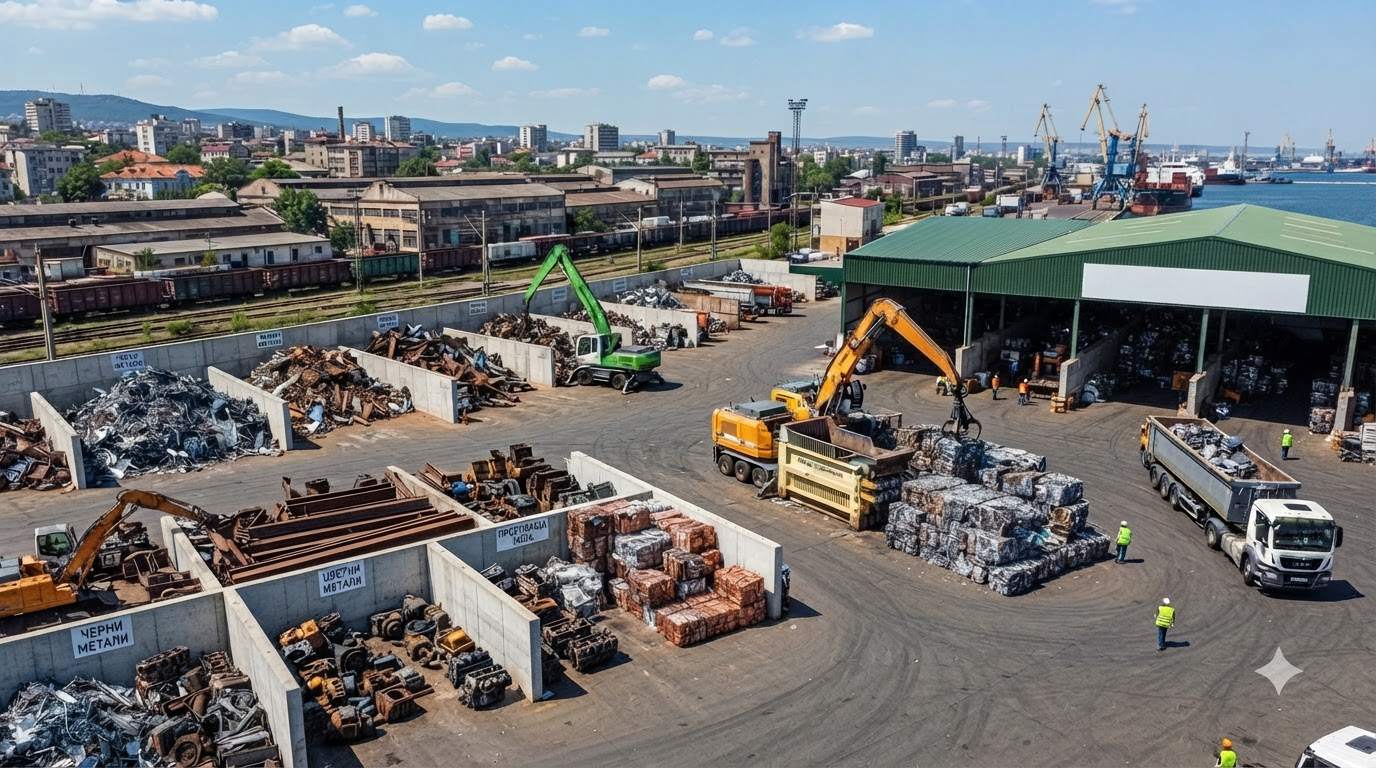
Market Analysis of Bulgaria's Ferrous Scrap and Secondary Steel Industry: EAF Capacity, Viohalco Integration, and Regional Trade Dynamics
Executive Summary and Macroeconomic Context
Bulgaria's secondary metals recycling and steel manufacturing industry operates as a scrap-fed Electric Arc Furnace (EAF) ecosystem deeply integrated into Southeastern European supply chains. Lacking active primary blast furnace facilities, the domestic steel industry relies almost entirely on secondary metallic scrap to synthesize crude steel and manufacture finished rolled products.
The country's secondary metallurgy sector is anchored by Stomana Industry AD, located in Pernik, which represents the largest steel producer in Bulgaria. Owned by the Belgian-headquartered Greek industrial holding company Viohalco SA (via its steel division, Sidenor Group), Stomana Industry maintains a nominal EAF crude steelmaking capacity of 1.4 million metric tonnes per annum. Over 98% of the raw material inputs processed at the Pernik complex consist of recycled ferrous scrap.
In 2024, Bulgaria exported $8.11 billion worth of metals (making metals the 2nd most exported commodity group nationally) while importing $5.43 billion, yielding a net positive metals trade balance of $2.68 billion. Within secondary trade channels, Bulgaria imported $57.9 million of ferrous waste and scrap under Harmonized System Code HS 7204 in 2024, ranking as the 51st largest importer of scrap iron globally. Domestic steel producers export up to 70% of their total output to regional Balkan markets, Central Europe, and Mediterranean destinations.
| Macroeconomic & Industry Metric | Quantitative Benchmark (2024) | Operational Context & Industry Role | Primary Source |
|---|---|---|---|
| Gross Metals Exports (Total) | $8.11 Billion | 38th largest metals exporter globally; 2nd top export group | |
| Gross Metals Imports (Total) | $5.43 Billion | 48th largest metals importer globally | |
| Net Metals Trade Surplus | +$2.68 Billion | Positive balance driven by copper, refined metals, and steel | |
| Ferrous Scrap Imports (HS 7204) | $57.90 Million | 51st largest scrap iron importer globally | |
| Iron & Steel Articles Exports (HS 73) | $807.00 Million | 44th largest exporter globally; led by Germany and Romania | |
| Iron & Steel Articles Imports (HS 73) | $996.00 Million | 63rd largest importer globally; led by Turkey and Germany | |
| Stomana Industry Nominal EAF Capacity | 1,400,000 Tonnes / Year | Operates two 700kt EAF units (EAF 1 & EAF 3) | |
| Stomana Actual EAF Steel Output | 450,000 Metric Tonnes | Down from 489kt in 2023 and 548kt in 2021 |
EAF Industrial Infrastructure and Viohalco / Sidenor Integration
The industrial structure of Bulgarian scrap-based steelmaking is concentrated at the Pernik Steel Plant (Stomana Industry AD), situated approximately 30 kilometers southwest of Sofia. Originally established in 1953 as the Lenin Metallurgic Factory, the plant was privatized and acquired by Viohalco SA / Sidenor Group, transforming it into a modern secondary steelmaking complex.
Stomana Industry Production Fleet and Capacity Utilization
Stomana Industry operates two Electric Arc Furnaces (EAF 1 and EAF 3), each possessing a current operating capacity of 700,000 tonnes per annum, yielding a aggregate plant capacity of 1.4 million tonnes of crude steel per year. EAF 3 was commissioned in 2011 to optimize thermal efficiency and lower specific electrical consumption per melt heat.
Crucial operating parameters across the Pernik complex include:
- Recycled Raw Material Integration: Secondary steel recycling accounts for over 98% of total raw material charges, positioning Stomana as a major circular economy facility in Southeastern Europe.
- Production Volume Profile: Actual crude steel production at Pernik stood at 450,000 metric tonnes in 2024. This follows previous production levels of 489,000 tonnes in 2023, 482,000 tonnes in 2022, 548,000 tonnes in 2021, and 484,000 tonnes in 2020.
- Secondary Processing Equipment: Continuous casting machines produce low-carbon slabs, billets, and blooms. Vacuum degassing units are deployed to refine steel chemistry for specialized engineering applications.
| Operational Parameter | Value / Detail | Strategic & Industrial Role |
|---|---|---|
| Primary Production Location | Pernik, Bulgaria (Vladaisko Vastanie str. 1) | Centrally located near Western Balkan transport corridors |
| Parent Entity / Corporate Group | Viohalco SA / Sidenor Group (100% ownership) | Integrated with Sidenor's Greek and regional trading assets |
| Primary Smelting Units | EAF 1 (700kt/yr) & EAF 3 (700kt/yr) | 100-ton furnace shell sizes utilizing 100% scrap feed |
| Primary Product Specialization | Rebar (SD grade), heavy plates, grinding balls | Rebar/wire rod account for 60-65% of domestic steel demand |
| Workforce Base | ~1,000 Direct Employees | One of the top five electricity consumers in Bulgaria |
Supply Chain Architecture and Regional Scrap Trade
Because domestic scrap generation within Bulgaria is insufficient to maintain full capacity utilization across Stomana's 1.4 million-tonne EAF fleet, local steelmakers rely on a combination of domestic collection and regional cross-border imports.
Inbound Ferrous Scrap Corridors (HS 7204)
Bulgaria imported $57.9 million worth of ferrous scrap (HS 7204) in 2024. The primary overland supplier of ferrous scrap to Bulgarian melt shops is neighboring Romania. In 2024, Romania exported $17.4 million of scrap iron to Bulgaria, representing a temporary decline from 2023 when Romanian scrap exports to Bulgaria reached $50 million (accounting for 9.39% of Romania's total outbound scrap trade). Additional scrap imports enter via short-sea feeder vessels and rail routes from Greece, Serbia, and Central Europe.
Outbound Metals and Downstream Steel Exports
Bulgarian steelmakers export up to 70% of their total finished and semi-finished output. Rebar and wire rod products supply roughly 60% to 65% of Bulgaria's internal steel consumption, with excess volumes exported across the Balkans and the European Union.
Under HS Chapter 73 (Articles of Iron & Steel), Bulgaria exported $807 million in 2024. The primary destinations for these outbound steel products included:
- Germany: $120 million
- Romania: $116 million
- Poland: $56.4 million
- Italy: $49.9 million
- Hungary: $48.6 million
In the broader metals category, Bulgaria exported $8.11 billion in 2024, led by refined copper ($1.87 billion), raw copper ($1.63 billion), and steel products, with primary export destinations being Germany ($1.8 billion), Italy ($1.35 billion), Turkey ($1.13 billion), Romania ($536 million), and Belgium ($505 million).
| Trade Direction / Commodity | 2024 Monetary Valuation | Key Partner Countries | Market Dynamics & Trade Context |
|---|---|---|---|
| Ferrous Scrap Imports (HS 7204) | $57.90 Million | Romania ($17.4M), Greece, Central Europe | Inbound feed for EAF furnaces in Pernik |
| Iron & Steel Articles Exports (HS 73) | $807.00 Million | Germany ($120M), Romania ($116M), Poland ($56.4M) | Finished structural bars, plates, and wire rod |
| Iron & Steel Articles Imports (HS 73) | $996.00 Million | Turkey ($191M), Germany ($150M), China ($146M) | Structural components, specialized pipe, and sheet |
| Total Metals Group Exports | $8.11 Billion | Germany ($1.8B), Italy ($1.35B), Turkey ($1.13B) | 2nd largest export category in Bulgaria |
| Total Metals Group Imports | $5.43 Billion | Turkey ($1.03B), Ukraine ($563M), Germany ($462M) | Primary ores, unwrought copper, and steel feed |
Specialized Product Applications: Heavy Plates and Mining Media
A distinguishing operational feature of Bulgaria's secondary steel sector is its diversification into high-value specialized long and flat steel products.
1. Low-Carbon Quarto Heavy Plates
Stomana Industry is among a limited number of European steel manufacturers producing 100% of its hot-rolled quarto heavy plates exclusively from recycled ferrous scrap. Utilizing low-carbon continuous cast slabs, these heavy plates supply machinery manufacturing, pressure vessel fabrication, yellow goods (construction equipment), energy infrastructure, and shipbuilding applications across Western Europe.
2. Steel Grinding Balls for the Mining Industry
Stomana Industry operates specialized forged line infrastructure producing high-density steel grinding balls utilized in ore grinding mills. Manufactured in diameters ranging from 60 mm to 125 mm with customizable hardness and impact resistance levels, these steel balls are supplied directly to major gold, copper, iron, zinc, nickel, and silver mining operations across South Eastern Europe and international export markets.
Strategic Outlook and Market Conclusions
Bulgaria's scrap metal and secondary steel market occupies a key position within Southeastern Europe's industrial framework. Operating a 1.4 million-tonne EAF production capacity centered at Stomana Industry in Pernik, the domestic sector relies on secondary scrap recycling for over 98% of its raw material inputs.
Key long-term market factors include:
- Energy Price Sensitivity: As one of Bulgaria's top five industrial electricity consumers, Stomana Industry's EAF operating margins depend on domestic power tariffs and participation in demand-side flexibility programs.
- Cross-Border Scrap Integration: Securing consistent seaborne and overland scrap inflows from Romania, Greece, and the Western Balkans remains essential for expanding EAF capacity utilization beyond current levels (~450,000 tonnes/year).
- Green Steel Product Advantage: Producing heavy quarto plates and structural steel from 100% recycled scrap provides a distinct carbon-intensity advantage under European Union sustainability mandates and the Carbon Border Adjustment Mechanism (CBAM).