

The Structural Reconstitution of China's Resource Recycling and Scrap Markets
Macro-Regulatory Architecture and the Rise of State-Led Consolidation
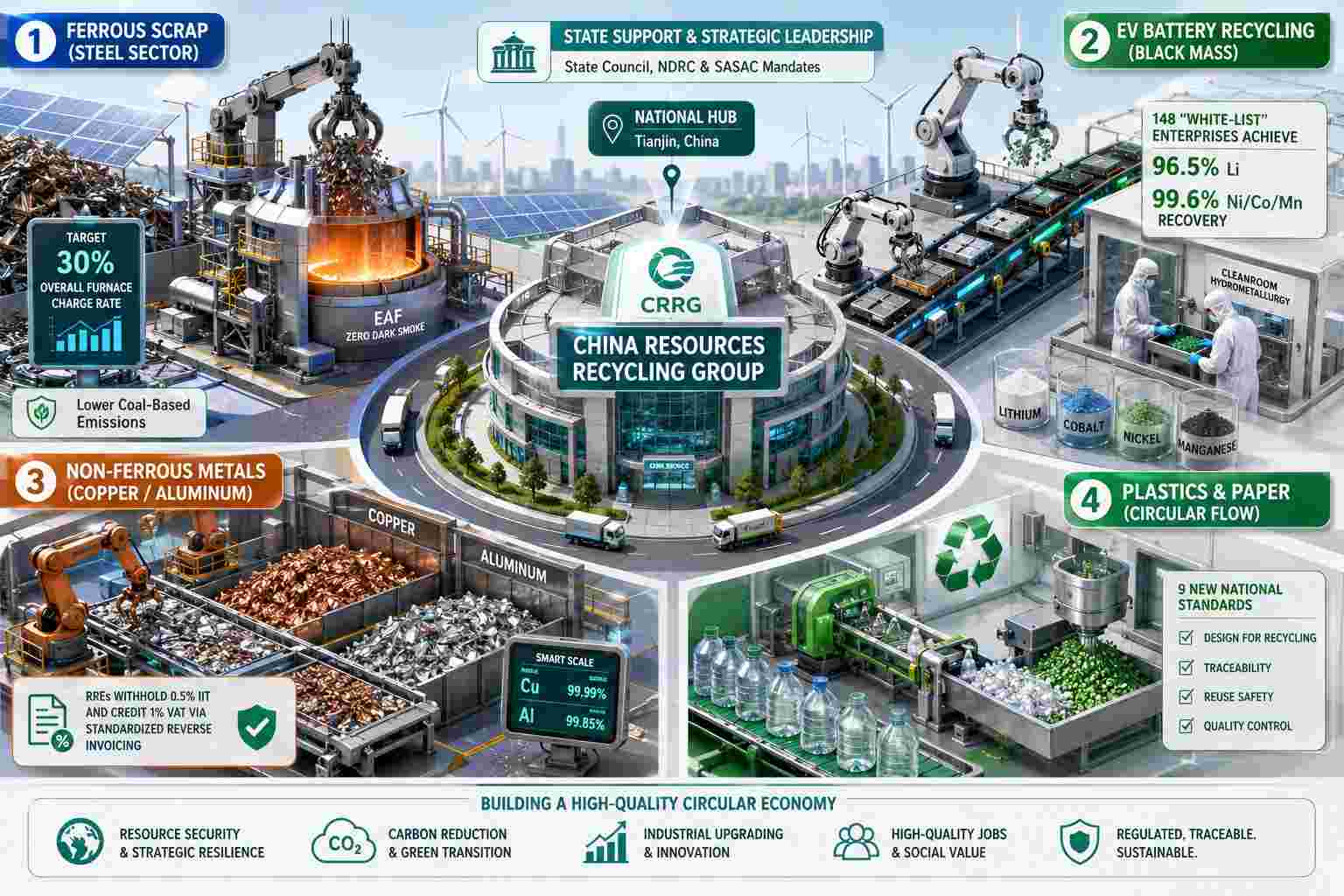
The Chinese state has initiated a comprehensive structural realignment of its domestic recycling and scrap markets, transitioning from a highly fragmented, locally subsidized ecosystem to a centralized, state-regulated circular economy. This institutional shift culminated in the establishment of the China Resources Recycling Group (CRRG) on October 18, 2024, in Tianjin. Functioning as a state-owned national champion with a registered capital of CNY 10 billion, CRRG is backed by the State-owned Assets Supervision and Administration Commission (SASAC) alongside prominent central enterprises, including China National Petroleum and Chemical Corporation, China Baowu Steel Group, Aluminum Corporation of China, and China Minmetals. The group serves as the primary national platform to consolidate and streamline recycling flows across strategic resource streams: scrap steel, non-ferrous metals, electric vehicle (EV) batteries, plastics, and retired renewable energy infrastructure.
This centralization directly supports the ambitious targets established under the State Council's February 2024 "Opinions on Accelerating the Construction of a Waste Recycling System". This policy mandated that by 2025, the annual utilization of major renewable resources—specifically scrap steel, copper, aluminum, lead, zinc, waste paper, waste plastic, waste rubber, and waste glass—must reach 450 million metric tons, with the resource recycling industry's annual output value targeted at 5 trillion yuan. These objectives were further reinforced by the State Council's March 2024 "Action Plan for Promoting Large-scale Equipment Renewal and Consumer Product Trade-in" and the May 2024 "Energy Conservation and Carbon Reduction Action Plan for 2024-2025". Collectively, these regulations have driven the National Development and Reform Commission (NDRC) to establish national "urban mining" demonstration bases, 100 industrial solid waste utilization bases, and 60 key recycling cities, pushing the comprehensive utilization rate of bulk solid waste to 59%.
To enforce standard practices across this newly consolidated market, the NDRC implemented "Document No. 770" during the 2025 transition period. This directive ordered the termination of non-compliant local government "investment promotion" schemes and illegal fiscal rebates. Historically, these local subsidies created an artificial "invoicing economy" that allowed shell recycling companies—frequently termed "migratory bird" enterprises—to arbitrage tax rates across provincial borders. By outlawing these local tax distortions, the central government has forced scrap flows to return to the fundamentals of physical supply and demand, driving non-compliant operators out of the market and concentrating trade volume within legitimate, state-approved channels.
| Circular Economy Metric / Target | Policy Reference | Target Deadline | Mandated Benchmark / Status |
|---|---|---|---|
| Annual Major Renewable Resource Utilization | State Council Waste Recycling Opinions | 2025 | 450 million metric tons utilized |
| Recycling Industry Annual Output Value | State Council Waste Recycling Opinions | 2025 | 5 trillion yuan |
| Major Waste Material Recycling Rate | Waste Recycling Guideline (NDRC et al.) | 2025 | Exceed 75% recycling rate |
| Green Sorting Centers | Waste Recycling Guideline (NDRC et al.) | 2025 | Build over 1,000 green sorting centers |
| Complete Waste Re-use Urban Systems | Waste Recycling Guideline (NDRC et al.) | 2025 | 60 cities with complete systems |
| Decommissioned Wind & Solar Equipment | CRRG Strategic Mandate | 2030 | Process 35 million tonnes annually |
| Recycled Scrapped Vehicles | CRRG Strategic Mandate | 2027 | Double the baseline recycling volume |
| Bulk Solid Waste Utilization Rate | NDRC Industrial Bases Program | 2026 (Active) | Current performance at 59% |
The Ferrous Scrap Dilemma and Stalled Electric Arc Furnace Transition
A critical pillar of China’s "dual-carbon" strategy—aiming to peak carbon emissions by 2030 and achieve carbon neutrality by 2060—is the decarbonization of its steel industry, which represents the country's second-largest industrial emitter. In 2022, the Chinese government mandated a target to raise the share of Electric Arc Furnace (EAF) steelmaking to 15% of total crude steel production by 2025. This transition aims to shift production away from carbon-intensive, coal-based Blast Furnace-Basic Oxygen Furnace (BF-BOF) routes to scrap-based EAF systems, which consume 75% less energy and generate significantly fewer greenhouse gases.
Despite this mandate, progress toward the 15% EAF target has stalled, with the actual EAF share hovering around 10% for over a decade. This stagnation has major environmental consequences; missing the 15% target is projected to increase China's carbon dioxide emissions by over 160 million metric tons, an amount equivalent to the entire annual carbon footprint of the European Union's steel sector.
The primary cause of this delay is a structural cost disadvantage. EAF operators face high industrial electricity tariffs and a volatile, uncoordinated domestic scrap collection network, resulting in severe financial losses. In mid-2025, these compounding financial pressures led to widespread mill suspensions and at least one high-profile bankruptcy.
Because scrap steel was priced higher than hot metal in 2025, BF-BOF mills systematically reduced their scrap charge. Consequently, China's total ferrous scrap consumption in 2025 dropped by 0.7% year-on-year to 256.9 million metric tons. This domestic supply squeeze was worsened by import restrictions; despite efforts to liberalize scrap steel imports, China's ferrous scrap imports actually halved in 2024, preventing mills from sourcing cheaper international feedstock to offset domestic price spikes.
To address these challenges, the Chinese steel sector is undergoing a capacity and policy reset. According to Shanghai Metals Market (SMM) data, the industry is building 100 million metric tons of highly efficient, new EAF steel production capacity while permanently retiring 40 million metric tons of obsolete capacity. This yields a net capacity increase of 60 million metric tons, designed to improve the economies of scale for EAF operators.
To support this capacity, the China Association of Metalscrap Utilization targeted a 30% scrap ratio in the overall furnace charge by 2025. Furthermore, forecasts for 2026 indicate a projected recovery in ferrous scrap demand, as tightening carbon compliance under the national emissions trading scheme forces steelmakers to increase scrap utilization despite short-term cost disparities.
| Steel Scrap & EAF Indicator | Global Benchmarks / Metrics | Chinese Market Metrics & Targets (2025/2026) | Regional & Operational Dynamics |
|---|---|---|---|
| Total Scrap Metal Recycled | ~630 million tons recycled globally per annum | ~230 million metric tons processed (2023) | China is the largest global recycler, representing over 35% of global scrap steel processing. |
| Share of EAF in Steelmaking | EAF represents ~29% of global steel production | Stagnant at ~10% (Targeted: 15% for 2025) | Stalled by high electricity costs, unreliable scrap supplies, and BF-BOF cost advantages. |
| Scrap Steel Utilization Volume | Integrated into global automotive & construction supply chains | Targeted to reach 300 million tons utilized annually by 2025 | Managed under the "14th Five-Year Plan for Circular Economy" to drive secondary metal utilization. |
| AC vs. DC EAF Furnace Type Growth | DC segment projected to grow at 5.9% CAGR (2026-2034) | AC EAF segment projected to grow at 8.4% CAGR | AC furnaces dominate large-scale installations due to lower upfront capital expenditure. |
| EAF Market Valuation | Global EAF market valued at $3.77B (2025) | China EAF market valued at $830.4M (2025) | Driven by state-enforced capacity replacement programs and green steel transition mandates. |
Non-Ferrous Scrap Compliance: Reverse Invoicing and Market Formalization
The non-ferrous scrap market, particularly copper and aluminum, has entered a period of strict compliance and price standardization. This transition was accelerated by the recategorization of high-grade copper, brass, and aluminum scrap as standardized "raw materials" rather than solid waste, effective July 1, which eliminated import restrictions and allowed direct global sourcing.
Domestically, the most significant fiscal reform is the "reverse invoicing" tax policy. Officially enacted by the State Taxation Administration on April 29, 2024, under Announcement No. 5, the policy allows qualified Resource Recycling Enterprises (RREs) to issue VAT invoices directly on behalf of individual, natural-person sellers. This represents a major shift from the standard "forward invoicing" model.
Historically, recycling companies purchased scrap from individual collectors who could not issue formal VAT invoices, leaving RREs without the "input" invoices required to claim tax deductions. This led to widespread tax non-compliance and tax evasion. Under the reverse invoicing framework, a "qualified individual" is defined as a natural person selling self-used or purchased scrapped products whose cumulative VAT-exclusive sales revenue does not exceed RMB 5 million within 12 consecutive calendar months. RREs must be registered with the relevant authorities for collecting hazardous wastes, scrapped automobiles, or other recoverable resources to participate.
The operational mechanics of this system create a structured tax-sharing mechanism:
- VAT Deduction and Offsets: If an RRE uses the general taxation method, it can issue either special or normal VAT invoices to the individual seller, allowing it to credit 1% of the output VAT payable. Conversely, RREs using the simplified taxation method can only issue normal VAT invoices. RREs that had opted for simplified taxation were permitted to shift to the general taxation method before July 31, 2024, but are locked into that choice for 36 months.
- Withholding Obligations: RREs must declare and pay VAT, associated surcharges, and Individual Income Tax (IIT) on behalf of the individual seller.
- Preferential Tax Treatment: Individual sellers enjoy small-scale taxpayer benefits, including VAT exemption for monthly turnovers below RMB 100,000 and a reduced 1% levy rate above that threshold. RREs withhold a provisional IIT of 0.5% of sales revenue for the individual, who must complete an annual IIT self-declaration by March 31 of the following year.
- Operational Verification: To prevent fraud, RREs must maintain standardized purchase ledgers and verify transactions using photos or videos, facing severe criminal liability for false invoicing.
This tax-inclusive system has fundamentally restructured copper and aluminum scrap pricing. During the 2025 transition period, as local subsidies were eliminated under Document No. 770, the cost of VAT-compliant copper scrap rose sharply. On several trading days, VAT-inclusive bare bright copper prices inverted against primary copper cathode prices, creating a structural deficit for scrap-consuming mills.
Moving into 2026, tax authorities have intensified audits, focusing on eliminating shell companies and verifying physical operations. This strict enforcement has forced non-compliant "migratory bird" traders out of the market, directing copper and aluminum scrap toward legitimate, MIIT-registered processing facilities.
| Fiscal Parameter / Rule | General Taxation Method (RRE) | Simplified Taxation Method (RRE) | Individual Seller (Small-Scale) |
|---|---|---|---|
| Invoice Issuance Type | Special VAT or Normal VAT Invoice | Normal VAT Invoice only | Exempt from issuing; RRE generates invoice |
| Output VAT Credit Limit | 1% of output VAT payable credited | Not eligible for standard 1% credit | Subject to 1% levy rate if monthly sales exceed RMB 100,000 |
| Withheld Individual Income Tax | 0.5% provisional IIT prepaid by RRE | 0.5% provisional IIT prepaid by RRE | Requires annual self-declaration by March 31 |
| Monthly Turnover VAT Exemption | N/A | N/A | Exempt if monthly sales are under RMB 100,000 |
| Compliance & Verification Ledger | Mandated photo/video log of transactions | Mandated photo/video log of transactions | Subject to a cumulative limit of RMB 5 million per year |
EV Battery Recycling and the Geopolitics of Black Mass
China dominates the global electric vehicle battery recycling sector, controlling over 75% of global battery pre-treatment capacity and more than 85% of black mass refining capacity in 2025. The domestic market reached an estimated valuation of 558 billion yuan (approximately USD 78 billion) in 2025, led by CATL-affiliated Brunp Recycling, which processes 50.4% of China's retired EV batteries with a processing capacity of 120,000 metric tons. With research institutions projecting that annual retired battery volumes will reach 1 million metric tons by 2030, the Chinese state has introduced a series of strict standards to regulate this high-value market.
A major regulatory shift occurred on August 1, 2025, when China officially adopted national standard GB/T 45203-2024. This standard reclassifies qualifying black mass—the valuable, mineral-rich powder derived from crushing and pre-treating spent lithium-ion batteries—as a non-waste raw material. Under this standard, black mass that meets specific quality thresholds, including a combined nickel and cobalt content of 25% or more alongside strict limits on moisture and impurities, is exempt from solid-waste import bans. This reclassification allows Chinese hydrometallurgical processors to import black mass directly, bypassing the need to route shipments through Southeast Asian processing hubs.
However, this import policy faces regulatory and geopolitical hurdles in Western markets, particularly the European Union. Since March 2025, the EU has classified black mass as hazardous waste. Under the Basel Ban Amendment, EU member states are prohibited from exporting hazardous waste to non-OECD countries, including China. In the absence of a Prior Informed Consent (PIC) agreement between the EU and China, European exporters cannot legally ship black mass to Chinese buyers, even if the material meets GB/T 45203-2024 standards. This bottleneck has locked European feedstocks within regional borders, limiting the raw material supply for China’s refining capacity.
To secure domestic supply, China enacted the "Interim Measures for the Management of Recycling and Comprehensive Utilization of Retired Power Batteries of NEVs" on April 1, 2026. This regulation enforces strict Extended Producer Responsibility (EPR), allocating recycling obligations to battery manufacturers and vehicle importers across nine distinct lifecycle stages: research and development, production, testing, vehicle assembly, storage, transportation, use, maintenance, and vehicle scrapping.
A major element of the 2026 Interim Measures is the requirement that EV batteries must remain with the vehicle upon scrapping, integrating licensed auto dismantlers directly into the regulated recycling chain. This stops retired batteries from leaking into the informal, unregulated market. To track compliance, the MIIT is implementing a national traceability platform and a digital battery identity system, transitioning voluntary coding rules to mandatory standards, such as standard 20261952-Q-339.
The Interim Measures also redefine "comprehensive utilization" strictly as resource recovery, focusing on dismantling, crushing, sorting, and smelting. This has concentrated the market around 148 licensed "white-list" enterprises, which include 48 recycling specialists, 85 battery reuse companies, and 15 integrated operators. These advanced processors achieve exceptional metal recovery rates, reclaiming 96.5% of lithium and 99.6% of nickel, cobalt, and manganese.
Non-compliant operators face strict financial penalties under this new regime. For example, diverting retired batteries to unlicensed workshops carries fines between RMB 10,000 and RMB 30,000, while failing to establish mandated regional recycling service stations carries penalties of up to RMB 50,000.
| Battery Lifecycle Stage | Target Operations & Logistics | Primary Responsible Entity | Compliance & Traceability Mandate |
|---|---|---|---|
| R&D & Production | Standardized cell design, low-toxic and recyclable material integration | Battery Manufacturers & Importers | Establish unique battery codes under standard 20261952-Q-339 |
| Testing & Vehicle Assembly | Technical specification reporting; disassembly manual generation | Automakers / EV Importers | Submit battery technical specifications within 6 months of mandatory product certification |
| Storage & Transportation | Fire safety enforcement; battery health monitoring during transport | Logistics Providers & Distributors | Log transit dates and battery status on the national digital traceability platform |
| Use & Maintenance | Battery swapping and regional servicing operations | Battery Swapping / Service Enterprises | Entrust retired batteries exclusively to licensed comprehensive utilization firms |
| Vehicle End-of-Life | Vehicle decommissioning and battery dismantling | Licensed End-of-Life Vehicle Dismantlers | Ensure batteries remain with vehicles upon scrapping; log dismantling data within 20 days |
| Comprehensive Utilization | Physical pre-treatment (crushing, black mass extraction) and hydrometallurgical refining | 148 Licensed "White-List" Enterprises | Achieve 96.5% lithium recovery and 99.6% nickel, cobalt, and manganese recovery |
Plastic and Paper Recycling: Standardizing the Circular Flow
China’s domestic plastic recycling services market is growing steadily, valued at USD 349.32 million in 2025 and projected to reach USD 671.74 million by 2034, growing at a CAGR of 7.53%. To support this growth, the State Administration for Market Regulation approved nine new national standards for plastics and recycled plastics on August 1, 2025, with implementation taking effect on February 1, 2026. Combined with GB/T 45090-2024 (marking and labeling) and GB/T 45091-2024 (restricted substances), these guidelines establish a full-chain regulatory framework spanning production, collection, recycling, and reuse.
The 2026 standard system introduces three main changes to the plastic recycling industry:
- Design-for-Recycling Guidelines: Provides grading frameworks to assess the recyclability of PET bottles and HDPE containers from the initial product design stage. This aligns with regional policies, such as South Korea's January 2026 mandate requiring 10% recycled PET (rPET) in beverage bottles, and Japan's green procurement incentives for easily recyclable designs.
- Quality and Environmental Identification: Standardizes advanced testing methods to verify the purity and grade of recycled PET and polypropylene (PP), improving consumer trust in recycled packaging.
- Traceability and Safety Protocols: Establishes tracking mechanisms to monitor the lifecycle of recycled plastics, ensuring they meet safety requirements before reuse in consumer goods.
These standards are supported by the NDRC's "Action Plan for Promoting the Use of Recycled Materials," released on December 23, 2025. This plan outlines specific 2030 targets to increase recycled content in manufacturing, setting annual production goals of over 300 million tons of recycled steel, over 80 million tons of recycled paper, over 25 million tons of recycled non-ferrous metals, and over 19.5 million tons of recycled plastics. To achieve these targets, the plan encourages chemical recycling technologies to convert low-value plastic waste into high-value chemical feedstocks, while expanding source-separated collection networks across urban areas.
| Key Product Sector | Target Industrial Component | Approved Recycled Feedstock Type |
|---|---|---|
| Automobiles | Frame structures, body panels, glass panels, wheels | Recycled steel, recycled non-ferrous metals, recycled glass, recycled plastics |
| Electrical & Electronics | Non-moving structural casings, internal brackets, protective packaging | Recycled plastics, recycled copper, recycled aluminum, recycled paper, recovered rare metals |
| Batteries | Electrodes (lead-acid batteries), outer protective casings | Recycled lead, recycled non-ferrous metals, recycled plastics |
| Textiles | Sound-absorbing fibers, structural insulation layers | Recycled synthetic fibers |
| Packaging | Corrugated shipping boxes, shrink wrap, heavy-duty bags, foam fillers | Recycled paper, recycled plastics |
E-Waste Management and Automated Material Recovery
China's domestic e-waste management market was valued at USD 5.06 billion in 2024 and is projected to reach USD 25.91 billion by 2035, growing at a CAGR of 16.0%. This growth mirrors the expansion of the global e-scrap recycling market, which is expected to rise from USD 10.26 billion in 2025 to USD 11.26 billion in 2026, and reach USD 16.75 billion by 2030.
Driven by rapid urbanization and the widespread adoption of consumer electronics, China's e-waste generation is expected to reach 10 million metric tons annually. This volume is fueled by massive domestic sales of smartphones, laptops, and tablets, which are projected to reach 1.5 billion units.
The economic value of this waste stream lies in the recovery of precious and rare earth metals. The market for recovered metals—such as gold, silver, palladium, and copper is projected to reach USD 50 billion by 2027.
To capture this value, Chinese recyclers are shifting from manual dismantling to automated material recovery technologies. Companies are investing in automated optical sorting systems and advanced shredding technologies. However, this shift is facing cost pressures from global trade tariffs, which have raised the cost of imported dismantling machinery, sorting equipment, and industrial shredders.
Because of strict domestic solid waste regulations, China's international trade in raw e-waste remains small. Under HS Code 85.49, China exported USD 2.13 million of e-waste and scrap in 2025, primarily to Venezuela (USD 418,000), Singapore (USD 341,000), Turkmenistan (USD 270,000), Russia (USD 216,000), and India (USD 169,000).
In contrast, China imported USD 3.06 million of e-waste and scrap in 2024, primarily from the United States (USD 1.88 million) and Japan (USD 252,000). China’s net e-waste trade balance in 2024 was USD 33.3 million, with total exports of USD 36.3 million, mainly to Sweden (USD 10.7 million) and Belgium (USD 5.72 million).
However, trade patterns shifted significantly in early 2026. In March 2026, China's e-waste and scrap exports surged by 605% month-on-month, rising from USD 85,200 in February to USD 601,000. This spike represents a 92.5% year-on-year increase, driven by a sharp rise in shipments to Belgium (USD 554,000), Singapore (USD 24,000), and Nigeria (USD 11,500).
Long-term trade projections suggest that China’s highest export growth potential for pre-treated e-scrap remains focused on nearby high-capacity smelting hubs, led by Japan (estimated growth potential of +USD 4.04 million) and South Korea (+USD 2.34 million).
| Bilateral Trade Metric | Imports (2024 Annual) | Exports (2025 Annual) | Monthly Trade (March 2026) | Long-Term Export Potential |
|---|---|---|---|---|
| Total Trade Value | USD 3.06 Million | USD 2.13 Million | USD 601,000 | Net growth driven by regional smelting integration |
| Primary Trading Partners | United States ($1.88M), Japan ($252k), Philippines ($167k) | Venezuela ($418k), Singapore ($341k), Turkmenistan ($270k) | Belgium ($554k), Singapore ($24k), Nigeria ($11.5k) | Japan (+$4.04M), South Korea (+$2.34M), USA (+$1.01M) |
| Fastest Growing Partners | Indonesia (+$87.2k), Dominican Republic (+$84.7k) | Russia (+$176k), South Korea (+$85.2k), India (+$84.6k) | Belgium (+$554k YoY), Singapore (+$24k YoY) | Shift toward high-value, processed precious metal scraps |
| Global Export Ranking | N/A | 18th largest exporter globally (0.95% share) | Export volume grew 605% MoM from February 2026 | Transitioning to higher global export shares via automated pre-treatment |
| Global Import Ranking | 43rd largest importer globally (0.08% share) | N/A | Import flows remain strictly regulated under waste bans | Import volumes constrained by strict quality standards |
Strategic Synthesis and Systemic Conclusions
The systematic restructuring of China's resource recycling and scrap markets represents a transition from a highly fragmented, informal industry to a consolidated, state-regulated sector. By establishing central entities like the China Resources Recycling Group and enacting strict tax and environmental regulations such as the reverse invoicing framework and the 2026 NEV Battery Interim Measures. The Chinese government is eliminating non-compliant operators and formalizing its circular economy.
While this transition has introduced short-term economic friction—such as elevated procurement costs for copper scrap and delays in meeting the 15% EAF steel target. The long-term strategic benefits are clear. The integration of design-for-recycling standards, the reclassification of black mass, and the expansion of automated e-waste recovery systems are strengthening China’s domestic resource security. This regulatory model provides China's advanced manufacturing sectors with a reliable supply of high-purity, secondary raw materials, reducing dependence on imported virgin ores and supporting the country's broader decarbonization goals.