

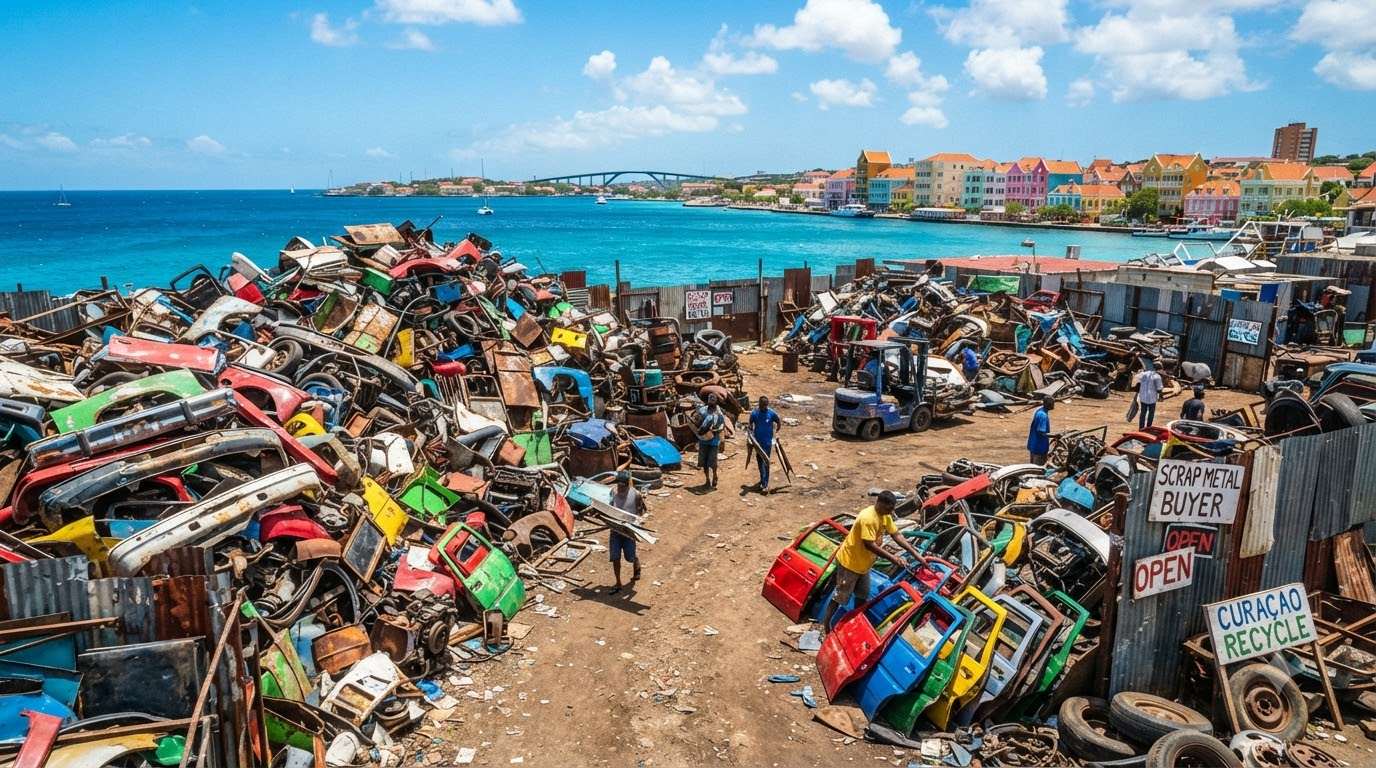
Strategic Analysis of the Scrap and Secondary Material Market in Curaçao
Executive Summary and Island Recycling Landscape
The recycling and scrap material market in Curaçao a constituent country of the Kingdom of the Netherlands located in the southern Caribbean functions within the structural framework typical of a Small Island Developing State (SIDS). Characterized by limited geographic territory, a delicate marine environment, and an absence of heavy domestic metallurgical smelting infrastructure, Curaçao's scrap industry operates primarily as an aggregation, processing, sorting, and export-driven network.
Rather than feeding local mills, secondary raw materials generated on the island are collected by private operators and public utilities, processed to international standards, and exported via the deep-water maritime port facilities of Willemstad. The island's secondary materials trade is anchored by two distinct pillars: high-value precious metal scrap exports (HS 7112), which represent a significant foreign revenue generator, and base industrial streams comprising non-ferrous metals, ferrous car scrap, e-waste, lead-acid batteries, and oil refinery residues.
| Market Dimension / Indicator | Baseline Metric / Status | Strategic Context & Primary Operational Focus | Primary Source |
|---|---|---|---|
| Precious Metal Scrap Exports (2024) | $4.33 Million | Ranked 13th among Curaçao's total merchandise export categories.
| OEC / UN Comtrade
|
| Primary Precious Scrap Destinations | United States ($3.09M), Belgium ($1.17M) | US and EU refiners absorb over 98% of total precious scrap shipments.
| OEC
|
| Established Local Processing Hubs | Willemstad (Zeelandia & San Souci Industrial Districts) | Center for private processing yards, automated baling, and container consolidation.
| Industry Directories
|
| Public Sector Waste Authority | Selikor NV | State waste company spearheading circular economy transitions.
| Selikor Corporate
|
| International Development Funding | RESEMBID / European Union Grants | Funding national waste characterization and circular policy frameworks through 2025.
| RESEMBID
|
Strategic Trade Profile: Precious Metals and Export Outlets
Due to the limited domestic market, international trade channels dictate the commercial viability of Curaçao’s recycling sector. The island relies on ocean container shipping (typically under Freight on Board / FOB terms) to ship consolidated materials to European, North American, and Asian refiners.
Precious Metal Waste and Scrap (HS 7112)
Precious metal scrap represents Curaçao’s highest-value secondary material export stream. This category includes circuit board residues, dental alloys, industrial catalysts, and precious metal sweepings.
- 2024 Export Volume: Curaçao exported $4.33 million worth of precious metal scrap in 2024, positioning the island as the 88th largest exporter globally in this commodity category.
- United States: The US serves as the primary buyer, importing $3.09 million of precious metal scrap from Curaçao in 2024, expanding by $828 thousand compared to 2023 levels.
- Belgium: Belgium represents the second-largest destination, absorbing $1.17 million in 2024 (a 100% year-on-year increase).
- Secondary Markets: Additional smaller export consignments were directed to Malaysia ($74.7 thousand) and Armenia ($1.88 thousand).
Base Metals and Industrial Packaging Streams
In addition to precious metals, local traders maintain steady export volumes across base metals and non-metallic recyclables. Ferrous structural scrap and compressed end-of-life vehicle (ELV) bodies are aggregated for regional Caribbean or South American re-smelting, while non-ferrous commodities (aluminum UBCs, copper wire, brass, lead) are exported predominantly to European buyers.
| Scrap Commodity Stream | Primary Material Sources | Core Target Destination Markets | Operational Logistics & Trade Terms |
|---|---|---|---|
| Precious Metal Scrap (HS 7112) | Electronics, industrial catalysts, precious residues
| United States ($3.09M), Belgium ($1.17M)
| Containerized air/sea freight; refined by specialized metal works.
|
| Aluminium UBC & Extrusions | Beverage cans, architectural window profiles
| Regional Caribbean & European Foundries
| Baled and containerized; traded under L/C and FOB terms.
|
| Spent Lead-Acid Batteries (SLAB) | Automotive, truck, and marine vehicle batteries
| Certified Overseas Secondary Lead Smelters
| Hazardous cargo protocols; processed to prevent soil contamination.
|
| Paper, Cardboard & Tyre Rubber | Commercial packaging, automotive service centers
| European Recycling Facilities
| High-density baling at Port of Willemstad.
|
Primary Commodity Streams and Specialized Industrial Waste
Curaçao's scrap generation profile reflects its local economic structure, which combines urban residential activity, maritime logistics, commercial shipping, and historical petroleum refining.
Ferrous and Non-Ferrous Metallic Streams
- Ferrous Scrap: Consists of heavy structural steel, steel pipes, machinery offcuts, and end-of-life automotive shells. Local yards employ hydraulic balers and shears to process auto scrap into dense bales prior to shipping.
- Non-Ferrous Scrap: Includes bright copper wire, insulated electrical cabling, aluminum car rims, architectural paneling, zinc, brass, bronze, lead, and tin. These high-value non-ferrous streams are sorted manually or mechanically to achieve high purity levels.
- Automotive Catalytic Converters: Collected specifically for their platinum group metal (PGM) content (platinum, palladium, and rhodium), which is extracted by international refiners.
Electronic Waste (E-Waste)
E-waste recovery is a growing sub-sector on the island. Local recyclers collect discarded mobile phones, laptops, desktop computers, telecom routers, air conditioning units, and audiovisual equipment. Dismantling facilities extract printed circuit boards (PCBs), copper wiring, and aluminum heat sinks, diverting toxic heavy metals (lead, cadmium, mercury) from the island's landfill.
Oil Refining Waste and Spent Catalysts
Due to Curaçao's industrial history with the Isla Oil Refinery in Willemstad, specialized industrial waste recovery forms a unique market segment. Recycling operators process metal-containing refinery residues, spent catalysts, fly ash, and vanadium and nickel slag, extracting valuable base metals for international industrial re-use.
Key Market Participants and Corporate Ecosystem
The competitive landscape in Curaçao comprises established private recycling companies, specialized scrap traders, and public utility partners.
| Enterprise / Organization | Headquarters / Facility Location | Operational Footprint & Specialization | Key Market Role |
|---|---|---|---|
| Recupal Group | Kaya Jacob Posner #14, Zeelandia, Willemstad
| Operating for 30+ years (since 1994); specializes in e-waste, non-ferrous metals, SLAB batteries, catalytic converters, and refinery slag.
| Major island processing center with on-site weighing and immediate cash settlement.
|
| Pro-Green Recycling Waste Management | San Souci 31, Willemstad (License #97130)
| Established in 2014 by James A. Luciana; trades ferrous/non-ferrous metals, cardboard, glass, and tyre scrap.
| Major exporter operating a dedicated yard; ships FOB primarily to European markets.
|
| STATERA | Willemstad, Curaçao
| Established in 2020; focuses on collecting, processing, and trading Aluminium UBC scrap.
| Specialized non-ferrous aggregator.
|
| Selikor NV | Willemstad, Curaçao
| State-backed waste management authority managing municipal solid waste streams.
| Drives national circular policy and waste-to-value initiatives.
|
National Infrastructure, Government Policy, and Circular Initiatives
Waste management and recycling in Curaçao are undergoing a structural modernization aimed at reducing landfill burdens and protecting island ecosystems.
Selikor's "Transforming Waste to Value" Project
Supported by significant funding from the European Union through RESEMBID (Regional Facility for Sustainable Energy in Caribbean Overseas Countries and Territories) and technical guidance from Dutch engineering consultancy HaskoningDHV, state waste utility Selikor NV launched the "Transforming Waste to Value" program. Key components include:
- Waste Characterization Study (WCS): Executed in partnership with EcoVision NV, this initiative collects quantitative data on island waste composition to identify recyclable volumes currently lost to landfills.
- National Waste Management Policy Paper: Establishing a formal policy framework based on circular economy principles, enforcing source separation, and encouraging private sector recycling investments.
- Landfill Diversion Goals: Minimizing waste disposal at the municipal landfill to prevent soil and groundwater contamination while protecting surrounding marine habitats.
Systemic Challenges, Opportunities, and Strategic Outlook
Curaçao’s secondary materials market presents distinct operational dynamics:
Core Challenges
- High Maritime Freight Vulnerability: Because all scrap must be exported, local recyclers are exposed to international shipping container rates, port handling fees, and global price volatility.
- Diseconomies of Scale: As a small island, domestic generation of specific high-grade industrial scrap can be irregular, requiring recyclers to maintain large yard storage capacity to aggregate full container loads (FCL).
Emerging Opportunities
- Precious Metal Recovery Expansion: Expanding electronic waste collection networks allows recyclers to capture high-margin gold, silver, and palladium residues, maximizing export value per container shipped to US and European refiners.
- Public-Private Recycling Partnerships: Alignment between state utility initiatives (Selikor) and private scrap yards (Recupal, Pro-Green) will improve waste collection rates and formalize recycling channels across the island.
Strategic Outlook
Curaçao's scrap metal and recycling sector is positioned to maintain a steady export profile. Supported by strong precious metal export values ($4.33M in 2024), EU-funded circular economy reforms, and established private processing yards in Willemstad, the market will remain an essential component of Curaçao's environmental management and trade infrastructure.