

Strategic Analysis of the Scrap and Recycling Market in Myanmar
Executive Summary and ASEAN Regional Framework
The scrap metal and recycling industry in Myanmar forms a developing operational segment within the broader Southeast Asian secondary materials ecosystem. Valued at USD 10.20 billion in 2025, the Southeast Asian metal recycling market is projected to reach USD 19.07 billion by 2034, expanding at a compound annual growth rate (CAGR) of 6.98%. Within this regional landscape, ferrous metals dominate material throughput with a 68.4% volume share, while building and construction represents the single largest end-use sector, accounting for 27.8% of regional scrap consumption.
Myanmar's scrap market functions primarily as a raw material collection, primary processing, and export-oriented network. Driven by domestic structural demolition, obsolete infrastructure dismantling, and industrial offcuts, local recyclers consolidate scrap to supply domestic secondary steel furnaces and regional manufacturing hubs in South and Southeast Asia. While domestic industrial processing infrastructure remains emerging, the country maintains active international trade channels for heavy melting steel (HMS) and high-value stainless steel scrap grades.
| Market Parameter / Metric | Regional / Domestic Value | Strategic Context & Operational Significance | Primary Data Source |
|---|---|---|---|
| Southeast Asia Metal Recycling Market (2025) | USD 10.20 Billion | Base regional market valuation across ferrous and non-ferrous sectors. | IMARC Group |
| Southeast Asia Projected Market Value (2034) | USD 19.07 Billion | Forecast expansion growing at a 6.98% CAGR (2026–2034). | IMARC Group |
| Ferrous Metal Regional Share | 68.4% | Dominant volume segment supporting EAF and induction furnace steelmaking. | IMARC Group |
| Construction End-Use Share | 27.8% | Primary driver of scrap generation (demolition) and rebar consumption. | IMARC Group |
| Ferrous Scrap Exports to India (2025) | US$ 4.53 Million | Key export route for secondary iron, steel scrap, and remelt ingots. | UN COMTRADE |
| Ferrous Scrap Exports to Malaysia (2025) | US$ 32.5 Thousand | Regional export route for secondary steel raw materials. | UN COMTRADE |
Commodity Stream Analysis and International Trade Dynamics
International trade data indicates that Myanmar acts as a net exporter of secondary metal scrap, supplying heavy melting steel and sorted stainless steel to foreign buyers.
Ferrous Scrap Exports and Regional Destinations
Ferrous waste, scrap, and remelt iron/steel ingots represent the bulk of exported metal volumes.
- India: India serves as one of Myanmar's primary international trade partners for secondary ferrous metals. In 2025, India imported US$ 4.53 million worth of ferrous waste, scrap, and remelt scrap iron/steel ingots from Myanmar.
- Malaysia: Shipments of ferrous scrap and remelt ingots to Malaysia totaled US$ 32.5 thousand in 2025.
- Historical Import Flows: On the import side, specialized ferrous waste and scrap items (HS 720449) have historically been sourced in smaller volumes from countries including Italy, Vietnam, Malaysia, Singapore, and Thailand to meet specific industrial grade requirements.
Stainless Steel and High-Grade Non-Ferrous Alloys
Myanmar’s scrap collection networks actively recover non-ferrous and stainless steel scrap from industrial equipment, maritime vessels, and consumer appliances. Key trade categories include:
- Stainless Steel Grade 304: High-nickel melting scrap generated from industrial vessel dismantling and commercial food processing equipment. Recent export shipments have logged individual consignment volumes ranging between 90 and 94 metric tons per transaction.
- Stainless Steel Grade 201: Solid and melting scrap sourced from consumer durables and architectural fittings, exported in consolidated lots exceeding 50 to 98 metric tons per shipment.
- Heavy Melting Scrap (HMS 1&2): Structural steel scrap recovered from demolition sites, machinery frames, and heavy transport equipment.
| Scrap Commodity Category | Trade Direction | Destination / Source Markets | Primary Material Grades & Descriptions |
|---|---|---|---|
| Ferrous Waste & Remelt Ingots | Export | India (US$ 4.53M in 2025), Malaysia | Heavy melting scrap, iron/steel remelt ingots, turnings. |
| Stainless Steel Scrap (304) | Export | International Smelters & Traders | High-nickel solid melting scrap (Grade 304). |
| Stainless Steel Scrap (201) | Export | Regional Secondary Processors | Low-nickel stainless solid scrap (Grade 201). |
| Ferrous Waste (HS 720449) | Import | Italy, Vietnam, Malaysia | Specialized industrial iron and steel scrap. |
Key Industry Players and Corporate Ecosystem
The competitive structure of Myanmar’s scrap metal sector consists of domestic recycling enterprises, specialized trading entities, and regional exporters.
| Enterprise / Corporation | Operational Base | Primary Business Specialization | Market Role & Capabilities |
|---|---|---|---|
| Duonglinh Holdings (Duonglinh Metals) | Myanmar | Scrap Recycling & Metal Trading | Operates as a leading domestic metal recycler, providing market pricing, news, and processing. |
| HLH Laszakovits Company Ltd | Yangon, Myanmar | Scrap Manufacturing & Export | Established in 2009; major exporter of HMS 1&2 iron scrap. |
| Thu Kha Steel World Co Ltd | Myanmar | Steel Scrap Export & Distribution | Significant exporter of ferrous heavy metal scrap shipments. |
| Age Exim Ltd | Myanmar | Scrap Export & Procurement | Key supplier accounting for a high volume of international scrap exports. |
| Hedav Pte Limited | Myanmar / Singapore | International Scrap Trading | Cross-border trader facilitating non-ferrous and ferrous scrap movements. |
Market Drivers, Steel Capacity, and Processing Infrastructure
The growth trajectory of Myanmar's scrap market is linked to domestic infrastructure requirements and regional raw material demand.
Steel Demand and Secondary Feedstock Needs
Myanmar maintains steady demand for finished steel products, particularly construction rebar, structural sections, and wire rod. In 2024, national steel import quotas were estimated at approximately 900,000 tonnes to support infrastructure projects. Domestic steelmakers and induction furnace operators rely on locally recovered scrap metal to supplement imported steel billets, reducing reliance on expensive foreign imports.
Collection Networks and Processing Methods
Scrap metal collection in Myanmar operates through a multi-tiered network:
- Primary Collection: Informal collectors and micro-dealers gather obsolete household metal, demolition waste, and small industrial scrap across urban centers such as Yangon and Mandalay.
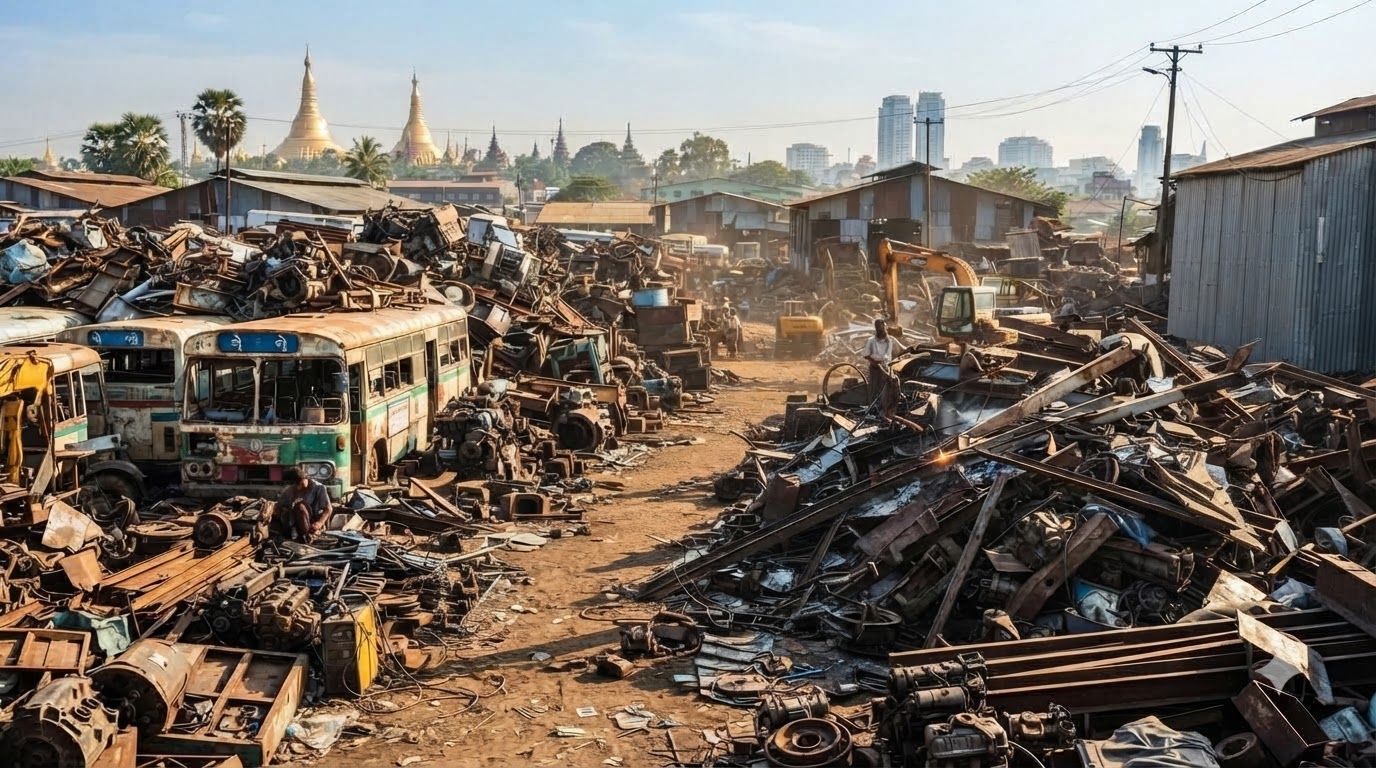
- Intermediate Aggregation: Urban scrap yards aggregate materials, performing manual sorting, torch-cutting, and basic mechanical baling.
- Industrial Processing & Export: Formal recycling operations shear heavy scrap into standardized sizes, package stainless steel grades, and prepare containerized shipments for maritime export.
Strategic Challenges and Sector Outlook
Key Market Challenges
- Regulatory and Trade Controls: Importers and exporters must navigate changing trade rules, foreign exchange regulations, and import/export licensing constraints.
- Infrastructure and Logistics Bottlenecks: Limited automated sorting facilities and high inland transport costs reduce net profit margins for scrap aggregators operating outside major port cities.
- Commodity Price Volatility: Local scrap collection rates remain sensitive to shifts in global steel prices and regional demand fluctuations across South and Southeast Asia.
Strategic Outlook
Driven by regional urbanization, expanding construction activity, and steady demand for secondary raw materials in neighboring markets like India, Myanmar’s scrap market is set to remain an active trading link within Asian secondary metal networks. Recyclers that invest in standardized sorting, formalize collection channels, and maintain direct export relationships will be best positioned to capture value from domestic scrap streams.