

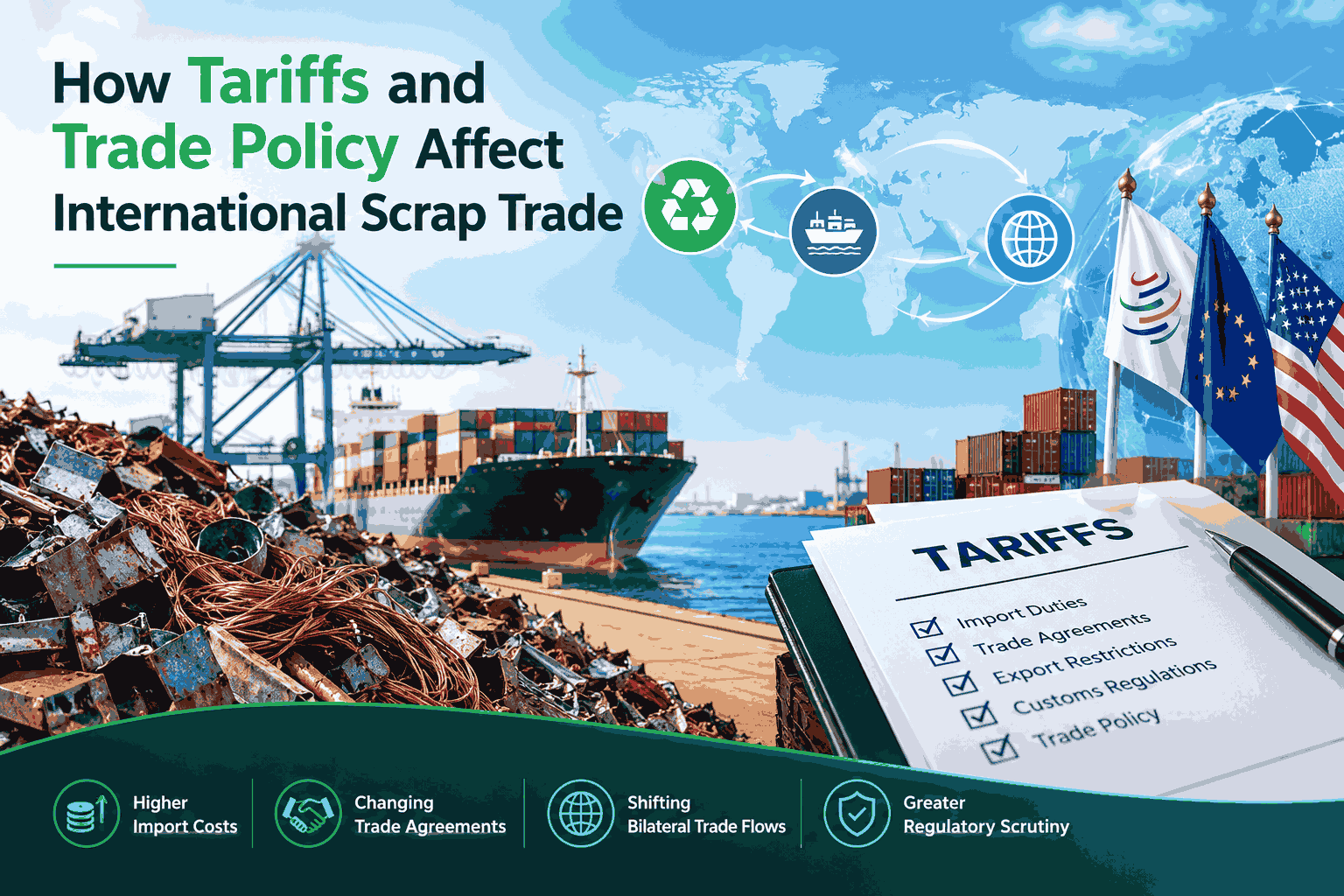
International scrap metal trading connects recyclers, manufacturers, processors, exporters, and buyers across different markets. However, a deal that looks commercially attractive can become less profitable when tariffs change, import restrictions are introduced, or customs requirements affect the movement of material.
Trade policy influences the cost of moving scrap across borders, the markets that businesses can access, and the specifications buyers require. For traders working with copper, aluminium, steel, paper, plastics, and other recyclable materials, understanding these measures is an important part of managing international transactions.
Tariffs are only one part of the picture. Export duties, quotas, licensing requirements, customs classifications, technical standards, and environmental controls can also influence whether a shipment is permitted and commercially viable.
This guide explains how trade policy affects international scrap trading, how businesses can respond to changes, and where traders can find reliable information before committing to a deal.
Why Trade Policy Matters to Scrap Traders
Scrap is an internationally traded industrial resource. Manufacturers may source recyclable materials from overseas suppliers, while recycling businesses may sell recovered material to buyers in other countries. The commercial viability of these transactions depends partly on the rules governing cross-border trade.
A tariff can increase the cost of importing a material. An export restriction can limit the quantity available to overseas buyers. A change in customs classification can affect the duty calculation, while additional documentation or inspection requirements can influence delivery times and operating costs.
These measures can affect both sides of a transaction. An importer may face higher landed costs, while an exporter may need to reconsider the destination market or renegotiate commercial terms with a buyer.
Trade policy can also influence competition between domestic and imported materials. Depending on the measure and market conditions, buyers may adjust their sourcing strategies, compare alternative suppliers, or look for different material grades.
The effect is not identical for every scrap category. A measure applying to one product classification may not apply to another, even when the materials appear similar. Traders should therefore check the exact product description, classification, origin, destination, and transaction date rather than relying on general statements about a country's scrap trade policy.
Types of Policy That Affect Scrap Flows
Several types of government measures can influence international scrap metal trading. Their purpose, legal basis, and commercial effect vary.
Tariffs and Customs Duties
A tariff is a customs duty imposed on imported goods. It may be calculated as a percentage of customs value, as a fixed amount per unit, or through another applicable method.
Tariffs can affect the landed cost of imported scrap and the price an overseas buyer is willing to pay. However, the actual duty depends on the applicable tariff schedule, product classification, country of origin, trade agreement eligibility, and other relevant rules.
The World Trade Organization (WTO) provides official tariff information through its Tariff and Trade Data platform. The platform distinguishes applied rates from bound rates, which represent members' tariff commitments.
Export Duties and Restrictions
Some jurisdictions may use export duties, licensing rules, quotas, or other measures affecting particular materials. These policies can change the economics of selling scrap overseas by affecting export costs, permitted quantities, or access to a destination market.
The existence and scope of such measures must be checked for the specific material and jurisdiction. Traders should not assume that a rule applying to one metal or waste category automatically applies to all scrap.
Import and Export Quotas
A quota limits the quantity or, in some cases, the value of goods that may be imported or exported under a particular arrangement. Depending on its design, a quota can restrict the number of shipments or affect the timing of transactions.
The WTO describes quantitative restrictions, including quotas and certain licensing measures.
Where a quota applies, traders may need to confirm whether the relevant allocation is available and whether additional approvals are required before entering into a binding supply commitment.
Import Standards and Licensing
Scrap shipments may also be affected by product specifications, customs documentation, inspection requirements, environmental controls, and licensing procedures. Requirements can differ according to the material's composition, condition, contamination, processing level, and intended use.
For example, a shipment of clean, separated metal may be classified differently from a mixed material stream or a load treated as waste under the applicable rules. The correct classification should be confirmed rather than inferred from a commercial description alone.
The World Customs Organization explains that the Harmonized System provides an international framework for classifying traded goods, while the final tariff classification is determined under the relevant national tariff schedule.
How Policy Changes Shift Demand and Pricing
Trade policy can affect scrap prices through several connected channels, but the direction and size of the impact depend on the material, market conditions, and details of the measure.
Landed costs: If an applicable import duty increases, the buyer's total cost may rise. The buyer may respond by negotiating a lower purchase price, seeking alternative suppliers, or adjusting the quantity purchased. The effect depends on how the cost is shared across the transaction.
Buyer demand: Import restrictions or additional compliance requirements can reduce the number of buyers able or willing to purchase a particular material. Alternatively, buyers in markets with fewer restrictions may become more attractive to exporters, provided the shipment is permitted and logistics remain commercially viable.
Export availability: Export duties or quantity limits can affect the volume of material available to international buyers. This may change sourcing patterns or encourage domestic processing, depending on the policy and local market conditions.
Supplier competition: If a market becomes more expensive or difficult to access, buyers may compare suppliers in other eligible origins. Yet changing suppliers does not automatically eliminate costs or restrictions; rules of origin, transport expenses, and destination requirements still matter.
Contract risk: A policy change between the date of quotation and shipment can affect a transaction's costs or feasibility. Contracts should clearly address responsibility for duties, customs clearance, compliance documents, and any agreed process for dealing with material changes to trade requirements.
Tariffs should not be treated as the sole explanation for price movements. Global reference prices, exchange rates, freight, energy costs, inventory, manufacturing demand, and material quality can also influence the final offer. Traders should evaluate these factors together.
Examples of How Traders Typically Respond
The following are illustrative business scenarios, not reports of current restrictions in any particular country.
Scenario 1: An import duty changes. A buyer discovers that the applicable duty for a planned shipment has changed. Before confirming the order, the buyer recalculates the landed cost, reviews the purchase price, and discusses revised commercial terms with the seller. If the transaction is no longer viable, both parties may consider another eligible market.
Scenario 2: A shipment requires additional approval. An exporter learns that the material classification or destination rules require an additional licence or document. The exporter pauses dispatch, confirms the requirement with the relevant authority or customs professional, and updates the shipment schedule. This can help avoid a shipment being delayed or rejected.
Scenario 3: A preferred route becomes less attractive. A trader finds that duties, freight, or other costs have changed the economics of a destination market. The business compares other potential buyers, taking into account applicable import rules, delivery costs, payment terms, and demand for the specific grade.
Scenario 4: A buyer requests a different material specification. A buyer's compliance or processing requirements make a particular mixed load unsuitable. The seller may review sorting, documentation, or material preparation options, but should confirm acceptance criteria before spending money on additional processing.
Across these scenarios, the consistent principle is to verify the applicable rules early, calculate the full transaction cost, and avoid treating an unconfirmed market opportunity as a guaranteed sale.
How ScrapTrade Helps You Reach Buyers in New Markets
A global marketplace can help scrap businesses discover potential buyers and compare opportunities across different markets. However, finding a buyer is only one part of a successful international transaction. Sellers and buyers must still confirm that the material can be traded lawfully and that the complete deal makes commercial sense.
ScrapTrade connects businesses interested in buying and selling scrap materials through an online B2B marketplace. Sellers can present available material, while buyers can review listings and communicate their requirements. ScrapTrade does not take ownership of the material or act as the buyer or seller.
When listing scrap for international trade, provide a clear material description, grade where known, quantity, location, photographs, and relevant specifications. Before agreeing to an order, discuss delivery arrangements, payment terms, required documents, and the responsibilities each party will assume.
Use the marketplace to explore potential buyers, then complete the necessary checks for the proposed route and destination. You can explore the ScrapTrade marketplace or register to trade.
The aim is to build a wider set of commercial options while making decisions based on verified requirements, realistic costs, and suitable counterparties.
FAQs
What are scrap metal tariffs?
Scrap metal tariffs are customs duties that may apply when specified scrap materials are imported into a country. The rate and calculation method depend on the applicable tariff classification, origin, destination, and current rules.
Do all countries apply the same tariffs to scrap metal?
No. Tariffs and other trade requirements differ across jurisdictions and may vary by material classification, origin, trade agreement, and destination. Traders must check the relevant official tariff schedule for each transaction.
What is the difference between an import tariff and an export duty?
An import tariff is a duty imposed on goods entering a market. An export duty is a charge imposed on specified goods leaving a jurisdiction. Whether either measure applies depends on the relevant rules in force.
Can trade policy changes affect scrap metal prices?
Yes. Policy changes can affect landed costs, buyer demand, supply availability, and the attractiveness of different markets. However, their impact depends on the specific measure and other factors such as freight, exchange rates, material quality, and broader market conditions.
Conclusion
Tariffs and trade policy can influence international scrap flows by changing landed costs, limiting access to certain markets, and creating additional documentation or licensing requirements. The effect varies by material, jurisdiction, and transaction, so businesses should avoid relying on general assumptions about what is permitted or commercially viable.
For scrap traders, the practical response is to verify current rules, confirm the correct classification, calculate total costs, and maintain clear agreements with buyers and sellers. Official customs authorities and recognised trade resources should be used to confirm requirements before a shipment is committed or dispatched.
ScrapTrade helps businesses connect with potential buyers and sellers in international scrap markets. Explore buyers in new markets, compare suitable opportunities, and verify the trade requirements before finalising your next deal.