
Comprehensive Market Analysis of Indonesia's Scrap and Recycling Sector: Industrial Feedstock Deficits, Regulatory Dynamics, and Value Chain Restructuring
Macro-Fundamental Drivers and Industrial Market Overview
The Indonesian scrap and recycling market is undergoing a structural transformation driven by rapid urbanization, industrial expansion, and national decarbonization imperatives. The market is projected to grow at a compound annual growth rate (CAGR) of 6.2% between 2025 and 2031. Growth is fueled by escalating material consumption across key downstream industries, notably building and construction, automotive manufacturing, and consumer appliance production. However, the market's growth trajectory is constrained by systemic supply chain bottlenecks, including elevated internal logistical costs across the archipelagic nation, material quality inconsistencies, and regulatory uncertainty.
Indonesia's broader circular economy strategy aims to decouple industrial manufacturing from primary raw material extraction, utilizing secondary ferrous and non-ferrous metals to reduce industrial emissions and lessen dependence on foreign primary commodities. In the non-ferrous segment classified under the Indonesian Standard Industrial Classification (KBLI) code 24202—processing activities encompass brass, aluminum, zinc, copper, tin, and rare earth metals. Foreign commercial entities, such as Marubeni Corporation, maintain an operational presence in the country to trade non-ferrous ingots and engage in the multi-metal recycling of ferrous, non-ferrous, and rare metals.
Despite growing private-sector involvement, the industry operates under a dual mandate that creates structural friction. The Ministry of Industry (Kemenperin) advocates for relaxed import controls to secure affordable raw materials for local manufacturing, whereas the Ministry of Environment and Forestry (KLHK) enforces strict environmental protection standards to prevent foreign waste dumping. This policy divergence directly affects raw material availability for major domestic industrial consumers.
| Industrial Parameter | Operational Metric / Value | Strategic Market Context | Primary Sources |
|---|---|---|---|
| Forecast Market Growth Rate (2025–2031) | 6.2% CAGR | Driven by urban construction, automotive, and appliance production | |
| National Ferrous Scrap Annual Demand | 9.0 Million Tonnes | Total raw material volume required for optimal domestic EAF steel production | |
| Annual Domestic & Imported Scrap Supply | 4.0 – 5.0 Million Tonnes | Structural feedstock deficit forcing raw material rationing in local mills | |
| Steel Industry Capacity Utilization Rate | ~40% | Severe underutilization caused directly by scrap feedstock shortages | |
| Target Capacity Utilization Post-Relaxation | 70% | Policy target to meet domestic finished steel demand and curb billet imports | |
| Billet Import Cost Differential | +$100 / Tonne | Cost premium paid for importing steel billets versus local scrap conversion | |
| Annual Trade Deficit Impact of Billet Imports | ~$400 Million | Foreign exchange drain resulting from importing ~4 million tonnes of billets |
Ferrous Scrap Economics and the Steel Capacity Crisis
Feedstock Shortages and Capacity Underutilization
The Indonesian ferrous recycling sector is closely linked to the health of the domestic steel industry, which relies on Electric Arc Furnace (EAF) technology. EAF steelmaking uses ferrous scrap as a primary input, offering lower energy consumption and reduced carbon emissions compared to blast furnace-basic oxygen furnace (BF-BOF) production routes. However, local steelmakers face a severe raw material shortage. The national steel industry requires approximately 9.0 million tonnes of ferrous scrap annually to operate at efficient output levels. Yet, total available supply combining domestic collection and foreign imports has historically hovered between 4.0 and 5.0 million tonnes per year, creating an annual supply deficit of 4.0 to 5.0 million tonnes.
This feedstock deficit forces domestic steel mills to operate at approximately 40% of their installed production capacity. The Indonesian Iron and Steel Industry Association (IISIA) notes that despite anti-dumping duties (BMAD) and Indonesian National Standards (SNI) designed to shield local producers from foreign steel imports particularly from China the lack of accessible scrap feedstock leaves domestic mills unable to achieve economies of scale. If raw material bottlenecks were resolved and mill capacity utilization increased to 70%, domestic manufacturers could fulfill over 70% of total national finished steel demand.
Economic Calculus of Billet Import Substitution
To compensate for the scrap deficit and maintain minimal plant operations, Indonesian steel producers import semi-finished steel billets rather than melting scrap locally. This structural substitution imposes a financial and macroeconomic burden. Converting domestic or imported scrap into steel billets locally is substantially cheaper than purchasing intermediate billets on the international market. Importing steel billets carries a cost premium of approximately $100 per tonne over domestic scrap-based billet conversion.
Given that Indonesia imports approximately 4.0 million tonnes of steel billets annually to bridge its meltshop deficit, this price differential generates an estimated trade balance penalty of $400 million per year.
$$\text{Annual Trade Deficit Drag} = \text{Billet Import Volume} \times \Delta \text{Unit Cost} = 4,000,000 \text{ tonnes} \times \$100/\text{tonne} = \$400,000,000$$
This foreign exchange drain inflates overall construction and manufacturing costs across the economy. Consequently, the Ministry of Industry has prioritized the relaxation of scrap import regulations as an intervention to lower intermediate production costs and improve national trade balances.
Trade Policy Architecture: Import Relaxation, Non-Tariff Controls, and Export Bans
Hazardous Waste Reclassification and Non-Tariff Import Controls
Historically, scrap metal imports into Indonesia were tightly restricted due to the inclusion of metal scrap on the national Hazardous and Toxic Waste (Batan/B3) list. Under B3 classifications, importers were subject to complex licensing, multi-agency approvals, and environmental clearance permits, which constrained foreign scrap inflows. To relieve feedstock constraints for local industry, the Indonesian government initiated policy reforms to remove non-hazardous scrap metal from the B3 list, aiming to streamline customs clearance and allow scrap imports to reach the target volume of 5.0 million tonnes annually.
However, the easing of B3 classifications has been counterbalanced by non-tariff regulatory mechanisms designed to prevent the country from receiving contaminated foreign waste. These regulatory friction points stem from past enforcement actions, such as the 2012 discovery of imported scrap shipments contaminated with asphalt, municipal garbage, hazardous chemicals, slag, oil filters, and electronic waste.
| Regulatory Measure | Primary Policy Mechanism | Operational & Supply Chain Impact | Primary Sources |
|---|---|---|---|
| Ministry of Trade Regulations No. 8 & 9 of 2025 | Effective March 10, 2025; updates prohibited export lists for iron, steel scrap, and marine sediments | Restricts raw metal scrap exports to enforce domestic downstream processing (hilirisasi) | |
| B3 Waste List Reclassification | Reclassifies non-hazardous metal scrap outside toxic waste categories | Streamlines import permits, targeting a raw scrap import threshold of 5.0 million tonnes | |
| Direct Shipment Mandate | Bans transshipment through intermediary regional ports (e.g., Singapore) | Requires direct routing from exporting nation to Indonesian ports, raising freight logistics costs | |
| Processor-Exclusive Permitting | Restricts import licenses to end-user manufacturing facilities | Excludes third-party brokers and scrap traders, reducing trading market liquidity | |
| Pre-Shipment Inspection Standards | Enforces "clean and homogenous" zero-contamination inspection thresholds via KSO-Sucofindo | Causes port-of-loading moratoriums, shipment rejections, and customs clearance delays |
To maintain environmental standards, the government imposed procedural requirements on international scrap supply chains. Importers must execute direct shipments from the country of origin to Indonesia, prohibiting transshipment through regional logistics hubs such as Singapore. Furthermore, policies restrict import permits primarily to licensed end-user processing facilities, limiting the role of non-processing brokers and independent scrap traders. Inspection guidelines require imported materials to be "clean and homogenous," which international industry bodies, including the Institute of Scrap Recycling Industries (ISRI), note has often been interpreted as a zero-contamination policy. Pre-shipment verification enforced by inspection bodies such as KSO-Sucofindo has occasionally resulted in import moratoriums, delaying scrap shipments and disrupting supply chain predictability.
Downstream Export Protectionism: Permendag No. 8 and No. 9 of 2025
While Indonesia has taken steps to ease scrap imports, it has simultaneously tightened controls on scrap exports to support its national downstreaming (hilirisasi) agenda. On March 10, 2025, the Ministry of Trade enacted Regulations (Permendag) No. 8 and No. 9 of 2025. Permendag 8/2025 revised the national list of prohibited exports across seven major sectors, placing strict prohibitions on the export of metal waste and scrap including iron and steel scrap as well as marine sedimentation products.
Permendag 8/2025 aims to retain secondary raw materials generated within Indonesia to feed local manufacturing rather than supplying foreign processing hubs. The regulation provides limited flexibility: mineral refiners that have constructed domestic smelting facilities but face operational delays due to force majeure events may receive temporary export relaxations, such as for copper concentrate with a minimum grade of 15% Cu. In parallel, Permendag 9/2025 established administrative mechanisms for restoring suspended export licenses once companies fulfill compliance obligations or resolve legal disputes.
This regulatory framework creates an asymmetrical trade environment. Indonesia restricts raw scrap exports to retain domestic resources while maintaining non-tariff controls on incoming imports. As a result, domestic scrap consumers remain vulnerable to raw material shortages whenever regulatory friction slows import flows.
Industrial Polymer Recycling Benchmarks: PlastiLoop Indonesia
The structural dynamics observed in Indonesia's metal scrap sector are mirrored in its polymer recycling ecosystem. Indonesia generates approximately 6.8 million tonnes of plastic waste annually. Due to underdeveloped municipal collection infrastructure, the country became a significant contributor to marine plastic pollution. In response, the Indonesian government established a National Action Plan to reduce ocean plastic leakage by 70%.
To achieve this target, the market has shifted toward capital-intensive, industrial-scale circular infrastructure. A major benchmark for this transition is the PlastiLoop Indonesia facility, located in the Pasuruan industrial zone in East Java. Established through a partnership between Veolia and Danone-AQUA, the plant represents the country’s largest integrated, food-grade polyethylene terephthalate (PET) recycling facility.
| Operational Benchmark | Facility Standard / Target | Industrial Context | Primary Sources |
|---|---|---|---|
| Annual Processing Capacity | 25,000 Tonnes (~1 Billion Bottles) | Converts post-consumer PET bottles into circular resins | |
| End-Product Quality Standard | Food-Grade & Halal-Certified rPET Pellets | Meets domestic food safety and cultural compliance requirements | |
| Decarbonization Impact | Up to 75% Carbon Emission Reduction | Reduces greenhouse gas footprint compared to virgin PET resin | |
| Informal Economy Integration | 4,000+ Collection Workers Supported | Formalizes waste collection networks and mandates ethical labor standards | |
| Direct Employment Creation | 225 – 250 Skilled Technical Jobs | Provides localized industrial employment in East Java |
The Pasuruan facility processes approximately 1.0 billion post-consumer PET bottles annually, producing 25,000 tonnes of food-grade recycled PET (rPET) pellets. Operating under Veolia’s PlastiLoop circular polymer brand, the plant integrates mechanical sorting, high-temperature washing, flaking, decontamination, and extrusion compounding to meet food-contact safety standards and local Halal certifications. Substituting primary virgin PET resin with these circular polymers reduces carbon emissions by up to 75%.
Securing a stable feedstock supply within a fragmented market required building an integrated collection network that formalizes informal waste pickers. The facility supports over 4,000 informal waste collectors, waste banks (Bank Sampah), and collection centers by providing technical training, personal protective equipment, and transparent pricing structures. Additionally, the program enforces social compliance standards to prevent child labor in its supply chain.
This model illustrates an operational framework relevant to the broader recycling market: industrial processing facilities in archipelagic economies require vertically integrated supply networks that formalize informal collection, establish regional aggregation hubs, and enforce quality sorting at the source.
Archipelagic Supply Chain Mechanics, Impurity Control, and Strategic Outlook
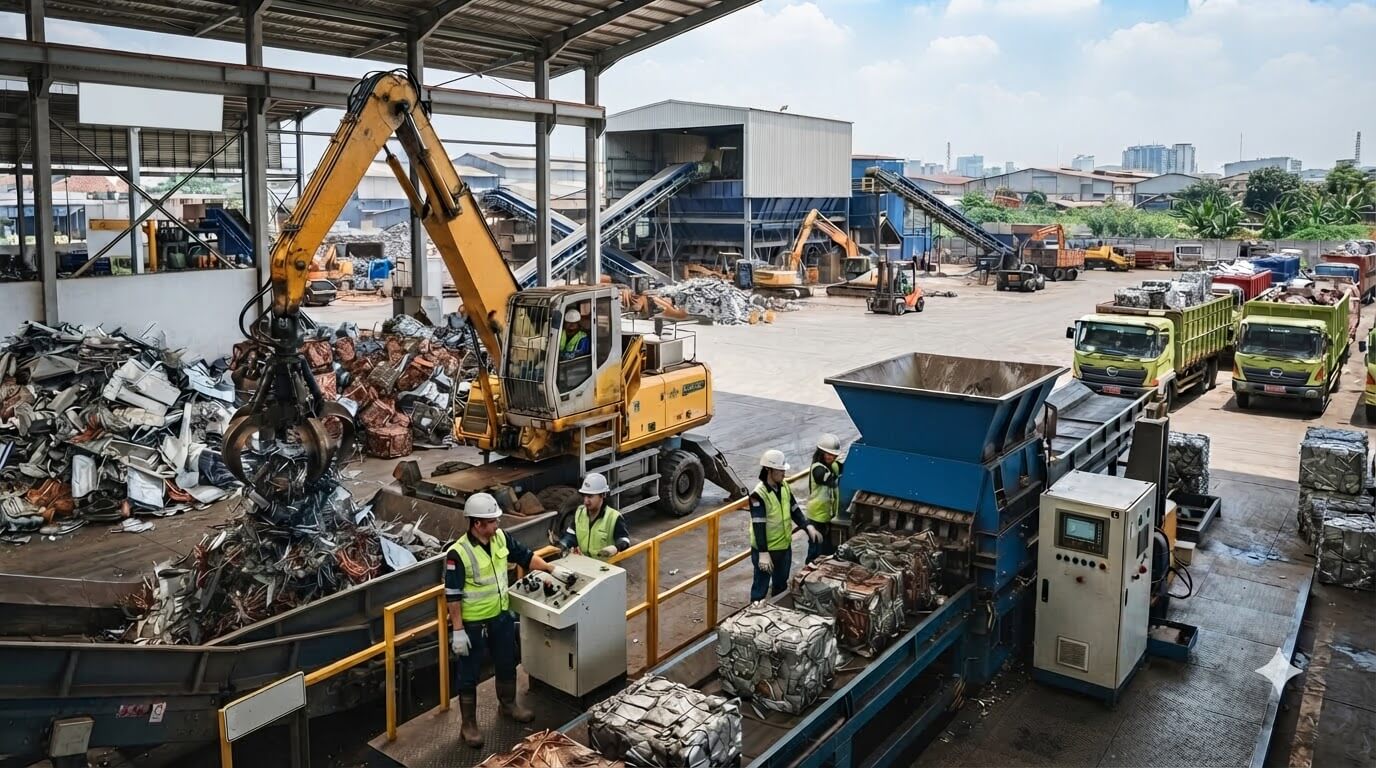
Indonesia's scrap metal supply chain spans domestic collection networks, regulatory compliance checkpoints, conversion facilities, and end-use manufacturing sectors. The value chain originates at point-of-generation sites, including demolition projects, end-of-life vehicles, industrial offcuts, and municipal waste streams. Domestic scrap flows through informal waste pickers, localized scrap yards, and regional consolidation centers before reaching melting plants. Concurrently, imported scrap enters through designated sea ports, where it undergoes pre-shipment inspections by KSO-Sucofindo to verify compliance with national purity standards. Once cleared, materials are processed by non-ferrous foundries under KBLI 24202 or melted in Electric Arc Furnaces to produce billets and ingots for construction, automotive, and industrial equipment manufacturing.
However, geographical fragmentation presents severe logistical challenges. Domestic inter-island shipping costs from outer islands such as Kalimantan, Sulawesi, or Papua to processing hubs on Java often exceed international maritime freight rates per tonne. This cost structure limits scrap collection in remote regions, resulting in resource underutilization and localized landfill disposal.
Metallurgical purity remains another critical operational challenge. Scrap collected outside formal channels often contains non-metallic contaminants, dirt, and mixed alloys. EAF steelmaking requires specific chemical compositions to maintain product quality; tramp element contamination, such as elevated copper content in ferrous scrap, causes structural flaws in finished steel. Without widespread adoption of automated shredding, eddy-current separation, and sensor-based sorting technologies, local processors struggle to achieve the consistency provided by international scrap suppliers.
To address these structural issues, policy and market adjustments are under consideration across the industry. Establishing standardized scrap grading metrics aligned with international specifications (such as ISRI standards) would provide clearer inspection guidelines, reducing customs delays while maintaining environmental protection. Furthermore, expanding national maritime transport links to offer freight subsidies for secondary materials could lower the cost of transporting scrap from outer islands to central processing facilities.
Finally, scaling formal partnerships between industrial processors and informal collector networks similar to models established in the polymer sector offers a pathway to stabilize domestic feedstock supplies. Combining technological upgrades in sorting infrastructure with formal collection networks can help Indonesia reduce its raw material deficit, decrease reliance on intermediate imports, and advance its circular economy objectives.