

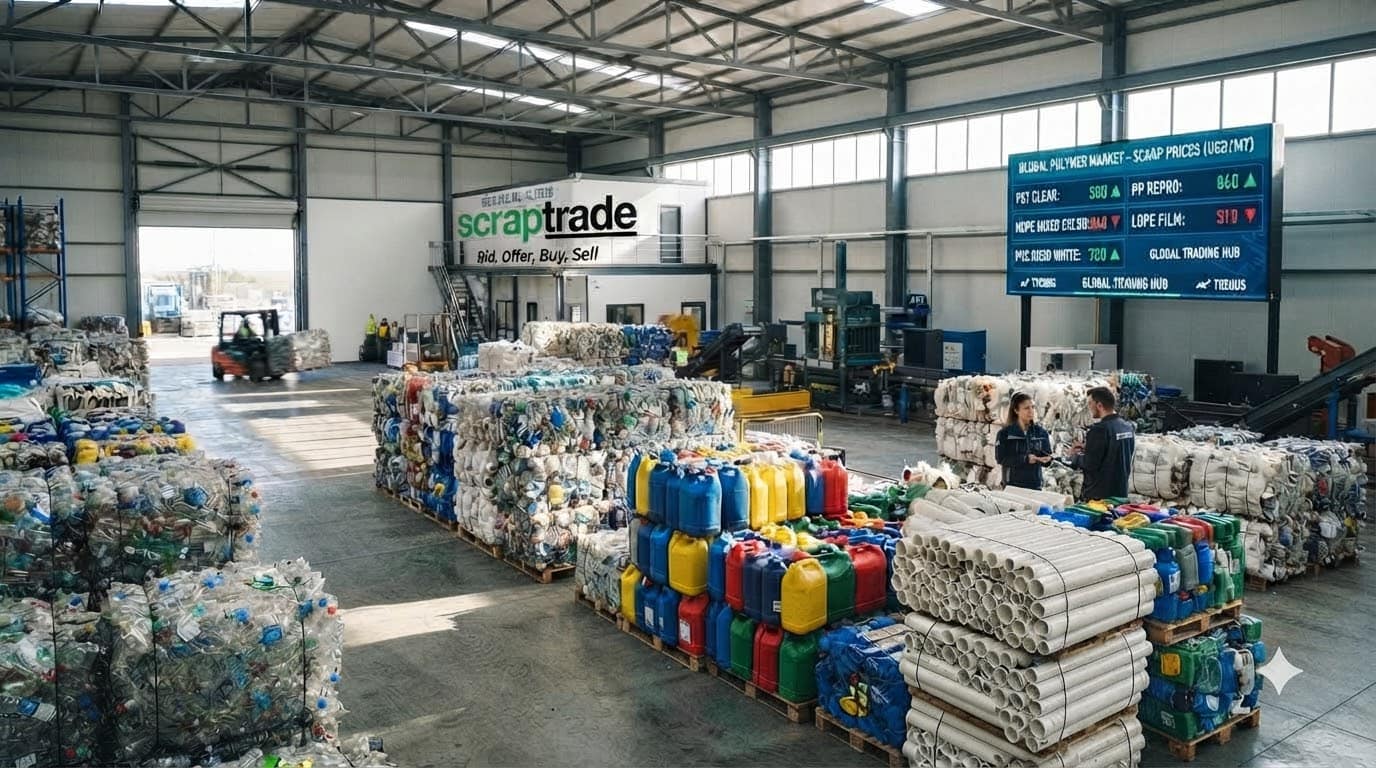
Plastic scrap can look like one waste category, but different plastics behave very differently during recycling. A clean stream of one polymer may be relatively straightforward to process, while mixed, contaminated or multilayer plastic can require much more complex treatment. This is why understanding plastic recycling types matters for manufacturers, recyclers, scrap traders and businesses selling plastic waste.
The two major approaches are mechanical and chemical recycling. Mechanical recycling generally processes plastic without fundamentally changing its polymer structure, while chemical recycling uses chemical or thermal processes to break polymers into smaller molecules or other feedstocks. Neither route is suitable for every plastic stream.
Why Plastic Recycling Is Complicated
Plastic products are made from different polymers, additives, colours, coatings and combinations of materials. Packaging may also contain multiple layers designed for strength, barrier protection or product preservation.
Common plastic polymers include:
- PET (polyethylene terephthalate): commonly used for beverage bottles, food packaging and other containers.
- HDPE (high-density polyethylene): used in containers, pipes, drums and various industrial products.
- LDPE (low-density polyethylene): frequently used in films, bags and flexible packaging.
- PP (polypropylene): used in packaging, automotive components, containers and household products.
- PVC (polyvinyl chloride): used in pipes, profiles, cables and other products.
- PS (polystyrene): used in packaging, containers and other applications.
These polymers have different melting behaviour, additives and processing requirements. Mixing them together can reduce the quality and commercial usefulness of recycled output.
Contamination creates another problem. Plastic scrap may contain food residue, dirt, labels, adhesives, metals, paper, moisture or other polymers. Before recycling, processors need to determine what they actually have.
This makes plastic scrap processing a combination of identification, sorting, preparation and material recovery rather than simply melting waste plastic.
Mechanical Recycling
Mechanical recycling is a physical processing route in which plastic waste is sorted, cleaned, reduced in size and processed into a form that can be used as secondary plastic feedstock.
The polymer generally remains a polymer rather than being chemically broken down into its constituent molecules.
Mechanical recycling is widely used for suitable plastic streams because the process can be integrated into established collection, sorting and plastics-processing systems.
Sorting, Washing and Shredding
The first stage is usually sorting.
Plastic scrap may be separated according to polymer type, colour, form, product source or other characteristics. Automated sorting technologies can assist with identification, while manual sorting may still be used for particular waste streams.
Once sorted, the material may undergo washing to remove dirt, food residues, labels, adhesives and other contaminants.
The cleaned plastic is then shredded or granulated into smaller pieces known as flakes.
A typical mechanical recycling workflow can therefore look like:
Collection → Sorting → Washing → Shredding → Screening → Drying → Further processing
The exact sequence depends on the material and recycling facility.
Clean, consistent feedstock is particularly important. A processor handling clear PET bottles, for example, may have very different specifications from a facility processing mixed post-consumer plastic.
Pelletising
After sorting, cleaning and size reduction, suitable plastic flakes can be processed through an extruder.
Heat melts the plastic, while the equipment controls the material flow and removes or manages certain impurities. The molten plastic can then be filtered and formed into strands or other shapes before being cut into pellets.
These recycled plastic pellets can be supplied to manufacturers as secondary raw material.
However, recycled pellets are not automatically equivalent to virgin resin. Their properties depend on the original feedstock, contamination, processing history, additives and the recycling process.
Buyers may therefore specify requirements for polymer type, colour, melt characteristics, contamination, moisture and other quality parameters.
Chemical Recycling
Chemical recycling takes a different approach.
Instead of primarily reshaping or remelting plastic, chemical recycling technologies seek to alter the polymer into smaller molecules, chemical feedstocks or other useful intermediates.
The term covers several different technologies, so it should not be treated as one single process.
How It Differs
Mechanical recycling generally keeps the polymer structure intact.
Chemical recycling can break down or transform polymer chains through processes such as depolymerisation, pyrolysis, gasification or other chemical or thermal methods, depending on the technology and feedstock.
For example, some depolymerisation processes are designed for particular polymers and can produce chemical building blocks that may be used to make new materials.
Pyrolysis can process certain plastic mixtures into hydrocarbon-rich products that may be further refined or used as feedstock, depending on the technology and product specifications.
The important distinction is that chemical recycling is focused on transforming the material at a chemical level rather than simply sorting, cleaning and remelting it.
Current Limits
Chemical recycling is a developing field, and its suitability varies significantly by technology, plastic type and operating conditions.
Several challenges remain important:
Feedstock quality: Chemical processes still need appropriate input material. A process designed for a particular polymer or waste stream may not perform the same way with heavily contaminated or mixed plastic.
Pre-treatment: Sorting, shredding and contaminant removal may still be necessary before chemical processing.
Infrastructure: Chemical recycling facilities require specialised equipment, process controls and downstream systems for handling the resulting products.
Economics: The commercial viability depends on feedstock costs, collection, transportation, energy, processing, product markets and regulatory requirements.
Product quality: The output must meet the specifications of the intended industrial application.
Because the field continues to develop, claims about environmental performance, commercial scale or recycling efficiency should be evaluated against current, independently verifiable sources rather than assumed from the name of the technology alone.
Which Plastics Suit Which Route
There is no universal rule that assigns every plastic to one recycling method. Suitability depends on polymer type, contamination, additives, product design and available processing technology.
| Plastic or feedstock | Mechanical recycling | Chemical recycling |
|---|---|---|
| Clean PET bottles | Commonly suitable | Certain specialised processes may apply |
| Clean HDPE | Commonly suitable | Possible depending on technology |
| Clean PP | Commonly suitable | Possible depending on process |
| LDPE film | Possible when sufficiently clean and sorted | Some technologies may process suitable feedstock |
| PVC | Requires careful handling due to chlorine content | Technology-specific and process-dependent |
| Polystyrene | Mechanical routes may apply | Certain chemical routes are being developed |
| Mixed plastics | More difficult due to polymer incompatibility | Some technologies are designed for selected mixed streams |
| Multilayer packaging | Often difficult to mechanically recycle | Certain advanced processes may be considered |
This table is a general guide rather than a specification for accepting material. Buyers should always confirm the exact polymer and contamination requirements of their recycling process.
A major commercial distinction is whether the material is mono-material or mixed.
A clean stream containing predominantly one polymer can be easier to sort and process. Mixed plastic may require additional separation or a recycling route designed specifically for mixed feedstock.
FAQs
What are the main types of plastic recycling?
The two broad approaches are mechanical and chemical recycling. Mechanical recycling sorts, cleans, shreds and processes plastic while generally retaining its polymer structure. Chemical recycling uses chemical or thermal processes to transform polymers into smaller molecules, feedstocks or other products.
Is mechanical recycling better than chemical recycling?
Neither method is universally better. Mechanical recycling can be suitable for clean, well-sorted plastic streams, while chemical recycling may offer options for certain feedstocks that are difficult to process mechanically. The appropriate route depends on polymer type, contamination, technology and economics.
What plastics are easiest to recycle mechanically?
Clean, well-sorted streams of polymers such as PET, HDPE and PP can be suitable for mechanical recycling. Actual acceptance depends on the recycling facility's equipment, specifications, contamination limits, colour requirements and intended recycled product.
What is chemical recycling of plastic?
Chemical recycling uses processes that transform plastic polymers into smaller molecules, chemical feedstocks or other products. Technologies include depolymerisation and certain thermal conversion processes. Different technologies work with different plastic feedstocks.
Conclusion
Plastic recycling is not a single process. Mechanical recycling remains an important route for suitable, clean and well-sorted plastic streams, while chemical recycling uses different technologies to transform selected plastic feedstocks into chemical intermediates or other products.
For plastic scrap sellers, the most important step is accurate material identification. Polymer type, contamination, form, colour, quantity and preparation can all affect buyer interest and processing suitability.
As recycling technologies develop, businesses should evaluate each plastic stream according to its actual composition and available market rather than assuming that every plastic can be processed in the same way.
If you have plastic scrap to sell, explore the ScrapTrade marketplace and connect with businesses looking for recyclable materials.