

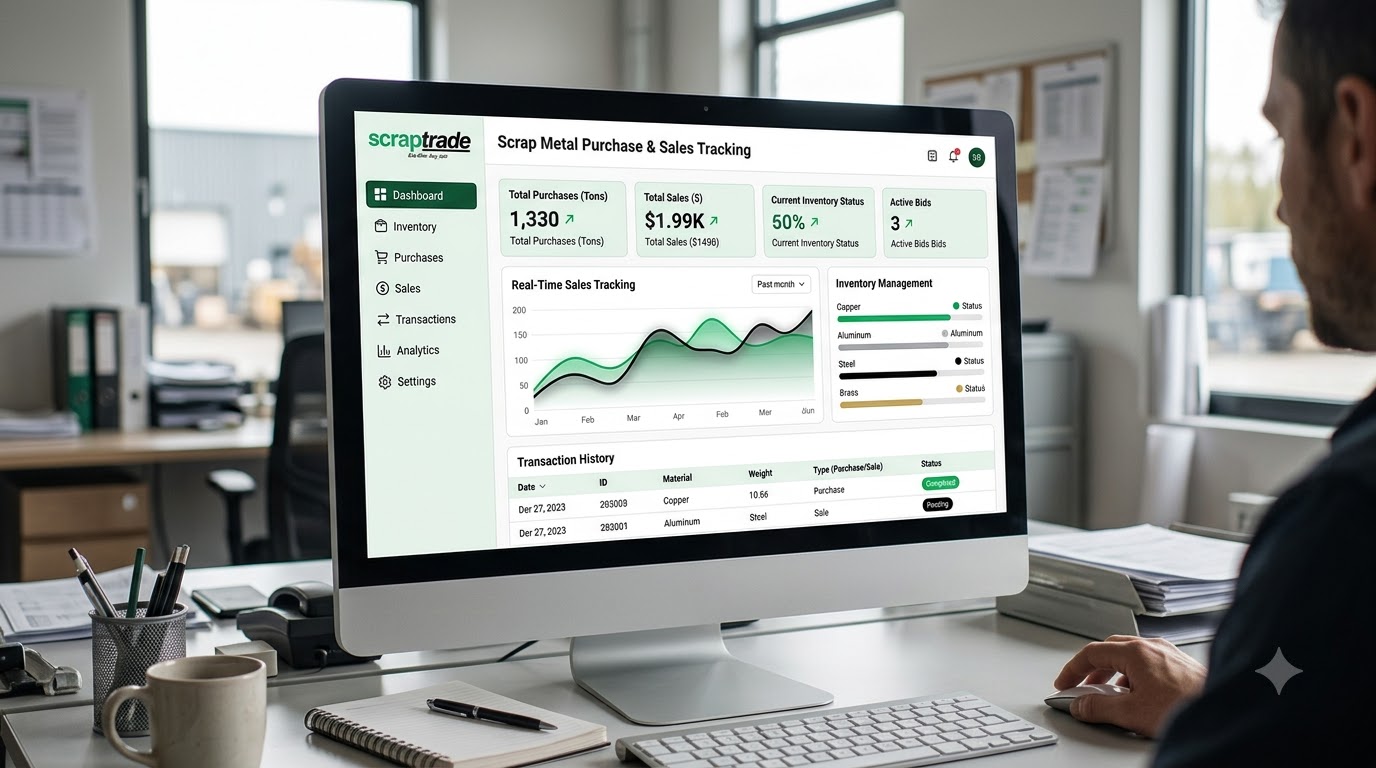
Scrap businesses manage a constant flow of material purchases, sales orders, supplier payments, buyer offers, weights, and invoices. When these records are scattered across spreadsheets, paper documents, emails, and messaging apps, it becomes harder to track transactions, confirm agreed prices, and understand the profitability of each deal.
Scrap purchase and sales software helps businesses organize these activities through digital records and structured workflows. Depending on the system, it can support supplier records, purchase entries, sales orders, transaction documentation, pricing information, and reporting.
For scrap yards, metal recyclers, scrap dealers, and industrial businesses, accurate purchase and sales records are important for controlling costs, reconciling quantities, monitoring customer transactions, and making better commercial decisions.
However, purchase and sales tracking is only one part of scrap business management. Operational software records transactions within a business, while an online scrap marketplace helps buyers and sellers discover trading opportunities and negotiate deals. Businesses may use both to support their operations and expand their trading networks.
Why Scrap Businesses Need Digital Purchase and Sales Records
Scrap transactions involve several details that must remain consistent from purchase to final sale. These can include material type, grade, supplier, buyer, gross and net weight, purchase price, sales price, transport costs, processing expenses, and payment status.
When records are maintained manually across different systems, information can become incomplete or inconsistent. A purchase entry might show one weight while a stock record shows another. An invoice may refer to a different material description from the original supplier document. Sales staff may also struggle to confirm which price was agreed with a buyer.
Digital purchase and sales tracking provides a more organised way to record and retrieve this information.
A scrap metal sales management system can help businesses:
- Maintain records of purchases from suppliers.
- Track sales orders, buyer offers, and agreed terms.
- Record material grades, quantities, and prices.
- Organise purchase orders, invoices, and transaction documents.
- Review transaction costs and calculate margins.
- Compare purchase, sales, and inventory records.
The actual benefits depend on the software's capabilities and how consistently staff use it. A digital system cannot correct inaccurate source data automatically unless suitable validation and reconciliation controls are in place.
For businesses handling frequent transactions or multiple material categories, consistent digital records can provide better visibility into daily activity and help identify discrepancies earlier.
Recording Scrap Purchases From Suppliers
Purchasing is the starting point for many scrap trading operations. Every incoming load should have a record that explains what was purchased, from whom, in what quantity, and under which commercial terms.
A scrap purchase tracking system can organise these details in a consistent format.
Essential purchase information
Each purchase record should include the supplier's business details, transaction date, material description, grade where known, quantity, unit of measurement, agreed price, and total purchase value.
Depending on the transaction, businesses may also need to record vehicle details, weighbridge tickets, inspection results, contamination findings, transport charges, and payment status.
For example, when a scrap yard purchases a load of steel offcuts, the record should identify the supplier, the material description, the accepted weight, the agreed price basis, and any additional costs covered by the purchase agreement.
If the load is subject to inspection or final weighing, the system should distinguish estimated information from confirmed figures. This helps prevent preliminary quantities or prices from being mistaken for final settlement details.
Managing Sales Orders and Buyer Offers
Sales tracking begins when a business offers material to potential buyers and continues through negotiation, order confirmation, dispatch, invoicing, and settlement.
Scrap sales records software helps businesses maintain a structured record of these stages. The available features vary, so businesses should check whether a system supports the workflow they need.
Recording buyer enquiries and offers
When buyers enquire about available scrap, sales staff need to know which material is being discussed, the quantity requested, the proposed price, and any relevant conditions.
A transaction record can connect the enquiry to the material listing and preserve the details of each offer.
If multiple buyers submit offers, recording them separately helps staff compare the proposed terms. These may include price, required grade, quantity, collection arrangements, inspection requirements, and payment conditions.
The highest offer may not always represent the best commercial outcome. Transport responsibilities, quality conditions, settlement timing, and other expenses can affect the overall value of a transaction.
Confirming sales orders
Once the parties agree on a deal, the business should record the confirmed terms and identify any conditions that remain outstanding.
A sales order may include the buyer's details, material description, accepted quantity, price basis, delivery location, dispatch date, and payment terms.
If the final quantity or value depends on inspection or weighing, the record should indicate how the final settlement will be determined.
Keeping order confirmation separate from preliminary enquiries reduces the risk of treating an unaccepted offer as a completed sale.
Tracking order status
A useful sales workflow may track stages such as enquiry received, offer under review, terms agreed, order confirmed, material dispatched, invoice issued, and payment completed.
These status labels are examples rather than a standard workflow for every business. The important point is that staff can identify the current position of each transaction and the next action required.
This can help sales teams follow up on outstanding offers, prepare dispatches, and identify orders that need attention.
Tracking Material Quantity, Grade and Agreed Price
Quantity, grade, and price are central to scrap transaction management. Errors in any of these details can affect stock records, invoices, payments, and reported margins.
Recording material quantities
Scrap businesses should record weights using a consistent unit of measurement and identify whether a quantity is estimated or confirmed.
For weighbridge transactions, the record may include gross weight, tare weight, and calculated net weight. For smaller quantities, the business may use suitable platform scales or another agreed weighing method.
Where a buyer and seller use different weighing locations, the parties should agree in advance which measurement will determine settlement and how discrepancies will be handled.
Retaining weighbridge tickets or scale records helps support the recorded figures.
Maintaining accurate grade information
Material descriptions should reflect what was actually purchased or sold. Copper wire, insulated copper cable, mixed metal scrap, and aluminium extrusion scrap should not be treated as interchangeable categories simply because they contain related materials.
A digital system should allow businesses to use consistent material names and grade descriptions. If a grade is unconfirmed, the record should indicate that uncertainty until the material has been assessed.
Clear grade records can help businesses compare purchases and sales more accurately and reduce confusion when the same material passes through several stages of processing.
Recording agreed prices and revisions
The system should preserve the agreed price basis, such as price per kilogram or per tonne, along with the relevant currency and quantity.
If the parties revise the price after inspection or negotiation, the change should be documented with its effective date and reason.
Businesses operating across different markets may also need to track multiple currencies and distinguish exchange-rate effects from changes in material pricing.
Accurate price records provide the foundation for invoicing, reconciliation, and transaction-level margin calculations.
Calculating Gross Margin on Scrap Transactions
Purchase and sales records become more valuable when they can be used to evaluate the commercial performance of individual transactions.
A basic gross margin calculation compares sales revenue with the cost of the material sold. However, scrap businesses should distinguish between a simple material margin and a more complete transaction-level profit calculation.
For a straightforward example, suppose a business purchases a confirmed quantity of scrap for a total material cost of $8,000 and sells that same quantity for $10,000.
The basic gross profit on the material is:
Gross profit = Sales revenue − Cost of material sold
In this example:
$10,000 − $8,000 = $2,000
Gross margin as a percentage of sales revenue is calculated as:
Gross margin (%) = (Gross profit ÷ Sales revenue) × 100
Using the example:
($2,000 ÷ $10,000) × 100 = 20%
These figures are illustrative, not market prices or a typical margin for scrap trading.
The calculation assumes that the material cost associated with the sold quantity is $8,000. If a business purchased a larger load and sold only part of it, the cost of the quantity actually sold must be calculated appropriately.
A more complete transaction analysis may also consider freight, handling, processing, testing, storage, finance costs, and other expenses. Depending on the business's accounting policy, some of these costs may be classified separately rather than included in gross profit.
For this reason, a basic gross margin should not automatically be treated as net profit.
A useful scrap transaction management system should help users distinguish material purchase costs, sales revenue, and other expenses so management can understand where the transaction's value comes from.
Integrating Purchase and Sales Records With Inventory
Purchase and sales tracking becomes more useful when it connects with inventory records. Without this connection, businesses may know what they bought and sold but struggle to establish what remains in stock.
Inventory integration can link incoming purchases, internal stock movements, processing activities, and outgoing sales.
For example, when a business purchases a load of mixed metal scrap, the incoming record increases the relevant stock quantity once the material is accepted and recorded according to the business's procedure. If the material is subsequently sorted into separate categories, the inventory system should reflect the resulting stock movements.
When a sale is confirmed and the material is dispatched, the corresponding quantity should be deducted from the appropriate inventory category. Any difference between recorded and actual weight should be investigated and documented.
A connected workflow can help businesses identify:
- Material purchased but not yet sold.
- Stock allocated to confirmed orders.
- Differences between recorded and physical quantities.
- Materials requiring inspection or further processing.
- Sales that depend on stock not yet available.
- Outstanding purchase and sales transactions.
Integration can also reduce duplicate data entry when purchase records, sales orders, inventory, and accounting tools share information appropriately.
However, not all scrap purchase and sales software includes inventory management. Some systems focus on transaction records, while others provide broader operational features. Businesses should confirm which functions are built in and which require integration with separate software.
For companies seeking to expand their trading network, operational tracking can also complement an online marketplace. Internal systems help manage the business's records, while marketplaces help businesses discover potential buyers and sellers.
ScrapTrade's global scrap trading marketplace provides a digital channel for discovering scrap trading opportunities. It serves a different primary purpose from software designed to manage internal inventory and accounting records.
FAQs
What is scrap purchase and sales software?
Scrap purchase and sales software helps businesses record material purchases, sales orders, agreed prices, quantities, supplier and buyer details, invoices, and transaction status. Features vary by provider.
How does a scrap purchase tracking system help scrap yards?
It creates consistent records of incoming material, supplier details, accepted weights, grade descriptions, purchase values, and adjustments. This can support reconciliation and make it easier to review historical transactions.
Can scrap sales management software track buyer offers?
Some systems support buyer enquiries, offer records, negotiations, and order status. Other systems focus mainly on completed sales and invoicing. Check the available features before choosing software.
How do scrap businesses calculate gross margin?
A basic gross profit calculation subtracts the cost of material sold from sales revenue. Gross margin divides that gross profit by sales revenue and multiplies the result by 100. Other expenses may need to be analysed separately to understand the full profitability of a transaction.
Conclusion
Scrap metal purchase and sales tracking software helps businesses organise supplier purchases, buyer offers, sales orders, material quantities, agreed prices, invoices, and transaction records. Consistent digital records can make reconciliation easier, improve visibility into outstanding transactions, and support more informed commercial decisions.
For scrap yards, dealers, and recyclers, connecting purchase and sales records with inventory can provide a clearer view of material movements and the quantities available for sale. Tracking transaction costs alongside revenue can also help management evaluate gross margins more accurately.
The right software depends on the business's requirements. Some companies need dedicated operational systems for inventory, purchasing, sales, and accounting. Others also need a marketplace to discover new buyers and suppliers.
ScrapTrade helps businesses explore potential trading opportunities through its global online scrap marketplace. By combining effective internal recordkeeping with suitable digital trading channels, scrap businesses can improve transaction visibility while expanding their potential network of trading partners.