

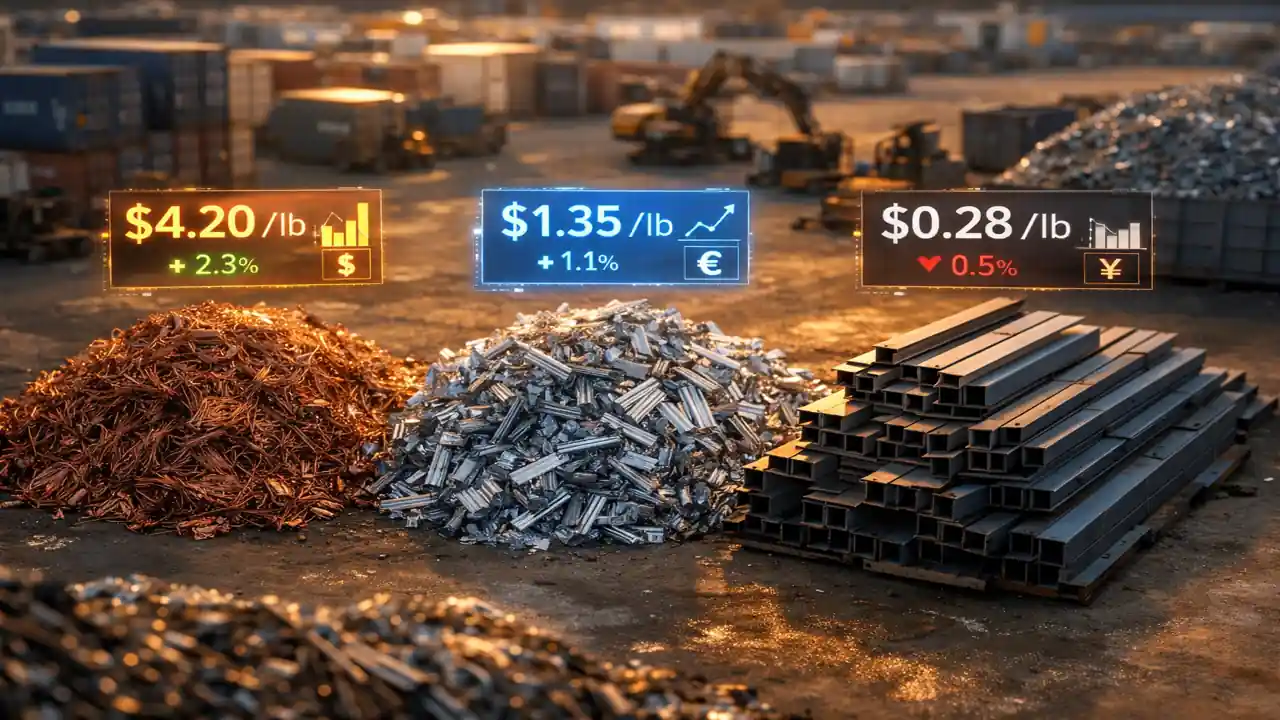
Global Secondary Metal Markets: A Comprehensive Analysis of Scrap Pricing Dynamics, Industrial Transitions, and Regulatory Frameworks in April 2026
The global secondary metals market in April 2026 is characterized by an intricate convergence of macroeconomic stabilization, heightened geopolitical risk, and the accelerating transition toward low-carbon industrial production. Scrap metal, once viewed primarily through the lens of cyclical waste management, has definitively transitioned into a strategic industrial asset, essential for the viability of the "Green Steel" movement and the broader circular economy.1 As primary extraction costs remain elevated due to energy volatility and ESG mandates, the valuation of secondary feedstocks—ranging from heavy melting scrap (HMS) to high-purity non-ferrous alloys reflects a complex interplay of regional supply constraints and structural demand shifts.1
The pricing landscape in early April 2026 exhibits notable regional divergence. While Turkish benchmarks for ferrous scrap have reached 20-month highs, the North American market signals a cautious bearish tilt, and the Chinese market remains relatively stagnant amid a slow recovery in the construction sector.4 These localized fluctuations are underpinned by global factors, including the implementation of the European Union’s Carbon Border Adjustment Mechanism (CBAM), fluctuating interest rate expectations, and the persistent influence of the US dollar on international trade flows.1
Global Ferrous Benchmarks and Futures Market Analysis
The London Metal Exchange (LME) Steel Scrap CFR Turkey (Platts) remains the foundational benchmark for global ferrous scrap trade, providing a transparent price discovery mechanism for the international movement of HMS 1&2 (80:20). In early April 2026, the market demonstrated remarkable stability in the forward curve, even as spot volatility persisted in certain regions.9
LME Steel Scrap CFR Turkey (Platts) Forward Curve (April 2026 – June 2027)
| Contract Month | Closing Price (USD/MT) | Market Sentiment |
| April 2026 | 415.00 | Neutral |
| May 2026 | 415.00 | Neutral |
| June 2026 | 414.50 | Mild Bearish |
| July 2026 | 413.50 | Bearish |
| August 2026 | 414.00 | Consolidation |
| September 2026 | 417.50 | Bullish |
| October 2026 | 418.50 | Bullish |
| November 2026 | 419.00 | Seasonal Peak |
| December 2026 | 416.50 | Correction |
| January 2027 | 416.50 | Stable |
| February 2027 | 417.50 | Recovery |
| March 2027 | 417.50 | Stable |
| April 2027 | 417.50 | Stable |
| May 2027 | 417.50 | Stable |
| June 2027 | 417.50 | Stable |
9
The stability of the LME forward curve through mid-2027 suggests that institutional participants have largely factored in the anticipated capacity expansions in Electric Arc Furnace (EAF) steelmaking across North America and Europe.9 However, the immediate spot market reflects more acute pressures. Turkish prices for key scrap grades rose by 3.9% over a recent five-week period, reaching their highest levels since mid-2024.4 This upward momentum is driven by a combination of limited scrap availability in traditional exporting regions—specifically Europe and the United States—and rising logistical costs, including freight and insurance premiums exacerbated by geopolitical tensions.1
Turkish steel mills have attempted to resist these higher scrap prices, citing poor demand for finished rebar and compressed margins. However, the lack of cheap Asian alternatives and the depletion of yard inventories following winter disruptions in the Northern Hemisphere have maintained a firm floor for scrap valuations.4 This tension between mill resistance and supply-side constraints defines the current Turkish benchmark, which serves as a barometer for global ferrous liquidity.
Regional Ferrous Market Dynamics
The regional performance of ferrous scrap markets in April 2026 highlights a significant decoupling between major industrial hubs. While global benchmarks provide a baseline, local conditions—ranging from weather events to specific manufacturing schedules—dictate the actual transactional value of scrap material.4
North American Ferrous Outlook
In the United States, the ferrous scrap market entered April 2026 with a softened outlook. Market indicators suggest a 3.1% month-on-month decline in scrap prices, following a period of relative stagnation.5 This bearish sentiment is encapsulated by the Trend Indicator, which posted a reading of 46.9, falling below the neutral 50 threshold.5 Perhaps more significant is the consensus reading of 47.0—the lowest ever recorded—indicating a profound lack of agreement among market participants regarding the short-term direction of prices.5
| Indicator | April 2026 Reading | Status |
| Overall Trend Indicator | 46.9 | Bearish Tilt |
| Buy-Side Sentiment | 40.7 | Weak |
| Broker/Seller Sentiment | 50.0 | Neutral |
| Inventory Assessment | 49.0 | Near Normal |
| Consensus | 47.0 | High Uncertainty |
5
The disparity between buyer and seller sentiment in the US is a critical factor. Consumers (mills) are more cautious about near-term pricing, influenced by concerns over the pace of finished steel absorption in the automotive and construction sectors.5 Conversely, sellers and brokers appear to expect little change in underlying supply-demand conditions, viewing current price levels as sustainable despite the slight downward pressure.5
Logistics also play a transformative role in US scrap valuations. The Midwest industrial corridor remains the primary generator of ferrous scrap, producing roughly 40% of the national volume.11 However, the expansion of EAF capacity in the Southeast and coastal regions necessitates long-distance transport, making the market highly sensitive to freight inflation and infrastructure bottlenecks.1
European Union and German Stabilization
The European market, led by Germany and Italy, exhibited a stabilizing trend in early 2026 after a period of volatility. German scrap prices fell by 1.3% in early spring as the supply constraints seen during the winter months began to fade.4 The Italian market, despite a brief uptick in offers, has largely remained stable, with steelmakers successfully resisting further price hikes.4
The European landscape is increasingly dominated by the impending impact of CBAM and the structural shift toward high-quality scrap.4 While the supply of lower-grade scrap is adequate, there is a persistent shortage of high-quality, low-residual material required for sophisticated EAF operations.4 This qualitative deficit is prompting some European mills to adjust production plans, leading to a "wait-and-see" phase in the market.4
China: Sluggish Demand and Environmental Constraints
The Chinese scrap market remains remarkably quiet, with prices showing minimal volatility.4 Despite a temporary supply-demand mismatch following the Lunar New Year, a sustained upward trend has failed to materialize.4 The primary constraint remains the slow recovery of the construction sector and a lack of new infrastructure projects, which has stifled demand for finished steel and, consequently, the secondary materials needed to produce it.4
Furthermore, environmental restrictions continue to impact Chinese production sentiment. Mills have sharply reduced crude steel production to levels not seen since early 2024, partly due to local environmental mandates and partly as a response to weak margins and high stocks.6 This cautious approach to production has kept scrap consumption low, with import markets appearing even weaker as Japanese offers remain uneconomical for Chinese buyers.4
Non-Ferrous Scrap Markets: Copper and Aluminum Volatility
Non-ferrous scrap categories have demonstrated significantly more dynamic price behavior than ferrous metals in 2026, driven by the structural demands of the global energy transition and localized supply disruptions.1
Copper Scrap: The EV and Electrification Driver
Copper scrap prices saw substantial gains in March and early April 2026. In China, key categories such as #1 Copper Bare Bright and #1 Copper Wire and Tubing rose by 1,400 yuan per metric ton in late March.13 In North America, copper scrap prices moved higher by approximately 0.52% to 0.54% weekly during early March, supported by improved market sentiment and industrial consumption.14
The fundamental driver for copper remains the electrification of the automotive sector. Electric vehicles (EVs) require approximately four times the copper content of traditional internal combustion engine vehicles, making high-purity copper scrap a critical resource.8 As of April 6, 2026, US prices for #1 Bare Bright Copper—a premium grade used in high-efficiency electrical applications—reached roughly $4.70 per pound.16
Comparative Copper Scrap Prices (North America - April 6, 2026)
| Category | Price (USD/lb) | Application/Origin |
| #1 Bare Bright Copper Wire | 4.70 | Electrical Stripped |
| #1 Copper Tubing/Flashing | 4.40 | Plumbing/Industrial |
| #2 Copper Tubing/Bus Bar | 4.15 | Mixed Rip-outs/Paint |
| #3 Roofing Copper | 3.95 | Decorative/Solar |
| Insulated Cable (84-88% ICW) | 3.25 | Heavy Power Lines |
| Romex® Wire (64-68% ICW) | 2.40 | Residential/Comm |
16
The premium for bare bright wire reflects its value in the "circular" manufacturing process, where it can be melted directly back into new wire rod with minimal processing costs.15 In India, copper scrap trades at 85-90% of the cathode price, which is directly linked to London Metal Exchange (LME) movements.15
Aluminum Scrap and Trade Policy Impact
Aluminum scrap prices have also trended upward, albeit at a more moderate pace than copper. In the United States, aluminum prices have been bolstered by aggressive trade policies, with tariffs on aluminum products rising to 25% in early 2026 and potentially reaching 50% for derivative products by mid-year.17 These measures are designed to support domestic smelters but have increased the cost basis for recyclers and end-users.17
The automotive industry’s shift toward lightweighting remains the primary structural tailwind for aluminum. Modern EVs utilize roughly 250 kg of aluminum per vehicle, representing a 30-40% increase over conventional cars.17 This has led to strong demand for 6063 extrusions and aluminum rims, which are preferred for their consistent alloy composition.16
Comparative Aluminum Scrap Prices (North America - April 2026)
| Category | Price (USD/lb) | Price (USD/MT) | Change |
| E.C. Aluminum Wire | 1.34 | 2,954 | +3.92% |
| 6063 Extrusions | 1.15 | 2,535 | +2.73% |
| UBC (Used Beverage Cans) | 0.89 | 1,962 | +3.06% |
| Old Cast Aluminum | 0.97 | 2,138 | +3.09% |
| Aluminum Rims (Clean) | 0.85 | 1,874 | Stable |
| Aluminum Siding/Gutters | 0.75 | 1,653 | Stable |
14
The sharp increase in E.C. Aluminum Wire prices (+3.92%) highlights the market's preference for high-conductivity grades that are easily reintegrated into electrical infrastructure projects.14
The Indian Market: A Global Scrap Hub
India occupies a unique position in the global secondary metals landscape, serving as both a major importer of high-grade scrap and a massive generator of domestic material through ship-breaking and industrial manufacturing.12 The Indian market is highly regionalized, with pricing hubs in Ahmedabad, Mumbai, Alang, and Delhi reflecting specific local industrial clusters.19
Alang and the Ship-Breaking Sector
The Alang ship-breaking yard in Gujarat is a global center for maritime recycling, providing a steady stream of ship-cutting plate and HMS 80:20 scrap for the regional steel industry.12 As of April 3, 2026, ship-cutting plate at Alang was priced at ₹37,300 per metric ton.19
The stability of the Indian ship-breaking market is crucial for the western and southern rebar manufacturing hubs, which rely on this scrap as a primary feedstock.12 Despite global steel market volatility, domestic demand in India has remained strong, supported by robust infrastructure spending and a surge in construction activities across Asia and the Middle East.6
Indian Scrap and Finished Metal Rates (April 2026)
| Location/Product | Size/Grade | Price (INR/MT) | Change |
| Mumbai: Melting Scrap | HMS (80:20) | 35,700 | 0 |
| Alang: Ship-cutting Plate | HMS (80:20) | 37,300 | -200 |
| Mumbai: Rebar (BF Route) | 12-32mm | 60,600 | +600 |
| Mumbai: HRC Index | 2.5-8mm | 59,700 | +200 |
| Raipur: Sponge Iron (PDRI) | Lumps | 27,250 | +200 |
| Raipur: Billet Index | 100x100mm | 42,950 | +100 |
| Delhi: Copper Armature | Cu 99% | 1,122,000 | 0 |
| Delhi: Aluminum Tense | Solid (Loose) | 272,000 | 0 |
19
The moderate price increases in rebar and billets (+600 and +100 INR/MT respectively) indicate that the Indian market is successfully absorbing the output from secondary steelmakers, despite rising input costs.19 The narrow negative spread between HRC and rebar in March 2026 suggests that flat product prices have risen faster than long products, reflecting a recovery in manufacturing and industrial demand.19
Industrial Production and Demand Drivers in India
India’s Index of Industrial Production (IIP) grew by 5.2% year-on-year in February 2026, with the manufacturing sector leading at 6.0% growth.23 Within the manufacturing sector, the "manufacture of basic metals" stood out with a 13.2% growth rate, while the "manufacture of motor vehicles" grew by 14.9%.23 This industrial momentum provides a strong demand floor for both ferrous and non-ferrous scrap, insulating the Indian market from some of the bearishness seen in the US and China.12
Major Indian metal producers, such as Vedanta and Hindustan Zinc, have reported record production levels for FY2025-26.24 Vedanta achieved record alumina production of 29.16 lakh tonnes (+48% YoY) and an all-time high aluminum output of 24.56 lakh tonnes.24 This surge in primary production capacity often complements the scrap market, as manufacturers require a mix of primary and secondary feedstocks to meet quality and sustainability targets.2
Macroeconomic and Geopolitical Undercurrents
The scrap metal pricing environment in April 2026 is inextricably linked to broader economic factors, including inflation, interest rates, and geopolitical shifts.1
Inflation and Operational Costs
Inflationary pressures continue to squeeze scrap metal margins globally. Rising costs for fuel, electricity, and labor have made it increasingly expensive to operate collection and processing facilities.1 Freight inflation, particularly for ocean transport, has increased the landed cost of scrap shipments, making exports less attractive for some producers and domestic procurement more essential for mills.1
In the US, weather-related disruptions during the winter months of 2026 significantly impacted collection efficiency, leading to seasonal price spikes that are only now beginning to normalize as spring weather improves.4 These fluctuations underscore the inherent volatility of the scrap supply chain, where even minor delays in transport can ripple through the pricing structure.1
The US Dollar and Global Commodities
The US dollar remains a primary driver of global metal prices. In April 2026, a stronger dollar—supported by positive US jobs data and the Federal Reserve’s cautious approach to interest rate cuts—has put downward pressure on dollar-denominated assets like gold and silver.8 Since international scrap prices are often benchmarked in US dollars, currency fluctuations can create significant price disparities between exporting and importing nations.1
| Commodity | Price (April 6, 2026) | Change | Sentiment |
| Gold (Spot) | $4,652.66 /oz | +0.03% | Bullish Hedge |
| Silver (Spot) | $72.91 /oz | +0.27% | Volatile/Ind. |
| Platinum (Spot) | $1,970.20 /oz | -0.37% | Bearish |
| Copper (Global) | $5.61 /lb | +0.49% | Bullish |
| Iron Ore | $107.97 /MT | +0.48% | Stable |
| Crude Oil | $113.68 /bbl | +1.13% | Inflationary |
8
Geopolitical tensions in the Middle East have added a safe-haven premium to precious metals while simultaneously increasing the costs for logistics and insurance across the region.8 For scrap markets, this translates into higher energy costs for processing and more expensive freight for international trade.1
The Green Steel Transition: A Structural Shift in Valuation
Perhaps the most significant development in the 2026 scrap market is the formalization of the "Green Steel" transition. Scrap metal is no longer just a raw material; it is the fundamental component in the decarbonization of the steel industry.2
Electric Arc Furnaces (EAF) and Scrap Demand
EAF technology has become the dominant force in the green steel market, capturing a 54.0% share in 2026.30 Melting scrap steel in an EAF requires 75% less energy than refining iron ore in a traditional blast furnace.2 This energy "gap" is the primary reason why scrap maintains its value even during market downturns—the energy "stored" within the metal represents a massive cost-saving opportunity for manufacturers facing volatile energy prices.2
The growth of EAF capacity, particularly in North America and Europe, is projected to increase by 28% through 2030.11 This expansion pattern creates a sustained demand growth for prime scrap grades while potentially oversupplying lower-quality material that traditional integrated mills consumed.11
The Impact of CBAM and Regulation
The implementation of CBAM in January 2026 has become a "watershed moment" for the industry, forcing a clearer definition of low-emission products and shifting cost structures globally.7 European producers who secure "clean" raw materials, renewable energy, and transparent emissions accounting are building a strong market position, while high-carbon imports from regions like China, India, and Turkey are becoming less competitive.3
For producers outside the EU, the default emissions values used by CBAM—such as 3.187 tonnes of CO2 per tonne for hot-rolled coil—create significant costs that undermine the competitiveness of their exports.7 This regulatory pressure is accelerating the adoption of scrap-intensive steelmaking worldwide as mills seek to reduce their emissions intensity to maintain access to the European market.2
The "Green Premium" Paradox
Despite the regulatory push, the "green premium"—the extra amount buyers are willing to pay for low-carbon steel—has remained relatively stable and narrow in 2026.7 This suggests a steady market perception rather than strong upward pressure, partly due to a lack of awareness among some buyers and a lack of harmonized certification standards.7 However, as standards like "LESS" (Low Emission Steel Standard) gain broad acceptance, 2026 could mark the birth of credible "lead markets" where low-emission steel becomes the baseline for responsible sourcing.7
Technological Innovations in Scrap Processing
To meet the high-purity requirements of modern EAF mills and the transparency mandates of CBAM, the scrap recycling industry is undergoing a technological revolution.1
Advanced Sorting and Digitization
Scrap processors are increasingly investing in advanced sorting technologies, including X-ray fluorescence (XRF) analyzers and magnetic separation systems, to improve material purity and reduce contamination risks.1 Automation and digital tracking systems are transforming how scrap is processed, providing the "traceability" that institutional buyers now demand for their ESG reporting.1
Direct Reduced Iron (DRI) and Green Hydrogen
While scrap is the primary feedstock for EAFs, traditional mills are also exploring Direct Reduced Iron (DRI) technology fueled by green hydrogen rather than coking coal.2 This technology significantly reduces CO2 emissions but introduces a "green premium" due to the high cost of green hydrogen production.2 In the MENA region, steelmaking is almost 100% EAF-based with emissions below one tonne of CO2 per tonne of steel, positioning the region as a potential leader in the green steel export market.7
Future Outlook and Strategic Implications
As the market moves into the second half of 2026, the secondary metals sector will be defined by its ability to balance immediate economic pressures with long-term structural changes.1
Forecasting the Scrap Price Cycle
Analysts believe that international steel prices are near the bottom of their current 4-5 year cycle as of March 2026.3 While ferrous scrap prices remain under pressure and are expected to stay rangebound between $350–380/MT (CFR Turkey) through 2026-27, the long-term trend for scrap demand is bullish.3 The 3.1% annual growth projected for scrap consumption exceeds historical averages, reflecting both environmental policy and the economic advantages of scrap-intensive production.11
Key Risks and Opportunities
The primary risks for the scrap market in the coming months include:
- Macroeconomic Stagnation: Slow construction activity in China and high interest rates in the West could delay a broad-based recovery in steel demand.4
- Trade Protectionism: Increasing tariffs and export restrictions on scrap (to preserve local feedstocks) could disrupt global trade flows and create localized price distortions.1
- Energy Volatility: For EAF-based producers, the high cost of electricity—which can account for 20% of total costs—remains a critical constraint for scaling output.7
Conversely, the opportunities lie in:
- EV Supply Chain Expansion: Continued growth in EV manufacturing will sustain strong premiums for copper and aluminum scrap.8
- Infrastructure Spending: Robust public investments in the US, India, and the Middle East will provide a consistent demand floor for ferrous long products.3
- Regulatory Compliance: Early movers in emissions certification and high-purity processing will gain a significant competitive advantage in the premium "Green Steel" lead markets.7
In conclusion, the global scrap metal market in April 2026 represents a sector in transition. From the ship-breaking yards of Alang to the EAF mills of North Texas and the regulatory hubs of Brussels, the valuation of secondary metals is increasingly determined by their environmental utility as much as their industrial utility. For professional participants, success in this environment requires a nuanced understanding of these interconnected factors—where a winter storm in the Great Lakes or a policy shift in Beijing can have immediate and profound implications for prices across the globe.
Works cited
- How Supply Chain Issues Are Changing Scrap Metal Prices 2026 - Blackrock Recycling, accessed on April 7, 2026, https://blackrock-recycling.com/supply-chain-inflation-changing-scrap-metal-prices-us-2026/
- How Expensive Is Steel in 2026? Global Market Price Trends - Okon Recycling, accessed on April 7, 2026, https://www.okonrecycling.com/industrial-scrap-metal-recycling/steel-and-aluminum/expensive-steel-currently/
- Steel Market Forecast 2026-2027 | Global Price Outlook & Analysis - Steelonthenet, accessed on April 7, 2026, https://www.steelonthenet.com/resources/market-data/market-outlook.html
- Global Scrap Metal Market Trends in March 2026: Rising Prices Amid Regional Variations, accessed on April 7, 2026, https://www.indexbox.io/blog/global-scrap-metal-market-trends-in-march-2026-rising-prices-amid-regional-variations/
- US scrap trends outlook: April 2026 - Fastmarkets, accessed on April 7, 2026, https://www.fastmarkets.com/insights/us-scrap-trends-outlook-april-2026/
- Global steel demand set to rebound in 2026, Worldsteel says - EUROMETAL, accessed on April 7, 2026, https://eurometal.net/global-steel-demand-set-to-rebound-in-2026-worldsteel-says/
- Global green steel markets in 2026: regulation, costs ... - Fastmarkets, accessed on April 7, 2026, https://www.fastmarkets.com/insights/global-green-steel-markets-in-2026-regulation-costs-and-regional-divergence/
- Gold, Silver Prices Dip on Geopolitics; Analysts See Buy Opportunity, accessed on April 7, 2026, https://www.whalesbook.com/news/English/commodities/Gold-Silver-Prices-Dip-on-Geopolitics-Analysts-See-Buy-Opportunity/69d35fd731d4f2ab480aaf01
- LME Steel Scrap CFR Turkey (Platts) | London Metal Exchange, accessed on April 7, 2026, https://www.lme.com/metals/ferrous/lme-steel-scrap-cfr-turkey-platts
- HMS 80/20 Ferrous Scrap, CFR Turkey (Platts TSI) Options Quotes - CME Group, accessed on April 7, 2026, https://www.cmegroup.com/markets/metals/ferrous/hms-80-20-ferrous-scrap-cfr-turkey-platts-swap.quotes.options.html
- US Ferrous Scrap Market Forecast: 2026 Trends & Outlook - Discovery Alert, accessed on April 7, 2026, https://discoveryalert.com.au/us-ferrous-scrap-market-forecast-2026-demand-trends/
- Global Scrap Market Update: HMS (80:20) Prices Hold Firm at ₹32,500/t in India, accessed on April 7, 2026, https://www.recycleinme.com/scrap-news/newsdetails-892
- Scrap Metal Prices Rise for Copper, Aluminum, Stainless Steel in March 2026 - IndexBox, accessed on April 7, 2026, https://www.indexbox.io/blog/scrap-metal-prices-rise-for-copper-aluminum-stainless-steel-in-march-2026/
- Scrap Metal Prices: Weekly Market Report- March 6-12, 2026, accessed on April 7, 2026, https://www.scrapmonster.com/news/weekly-metal-price-report/scrap-metal-prices-weekly-market-report-march-6-12-2026-2026-3-13/98679
- Non Ferrous Metal Prices | Aluminium ₹200-220/kg Copper ₹750-800/kg - OfBusiness, accessed on April 7, 2026, https://www.ofbusiness.com/prices/non-ferrous
- Current Scrap Metal Prices - Rockaway Recycling, accessed on April 7, 2026, https://rockawayrecycling.com/scrap-metal-prices/
- Steel vs Aluminum Market 2026: Data-Driven Trade Trends & Comparative Outlook, accessed on April 7, 2026, https://www.cypherexim.com/blogs/steel-vs-aluminum-market-data-driven-trade-trends-and-comparative-outlook
- Current Scrap Metal Prices - United States, Europe, China & India | ScrapMonster, accessed on April 7, 2026, https://www.scrapmonster.com/scrap-prices
- Bigmint - EEPC India, accessed on April 7, 2026, https://www.eepcindia.org/big-mint
- Melting Scrap Prices – Daily Scrap Metal Market Rates | BigMint, accessed on April 7, 2026, https://www.bigmint.co/prices/scrap-recycling
- Steel Market Price Trends | Commodities | Insights - BigMint, accessed on April 7, 2026, https://www.bigmint.co/steel
- Alang Ship-Breaking Scrap Prices Rise Modestly - Metalbook, accessed on April 7, 2026, https://www.metalbook.com/blogs/alang-ship-breaking-scrap-prices-rise-modestly/
- quick estimate of index of industrial production and use-based index for the month of february 2026 (base 2011-12=100) - PIB, accessed on April 7, 2026, https://www.pib.gov.in/PressReleasePage.aspx?PRID=2246871®=3&lang=1
- Vedanta's FY26: Record Metals Output, Oil & Gas Production Drops | Whalesbook, accessed on April 7, 2026, https://www.whalesbook.com/news/English/industrial-goodsservices/Vedantas-FY26-Record-Metals-Output-Oil-and-Gas-Production-Drops/69cfed3169ec081354e4adbd
- Factors That Affect Scrap Metal Prices in 2026, accessed on April 7, 2026, https://www.hillmetalrecycling.co.uk/news/factors-that-affect-scrap-metal-prices-in-2026/
- Gold Eyes Steady Gains, Silver Sees Volatile Swings in 2026, accessed on April 7, 2026, https://www.whalesbook.com/news/English/commodities/Gold-Eyes-Steady-Gains-Silver-Sees-Volatile-Swings-in-2026/69d4692931d4f2ab48103cf7
- Steel - Price - Chart - Historical Data - News - Trading Economics, accessed on April 7, 2026, https://tradingeconomics.com/commodity/steel
- Scrap Steel - Price - Chart - Historical Data - News - Trading Economics, accessed on April 7, 2026, https://tradingeconomics.com/commodity/scrap-steel
- Gold and silver outlook: Where are prices headed in FY27? Here's what analysts say, accessed on April 7, 2026, https://timesofindia.indiatimes.com/business/india-business/gold-and-silver-outlook-where-are-prices-headed-in-fy27-heres-what-analysts-say/articleshow/130056192.cms
- Green Steel Market | Global Market Analysis Report - 2036, accessed on April 7, 2026, https://www.factmr.com/report/green-steel-market