

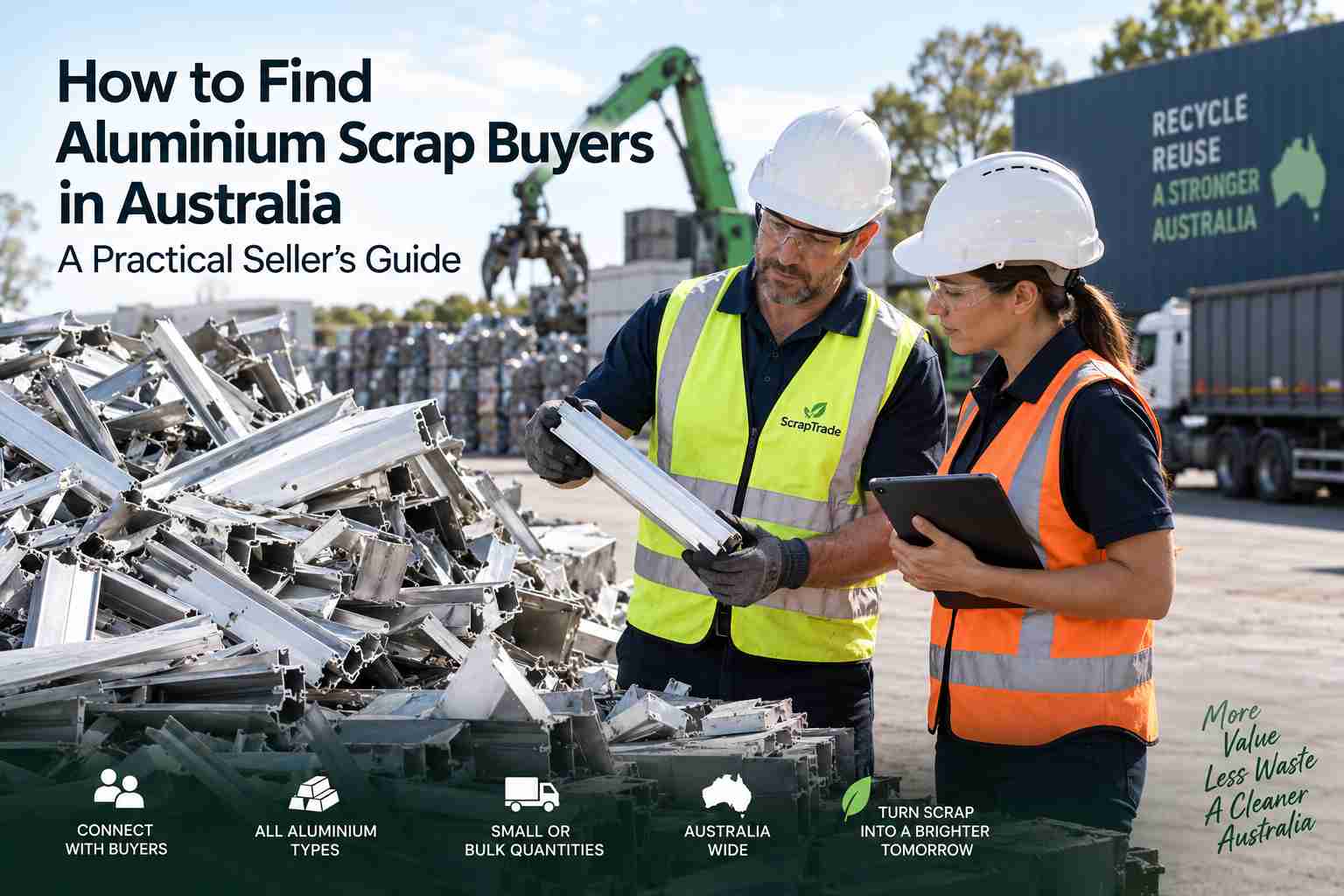
If you have aluminium scrap to sell, finding a buyer is only half the job.
The bigger question is:
Are you dealing with the right buyer for your material?
A business with a few hundred kilograms of aluminium offcuts has very different requirements from a manufacturer generating several tonnes of extrusion every month. A recycler may want one type of material, while a trader or industrial buyer may be interested in another.
That is why searching for aluminium scrap buyers should not simply mean finding the closest scrap yard and accepting the first number you hear.
You need to understand what buyers are looking for, how they assess aluminium scrap, what information they need from sellers and how to compare offers properly.
This guide explains how aluminium scrap buyers operate, what types of aluminium they purchase, what affects their offers and how Australian sellers can make their material more attractive to serious buyers.
Who Buys Aluminium Scrap?
Aluminium scrap moves through several parts of the recycling and trading supply chain.
The buyer you choose can depend on your quantity, material type, location and how prepared the scrap is.
Scrap Metal Recyclers
Scrap metal recyclers purchase recyclable materials, sort them and prepare them for further processing.
They may handle aluminium alongside copper, brass, steel, stainless steel and other metals.
For smaller sellers, a local recycler can be a straightforward option.
For larger commercial loads, however, it can be worth comparing several potential buyers rather than relying on one outlet.
Aluminium Recycling Companies
Some businesses specialise more heavily in aluminium and related recycling streams.
These buyers may have specific requirements for different grades, forms or levels of contamination.
If your aluminium is clean and consistently separated, explaining exactly what you have can help you reach buyers who are better suited to that material.
Scrap Metal Traders
Traders can act as an intermediary between sellers, processors and end users.
Their business model may depend on sourcing particular grades or quantities and moving those materials through established supply chains.
For sellers with regular or bulk supply, a trader may be interested in an ongoing relationship rather than a single load.
Manufacturers and Industrial Buyers
Some industrial businesses use recycled aluminium as part of their material supply chain.
Their requirements can be more specific than those of a general scrap buyer.
They may care about:
- Aluminium grade
- Alloy
- Consistency
- Quantity
- Contamination
- Packaging
- Delivery
- Supply frequency
If your business generates a consistent stream of aluminium scrap, this type of buyer can be worth exploring.
Bulk Aluminium Scrap Buyers
Large quantities can attract a different class of buyer.
A business selling 500 kg of aluminium has different logistics from a business selling 20, 50 or 100 tonnes.
Bulk buyers may evaluate the entire transaction rather than simply looking at the headline price per kilogram.
That can include:
Material value + quantity + freight + handling + collection + processing requirements
This is why sellers should look beyond the price alone.
What Types of Aluminium Scrap Do Buyers Look For?
Not all aluminium scrap is the same.
The more accurately you describe your material, the easier it becomes for the right buyer to identify it.
Aluminium Extrusion
Aluminium extrusion can come from window frames, doors, construction materials, fabrication offcuts and manufacturing.
Clean extrusion can be attractive because it is relatively consistent and easier to process than heavily mixed material.
When listing extrusion, explain whether it is:
- Clean
- Painted
- Powder coated
- Mixed
- Attached to other materials
- Cut into sections
- Loose or bundled
Aluminium Sheet
Sheet aluminium can come from fabrication, roofing, manufacturing, signage and construction.
Describe the condition and whether coatings, attachments or other materials are present.
Cast Aluminium
Cast aluminium can come from machinery, automotive components and other manufactured products.
If you know the source of the material, include it.
For example:
Cast aluminium automotive components.
That gives a buyer more information than simply saying:
Aluminium scrap.
Aluminium Cans
Aluminium cans are a common recyclable material.
For larger quantities, explain whether the cans are:
- Loose
- Baled
- Compacted
- Mixed with other materials
The preparation and quantity can affect how a buyer evaluates the load.
Aluminium Offcuts
Manufacturing and fabrication businesses can generate aluminium offcuts continuously.
These can become particularly interesting to buyers when the material is consistent.
If you produce the same type of offcut every week or month, mention your typical supply volume.
Aluminium Wheels
Aluminium wheels are another recognisable category of scrap aluminium.
If wheels contain tyres, steel components or other attached materials, make that clear.
Mixed Aluminium
Mixed aluminium can contain several types of aluminium scrap in one load.
Mixed material is still commercially useful, but buyers need to understand exactly what "mixed" means.
Photos are particularly valuable for this type of listing.
What Do Aluminium Scrap Buyers Look For?
When a buyer evaluates aluminium scrap, weight is only one part of the equation.
Several characteristics can influence whether they want the material and what they are prepared to offer.
Material Type
The first question is usually:
What exactly is being sold?
A clearly identified load is easier to price than an unknown mixture.
Grade and Alloy
Where known, provide the grade or alloy.
If you do not know it, do not guess.
An incorrect grade can create problems later if the buyer expects something different from what arrives.
Instead, describe the material accurately and provide photographs or other evidence.
Cleanliness
Clean aluminium generally requires less sorting and processing.
Attached steel, plastic, rubber, insulation, wood, dirt and other materials can affect the buyer's calculation.
This does not mean contaminated aluminium has no value.
It simply means the buyer has to account for additional work and material losses.
Consistency
A consistent load can be more attractive than a highly variable one.
For example, a manufacturer producing the same aluminium extrusion offcuts every week may be able to offer a buyer a predictable supply.
That can be valuable beyond a single transaction.
Quantity
Quantity can significantly affect the economics of a deal.
Large loads can make collection and transport more efficient on a per-kilogram basis.
Smaller loads may make more sense for nearby buyers.
Always provide the best weight estimate you have.
Location
Location matters because aluminium is relatively low value per kilogram compared with some other non-ferrous metals.
Transport can therefore make a meaningful difference to the final transaction.
A buyer offering a higher price but located much further away may not necessarily produce a better overall result.
Why Aluminium Scrap Buyers Ask About Contamination
One of the biggest mistakes sellers make is treating contamination as a minor detail.
For buyers, it can directly affect processing costs.
Consider a load described as:
10 tonnes of aluminium.
That sounds straightforward.
But if the 10 tonnes includes significant amounts of steel, plastic, rubber or other attached materials, the actual recoverable aluminium may be considerably different.
That is why serious buyers may ask questions such as:
- Is the aluminium clean?
- Is it mixed?
- Is it painted?
- Does it contain steel?
- Are plastics attached?
- Is insulation present?
- Has the material been sorted?
- Is the weight confirmed?
These are not unnecessary questions.
They help the buyer calculate what the load is actually worth.
What Affects an Aluminium Scrap Buyer's Offer?
There is rarely one universal price for every load of aluminium scrap.
The offer can be influenced by several variables.
Aluminium Type
Different forms of aluminium have different processing characteristics.
A clean, consistent material may receive stronger interest than a mixed load.
Quality
The cleaner and more consistent the material, the easier it can be for a buyer to evaluate and process.
Quantity
A larger quantity can create economies of scale for collection and processing.
Location
Transport costs can influence the final offer, particularly for bulky or lower-value loads.
Market Conditions
Aluminium scrap values move with broader market conditions, supply, demand and processing economics.
This is why an online search for aluminium scrap price per kg should be treated as a reference rather than a guaranteed transaction price.
ScrapTrade already has dedicated content covering scrap aluminium prices in Australia and Aluminium Market Prices.
Keeping pricing information in those dedicated articles allows this article to focus on the separate question:
Who is the right buyer for my aluminium scrap?
How Do Aluminium Scrap Buyers Evaluate a Load?
A buyer generally needs to understand both the material and the cost of moving it.
Think about the process from the buyer's side.
They are effectively asking:
What am I buying?
How much usable material is there?
How much work will it take to process?
How much will it cost to collect or transport?
What can I ultimately do with the material?
The clearer your listing answers those questions, the easier it is for a buyer to make an offer.
What Information Should You Give an Aluminium Scrap Buyer?
Before contacting buyers, prepare the basic information about your material.
Material
State exactly what you believe the material is.
For example:
Clean aluminium extrusion offcuts.
is much better than:
Aluminium metal.
Quantity
Provide the approximate weight.
For example:
Approximately 8 MT.
If the figure is estimated, say so.
Location
Include the city and state.
For example:
Located in Brisbane, QLD.
Condition
Explain whether the aluminium is clean, mixed, painted, coated or attached to other materials.
Photos
Use photographs of the actual material.
Include both wide shots and close-ups.
Video
For large quantities, a short video can help demonstrate the material, storage conditions and approximate scale.
Availability
Tell buyers whether the material is available immediately or at a future date.
Collection
Explain whether the buyer can collect the material and whether there are any site requirements.
Recurring Supply
If the material is generated regularly, include the expected frequency.
For example:
Approximately 10 MT generated every month.
That can turn a one-off enquiry into a potential ongoing supply relationship.
How to Find Aluminium Scrap Buyers in Australia
There are several ways to find buyers.
Search Local Scrap Buyers
A simple local search can identify nearby recyclers and scrap businesses.
This can work particularly well for small quantities where transport costs are significant.
However, local proximity does not automatically mean you are receiving the most competitive offer.
Contact Specialist Buyers
If your material is a particular grade or type, look for buyers that specifically handle that material.
A specialist buyer may understand your material better than a general scrap outlet.
Approach Industrial Buyers
If you have consistent commercial supply, industrial buyers may be worth approaching.
This is especially relevant for manufacturers, fabricators, demolition companies and businesses generating recurring aluminium scrap.
Use an Online Scrap Marketplace
An online marketplace can provide another route to potential buyers.
Instead of searching buyer by buyer, you can create a listing describing the material and allow interested buyers to evaluate the opportunity.
This approach can be particularly useful when you want to compare buyer interest rather than relying on a single quote.
Aluminium Scrap Buyer vs Local Scrap Yard
These terms can sometimes be used interchangeably, but the commercial experience can be different.
A local scrap yard may provide:
- Convenient drop-off
- Fast transactions
- Local collection
- Straightforward weighing
An online marketplace can provide:
- Broader buyer access
- More visibility
- Buyer competition
- Multiple transaction options
- A structured listing of your material
Neither option is automatically better for every seller.
The right choice depends on what you are selling.
For a small mixed load, convenience may matter most.
For a large, clean and clearly specified industrial load, access to more potential buyers may be more valuable.
Should You Accept the First Aluminium Scrap Buyer Offer?
Not necessarily.
If you have a significant quantity, comparing offers can make a meaningful difference.
For example, imagine you have:
20,000 kg of aluminium scrap.
A difference of just $0.10 per kg represents:
20,000 × $0.10 = $2,000
That is why even a seemingly small difference in the quoted rate can matter when you are selling in bulk.
However, do not compare only the price.
Also compare:
- Collection
- Freight
- Payment terms
- Minimum quantities
- Processing deductions
- Inspection requirements
- Timing
- Reliability
The best deal is the one that works commercially from end to end.
How to Compare Aluminium Scrap Buyers
Create a simple comparison before committing to a buyer.
| Factor | Buyer A | Buyer B | Buyer C |
|---|---|---|---|
| Price per kg | |||
| Estimated total | |||
| Collection | |||
| Freight | |||
| Payment terms | |||
| Material requirements | |||
| Deductions | |||
| Availability | |||
| Overall deal |
This is particularly useful for commercial quantities.
A higher headline price can lose its advantage if the buyer applies significant deductions or requires expensive transport arrangements.
How to Make Your Aluminium Scrap More Attractive to Buyers
You do not always need to process your aluminium extensively before selling it.
Instead, focus on making the material easy to understand and easy to evaluate.
Separate Clearly Different Materials
If practical, keep extrusion, sheet, cast aluminium and other categories separate.
Keep Loads Organised
Neatly bundled or organised material can be easier to inspect and handle.
Remove Obvious Contamination Where Practical
Loose rubbish and unnecessary non-metal materials can reduce buyer confidence.
However, do not spend more on labour than the additional value is worth.
Know Your Weight
Keep records of your scrap generation if you produce material regularly.
Photograph Everything
A buyer should be able to see what they are considering.
Be Transparent
If the material is mixed, painted or contaminated, say so.
Transparency can actually make a listing stronger because buyers can price the opportunity with greater confidence.
How Regular Aluminium Scrap Supply Can Attract Better Buyers
One-off loads are useful.
But consistent supply can be even more commercially interesting.
Consider a manufacturing business that generates:
5 tonnes of aluminium scrap every month.
That is not just one sale.
It represents approximately:
60 tonnes of potential annual supply.
A buyer interested in long-term supply may value consistency because it can help with procurement and planning.
If you have recurring aluminium scrap, include:
- Typical monthly quantity
- Material type
- Consistency
- Location
- Collection frequency
- Packaging
- Typical contamination
- Expected duration of supply
You may find that your most valuable buyer is not simply the one offering the highest price for today's load, but the one capable of building a reliable long-term relationship.
What Makes a Good Aluminium Scrap Buyer?
Price matters.
But a good buyer should also be able to understand and handle the material you are offering.
Consider whether the buyer:
Understands Your Material
A buyer should be able to ask sensible questions about grade, quality and quantity.
Can Handle Your Volume
A buyer who regularly handles tonnes of material may be more suitable for industrial sellers than one focused on small loads.
Can Meet Your Collection Requirements
Make sure their logistics work for your site.
Communicates Clearly
Good communication can prevent misunderstandings around quality, weight and payment.
Provides Clear Commercial Terms
You should understand the agreed price, quantity, collection arrangements and payment expectations before completing the transaction.
Warning Signs When Dealing With an Aluminium Scrap Buyer
Most scrap transactions are straightforward, but sellers should still use common commercial sense.
Be cautious when:
- The buyer refuses to explain how the price was calculated.
- The buyer changes the agreed terms without explanation.
- The buyer cannot clearly describe collection arrangements.
- Material specifications are deliberately vague.
- The buyer expects significant work that was not discussed beforehand.
- Payment terms are unclear.
- The buyer's final price differs substantially from the original offer without a reasonable explanation.
For larger transactions, written confirmation of the commercial terms can help both parties.
Can Aluminium Scrap Buyers Collect the Material?
Some buyers may offer collection, particularly for larger quantities.
Whether collection makes sense depends on:
- Quantity
- Location
- Material value
- Truck access
- Loading requirements
- Distance
- Freight costs
For a bulk load, always discuss collection before agreeing to a final transaction.
A quoted price without understanding logistics can be misleading.
Can You Sell Aluminium Scrap to Buyers Outside Your City?
Potentially, yes.
For larger quantities, buyers may be willing to travel or arrange transport when the economics make sense.
This is one reason online marketplaces can be useful for bulk sellers.
Instead of restricting your search to:
Aluminium scrap buyers near me
you can think in terms of:
Which aluminium scrap buyers can economically purchase this particular load?
That is a much more useful question.
Aluminium Scrap Buyers and Recycling
Selling aluminium scrap is part of a larger recycling supply chain.
The Australian Aluminium Council reports that aluminium can be recycled repeatedly and that recycling aluminium uses around 5% of the energy required for primary aluminium production.
That gives aluminium scrap an important role beyond simply clearing unwanted material from a yard or workshop.
Recovered aluminium can return to the manufacturing cycle instead of being treated as waste.
For sellers, this means the right buyer is not simply someone willing to take the material.
It is a buyer who can economically recover, process, trade or use it.
Why Buyer Competition Can Matter
Imagine you have one buyer interested in your aluminium scrap.
You receive an offer.
You have little context for whether it is competitive.
Now imagine several relevant buyers can see the same opportunity.
The dynamic changes.
Instead of asking:
"Is this the best price I can get?"
you can ask:
"Which buyer offers the best overall deal?"
That distinction is important.
Buyer competition does not guarantee a higher price every time.
But it can give sellers more choice and better information about what the market is willing to offer for a particular load.
Using ScrapTrade to Reach Aluminium Scrap Buyers
This is where an online scrap marketplace can become useful.
ScrapTrade allows sellers to create listings for scrap materials and connect with potential buyers.
For aluminium sellers, the value is not simply putting the words "aluminium scrap for sale" on a webpage.
It is giving buyers enough information to decide whether the material fits what they are looking for.
A strong listing can include:
- Aluminium type
- Quantity
- Location
- Condition
- Photos
- Video
- Availability
- Collection details
- Selling method
The seller can then choose how they want to approach the transaction.
For sellers looking for broader guidance, ScrapTrade's existing guide to selling used and scrap products online in Australia covers the broader process of preparing and listing scrap products.
Fixed Price, Auction or Negotiation?
Different aluminium loads can suit different selling methods.
Fixed Price
A fixed price is useful when you know the number you want and prefer a straightforward transaction.
Live Auction
An auction allows interested buyers to compete for the material.
This can be useful when you want market demand to help establish the final price.
Private Negotiation
Private negotiation gives both parties more flexibility.
This can be particularly useful for large loads where price, collection, quantity and recurring supply all need to be discussed.
The important point is that sellers do not have to approach every transaction in exactly the same way.
How to Prepare Your Aluminium Scrap Before Contacting Buyers
Before approaching buyers, spend a few minutes creating a simple material summary.
For example:
Material: Aluminium extrusion offcuts
Quantity: Approximately 12 MT
Condition: Mixed painted and unpainted
Location: Brisbane, QLD
Availability: Immediate
Collection: Truck access available
Supply: Similar quantity generated monthly
Evidence: Photos and video available
That short description already answers many of the questions a buyer would normally ask.
It also makes you look more prepared and makes it easier for buyers to assess the opportunity.
Example: A Strong Aluminium Scrap Buyer Listing
Weak Version
Aluminium scrap available. Good quantity. Buyer wanted.
There is almost nothing here for a serious buyer to evaluate.
Better Version
Approximately 12 MT of aluminium extrusion offcuts available in Brisbane, QLD. Material includes painted and unpainted extrusion and is stored undercover. Truck access is available for collection. Photos and video available. Similar quantities are generated monthly.
Now a buyer can immediately understand:
- What the material is
- How much is available
- Where it is
- What condition it is in
- How it can be collected
- Whether recurring supply exists
That is the difference between a listing that simply announces material and one that creates a commercial opportunity.
Questions to Ask an Aluminium Scrap Buyer
You should also evaluate the buyer.
Useful questions include:
What Aluminium Grades Do You Buy?
Make sure your material matches their requirements.
What Quantity Do You Typically Purchase?
This helps determine whether your load is suitable.
Do You Collect?
If yes, clarify the collection arrangements.
How Is the Final Weight Determined?
Understand whether the transaction is based on seller weight, buyer weight, weighbridge weight or another agreed method.
Are There Quality Deductions?
Ask how contamination or unexpected material affects the final price.
What Are the Payment Terms?
Know when and how payment will be made.
Can You Handle Recurring Supply?
If you generate material regularly, ask whether they are interested in ongoing purchases.
Questions Aluminium Scrap Buyers May Ask You
Be ready for questions such as:
What type of aluminium is it?
How much do you have?
Is it clean?
Is it mixed?
Does it contain steel or plastic?
Where is it located?
Can we collect it?
How quickly is it available?
Do you have more coming?
Can you provide photos or video?
If you already have these answers prepared, the buying process becomes much faster.
Aluminium Scrap Buyers for Small Quantities vs Bulk Loads
The right buyer can be very different depending on your quantity.
Small Quantities
For small quantities, focus on:
- Local buyers
- Convenient collection
- Low transport costs
- Simple transactions
- Clear material descriptions
Medium Quantities
For medium loads, start comparing:
- Buyer price
- Collection
- Freight
- Material requirements
- Payment terms
Bulk Quantities
For bulk loads, consider:
- Multiple buyer offers
- Material specification
- Recurring supply
- Logistics
- Loading
- Freight
- Inspection
- Payment terms
- Long-term relationships
The larger the transaction, the more important the commercial structure becomes.
Finding the Right Aluminium Scrap Buyer Is About More Than Price
It is tempting to make the entire process about dollars per kilogram.
But a buyer's offer is only one part of the transaction.
Suppose one buyer offers:
$2.50/kg
and another offers:
$2.60/kg
At first glance, the second buyer wins.
But then you discover:
- Buyer A collects from your site.
- Buyer B requires you to deliver.
- Buyer B is 200 km away.
- Buyer A pays immediately.
- Buyer B applies a quality deduction after inspection.
The higher number may no longer be the better deal.
That is why experienced sellers look at the total commercial outcome, not just the headline price.
Aluminium Scrap Buyers: Seller Checklist
Before accepting an offer, check the following.
Material
- Have you identified the aluminium correctly?
- Is the material mixed or separated?
- Have you disclosed contamination?
Quantity
- Is the weight confirmed or estimated?
- Can the buyer handle the quantity?
Location
- Where is the material stored?
- Is truck access available?
Price
- What is the agreed price?
- Is it per kilogram or per tonne?
- Are there deductions?
Logistics
- Who arranges collection?
- Who pays freight?
- How will loading work?
Payment
- When will payment be made?
- How is the final weight confirmed?
Future supply
- Is this a one-off load?
- Do you have more material available?
A few minutes of preparation can prevent much bigger problems later.
Frequently Asked Questions About Aluminium Scrap Buyers
Who buys aluminium scrap in Australia?
Aluminium scrap can be purchased by scrap metal recyclers, aluminium recycling businesses, scrap traders, industrial buyers, manufacturers and other businesses that use or process recovered aluminium.
Where can I find aluminium scrap buyers?
You can search local recyclers and specialist buyers, contact industrial businesses or use an online scrap marketplace to reach potential buyers.
Who buys bulk aluminium scrap?
Bulk aluminium can be purchased by larger recyclers, traders, processors and industrial buyers. For significant quantities, it can be useful to compare several potential buyers.
What do aluminium scrap buyers look for?
Buyers commonly consider the material type, grade, cleanliness, contamination, quantity, location, collection requirements and current market conditions.
Do aluminium scrap buyers buy mixed aluminium?
Some buyers do. However, mixed material should be described accurately so the buyer understands what is included.
Do buyers collect aluminium scrap?
Some buyers may provide collection, particularly for larger quantities. Collection depends on the quantity, location and economics of the transaction.
Can I sell aluminium scrap directly to a manufacturer?
Potentially. Some manufacturers and industrial businesses use recycled aluminium, although their material specifications may be more specific than those of general scrap buyers.
Should I separate my aluminium before selling?
Where practical, separating clearly different aluminium types can make the material easier for buyers to evaluate. However, the cost and effort of additional preparation should also be considered.
How do aluminium scrap buyers determine price?
They can consider material type, grade, cleanliness, quantity, location, processing requirements, freight and broader market conditions.
Should I compare multiple aluminium scrap buyers?
For meaningful quantities, comparing multiple offers can help you understand the market and choose a stronger overall deal.
What information should I give a buyer?
Provide the material type, quantity, location, condition, photographs, availability and collection information. For larger loads, video can also be useful.
Can I sell aluminium scrap on a recurring basis?
Yes. If you generate aluminium scrap regularly, tell buyers your typical quantity and supply frequency. Consistent supply can be attractive to commercial buyers.
Final Thoughts: Find the Right Aluminium Scrap Buyer
Selling aluminium scrap is not simply about finding someone who will take the material.
It is about finding a buyer who understands what you have, can handle the quantity, fits your logistics and offers terms that make commercial sense.
The process becomes much easier when you know your material.
Identify it.
Measure it.
Photograph it.
Describe it honestly.
Explain the logistics.
Compare the buyers.
And most importantly, do not assume the nearest buyer is automatically the best buyer.
For small quantities, convenience may win.
For bulk quantities, buyer competition and logistics can become much more important.
For recurring industrial supply, the right buyer may be the one who can build a reliable long-term relationship around your material.
Have Aluminium Scrap to Sell?
If you have aluminium scrap available, you can create a detailed listing on ScrapTrade and put the opportunity in front of potential buyers.
Whether you have a small load, several tonnes or regular industrial supply, give buyers the information they need to understand the material and make a serious offer.
List your aluminium scrap on ScrapTrade and find potential buyers for your material.