

When an air conditioner is replaced, the old one cannot simply be put out for hard rubbish. It holds refrigerant gas, and in Australia the gas has to be recovered before the unit is dropped at a tip or yard. This guide sets out what we could find on who may recover it, what licence is needed, what councils and the takeback scheme do and what that means whether you sell the unit, scrap it or recycle it. The sources are fact sheets from the industry's licensing body, which are dated, and we did not read the legislation itself. It is general information and not legal advice, and it follows our guides to scrapping an air conditioner and selling a used air conditioner. ScrapTrade runs a scrap marketplace and has a commercial interest in the scrap trade.
What the rules say
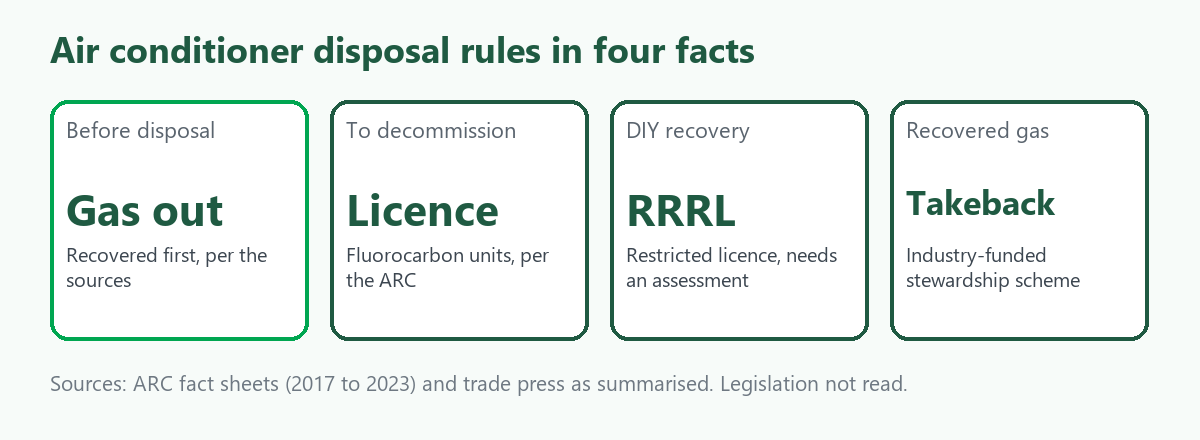
The Australian Refrigeration Council (ARC) says that, by law, anyone wanting to install, repair or decommission refrigerators and air conditioners that contain fluorocarbon gas must hold a licence issued through the ARC. Trade sources point to the Ozone Protection and Synthetic Greenhouse Gas Management Regulations 1995 as the basis, and one ARC document cites a slightly different title, so the exact name is inconsistent across what we read. We did not find the legislation's own text. Recovery is required before a unit goes to hard rubbish, a tip or a yard, according to the sources, and the ARC business directory at lookforthetick.com.au lists licensed businesses.
Can a householder recover the gas?
The ARC says there is a Restricted Refrigerant Recoverer Licence for people who want to recover refrigerant themselves, and that it covers recovery from stationary equipment such as home air conditioners and refrigerators. Getting one means passing an assessment. For most households the practical route is the one the ARC recommends first, which is to hire a licensed technician. These fact sheets are dated between 2017 and 2023, so licence classes and rules may have changed, and arctick.org has the current position.
What happens to the gas
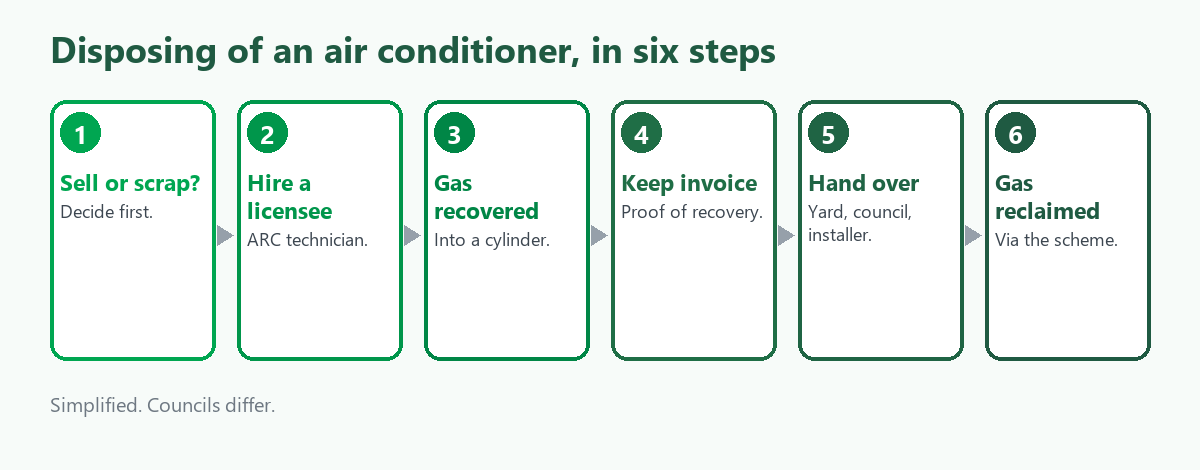
Recovered refrigerant goes into a stewardship scheme. Refrigerant Reclaim Australia (RRA) is a not-for-profit, industry-funded scheme that takes back used and unwanted refrigerants so they are destroyed or reclaimed and not released. A technician takes a recovery cylinder from a gas supplier, fills it with used refrigerant and returns it to a participating wholesaler, which weighs it and pays a per-kilogram rebate, according to one description of the scheme. The ACCC authorised RRA to continue for five years, and a review of the scheme is looking at how it is working. This pathway is aimed at the trade, and we found no household drop-off points for refrigerant itself.
What councils do
A council fact sheet from the ARC says local councils are central to managing air conditioners and refrigerators as they move from kerbside to landfill or recycling, and that if units go without the refrigerant recovered, the gas is likely to escape. Councils differ in what they accept, and we did not review them all, so ask yours before you book a collection. Some retailers also offer to collect and degas an old appliance when a new one is delivered, and one appliance retailer says it does this even when the old unit was bought elsewhere, which is one company's service.
What this means for each route
- Selling a working unit. Have a licensed technician disconnect it and recover the gas, and say so in your listing. Our guide to selling a used air conditioner covers the rest.
- Scrapping it. Ask the yard whether it takes the unit with or without the gas, and what proof it wants. Our guide to scrapping an air conditioner explains how yards value the metal.
- Replacing it. Ask the installer to remove and dispose of the old one, and ask whether the price includes the gas.
- Council collection. Confirm that the council takes units and what it requires.
Where ScrapTrade fits
ScrapTrade is not a disposal service and does not recover refrigerant. What it offers is a place to sell scrap to verified buyers, which could suit a contractor or a demolition crew that already has degassed units or separated copper and aluminium. Fees do not apply to listings, you negotiate in chat, and the buyer's 5 percent deposit sits in escrow after a bid is accepted. How buyers treat a unit that still holds gas is not something we could confirm, so ask cs@scraptrade.com.au.
For the global view, with US, UK and EU examples, see Scrapping an Air Conditioner: Refrigerant Rules.
What we could not verify
- The legislation and current licence classes. We read fact sheets from 2017 to 2023 and not the law.
- Penalties for disposing of a unit with gas in it.
- Household drop-off points for refrigerant. We found none.
- How each council treats air conditioners.
- Rules for heat pumps and fridges. This guide is about air conditioners.
Frequently asked questions
Do I need a licence to get rid of an old air conditioner?
Anyone who decommissions one that contains fluorocarbon gas must hold a licence, according to the ARC, so most people hire a licensed technician.
Can I recover the refrigerant myself?
Only with a Restricted Refrigerant Recoverer Licence, which requires an assessment, according to the ARC.
Can I put an air conditioner out for hard rubbish?
The gas must be recovered first, according to the sources, and councils differ, so ask yours.
What happens to recovered refrigerant?
It goes to a stewardship scheme run by Refrigerant Reclaim Australia, which destroys or reclaims it.
Does ScrapTrade handle refrigerant?
No. It is a marketplace, and the gas must be recovered by a licensed person before a unit is sold or scrapped.
Sources
- Australian Refrigeration Council (arctick.org) fact sheets on licences, restricted recovery licences and council guidance, 2017 to 2023, as summarised in search results.
- Refrigerant Reclaim Australia and trade-press coverage of the takeback scheme and the ACCC authorisation, as summarised in search results.
- ScrapTrade website, accessed November 2026.
Not legal advice. We did not read the legislation, and rules change by state.