

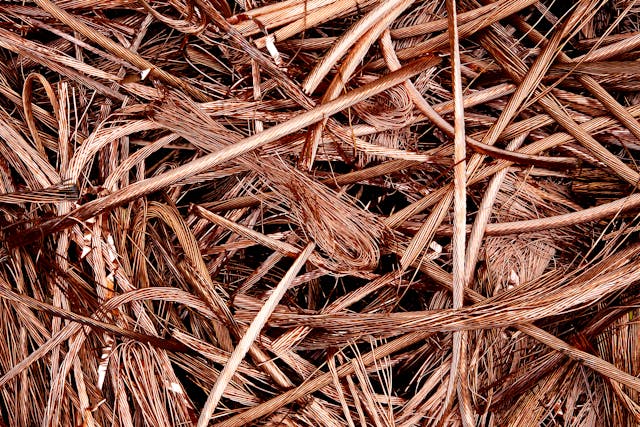
The honest answer to "how much is my scrap copper worth" is a formula, not a number. This page gives the formula and works it through for three loads, so you can see how the answer changes with the share a yard pays. The shares in the tables are scenarios, not typical rates, because we found no sourced Australian yard price list. For how to check a real offer, see Scrap Yard Copper Prices: How to Check an Offer.
The formula
Value = weight x benchmark per kilogram x share the yard pays, less deductions.
On 29 October 2026 the benchmark was about A$20.64 a kilogram, from the London Metal Exchange cash price of US$14,560 a tonne and a Reserve Bank rate of US$0.7053 per A$1 [1][2]. The share is what you ask each buyer. Deductions cover contamination and handling.
Example 1: clean bare bright wire
Priya has 25 kg of clean, uncoated, insulation-free copper wire (invented). At the benchmark the metal is worth 25 x 20.64 = A$516. At different shares, a yard's offer would be:
| Share the yard pays | Value of 25 kg |
|---|---|
| 60% | A$310 |
| 70% | A$361 |
| 80% | A$413 |
| 90% | A$464 |
Example 2: insulated cable
Marco has 10 kg of insulated cable (invented). The ScrapTrade index says insulated cable recovers 60 to 70% copper, so 10 kg holds about 6 to 7 kg of copper. At the benchmark, that copper is worth roughly A$124 to A$145 before any share or deduction. The yard pays for the recoverable copper, not the 10 kg on the scale, and then a share of that. The recovery figure is the index's, and your cable may differ.
Example 3: a 100 kg mixed lot
Dev has 100 kg of clean copper tube (invented). At the benchmark, 100 kg is worth 100 x 20.64 = A$2,064, and at different shares a yard's offer would be:
| Share the yard pays | Value of 100 kg at one share |
|---|---|
| 60% | A$1,239 |
| 70% | A$1,445 |
| 80% | A$1,651 |
| 90% | A$1,858 |
Sorting matters because a mixed lot may be priced at the lowest grade in it. We found no sourced figure for how much lower.
What to take from the examples
- The share is the biggest lever you can compare. Ask every buyer what share of the benchmark it pays for your grade.
- Sort before you go. The grades are explained in Copper Scrap Price Per Kg: Grades Explained.
- Date everything. The benchmark changes every day, as shown in Copper Price Today in A$.
- Keep records. If you sell as a business, the ATO's scrap code expects an ABN or the buyer withholds 47%, and in NSW and Victoria dealers cannot pay cash. See What If Every Scrap Trade Were on the Books?.
Selling it
ScrapTrade is a marketplace where you list material, review buyer offers and negotiate. Its How It Works page describes the steps, and its Trust & Safety page says payment is held in escrow from the moment a deal is confirmed and released once pickup or delivery is confirmed. The scrap calculator gives an indicative estimate, but when we checked on 30 October the index said live pricing was temporarily unavailable. You can create a free account to try it. ScrapTrade has a commercial interest in the scrap trade.
What we could not verify
- The share any Australian yard actually pays for any grade. The shares above are scenarios.
- Recovery for your particular cable.
- Deductions, which vary by yard.
Frequently asked questions
How much is scrap copper worth per kg?
It depends on the grade and the day. The benchmark was about A$20.64 a kilogram on 29 October 2026, and scrap sells below it by an amount we could not source [1][2].
How do I work out what my copper is worth?
Multiply the weight by the benchmark per kilogram and by the share the yard pays, then subtract deductions.
Is insulated cable worth the weight on the scale?
No. The index says it recovers 60 to 70% copper, so the yard pays for the recoverable copper.
Sources
- Westmetall, Official LME prices, 29 October 2026.
- Reserve Bank of Australia, Exchange rates, 29 October 2026 (US$0.7053 per A$1).
The three loads and people are invented. The shares are scenarios, not typical rates. Figures are indicative and not an offer or advice. ScrapTrade operates a scrap marketplace and has a commercial interest in the scrap trade.