

Empty steel drums, intermediate bulk containers (IBCs) and gas cylinders look like scrap and sometimes are, but they are not safe to treat as ordinary metal. A drum that held a flammable liquid can still hold vapour or residue, and a cylinder may hold gas under pressure. This guide sets out what we could find in Australian regulator material about the dangers, the transport wording and who to ask. It is not instructions for cleaning, cutting or decommissioning anything, and it is not a how-to. We found nothing on who owns a gas cylinder, on reconditioning or on scrap rates, and we give no prices. Our searches returned mostly state regulator bulletins and some US material, and we flag what is a secondary summary. ScrapTrade runs a scrap marketplace and has a commercial interest in the scrap trade.
Empty does not mean safe
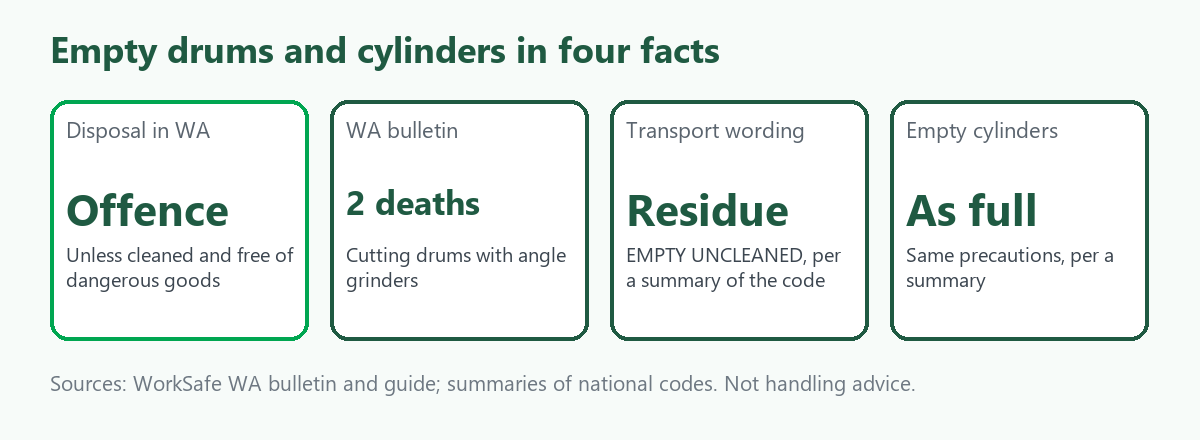
A WorkSafe WA bulletin says it is an offence to dispose of a dangerous goods container unless it has been thoroughly cleaned and made free of dangerous goods. The same bulletin records two deaths and a serious injury from cutting up 205 litre drums with angle grinders, where sparks ignited residual flammable liquid inside the drum. That is the central warning: never cut, grind, weld or heat a drum or tank unless it is confirmed clean and a competent person has dealt with it. We are not giving instructions for doing so.
Gas cylinders
A podcast summary cites Safe Work Australia's hazardous chemicals code as saying used or empty cylinders should be treated with the same precautions as full ones. That is a secondary source, so check the code itself. We found nothing on who owns a cylinder, whether a supplier has to take it back or how a cylinder becomes scrap, and a cylinder should not go into a skip, a recycling bin or a yard on its own initiative. Ask the gas supplier, whose name is usually on the cylinder, and the state dangerous goods regulator.
Transporting empties
The Australian Dangerous Goods Code covers the transport of empty dangerous goods containers in Chapter 7.2, according to a WA guide, and says transport documents should use descriptions such as EMPTY D/G DRUMS, D/G RESIDUE or EMPTY CYLINDERS. A summary of the Code says empty containers holding residue of a non-Class 7 substance must carry wording such as EMPTY UNCLEANED or RESIDUE LAST CONTAINED, and that empty IBCs and large packagings are treated like other empty packagings that held a dangerous substance. We did not read the Code, so rely on the carrier, the supplier or the regulator for what applies to your load.
What it means for a seller
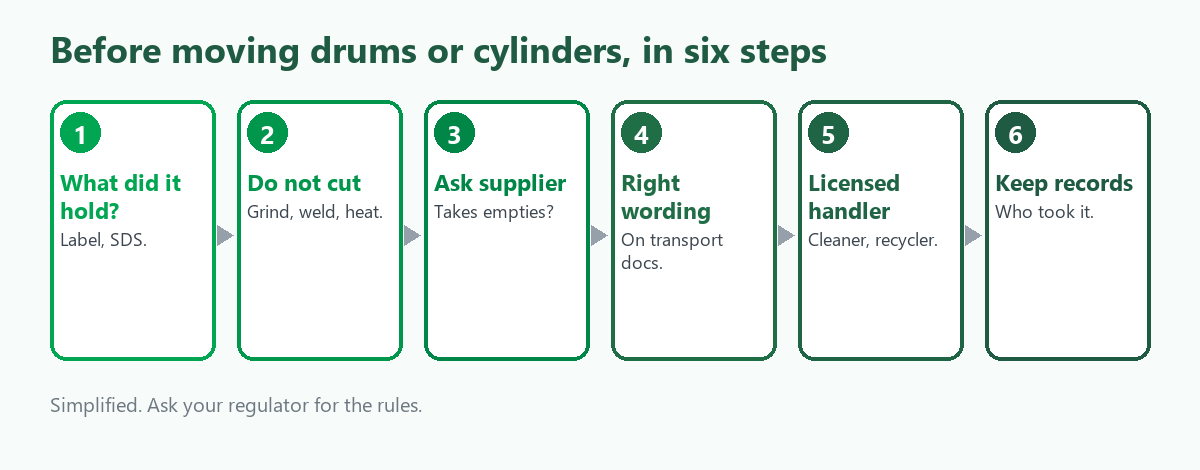
- Know what it held. The label, the safety data sheet or the supplier will tell you. If you do not know, treat it as unsafe.
- Do not cut, grind or weld. Leave that to a competent, licensed cleaner or recycler.
- Ask who takes empties. The chemical or gas supplier may have a return arrangement, and we could not confirm it. A reconditioner or licensed waste service may take the rest.
- Ask a yard before you deliver. Many yards will not take drums, tanks or cylinders, and you should expect to be asked what they held.
- Keep records. Note what was sent where and who took it.
Questions to ask
- Supplier: Do you take back drums, IBCs or cylinders, and under what conditions?
- Regulator (for example WorkSafe, SafeWork or the state EPA): What are the rules for disposing of and transporting these in my state?
- Scrap yard: Do you take them at all, and what proof of cleanliness or emptiness do you require?
- Cleaner or reconditioner: Do you take them, what do you charge and what record do you give?
Where ScrapTrade fits
These items are outside what ScrapTrade is set up to handle, and we would not list a drum, tank or cylinder on any marketplace without the regulator's rules and the buyer's agreement. A business with clean, certified, sorted steel from a site might use the marketplace for that steel, and listing is free, with no commission, price and terms agreed in chat and the buyer's 5 percent deposit held in escrow after a bid is accepted. Verified businesses and individuals can sell, and buyers in more than 50 countries bid. Containers that held dangerous goods are not something we could confirm the platform accepts, so ask cs@scraptrade.com.au before you list anything that held chemicals or gas.
What we could not verify
- Who owns gas cylinders and who must decommission them.
- Reconditioning rules and the drum market.
- Current state rules. We read WA and a summary of the national code.
- What any scrap yard accepts, or pays.
- Whether ScrapTrade accepts containers that held dangerous goods.
Frequently asked questions
Can I scrap an empty steel drum?
Not safely unless you know what it held and it is clean. Cutting drums with residue has killed people, according to a WA bulletin.
Is an empty gas cylinder safe?
Treat it with the same precautions as a full one, according to a summary of the national code. Ask the supplier.
How do I transport empty drums?
Documents should carry wording such as EMPTY UNCLEANED or RESIDUE LAST CONTAINED, per a summary of the code. Ask the carrier.
Can I put cylinders in a skip or recycling bin?
No. Ask the supplier and your council, as councils generally do not take them.
Can I list drums on ScrapTrade?
We could not confirm. Ask support first.
Sources
- WorkSafe WA Dangerous Goods Safety Bulletin No. 0111 on unsafe disposal of dangerous goods drums, and the WA guide to transporting empty dangerous goods containers, as summarised in search results.
- A summary of Australian Dangerous Goods Code transport provisions, and a podcast summary of the national hazardous chemicals code, as summarised in search results.
- ScrapTrade website, accessed November 2026.
General information only, not safety or legal advice. Do not cut, grind, weld or heat containers that held dangerous goods.