

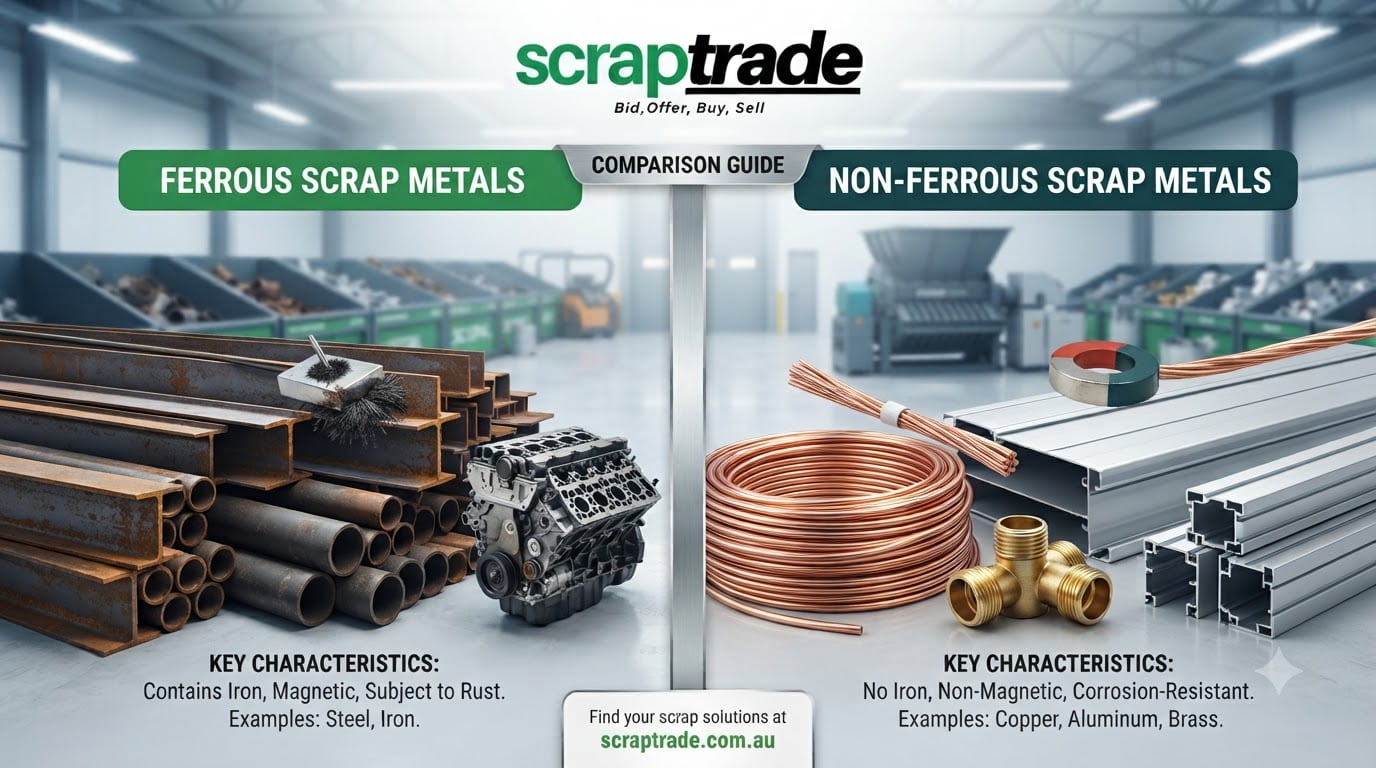
When you start buying or selling scrap metal, one of the first distinctions you will encounter is ferrous vs non-ferrous scrap.
The difference is primarily based on whether the material contains iron as a principal component. Ferrous metals include common materials such as steel and iron, while non-ferrous metals include materials such as copper, aluminium, brass, and many other metals.
This distinction matters because the two groups can differ in physical properties, identification methods, processing requirements, market value, and buyer specifications.
Understanding the difference can help sellers describe their material more accurately and help buyers identify the type of scrap they need.
What Is Ferrous Scrap?
Ferrous scrap refers broadly to scrap containing iron as a principal component.
Common ferrous scrap includes steel and cast iron. It can come from vehicles, construction materials, machinery, industrial equipment, appliances, structural components, manufacturing operations, and many other sources.
Steel is one of the most widely encountered ferrous scrap materials.
Ferrous scrap can be further classified according to its form, dimensions, composition, preparation, and other specifications. HMS (Heavy Melting Steel) is one commonly used category in the scrap trade.
For businesses trading steel scrap, factors such as thickness, size, cleanliness, attachments, and preparation can affect how a load is evaluated.
You can learn more in the Steel and HMS Scrap Trading Guide.
Common Ferrous Materials
Examples include:
- Steel
- Cast iron
- Heavy structural steel
- HMS scrap
- Automotive steel components
- Industrial machinery scrap
Not every iron-containing material will have the same commercial specification. Buyers often have particular requirements for the grade, dimensions, preparation, and contamination level.
What Is Non-Ferrous Scrap?
Non-ferrous scrap generally refers to metals where iron is not the principal component.
Common non-ferrous scrap includes copper, aluminium, brass, and other metals and alloys.
These materials are widely traded because they can have significant industrial applications and can often be recovered and processed into new products.
Examples include copper wire, aluminium extrusion, aluminium wheels, brass fittings, and other nonferrous materials.
Non-ferrous scrap can also be divided into different grades based on composition, cleanliness, physical form, and other characteristics.
For example, copper wire may be evaluated differently depending on whether it is bare, insulated, mixed, or contaminated.
The Copper Scrap Trading Guide provides more detail on copper grades and trading considerations.
Key Differences
Ferrous and non-ferrous scrap differ in several important ways.
Magnetism and Identification
One of the simplest initial methods of distinguishing many ferrous metals from non-ferrous metals is magnetism.
Iron and many common steels respond strongly to magnets, while metals such as copper and aluminium do not.
However, magnetism should be treated as an initial identification method rather than a complete material-testing system.
Some stainless steels, for example, can have different magnetic properties depending on their alloy and condition.
Visual inspection can also provide useful clues, but it is not always sufficient to establish the exact alloy or grade.
For commercial trading, the material's known specifications, markings, documentation, testing, and buyer requirements may all be relevant.
Value and Pricing Drivers
Price is another major difference, but there is no universal rule that one category is always worth more than the other.
Scrap value depends on the specific metal, grade, composition, purity, contamination, quantity, preparation, location, logistics, and market conditions.
Non-ferrous materials such as copper and aluminium can have different pricing structures from ferrous materials such as steel and cast iron.
Within the same category, quality can also create major differences.
For example, clean copper scrap and heavily contaminated mixed copper material should not automatically be treated as the same commercial product.
Likewise, clean, properly prepared steel scrap may be evaluated differently from mixed steel containing significant non-metallic material.
For a broader explanation, see How Scrap Metal Pricing Works.
Recycling Process
Both ferrous and non-ferrous metals can be recycled, but their processing routes are not identical.
Ferrous scrap is often sorted using magnetic equipment and may then undergo preparation, shredding, separation, and steelmaking processes depending on the material.
Non-ferrous scrap may require different separation technologies and processing methods. Copper, aluminium, brass, and other non-ferrous materials can each follow different recycling routes.
The quality of sorting before processing is important for both categories because mixed materials can require additional separation or processing.
Common Examples of Each
A simple comparison can make the distinction easier to understand.
| Ferrous Scrap | Non-Ferrous Scrap |
|---|---|
| Steel | Copper |
| Cast iron | Aluminium |
| HMS | Brass |
| Structural steel | Copper wire |
| Automotive steel | Aluminium wheels |
| Machinery steel | Brass fittings |
| Iron scrap | Aluminium extrusion |
These are broad categories rather than complete grading systems.
A material's commercial grade still needs to be established according to its characteristics and the buyer's specification.
For example, "copper" is not a single scrap grade, just as "steel" is not a single grade.
Why the Distinction Matters When Trading
Correctly identifying whether material is ferrous or non-ferrous is an important first step when preparing a scrap listing.
It affects how buyers search for material, how the material may be processed, what information needs to be provided, and how the transaction may be evaluated.
For Sellers
Sellers should identify the material as accurately as possible before creating a listing.
Instead of simply writing "metal scrap," a better listing can specify whether the material is steel, cast iron, copper, aluminium, brass, or another known material.
Additional information such as grade, quantity, preparation, contamination, photographs, location, and availability can make the listing more useful to potential buyers.
For Buyers
Buyers should evaluate the actual material rather than relying only on a broad category.
A buyer sourcing copper, for example, may require a particular grade, purity, physical form, or quantity. A buyer sourcing steel may have requirements concerning dimensions, thickness, preparation, or contamination.
The more specific the buyer's requirement, the more important accurate listing information becomes.
FAQs
What is the difference between ferrous and non-ferrous scrap?
Ferrous scrap generally contains iron as a principal component, while non-ferrous scrap generally does not. Steel and cast iron are common ferrous materials, while copper, aluminium, and brass are common non-ferrous materials.
Is ferrous scrap magnetic?
Many common ferrous metals, including iron and many steels, are magnetic. However, magnetic behaviour varies between alloys, so a magnet should not be treated as a definitive method for identifying every metal grade.
Is non-ferrous scrap more valuable than ferrous scrap?
Not necessarily. Scrap value depends on the specific material, grade, composition, purity, contamination, quantity, market conditions, location, and logistics.
What are examples of ferrous scrap?
Common examples include steel, cast iron, HMS, structural steel, automotive steel, and machinery scrap.
Conclusion
Understanding ferrous vs non-ferrous scrap is one of the basic building blocks of scrap metal trading.
Ferrous scrap includes materials such as steel and cast iron, while non-ferrous scrap includes copper, aluminium, brass, and many other metals and alloys. The two categories can differ in identification, sorting, processing, pricing, and buyer requirements.
However, simply identifying a material as ferrous or non-ferrous is only the starting point. The specific grade, composition, cleanliness, quantity, preparation, location, and market conditions can all influence its commercial value.