

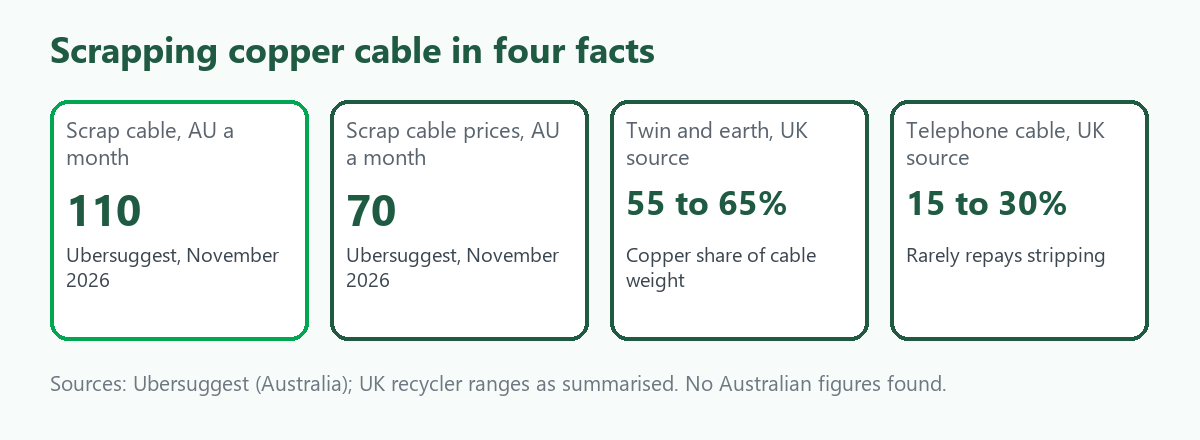
"Scrap cable" is searched about 110 times a month in Australia, according to Ubersuggest, "scrap cable prices" about 70 and "scrap cable near me" about 50. People with old cable want to know whether to strip it or sell it as it is, and how a yard decides. The answer is arithmetic: a yard pays for the copper inside, and the insulation is weight that earns nothing. This guide explains the recovery percentage, what the sources say it is for common cable, when stripping pays and the dealer rules you should know about. The recovery figures are from UK recyclers, and we found almost nothing Australian, so treat them as a guide to how it works. We give no prices. ScrapTrade runs a scrap marketplace and has a commercial interest in the scrap trade.
The recovery percentage
Recovery is the weight of copper as a share of the cable's gross weight. A UK recycler says a tonne of clean twin and earth installation cable typically holds 550 to 650 kilograms of copper, a recovery of 55 to 65 percent, and a tonne of telephone or alarm cable 150 to 300 kilograms, or 15 to 30 percent. The same source gives mid-grade domestic and light commercial cable at 40 to 55 percent and heavy insulated power cable at 55 to 70 percent. Armour lowers the figure. The non-copper remainder is plastic, rubber, PVC, paper tape, steel armour or jute. These are one UK source's ranges, and an Indian listing we saw gave similar ones, but we found no Australian figures and none for aluminium cable.
Strip it or sell it whole
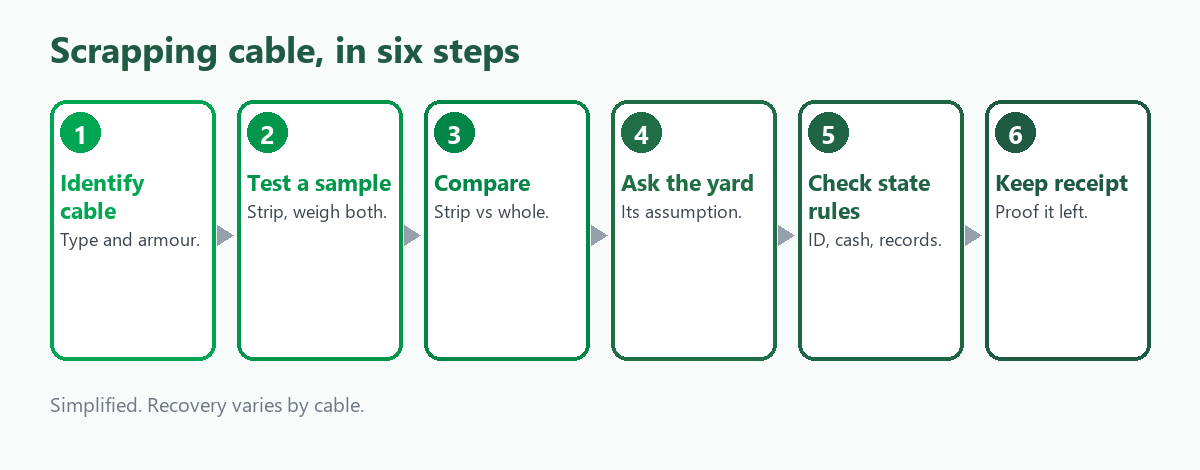
A yard pays for the copper content and not the insulation, and the sources say yards often apply a standard assumption for mixed insulated wire of around 45 percent. Stripping pays when your cable's actual recovery is better than the assumption, and does not when it is worse. Bright stripped wire is priced at the full copper rate because it needs no further processing, one source says. A Melbourne yard guide adds that prices for bare wire, insulated cable, pipe and radiators vary quite a bit, so ask the yard for its grading.
A practical method, from one forum answer, is to weigh a sample batch, strip it, weigh the copper and the insulation and work out your real yield. Compare that with the yard's assumption before you spend hours with a stripper. Our guide to scrap copper prices explains how the metal is priced.
Types of cable
- Household and installation cable. Higher copper content, according to the UK source, and the best candidate for stripping if you have a lot of it.
- Telephone, alarm and data cable. Low copper content, so it rarely repays stripping.
- Armoured and heavy power cable. The armour lowers the percentage, and the cable is heavy.
- Aluminium cable. We found no information on how it is priced.
Rules when you sell copper
Copper is a theft target, and states regulate scrap dealers differently. From search summaries and not the legislation:
- New South Wales. The Scrap Metal Industry Act 2016 is reported to require dealers to register with police, ban cash transactions and require records and reporting of suspicious activity.
- Victoria. Dealers are reported to be registered, to keep transaction records and to be banned from paying or receiving cash for scrap.
- South Australia. A Scrap Metal Dealers Bill 2025 was introduced, which would ban cash, cheque and in-kind payment and require ID and records. We did not confirm that it has passed.
- Queensland. One council submission says it is the only eastern state that does not prohibit cash payments for scrap, and cites a draft bill we did not confirm.
- Western Australia. The government said in 2020 it would regulate copper, and we did not find the current position.
The sources did not set out a separate proof-of-ownership requirement for copper sellers. Rules change, so ask your yard and the state regulator. Our state-by-state scrap business rules guide covers more.
Where ScrapTrade fits
A box of offcuts goes to the local yard. ScrapTrade may suit an electrician, a contractor or a demolition crew with a quantity of cable, stripped or unstripped, to offer to verified buyers: it costs nothing to list, there is no commission, you negotiate in chat and a bid that is accepted puts the buyer's 5 percent deposit into escrow. Businesses and individuals can sell after verification, with buyers from more than 50 countries. How cable lots are graded and whether insulated cable is taken are things we could not confirm, so ask cs@scraptrade.com.au first.
For the global view, with US, UK and EU examples, see Scrap Copper Cable: Recovery Rates Explained.
What we could not verify
- What any cable pays in Australia. We give no prices.
- Recovery rates for Australian cable. Ours are UK ranges.
- How yards price armoured or aluminium cable.
- The current dealer rules in every state. We read summaries.
- Whether ScrapTrade accepts insulated cable lots.
Frequently asked questions
Should I strip copper cable before selling?
Only if its real copper recovery beats the yard's assumption, which one source puts at about 45 percent for mixed insulated wire.
How much copper is in cable?
A UK source gives about 55 to 65 percent for clean twin and earth cable and 15 to 30 percent for telephone cable. Australian cable may differ.
Can I sell scrap copper for cash?
It depends on your state. New South Wales and Victoria are reported to ban cash payments, and rules are changing elsewhere.
Is stripped cable worth more?
Bright stripped wire is priced at the full copper rate, according to one source.
Can I list cable on ScrapTrade?
Verified sellers can list scrap. Ask support about cable lots.
Sources
- Ubersuggest keyword data, Australia, queried November 2026.
- UK recycler guides on cable recovery and stripping, a Melbourne yard guide, and forum answers, as summarised in search results.
- Press and parliamentary material on state scrap metal dealer laws, as summarised in search results. The legislation was not read.
- ScrapTrade website, accessed November 2026.
General information only, not legal or financial advice. Recovery rates and dealer rules vary.