


Second-hand solar panels have a market in Australia, but it is not an easy one. The people asking whether they can sell panels from a removed system are often an installer, a farmer or a householder, and the answer is yes, with caveats about testing, warranty and what buyers will pay. This guide explains what we found: why testing is the central problem, why warranties usually do not follow the panel, how the economics work against resale and what a seller should say in writing. Most of the sources are industry commentary and a university report, and none gives an Australian price, so we give none. It follows our guide to old solar panels. ScrapTrade runs a scrap marketplace and has a commercial interest in the scrap trade.
Testing is the gap
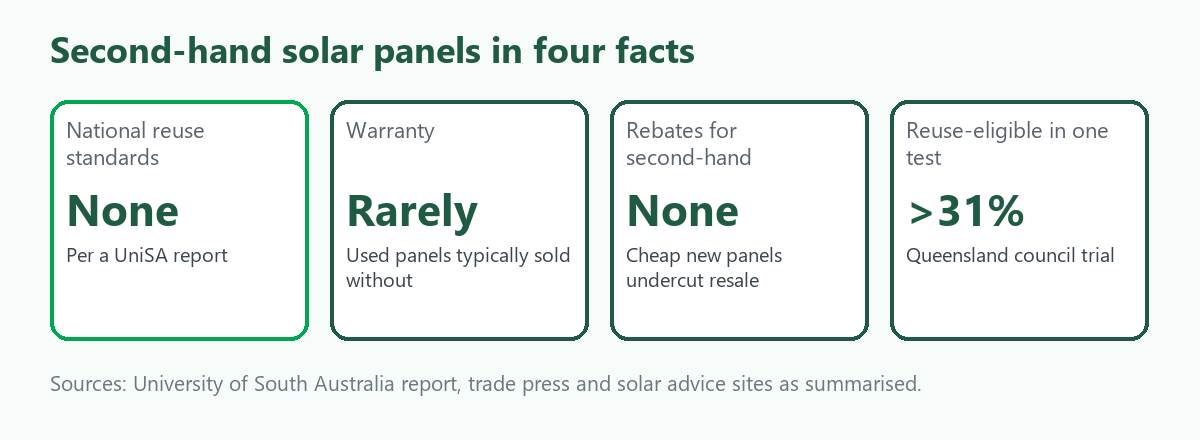
The University of South Australia's reuse report says there are no national standards for refurbishing or reusing panels, nothing to encourage second-hand systems and no legal cover for installers working with reused panels. Researchers say that variation in models and condition makes standard testing hard, and a consortium of recyclers is working on standards and test procedures to support reuse and resale. A certification from the Circular PV Alliance is described as the industry's gold standard, and a separate report says Australia is looking at resale certification. We did not review either in detail. In one Queensland council's trial, over a third were judged worth reusing instead of stripping for materials, which tells you that many panels do still work.
For a seller, the point is that a buyer cannot easily tell whether a panel is good. A recorded test result, even a simple one, is the strongest thing you can offer. We found no guide to the output loss to expect: one source treats degradation as critical, and its excerpt gave no measured rates.
No warranty, usually
Panels sold second-hand are typically sold without a warranty, and guides note that manufacturer warranties rarely transfer. Some sellers offer their own limited warranty after assessing each panel, and one offers five years. If you are selling, say plainly that no warranty applies unless you are giving one, and read the manufacturer's terms to see whether anything transfers.
The economics
There are no equivalent rebates or credits for installing second-hand panels, according to the sources, and cheap new panels undercut resale. One industry commentary argues that packaging, handling and freight put used panels on a par with new ones in cost. That is an argument and not a figure, and we could not check it. The practical result is that resale is easiest locally, to a buyer who can collect, for a purpose such as an off-grid shed, a pump or a community project. A NSW coastal council and volunteers have run a project repurposing second-hand panels locally, according to one report.
What to put in a listing
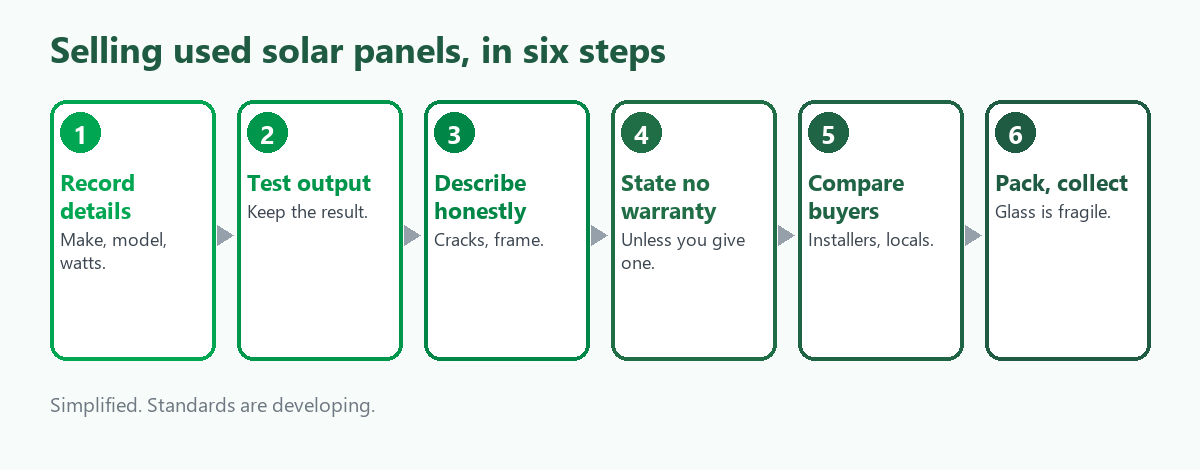
- Make, model and rated power. From the label on the back.
- Age and where they came from. A rooftop system, a roof that was replaced or a farm array.
- What you tested, and the result. A measured output is better than a guess.
- Physical condition. Cracks, chips, frame damage and discolouration.
- That no warranty applies. And whether you offer any guarantee.
- How they will be collected and packed. Glass is fragile and panels are heavy.
Who might buy
- Installers and reuse programs. Some recyclers and consortia are working on resale, and an installer who handles removals may have buyers.
- Local buyers. Off-grid and hobby users, and community projects.
- Marketplaces and classifieds. More control over price, with the work of describing and moving them on you.
- Recyclers. If the panels do not test well.
Where ScrapTrade fits
A handful of panels is a local sale and not a ScrapTrade job. For an installer clearing a whole season's removals, or a site selling frames, cable and inverters along with the panels, the marketplace puts the lot in front of verified buyers abroad as well as at home. Posting is free and no commission is taken. Price and terms are settled in chat, and the buyer's 5 percent deposit is held in escrow once a bid is accepted. Sellers need verification, whether a business or an individual. Whether working panels are accepted, and how a test result would be shown, is not something we could confirm, so ask cs@scraptrade.com.au before listing.
What we could not verify
- What any panel sells for. We give no prices.
- Output degradation rates. We found none.
- How resale certification works in practice.
- Clean Energy Council or installer rules for used equipment. The search did not return them.
- Whether ScrapTrade accepts working panels.
Frequently asked questions
Can I sell panels from a system I removed?
Yes, there is a second-hand market. There are no national standards, so a test record helps.
Do second-hand panels come with a warranty?
Usually not. Manufacturer warranties rarely transfer, and some sellers give their own.
Are used panels cheaper than new?
Cheap new panels undercut them, and one commentary says freight and handling erase the gap.
How do I know if a panel still works?
Test its output. We found no standard method, and standards are being developed.
Is ScrapTrade the right place for a few panels?
Not really. It suits larger lots, and working panels are unconfirmed, so ask support.
Sources
- Ubersuggest keyword data, Australia, queried November 2026.
- University of South Australia reuse report, trade-press coverage of resale certification and the Circular PV Alliance, and Australian solar advice sites, as summarised in search results.
- ScrapTrade website, accessed November 2026.
General information only, not technical, legal or financial advice. Standards are still developing.