

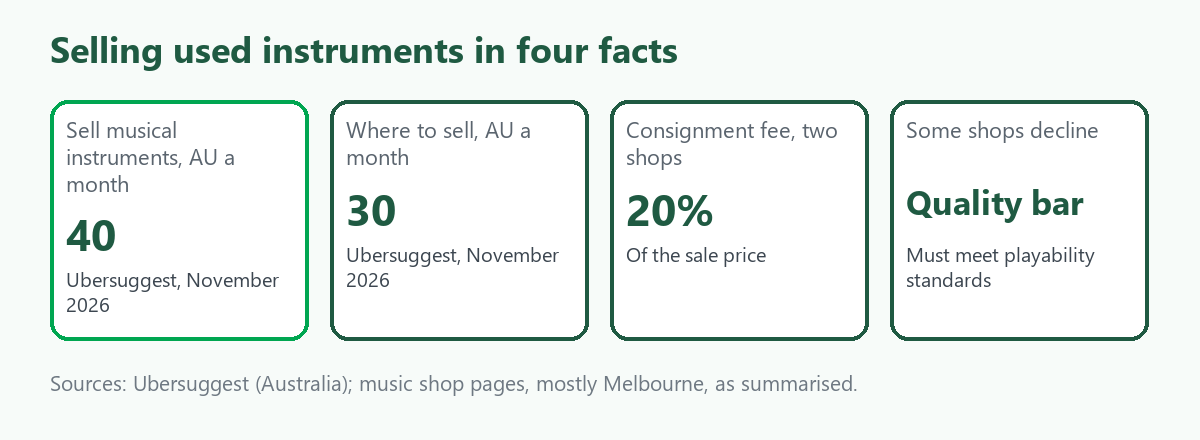
"Sell musical instruments" is searched about 40 times a month in Australia, according to Ubersuggest, and "where to sell musical instruments" about 30. The people searching have a guitar, keyboard, drum kit or piano they no longer play. Unlike the metal and electronics we write about most, instruments are resale goods, and the right route depends on whether you want a quick sale or the best price. This guide covers what we could find on the shops and routes in Australia, what fees look like and what a seller should ask. Most of our sources are music-shop pages, mainly in Melbourne, so we do not know that their terms hold elsewhere. We give no prices. It sits beside our guide to selling a used phone, which has the same trade-in versus resale question. ScrapTrade runs a scrap marketplace and has a commercial interest in the scrap trade.
Three ways to sell through a shop
- Outright purchase. Some stores buy guitars upfront as well as selling on consignment. It is quicker, and in our reading the price is lower.
- Consignment. The shop displays the instrument and takes a fee when it sells. One store says the seller receives the final sale price minus a 20 percent consignment fee, and a review of another says it takes 20 percent when the item sells, so 20 percent looks common in what we saw. Another store displays consigned items both online and in the shop. In our reading, consigning usually pays more than selling outright, because the shop is not taking the risk of holding stock, but it takes longer and not every instrument sells.
- Trade-in. Some shops trade in used gear against new. We could not confirm the terms of any, so ask.
Shops decline instruments
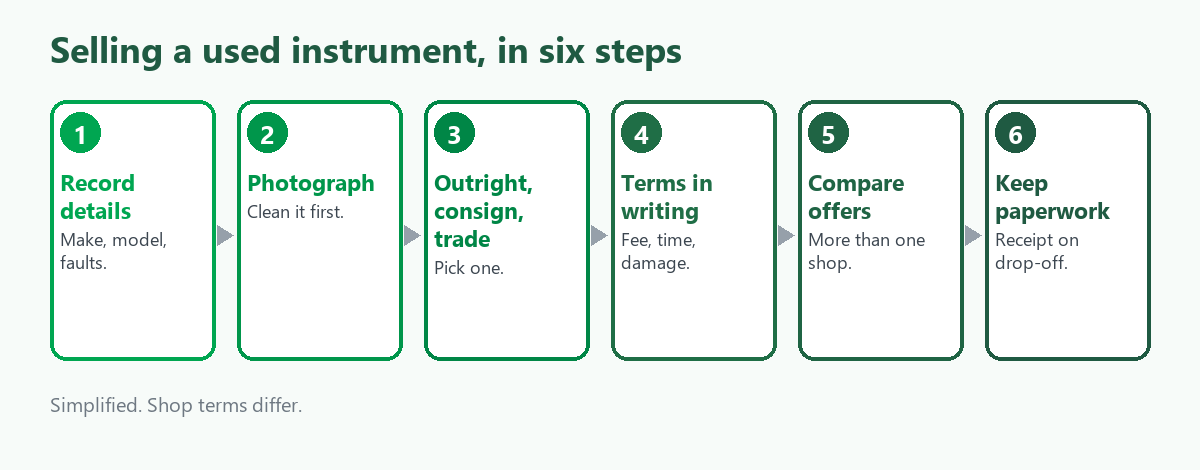
One South Melbourne store says it does not take every instrument offered, because gear must meet its standards for quality and playability. Expect the same from others. Before you visit, clean the instrument, replace dead strings or obvious wear if cheap, and be ready to tell the shop about faults. A shop that finds an undisclosed problem will lower the offer or refuse.
Pianos
Pianos are a different market. One Melbourne dealer says it buys upright and grand pianos directly from private owners, schools, churches and estates, which is the sort of buyer to call first for an instrument that is too big to carry in. We found nothing on what pianos sell for, and nothing on the cost of moving one, which is a real cost, so ask any buyer who moves it and who pays.
Online
A free online marketplace for instruments, Lonely Instruments, was mentioned in coverage we found. We did not review it. The results did not cover general classifieds sites, giving instruments away or serial-number valuation, so we say nothing about them here. Selling privately means you handle the photos, the questions, the meetings and the payment risk.
What to settle in writing
- The price or fee. What do you get if it sells, and when?
- How long they will keep it. And what happens to an unsold instrument.
- Insurance and damage. Who is responsible if the instrument is damaged in the shop?
- Paperwork. Ask for a receipt or an acknowledgement when you leave an instrument. A review we saw complained about missing documentation, so do not leave an instrument without a record.
- What happens to cases and accessories.
When an instrument is not worth selling
Some instruments have more value to a family than to a buyer, and some are broken beyond repair. Our searches did not cover donation, and we found nothing on scrap value, which would be small for most instruments. A piano that nobody wants is a removal problem and a materials problem, and we did not research it.
Where ScrapTrade fits
One guitar belongs with a music shop, and ScrapTrade is not an instrument marketplace. It may interest a school, a venue or a music retailer clearing a lot of equipment, or someone with sorted metal such as brass and stainless parts, because it is free to list with no commission, price and terms are agreed in chat and the buyer's 5 percent deposit is held in escrow once a bid is accepted. Businesses and individuals can sell once verified, and buyers in more than 50 countries bid. We could not confirm that working instruments are accepted, so ask cs@scraptrade.com.au before you plan around it.
What we could not verify
- What any instrument sells for. We give no prices.
- Consignment fees outside the stores we saw. The 20 percent figure is two shops' and a review.
- Trade-in terms.
- Rules or valuation tools for serial numbers, classifieds or giveaways.
- Whether ScrapTrade accepts working instruments.
Frequently asked questions
Where is the best place to sell a used guitar?
A music shop that buys or consigns, or a private sale. Compare an outright offer with a consignment quote.
How much is a consignment fee?
One store says 20 percent of the sale price, and another's reviewer reports the same. Others differ, so ask.
Will a shop take any instrument?
No. One store says it only takes instruments that meet its quality and playability standards.
Who buys pianos?
Some dealers buy uprights and grands from private owners, schools, churches and estates. Ask who moves it.
Can I list an instrument on ScrapTrade?
Verified sellers can list scrap. We could not confirm working instruments, so ask support.
Sources
- Ubersuggest keyword data, Australia, queried November 2026.
- Music shop pages, a music-industry directory, a piano dealer's page and a customer review, mostly Melbourne, as summarised in search results.
- ScrapTrade website, accessed November 2026.
General information only, not financial advice. Shop terms vary.