

The Word "Scrap" Is Getting a Makeover
Ask most people what scrap is, and they'll tell you it's the stuff left over when something breaks. The twisted car frame at the wrecking yard, the old copper piping ripped out during a renovation, the tangle of aluminium cans crushed at the kerb. Scrap, in the popular imagination, lives at the bottom of the value chain.
That understanding is decades out of date.
In 2025, the global scrap metal market is valued at over $435 billion USD and is projected to surpass $730 billion by 2032. More steel is recycled every year than any other material on Earth. Recycled aluminium requires 95% less energy to produce than smelting new aluminium from raw bauxite ore. And in Australia alone, metals achieve a recovery rate of 90% — making them the most successfully recycled material in the entire country, ahead of paper, plastic, and glass.
Scrap is not rubbish. Scrap is a raw material. And for the first time, an Australian-built digital platform — ScrapTrade — is building the infrastructure to trade it like one.
A Brief History of Scrap (For People Who've Never Thought About It)
The concept of scrap metal is as old as metalworking itself. Ancient Romans melted down worn-out bronze tools and coins to forge new ones. During both World Wars, civilian governments ran national scrap drives — asking families to donate pots, pans, and iron railings to the war effort. "Scrap drives" were patriotic acts.
After the wars, scrap collection became an industry. Travelling scrap collectors — in Australia, often called "scrappers" or "totters" — would buy unwanted metal from households and businesses, haul it to a local dealer, and the dealer would sell on to foundries and steel mills. The whole system ran on cash, personal relationships, and a network of scrap yards that operated in much the same way for seventy years.
This meant three things:
Prices were opaque. There was no publicly accessible price for a tonne of copper pipe or structural steel offcuts. You got what the local dealer would offer, and if you didn't know the market, you often got less than you should have.
Access was local. Sellers were limited to who was within driving distance. Buyers competed only with others in their region. National or international buyers couldn't easily reach small sellers.
Trust was personal. The industry ran on handshakes, long-standing relationships, and reputation. For insiders, this worked. For newcomers, it was opaque and hard to enter.
This was the scrap industry as recently as 2015. In many parts of the world, it still is.
The Numbers That Tell a Different Story
Before we look at where scrap is going, it's worth sitting with where it already is.
Australia
- Australia's scrap metal sector was valued at $4.5 billion AUD in 2024, comprising 152 businesses (IBISWorld)
- The overall Australian metal recycling market reached $5.07 billion USD in 2024 and is forecast to grow to $7.17 billion USD by 2033
- Australia exported 1.71 million tonnes of ferrous (iron-based) scrap in the most recent full year of data
- 9 in 10 tonnes of metal waste in Australia is recovered and recycled — the highest rate of any material category (DCCEEW National Waste Database, 2024)
- The construction sector accounts for 36% of recycled metal consumption, driven by infrastructure investment including a $16.5 billion AUD government commitment in the 2024–25 Federal Budget
- Australia has a national target to achieve an 80% resource recovery rate by 2030
Globally
- The global scrap metal recycling market is valued at approximately $435 billion USD in 2025
- It is projected to grow to $614 billion USD by 2034 at a compound annual growth rate (CAGR) of 3.9%
- Global steel scrap volume reached 543 million metric tonnes in 2024 and is forecast to hit 727 million metric tonnes by 2030
- 72% of all steel produced in the United States now comes from scrap steel
- The industry recycles over 100 million tonnes of steel annually, reducing the world's carbon footprint substantially
- The Asia-Pacific region dominates, holding over 51% of the global market share in 2025, driven by China and India's massive infrastructure programmes
These are not numbers from a cottage industry. These are the numbers of a foundational global commodity. The question was never whether scrap mattered — it's always mattered enormously. The question has always been: why is it still traded like it's 1975?
The Broken System That Billions Flowed Through
For an industry this large, the infrastructure supporting it has been surprisingly primitive. As recently as 2023, the majority of scrap deals worldwide were negotiated by phone call, confirmed by email, and tracked on spreadsheets.
The consequences were significant and well-documented:
For sellers — whether a construction company clearing a demolition site, a manufacturer with steel offcuts, or an individual with a shed full of old copper — there was no way to know if they were getting a fair price. The only benchmark was whatever the local dealer offered.
For buyers — foundries, steel mills, and recyclers looking for specific grades and volumes of material — sourcing was time-consuming and geographically limited. Building a reliable supply chain meant cultivating long-term relationships with specific dealers in specific regions. Expanding that network meant phone calls and site visits.
For the market — a 2022 IBISWorld analysis of the US scrap market found that inefficiencies in deal flow and price tracking contributed to cost overhangs amounting to nearly 12% of annual revenue for small-to-medium operators. That's money disappearing into friction.
A 2025 analysis by McKinsey & Company found that businesses operating with transparent pricing models build trust twice as fast with trading partners and reduce order friction by 40%. The scrap industry was systematically leaving both trust and money on the table.
The technology to fix this existed. It simply hadn't been applied to scrap.
What Digital Transformation Actually Means for Scrap
The phrase "digital transformation" gets thrown around a great deal. In the context of scrap, it means something very specific: replacing opacity with transparency, local relationships with verified networks, and phone calls with structured data.
Digital scrap trading platforms do several things the old model couldn't:
Standardised listings. When scrap material is listed on a digital platform with standardised grade categories — HMS 1, HMS 2, Zorba, Birch/Cliff, Braziery copper, and so on — a buyer in Melbourne can evaluate and bid on a lot from Brisbane with confidence, because the classification is clear and verifiable.
Competitive pricing. When multiple verified buyers can see the same listing and submit bids, the seller gets a market price rather than a dealer's offer. Research consistently shows this results in better returns for sellers, particularly smaller ones who previously lacked negotiating power.
Verified counterparties. Digital platforms can enforce Know Your Customer (KYC) and licensing checks at sign-up, meaning every party on the platform has been verified as a legitimate business. This addresses one of the oldest problems in scrap trading — the difficulty of vetting an unfamiliar buyer or seller.
A data trail. Every completed trade on a digital platform generates structured data: what material, what grade, what price, what volume, when, between whom. Over time, this builds the market intelligence that the scrap industry has never had — real pricing benchmarks, demand signals, and trend data that helps everyone from individual sellers to large manufacturers plan more effectively.
Scale without geography. A manufacturer in Townsville with excess stainless steel doesn't need to limit their search to local dealers. A buyer in Sydney who needs a specific alloy for production can source it nationally. Digital platforms collapse the geographic constraints that have defined scrap trading for a century.
ScrapTrade: Australia's Digital Home for Scrap
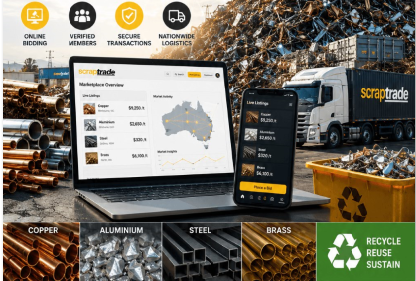
Into this context comes ScrapTrade — a platform built specifically for the Australian scrap and recyclable materials market.
ScrapTrade is not simply a classifieds board for old metal. It is a structured digital marketplace where buyers and sellers of scrap and recyclable materials — across metals, plastics, paper, glass, and more — can connect, verify, negotiate, and transact in a single environment.
The platform operates on a principle that sounds simple but has historically been absent from the industry: every participant should know who they're dealing with, what they're buying or selling, and what the market says it's worth.
What ScrapTrade offers sellers
For businesses and individuals with scrap material to move, ScrapTrade provides:
- Access to a national buyer network — not just whoever happens to be in your suburb
- Competitive bids — multiple buyers competing for your material, rather than a single take-it-or-leave-it offer
- Transparency — visibility of what comparable material is trading for across the market
- Efficiency — listing materials and receiving bids without the time cost of making individual calls to dealers
What ScrapTrade offers buyers
For recyclers, processors, foundries, and manufacturers sourcing secondary materials, ScrapTrade provides:
- Consistent access to supply — a live marketplace of available materials rather than a static supplier list
- Grade and volume filtering — the ability to search for specific material types, grades, and quantities
- Verified suppliers — every seller on the platform has passed through a verification process
- Reduced sourcing cost — less time spent making calls, more time evaluating real options
The broader mission
Beyond individual trades, ScrapTrade is building something larger: a structured record of the Australian scrap market. Every transaction on the platform contributes to an emerging dataset that, over time, will give the industry something it has never had — genuine, transparent price discovery based on actual deals.
This matters not just for individual businesses but for the entire Australian circular economy. When scrap is traded efficiently and transparently, more of it stays in the domestic supply chain. More value is captured locally. And the environmental case for using secondary materials over virgin resources becomes easier to make when pricing is consistent and supply is reliable.
Scrap Is Now a Strategic Resource — Not an Afterthought
One of the most significant shifts in the global scrap industry over the past decade is the recognition by major manufacturers and governments that scrap is not a byproduct — it is a strategic raw material.
This shift has been driven by several converging forces:
The energy maths are undeniable
Recycling one tonne of steel saves the equivalent of 1.1 tonnes of CO₂ emissions and 40% of the energy required to produce new steel from iron ore. Recycling aluminium requires 95% less energy than smelting it from bauxite. Recycling copper is significantly more energy-efficient than mining and refining primary ore.
At a time when energy costs are high and carbon commitments are binding, the case for secondary materials writes itself.
The electric arc furnace revolution
The steel industry is undergoing a fundamental transition. Historically, around 70% of steel was produced using the Basic Oxygen Furnace (BOF) method, which relies predominantly on iron ore and coal. The remaining 30% was produced using Electric Arc Furnaces (EAF), which use scrap as their primary input.
That ratio is reversing. EAF technology is cleaner, more flexible, and increasingly cost-competitive. In EAF steelmaking, scrap comprises up to 45% of the input material. As the world's steel mills transition to EAF — and Australia's own planned facilities, including the Alter Steel mill in Queensland's Pinkenba, come online — demand for high-quality, reliably graded scrap will grow substantially.
Sims Limited, Australia's largest scrap operator, has already signed a memorandum of understanding to supply up to 550,000 tonnes of ferrous scrap per year to Alter Steel when the mill opens in 2028. That is the scale of demand now taking shape domestically. The question is whether Australia's scrap supply chain — and its trading infrastructure — can meet it.
The export debate
Australia currently exports approximately 1.07 million tonnes of unprocessed ferrous scrap annually. The Australian Steel Institute and National Waste & Recycling Industry Council have argued strongly that this is economically and strategically counterproductive: processing 10,000 tonnes of scrap domestically generates $4.8 million in economic value and 37.2 jobs, compared to just $1.3 million and 10.3 jobs from exporting it raw.
As domestic EAF capacity expands, the pressure to retain and process scrap within Australia will only increase. Digital platforms that make domestic trade more efficient are not just a convenience — they are infrastructure for that strategic ambition.
The Environmental Case: Why Scrap Matters for the Planet
This section is for anyone who has ever wondered whether recycling metals actually makes a meaningful difference. The answer is: more than almost anything else we do.
Metals are uniquely recyclable. Unlike plastics, which degrade in quality with each recycling cycle, and paper, which can only be recycled five to seven times before the fibres break down — metals can be recycled indefinitely without losing strength or quality. A steel beam from a demolished building from the 1950s, when recycled, produces steel identical in quality to newly mined material.
The energy savings are enormous. Producing aluminium from recycled scrap uses 95% less energy than smelting it from bauxite ore. For steel, the energy saving is around 60–70%. For copper, recycled material requires significantly less energy than smelting primary ore. Across an industry that handles hundreds of millions of tonnes annually, those percentages represent staggering reductions in energy consumption and carbon emissions.
Australia is doing well, but there is room to do better. At a 90% metal recovery rate, Australia leads the world in recovering metals from commercial and industrial streams. But the household recovery rate lags significantly — only around 72% of metal from Municipal Solid Waste is recovered, compared to 95% from construction and demolition. Bridging that gap could recover hundreds of thousands of additional tonnes of metal annually.
Digital trading helps the environment. When scrap is priced transparently and traded efficiently, it is less likely to end up in landfill. When sellers can access competitive buyers nationally, material that might otherwise be uneconomical to move becomes tradeable. The infrastructure of a well-functioning scrap marketplace is, in a direct sense, environmental infrastructure.
The Definition of Scrap Is Already Changing — Whether the Industry Catches Up or Not
The transformation of scrap from "waste" to "strategic resource" is not a future event. It is happening now. It is visible in:
- The $16.5 billion AUD Australia is investing in infrastructure — all of which will generate ferrous and non-ferrous scrap as the old gives way to the new
- The planned expansion of EAF steelmaking, creating industrial-scale domestic demand for processed scrap
- The EU's Circular Economy Action Plan, passed in May 2025, with binding targets for specific material categories including scrap metals
- China's reclassification of high-quality scrap under standard GB/T 39733-2024, easing importation and treating premium recycled steel not as waste but as certified industrial feedstock
- India's removal of basic customs duty on non-ferrous metal scrap in the 2025 Union Budget
- The recognition by automotive manufacturers that recycled aluminium — using 95% less energy than virgin — is essential to making electric vehicles economically viable
In every one of these developments, scrap is treated as something valuable, something to be secured, something to be managed strategically. The old definition — rubbish, leftovers, waste — is being retired by the weight of economic reality.
Why Australia Needs ScrapTrade
Australia is in a peculiar position. It produces substantial quantities of valuable scrap — from its mining sector, its construction industry, its manufacturing base, and its growing volume of end-of-life consumer goods. Its metal recovery rates are among the highest in the world. And it is on the cusp of building significant new domestic demand for recycled feedstock.
But its scrap trading infrastructure has not kept pace.
The industry's 152 businesses (IBISWorld, 2024) are largely operating through traditional channels — direct relationships, phone networks, and local dealings. Price discovery is opaque. National supply and demand signals are hard to read. Smaller sellers and buyers lack the scale to maintain the broad networks that larger players take for granted.
ScrapTrade exists to fix that gap. Not by replacing the relationships that the scrap industry rightly values — but by giving those relationships a digital home where they can scale, where new ones can be formed, and where the whole market benefits from being able to see itself clearly.
The analogy that works is property. Before real estate listing platforms existed, buying or selling a home meant relying on local agents and word of mouth. The agent knew the local market; the buyer didn't. Platforms didn't eliminate agents — they made the market more efficient, more transparent, and more accessible. ScrapTrade is doing the same thing for scrap.
The Road Ahead
The scrap industry globally is at an inflection point. Digital platform adoption among small and medium enterprises in the sector is forecast to triple by 2027 as legacy broker models adapt. Carbon-linked pricing — where verified "green" scrap commands a premium because its provenance and environmental credentials are documented — is expected to emerge as a significant market feature by 2026, potentially adding $30–50 USD per tonne for certified material.
For Australia specifically, the road ahead runs through:
Domestic capacity expansion. As EAF mills like Alter Steel come online later this decade, they will need reliable, high-quality, domestically sourced scrap. Platforms that can aggregate and deliver that supply efficiently will be foundational to those mills' operations.
Transparency as a competitive advantage. As ESG reporting requirements tighten — particularly for large manufacturers and listed companies — the ability to document the provenance and carbon credentials of recycled inputs becomes commercially important. Digital trading records, built trade by trade on platforms like ScrapTrade, provide exactly that documentation.
Regional equity. One of the least-discussed problems in Australian scrap is geographic imbalance. Sellers in regional and rural areas have historically had fewer options than those in capital cities — often accepting lower prices simply because fewer buyers were within reach. National digital platforms break that dynamic.
Conclusion: Scrap Was Never Rubbish. Now, Everyone Knows It.
The word "scrap" carries old baggage — images of junkyards, worthless leftovers, the stuff nobody wanted. That image is being replaced, trade by trade, tonne by tonne, by a more accurate one.
Scrap is the raw material that produces 72% of American steel. It is the reason recycling aluminium uses a fraction of the energy of smelting it from ore. It is a $435 billion global market growing at nearly 5% per year. It is central to every serious country's decarbonisation strategy. It is, in the plain language of the market, valuable.
ScrapTrade is not inventing that value. The value was always there. What ScrapTrade is building is the transparent, accessible, digitally connected marketplace that the value deserves — one where a construction company in Cairns can reach a buyer in Adelaide, where a small recycler in regional Victoria can see the same market data as a Sydney processor, and where scrap, finally, is treated with the seriousness of the commodity it has always been.
The definition of scrap is changing. It was never waste. It just lacked the platform to prove it.
ScrapTrade is Australia's dedicated digital marketplace for scrap and recyclable materials. Whether you're looking to sell excess material, source secondary metals for manufacturing, or explore Australia's emerging circular economy, ScrapTrade connects verified buyers and sellers in a transparent, national marketplace.
Explore the ScrapTrade marketplace →
Sources and References
- IBISWorld: Australia's Scrap Metal Recycling Industry Report, 2024
- IMARC Group: Australia Metal Recycling Market, 2024–2033
- Department of Climate Change, Energy, the Environment and Water (DCCEEW): National Waste and Resource Recovery Database, December 2024
- Australian Steel Institute: Scrap Metal Strategic Resource Submission, 2024–2025
- Global Market Insights: Recycled Metal Market Report, 2024–2034
- Fortune Business Insights: Scrap Metal Recycling Market, 2025–2034
- Technavio: Scrap Metal Recycling Market Analysis, 2025–2029
- Straits Research: Metal Recycling Market Report, 2025–2033
- Recycling International: Australia's metal scrap market gathers pace, January 2026
- TDC Ventures: Digital Transformation in Scrap Metal Trading, 2025
- World Steel Association: Global Steel Statistics, 2024