


22 October 2026. ScrapTrade has launched two new ways to work in the scrap trade without owning a yard: the scrap agent and the scrap broker. An agent is hired by a seller or buyer to run their listings or deal for a commission. A broker sources scrap from an original seller and resells it on the platform for a margin. Both are aimed at people starting out who want to build an online scrap business without a large upfront outlay.
The two roles sound alike and work differently, and the difference decides how you are paid, who carries the risk and how much money you need to begin. This article sets out how each role works, with example figures that are invented to show the arithmetic, what a start-up really costs in each, and what to check before you begin. It is a company announcement published by ScrapTrade, and it does not promise any income.
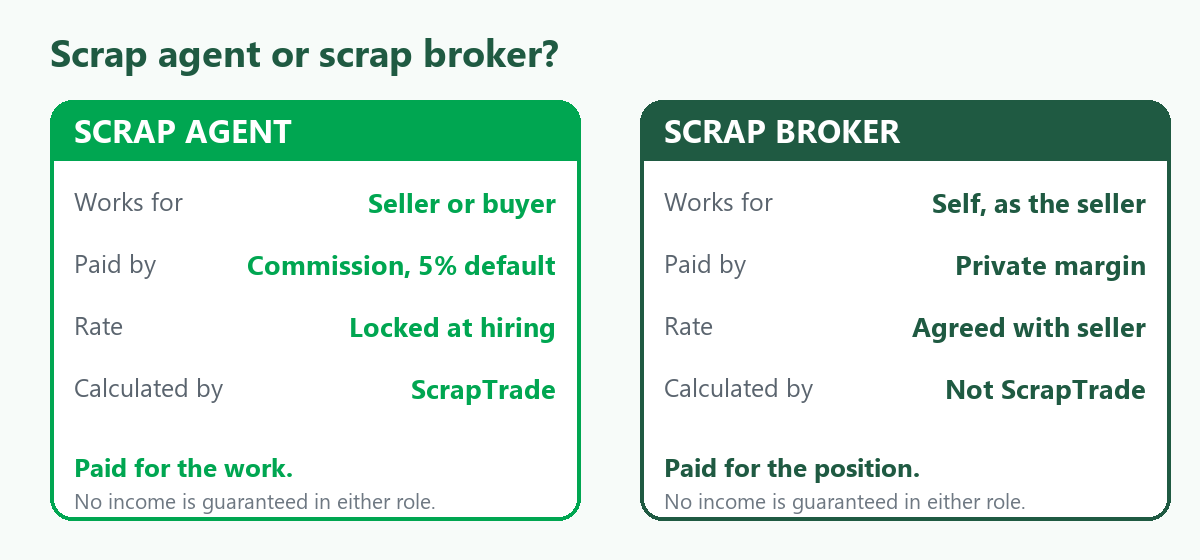
The key difference: an agent is paid for work done for someone else, at a percentage fixed when they are hired. A broker is paid for taking a position in the material, at a margin that can be larger, smaller or negative.
What is new
| Scrap agent | Scrap broker | |
|---|---|---|
| Who they work for | A seller or buyer who hires them | Themselves, as the seller on the platform |
| What they do | Create listings or requests, or run the deal, for the client | Source scrap from an original seller and list it for sale |
| How they are paid | A commission percentage set at hiring, locked once confirmed | The difference between the original seller's price and the selling price |
| Rate | 5% default, editable before confirmation | Arranged privately with the original seller |
| Does ScrapTrade calculate it? | Yes, and it appears in the payment breakdown | No. It does not calculate, deduct or distribute it |
| Platform fees | Apply to the deal as usual | Standard platform fees apply |
The scrap agent
What an agent does
A scrap agent is hired by a seller or a buyer to do the listing and dealing work for them. A seller with a load of mixed metal and no spare hours can hand over describing, photographing and publishing the material and answering buyers. A buyer who needs a particular grade can hand over the searching, shortlisting and posting of a request. The client stays the party to the deal, and the agent works for them under a hiring agreement.
The hiring agreement records who hired whom, the agent's commission, the scope of the work, the confirmation date and the status. The scope is chosen by the client. Common choices are:
- Listings only: the agent describes, photographs and publishes the material, and the client handles buyers and the deal.
- Deal only: the client creates the listing, and the agent handles questions, negotiation and collection coordination.
- Listing and deal: the agent does both, within the limits the client sets.
How the agent is paid
The commission is a percentage, and the rules are strict. The hirer sets it before the agreement is confirmed. ScrapTrade suggests a default of 5%, which the hirer can change. Once the agreement is confirmed the rate is locked for that agreement, and a different rate means a new agreement, with the original kept on record. The platform calculates the commission and shows each party the breakdown for their own part of the deal.
Who pays depends on who hired the agent:
| Seller hires the agent | Buyer hires the agent | |
|---|---|---|
| Who pays the commission | The seller | The buyer |
| How it is paid | Deducted from the seller's proceeds at settlement | Added on top of the purchase price |
| Effect on the other party | The buyer's price is unchanged | The seller's price is not reduced |
Worked examples
These figures are invented. They are not a price guide, and platform charges and taxes are not included.
| Seller hires the agent | Amount |
|---|---|
| Sale amount | US$1,000.00 |
| Agent commission at 8.5% | US$85.00 |
| Seller proceeds, before platform charges | US$915.00 |
| Buyer hires the agent | Amount |
|---|---|
| Purchase price of the listing | US$1,000.00 |
| Agent commission at 7.5% | US$75.00 |
| Total payable by the buyer | US$1,075.00 |
| Seller still receives, before platform charges | US$1,000.00 |
The scrap broker
What a broker does
A broker sources scrap from an original seller and resells it through ScrapTrade. To the platform the broker works like any other seller, with the same listing, order and payment tools, plus a broker classification on the account and a reference to the original seller on each listing. The original seller can be a registered ScrapTrade user or an outside business, subject to the platform's verification requirements.
The money works differently from an agent's. The broker agrees a price or commission with the original seller privately, lists the material at their own price and keeps the difference, before their own costs. ScrapTrade does not calculate that margin, take a share of it or pay any of it to the original seller, and the broker settles with the original seller under their own agreement.
Worked example
Again these figures are invented, and platform fees and tax are still to come off.
| Line | Amount |
|---|---|
| Original seller's agreed price | US$800 |
| Broker's listed selling price | US$1,000 |
| Potential gross margin | US$200 |
| Transport and handling, for example | -US$100 |
| Left before platform fees and tax | US$100 |
What a broker is responsible for
On the platform the broker is the seller, which brings the seller's responsibilities whatever was agreed privately:
- The authenticity of the listing. The material, quantity and condition must match what was described.
- Authority to sell. The broker needs the right to sell the material from the person who owns or controls it, and it is best confirmed in writing.
- Fulfilling seller obligations, including delivery or collection as described.
- Paying the original seller under their own agreement.
What starting up really costs
The headline is a low-investment start, and it is true in a specific way. Neither role needs a yard, machinery or a lease. But low is not zero, and the two roles differ.
| Cost | Agent | Broker |
|---|---|---|
| Stock | None. The material belongs to the client | Depends on the deal. A broker who pays the original seller before the sale carries that cost |
| Phone, internet, time | Yes | Yes |
| Travel to inspect material | Possibly | Possibly |
| Transport, handling, storage | Usually the client's | Usually the broker's, and they come out of the margin |
| Platform fees | Apply to the deal | Standard fees apply to the sale |
| Tax | Commission may be taxable income | Margin may be taxable income |
| Risk of a loss | Low on the material, but time can go unpaid if a deal fails | Real. A buyer cancelling after the broker has paid the seller leaves the broker holding the cost |
The practical advice follows from the table. If you have little money to risk, the agent role is the safer way to start, because you are paid for effort and do not buy material. If you have contacts who produce scrap and can judge a market, brokering offers a bigger upside and a real downside. Neither promises income, and results depend on the deals you find, the price of the metal, the grade of the material and your costs.
Who the new roles are for
| If you are... | Consider |
|---|---|
| New to scrap with no capital | Agent. Learn grades and pricing while working for clients |
| A seller short of time or unsure how to describe a load | Hiring an agent |
| A buyer who needs specific material but not the search | Hiring an agent |
| Someone with a network of businesses that produce scrap | Broker, or agent if you would rather not hold the position |
| Already trading and wanting a new income line | Either, stating which role you are in on each deal |
Rules and good practice
- Keep deals on the platform. Moving a deal or payment off the platform takes it outside the process that records the order, the commission and the settlement.
- Do not misstate the material. Overstated grade, quantity or condition leads to disputes and refunds.
- Do not promise what you do not control. A price or a buyer that depends on someone else's agreement should be described that way.
- Declare conflicts. If you act as both agent and broker, tell everyone which role you hold on each deal.
- Know the local rules. In many places buying scrap from the public is a regulated activity. Check your council, state regulator or national equivalent before you buy from the public, keep records and prefer traceable payment.
Our guide to starting a scrap metal business covers registration, licensing basics and sourcing in more detail.
How to start
- Learn the platform. Read how ScrapTrade works and browse the marketplace to see how listings are described and priced.
- Choose one material you can grade. See how to grade scrap metal.
- Learn the price. Use the material prices before you quote anyone.
- Register. Create your ScrapTrade account and complete verification.
- Put the terms in writing. As an agent, confirm the scope and commission in the hiring agreement. As a broker, agree authority, price, payment timing and dispute handling with the original seller.
- Start with a small deal, so a mistake is cheap.
What to confirm first
- Platform fees. Standard fees apply to deals, separate from an agent's commission and a broker's margin. We have not stated a rate here, so check the current fee structure for your account.
- Cancellations and refunds. How a cancelled, refunded or disputed deal affects an agent's commission should be settled in the hiring agreement before you confirm.
- Protections on agent deals. A deal an agent handles still runs on ScrapTrade. If you want to know how the platform's usual protections apply to it, ask the ScrapTrade team before you confirm a hiring agreement.
- Local rules and tax. Licensing and tax depend on where you operate. Speak to your regulator and a tax adviser.
Frequently asked questions
What is a scrap agent?
Someone hired by a seller or buyer to create listings or run a deal for them, for a commission set at hiring.
What is a scrap broker?
A seller who sources scrap from an original seller and resells it on ScrapTrade, with a margin arranged privately between them.
How much commission does an agent earn?
The hirer sets it. The default is 5%, which can be changed before the hiring agreement is confirmed and is locked afterwards.
Does ScrapTrade take a share of a broker's margin?
No. It does not calculate, deduct or distribute it. Standard platform fees apply to the sale.
Do I need money to start?
An agent does not buy stock but still bears their own costs. A broker may need to pay the original seller before the sale, depending on the agreement.
Is any income guaranteed?
No. Income in either role depends on the deals you find, the price of the metal, the grade of the material and your costs.
This is a company announcement published by ScrapTrade on 22 October 2026. The dollar figures are invented examples, not forecasts. Features, fees and availability can change, so check the site for current details. It is general information, not financial, tax or legal advice.