

22 October 2026. ScrapTrade has launched its online platform for buying and selling scrap, and it is now live. The marketplace, operated by Australian-registered company Mobeius Technologies Pty Ltd, lets sellers list scrap by fixed price, live auction or in reply to a buyer's request, and holds payment in escrow until a deal is confirmed. It is open to traders in Australia and to buyers and sellers elsewhere.
This article explains what has launched, how a deal runs from listing to payment, what protections are built in and where their limits are, and how to start. It is a company announcement published by ScrapTrade, so read it as the operator's account of its own platform. Where we describe a limit, we say so.
The idea in one line: instead of one yard giving one quote on one day, a listing is seen by many verified buyers at once, so the price reflects real competition, and the money is held safely until the deal is done.
What has launched
- Three ways to trade: fixed-price listings, live auctions and buyer requests on the Wanted Board.
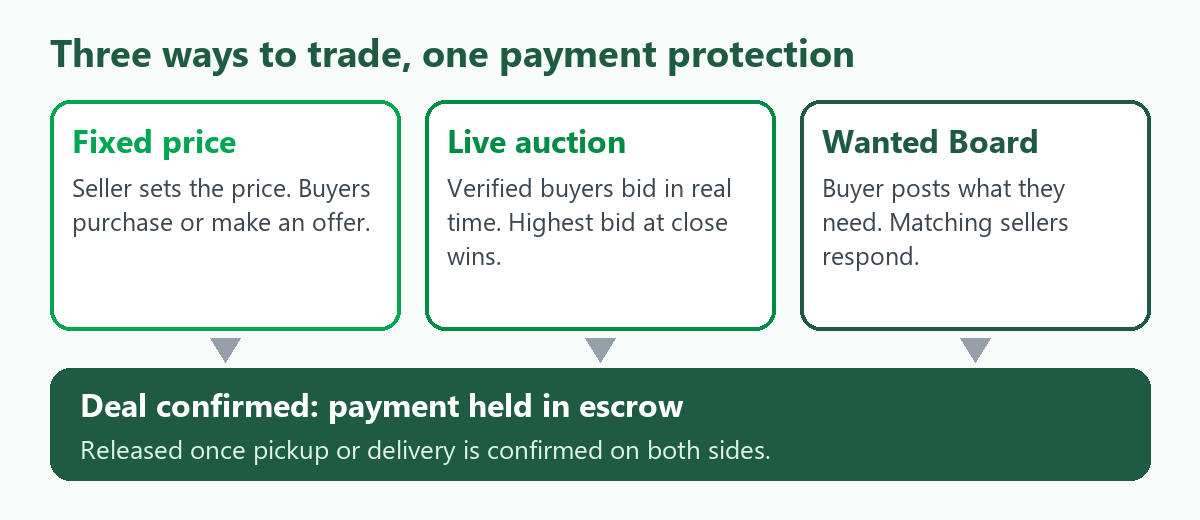
- Escrow on every deal: payment is held from the moment a deal is confirmed and released once pickup or delivery is confirmed.
- Verification: identity (KYC) and business checks for traders, and GPS video verification for listings.
- Live pricing tools: current material prices and a price calculator, so you can check a number before you agree to it.
- Quick Sale: a four-field listing with free pickup on most scrap loads across Australia.
- Nine languages: English, Spanish, Simplified Chinese, Arabic, Hindi, French, Portuguese, German and Malay.
Why a scrap marketplace
Selling scrap has long meant driving to a yard, accepting the price on the board that day and having little way to compare it. General classifieds sites reach plenty of people but were not built for scrap, so they offer no grading, no identity checks and no payment protection. ScrapTrade was built around how scrap is actually bought and sold. The comparison below is ScrapTrade's own, shown here so you can judge it.
| Feature | ScrapTrade | Local scrap yard | General classifieds |
|---|---|---|---|
| Several buyers see one listing | Yes | No | No |
| Competitive bidding sets the price | Yes | No | No |
| Escrow payment protection | Yes | No | No |
| Verified buyer and seller identity | Yes | Varies | No |
| GPS-verified listings | Yes | No | No |
| Built specifically for scrap trading | Yes | Yes | No |
A yard still has real advantages: you can drive in and be paid on the spot, and the person weighing your load can see it. Those are reasons a regular yard remains the right choice for some loads. Our guide to buying scrap online versus visiting yards sets out when each makes sense.
Three ways to trade
Fixed-price listings
A seller sets a price and buyers either purchase directly or send an offer to negotiate. This suits sellers who know what their material is worth and want a quick, predictable result.
Live auctions
Verified buyers compete by bidding in real time, and the highest bid at close wins the lot. Auctions suit material that several buyers want, where competition can lift the price.
Wanted Board requests
This is reverse bidding. A buyer posts exactly what they need, for example 500 kg of copper scrap in Melbourne, and sellers with matching stock respond. Once a seller accepts, the request becomes an order. Every seller sees the same requests, and buyers set the terms by describing what they need. See how it works for the full explanation, and how to choose between a fixed price, an auction and the Wanted Board if you are unsure which fits your load.
| Method | Who sets the terms | Best for |
|---|---|---|
| Fixed price | The seller | Known material, a quick sale |
| Live auction | Competing buyers | In-demand material or larger lots |
| Wanted Board | The buyer | Buyers sourcing a specific material and grade |
How a deal runs
The steps are the same whichever method closes the deal.
For sellers
- Register and verify. Create a profile and complete verification.
- Create the listing. Add clear details, photos and pricing preferences. Check the live material prices first if you are unsure what to ask.
- Manage offers. Review the bids or offers that arrive.
- Accept and confirm. Choose the best offer and confirm terms.
- Payment goes into escrow. The buyer funds it, and the seller can see the payment is secured.
- Arrange pickup. Use integrated logistics or your own carrier.
- Weigh transparently. Weighing at pickup is recorded and shared with both parties.
For buyers
- Register and verify.
- Browse listings by material type, quantity and location.
- Place bids or send a request for the material you need.
- Negotiate and confirm the terms with the seller.
- Pay into escrow.
- Arrange logistics with the platform's tools or your own partner.
- Track and receive, then confirm delivery.
How the protections work, and where they stop
Trading with someone you have never met, sometimes in another country, is where deals go wrong. The platform uses three layers, and each solves a different part of the problem.
| Layer | What it does | What it does not do |
|---|---|---|
| GPS video verification | Listings carry geolocated video, confirming the material shown is real and where the listing says it is | It does not grade the material or confirm its exact composition. Confirm that with the seller |
| Identity and business checks | Traders can carry identity (KYC) verification and business badges, so you deal with a checked account | It confirms identity, not intent. A verified account is not a guarantee of good behaviour |
| Escrow | Payment is held from the moment a deal is confirmed and released once pickup or delivery is confirmed on both sides | It adds the time needed to confirm delivery, which matters more on longer shipments |
If a deal does not go as agreed, a dispute is raised on the specific order, tied to the existing conversation with the other party. Raise it before releasing payment from escrow, because that sequence is what makes the protection work. The details are on the trust and safety page. No system removes all risk, and these layers are designed to remove the easiest ways a deal goes wrong, not to promise that none can.
Quick Sale: list it and have it collected
Not every seller wants to set a price or run an auction. Quick Sale asks for four things: a few photos, the location of the material, a pickup window and whether a forklift is on site. ScrapTrade's logistics partners then collect the load, with free pickup on most scrap loads across Australia. Remote areas are handled case by case.
The trade-off is stated plainly on the page. You do not set a price. The value is assessed against current material prices once the load is collected, so Quick Sale gives up some control over price in exchange for speed. If getting the most from a specific grade matters more than convenience, a regular listing is the better choice. See Quick Sale versus a regular listing.
What you can trade
ScrapTrade covers ferrous metals such as steel, iron, HMS and cast iron, and non-ferrous metals such as copper, aluminium, brass, lead and zinc. It also covers electronic waste, plastics, paper and cardboard, glass, rubber, textiles, wood, construction and demolition debris, automotive scrap and industrial equipment. There is no minimum quantity, so a listing can be a home workshop's offcuts or a full industrial load. Browse the scrap categories or the marketplace.
Built for Australia, open to the world
ScrapTrade is operated from Australia by Mobeius Technologies Pty Ltd, and the platform describes buyers and sellers in more than 50 countries. International trade adds freight, paperwork and rules that domestic trade does not, so it deserves more care. Our guides cover the real cost of sourcing scrap abroad, the world's biggest scrap metal markets and trading scrap internationally.
The platform in numbers
The ScrapTrade homepage showed the following counters on 22 October 2026. They are the platform's own figures and have not been independently verified.
| Counter | Shown on 22 October 2026 |
|---|---|
| Active listings | 553 |
| Sellers | 1,757 |
| Completed deals | 200 |
These are early numbers for a new marketplace, and they will change as the platform grows.
How to get started
- Look first. Browse the marketplace to see how material is described and priced.
- Know your grade. Read how to grade scrap metal, because grade moves the price more than almost anything else.
- Check today's price. Use the material prices before you list or bid.
- Register and verify. Create your account and complete verification.
- Pick a method. Fixed price, auction, Wanted Board or Quick Sale, depending on what you are selling and how fast you need it gone.
What to keep in mind
- Rules still apply. Licensing, record-keeping, tax, transport and environmental rules apply to scrap trading and vary by country and state. Check your local regulator.
- Escrow takes time. Payment is released after delivery is confirmed, not at the moment of agreement.
- Verification has limits. It confirms who you are dealing with and where the material is, not the exact grade or what the other party will do next.
- Results vary. Prices move daily, and no outcome on any listing is guaranteed.
Frequently asked questions
Is the ScrapTrade platform live?
Yes. Sellers can list scrap by fixed price, live auction or in response to a buyer request, and buyers can browse, bid and post requests.
Who operates ScrapTrade?
Mobeius Technologies Pty Ltd, an Australian-registered company.
How does payment work?
Once a deal is confirmed, payment is held in escrow and released after pickup or delivery is confirmed on both sides.
Do I need a scrapyard to sell?
No. There is no minimum quantity, and Quick Sale arranges collection of most loads across Australia.
Can overseas buyers and sellers use it?
Yes. The platform serves traders in more than 50 countries and is available in nine languages. International deals involve extra freight, paperwork and rules, so allow for them.
Where can I get help?
Use the contact page, or read what ScrapTrade is for a longer explainer.
This is a company announcement published by ScrapTrade on 22 October 2026, describing its own platform. Features, fees and availability can change, so check the site for current details. It is general information, not financial, tax or legal advice.