

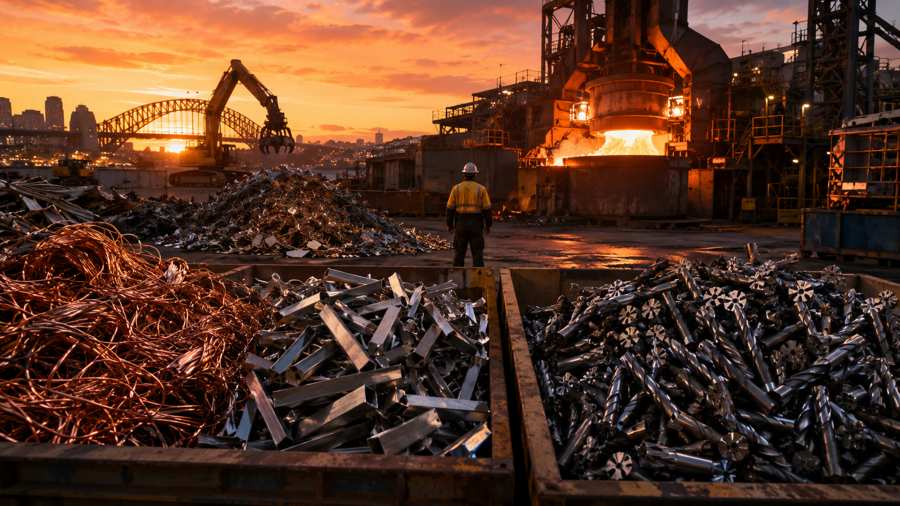
The Australian Scrap Metal and Critical Minerals Market in 2026: Commodity Valuation, Regulatory Compliance, and Industrial Circularity
Macroeconomic Landscape of Secondary Metals in Australia
The Australian scrap metal and secondary materials industry in 2026 operates in a highly volatile macroeconomic environment shaped by resource nationalism, tightening global supply chains, and domestic regulatory transformations. Secondary metal commodities serve as critical supply buffers for industrial manufacturing, infrastructure, and defense sectors . In the non-ferrous metal segment, strong global demand continues to be driven by electrification, green energy infrastructure, and advanced defense manufacturing. Consequently, pricing is highly sensitive to international commodity benchmarks, primarily those set by the London Metal Exchange (LME), alongside fluctuations in the AUD/USD exchange rate, which directly dictate the domestic purchasing power of export-oriented scrap yards.
The domestic market exhibits a sharp structural divergence between high-volume, low-margin ferrous scrap (such as structural steel and heavy melting scrap) and low-volume, high-value non-ferrous commodities (such as copper, nickel-rich stainless steels, and refractory alloys). This valuation gap is further widened by the differing energy economics of recycling; refining secondary aluminium, for instance, requires up to 95% less energy than smelting virgin bauxite ore, making high-purity scrap highly sought after by industrial players aiming to satisfy carbon-reduction mandate obligations. Concurrently, severe supply-side constraints for critical refractory metals like tungsten have transformed secondary carbide recycling from a conventional scrap activity into a strategic, closed-loop industrial necessity.
Regional Scrap Metal Valuations and Pricing Discrepancies
Domestic scrap metal pricing across Australian industrial centers is heavily influenced by localized supply and demand, regional processing efficiencies, and transport logistics. Yards situated in major logistical ports like Sydney and Melbourne offer highly competitive pricing structures linked to direct export access, while regional variation persists due to local freight overheads and consolidation costs.
Non-Ferrous and Stainless Steel Pricing Dynamics
Copper remains the most liquid and valuable non-ferrous commodity in the Australian scrap market. Clean, uninsulated "bright bare" copper wire commands premium rates, trading between $11.00 and $14.00 per kilogram in Sydney, and up to $11.10 per kilogram in Melbourne. Lower-grade copper, such as insulated household wires or contaminated plumbing pipes (#2 copper), is discounted by 10% to 20% due to the mechanical processing required to separate the copper core from insulation and soldering materials.
Stainless steel scrap valuations are dictated almost entirely by the concentration of nickel and chromium in the alloy. Grade 316 stainless steel, containing higher nickel content and molybdenum, commands a high-tier price of $1.80 to $2.30 per kilogram in Sydney and $1.40 to $1.75 per kilogram in Melbourne. Grade 304 stainless steel, which lacks molybdenum and has lower nickel levels, trades at a lower bracket of $1.20 to $1.70 per kilogram in Sydney and $0.70 to $1.15 per kilogram in Melbourne. Mixed or contaminated stainless scrap drops significantly in value, often yielding as little as $0.50 per kilogram because of the high cost of thermal purification in induction furnace.
Ferrous Scrap and Light-Gauge Valuations
Standard ferrous scrap, while operating on thin margins, represents the highest volume segment of the recycling trade. Heavy melting steel (such as HMS 1 and HMS 2) trades at $0.25 to $0.36 per kilogram, as its density and purity make it highly suitable for direct melting in domestic electric arc furnaces. Conversely, light-gauge mixed steel and pressed car bodies sit at the lowest end of the pricing spectrum, trading between $0.10 and $0.15 per kilogram due to their high volume-to-weight ratio and potential for contamination with non-metallic elements.
| Metal Commodity Class | Specific Grade / Alloy | Sydney Price Range (AUD/kg) | Melbourne Price Range (AUD/kg) | Primary Industrial Sources and Applications |
| Non-Ferrous | Bare Bright Copper Wire | $11.00 -- $14.00 | $10.50 -- $11.10 | Electrical installations, heavy cables, construction offcuts |
| Non-Ferrous | Insulated Copper Cables | $2.50 -- $8.00 | $2.05 -- $7.10 | Demolition wire, household wiring, telecommunication lines |
| Non-Ferrous | Clean Brass | $6.00 -- $8.00 | $5.50 -- $6.00 | Plumbing valves, marine fittings, heat exchangers |
| Non-Ferrous | Clean Aluminium Extrusion | $1.80 -- $2.80 | $1.65 -- $2.00 | Architectural window frames, structural industrial channels |
| Non-Ferrous | Aluminium Beverage Cans | $0.50 -- $1.20 | $0.30 -- $0.60 | Post-consumer recycling schemes, container deposit centre |
| Stainless Steel | Grade 316 Stainless Steel | $1.80 -- $2.30 | $1.40 -- $1.75 | Chemical processing equipment, marine fixtures, food manufacturing |
| Stainless Steel | Grade 304 Stainless Steel | $1.20 -- $1.70 | $0.70 -- $1.15 | Commercial kitchen counters, architectural trim, domestic sinks |
| Ferrous | Heavy Steel / Insize / HMS | $0.15 -- $0.30 | $0.25 -- $0.36 | Structural steel columns, machinery plates, heavy railway lines |
| Ferrous | Mixed Normal / Light Steel | $0.10 -- $0.15 | $0.10 -- $0.15 | Domestic appliances, roofing sheet offcuts, light automotive panels |
High-Value Alloy Reclamation: Tool Steels and High-Speed Steel (HSS) Scrap
Alloy tool steels and High-Speed Steels (HSS) represent a specialized, high-value tier of the ferrous recycling market. These highly engineered materials are manufactured to retain exceptional hardness, toughness, and wear resistance at elevated temperatures, making them the standard choice for industrial cutting, drilling, and metal-shaping applications. Standard HSS grades, such as the molybdenum-tungsten M-series (predominantly M2) and the cobalt-bearing M42 grade, contain substantial percentages of critical alloying elements, including tungsten, vanadium, chromium, and cobalt.
The economic incentive to recycle tool steel and HSS scrap is highly pronounced due to the severe cost inflation of primary alloying elements. Globally, importing raw nickel, molybdenum, and chromium carries significant supply chain risks and cost premiums, which imposes a -0.9% impact on the compound annual growth rate (CAGR) forecast for the high-strength steel market. Reclaiming clean HSS drill bits, tap dies, and milling cutters allows domestic alloy manufacturers to bypass raw material processing steps, reducing energy consumption and mitigating reliance on imported primary ores.
HSS cutting tools remain deeply embedded in industrial manufacturing. The manufacturing and automotive sectors account for 49.6% of the global demand for HSS cutting tools, with drilling operations comprising 37.5% of this tool type segment. Because conventional forged processes still account for 63.8% of HSS tool production, a massive volume of spent HSS drill bit scrap is continuously generated across heavy engineering workshops, automotive fabrication lines, and aerospace facilities. Within the Australian scrap stream, tool steels command a premium salvage payout compared to conventional carbon steel scrap, as their chemical composition makes them invaluable for producing advanced metallurgical alloys.
Tungsten Carbide (WC) Circularity and Industrial Mining Scrap
Global Pricing Pressures and Geopolitical Dynamics
Tungsten has emerged as one of the most critical minerals in the global commodities market, experiencing a historic price surge through 2025 and 2026. In early 2025, Ammonium Paratungstate (APT)--the global benchmark chemical precursor for tungsten--traded at approximately $300 per metric tonne unit (MTU). By early 2026, severe supply constraints drove APT prices to a volatile peak of $1,700 to $1,800 per MTU, representing a near sixfold increase over twelve months. In mid-2026, international spot prices stabilized, with China Tungsten APT 88.5% FOB trading at approximately $1,705 per MTU and primary ferrotungsten trading above $200 per kilogram.
This pricing surge is caused by structural supply deficits, including tightening export quotas and declining ore quality in China, coupled with rising demand from defense, aerospace, and high-end tooling industries. Because tungsten possesses an exceptionally high melting point of 3422 degreesC and twice the density of steel, it is indispensable in manufacturing armored munitions, radiation shielding, turbine blades, and high-wear cutting inserts.
This pressure on primary tungsten has dramatically elevated the value of secondary tungsten carbide (WC) scrap. In mid-2026, Chinese scrap tungsten drill bits traded at approximately RMB 680 to 1,370 per kilogram, while sorted carbide drills (88% tungsten minimum) and CNC cutting blades (70% tungsten minimum) commanded international prices of $98.30 to $101.00 USD per kilogram and $89.50 to $92.50 USD per kilogram, respectively. In Western recycling markets, clean carbide inserts fetch up to EUR60.00 per kilogram or up to $25.00 USD per pound.
Closed-Loop Recovery Technologies and Chemistry
To mitigate exposure to these volatile pricing regimes, original equipment manufacturers (OEMs) and advanced engineering firms operating in Australia have established automated, closed-loop recycling systems. Historically, separating tungsten carbide inserts from steel drill bodies was a highly labor-intensive, hazardous, and slow manual process. It required heating the entire worn drill bit to a red-hot 1100 degreesC before manually striking out individual inserts with hammer and pick.
To revolutionize this recovery path, Sandvik Rock Tools and induction-heating specialists ENRX deployed a circular thermal-vibrational separation system. The system heats the steel drill bit to 850 degreesC within seconds to soften the copper alloy braze holding the carbide inserts in place, while simultaneously inverting and vibrating the drill bit, allowing the heavy WC inserts to fall out effortlessly. Once separated, the recovered inserts are transported to specialized chemical refining refineries, such as Wolfram Bergbau und Hutten, where they are reprocessed back into high-purity, "good-as-new" carbide powders.
The environmental and economic advantages of this closed-loop process are extensive:
- Energy Savings: Manufacturing cutting tools from recycled carbide scrap consumes up to 75% less energy compared to refining virgin ores.
- Carbon Abatement: Lifecycle CO2 emissions are reduced by approximately 40% to 64%.
- Logistical Footprint: Localized thermal extraction programs have allowed Sandvik to reduce its transport-related carbon footprint in this area by approximately 93%.
For complex or contaminated hardmetal sludges, grinding swarfs, and spent cobalt-cemented carbide scraps (WC-Co), chemical and hydrometallurgical recovery technologies are deployed. A prominent industrial process involves high-temperature roasting of WC-Co scrap with sodium carbonate (Na2CO3) to synthesize water-soluble sodium tungstate (Na2WO4), which is then leached with water and precipitated, liberating gaseous carbon dioxide (CO2) safely while leaving cobalt and other heavy metals to be recovered as an insoluble oxide residue. Alternatively, the zinc melt process is utilized, which dissolves the scrap's cobalt binder in molten zinc at high temperatures, causing the alloy to swell and crumble, allowing the zinc to be vacuum-distilled away to yield a reusable WC powder blend.
National Industrial Footprint of Tungsten and Mining Scrap (TMS)
Within the domestic Australian landscape, Tungsten and Mining Scrap Pty Ltd (TMS) has emerged as a premier specialized recycling business, leveraging 40 years of expertise in high-density metallurgy. TMS specializes in acquiring a wide range of industrial and mining scraps, specifically tungsten carbide, drill bits, nickel alloys, and titanium. The company purchases worn rotary tricone drill bits (ranging in size from 159 mm to 349 mm) and Down-The-Hole (DTH) drills directly from mining sites across Australia, providing point-to-point recycling services to ensure competitive commercial rates and prompt payments.
| Yard Location | Facility Type | Address | Target Materials and Scrap Classes |
| Western Australia (Head Office) | Corporate HQ & Central Logistics | 10 Jacquard Way, Port Kennedy WA 6172 | Heavy mining drill bits, titanium alloys, nickel superalloys |
| Western Australia Yard | Regional Sorting & Consolidation | 10 Browning Road, Armadale WA 6112 | Rotary tricone bits, tool steel offcuts, high-chrome scrap |
| Victoria Yard | Regional Processing Facility | 50 Potter Street, Craigieburn VIC 3064 | CNC tungsten inserts, HSS drills, manufacturing swarf |
| Queensland Yard | Regional Scrap Depot | 43 Piper Street, Caboolture QLD 4510 | Mining scrap, manganese steel, nitronics, copper wires |
| New South Wales Yard | Industrial Reclamation Center | 101 Russell Street, Emu Plains NSW 2750 | Tungsten carbide profile picks, insulated wire, transformers |
| South Australia Yard | Heavy Industrial Port Depot | 1-5 Newhaven Road, Gillman SA 5013 | Tricone bits, nickel alloys, tantalum, marine heavy scrap |
| Northern Territory Yard | Mining Consolidation Hub | 4614 Clarke Rd, Marrakai NT 0822 | Remote mine site drill bits, DTH hammers, Ni-hard steel |
TMS processes specific metallurgical compositions of tungsten carbide to cater to distinct industrial client requirements:
- Tungsten Carbide Straight Grade: Formulated with 87.00% Tungsten (W), 6.00% Cobalt (Co), and 6.00% Carbon (C) to offer maximum hardness and wear resistance.
- Tungsten Carbide TiC-TaC Alloyed Grade: Composed of 81.00% Tungsten (W), 6.00% Cobalt (Co), 6.00% Carbon (C), 3.00% Tantalum Carbide (TaC), and 4.00% Titanium Carbide (TiC) to provide enhanced thermal stability under high-speed cutting loads.
The domestic market also includes specialized entities like PF Metals (trading as Platinum Recycling in Melbourne) and Toolprocure Australia. These firms reclaim spent cutting tools, abrasives, ammunition cores, and medical instruments, feeding high-purity recycled tungsten carbide back into localized industrial casting, jewelry manufacturing, and sporting equipment production lines.
Regulatory Architecture and Legislative Compliance Across Australian States
The Australian scrap metal industry in 2026 is governed by some of the most stringent regulatory and compliance frameworks in the world, enacted to eliminate illegal trade, trace stolen municipal copper infrastructure, and prevent tax evasion.
The Cashless Scrap Mandate and Identity Verification
Across all major Australian states, paying cash for scrap metal is strictly illegal. All commercial transactions must be executed via traceable electronic means--primarily Electronic Funds Transfer (EFT) or bank cheque. Furthermore, scrap yards are required to implement rigid customer verification protocols.
When presenting scrap metal to a licensed yard, sellers must provide:
- Valid Photo ID: A current Australian driver's license, passport, proof of age card, or firearms license.
- Logbook Recording: The dealer must record the seller's personal details, a detailed description of the metal (including its weight, type, and value), the exact time and date of the transaction, and the bank transaction reference number.
- Vehicle Registration Tracking: Recyclers must record the license plate and vehicle details of the delivery vehicle, establishing a clear link between the seller and the physical transport of the material.
- Data Retention Compliance: Yards must securely archive transaction data for statutory periods of five to seven years, making them immediately available for random police audits. Non-compliance carries severe civil penalties of up to $11,000 or the immediate revocation of the dealer's scrap metal license.
State-by-State Legislative Frameworks
The enforcement of these cashless rules and transaction audits is divided into specific state-level statutes and police programs.
- New South Wales (NSW): Governed by the Scrap Metal Industry Act 2016, which is strictly monitored by the NSW Police Force. Under Section 12A of the Act, dealers are legally prohibited from advertising cash-for-scrap payments in any medium, including physical flyers, social media, or online listings. Violations of this advertising ban carry a maximum penalty of 100 penalty units, acting as a strong deterrent against underground, cash-in-hand trading networks.
- Victoria (VIC): Regulated under the Second-Hand Dealers and Pawnbrokers Act 1989. Victoria enforces a strict cashless regime where all yards must register as second-hand dealers, maintain complete transaction logs, and transition all customer payments to electronic transfers.
- Queensland (QLD): Enforced via the Waste Reduction and Recycling Act 2011 (Scrap Metal Industry Amendment). Queensland has introduced significantly harsher criminal penalties for dealers processing suspected stolen copper infrastructure, with severe offenses carrying substantial prison sentences.
- Western Australia (WA): Governed by the Criminal Code Amendment (Metal Theft) Act 2011. WA Police carry out frequent inspections of yard logbooks and scale data. Some critical categories, such as copper cable and catalytic converters, are subject to mandatory holding periods to allow law enforcement to cross-reference theft reports.
- South Australia (SA): Historically, South Australia operated under looser constraints governed by the Second-Hand Vehicle Dealers Act 1995 and minor state regulations, where cash bans were only partially enforced. This regulatory gap is being eliminated by the Scrap Metal Dealers Act 2025, which received assent from the Governor of South Australia on December 4, 2025. In 2026, the South Australia Police (SAPOL) Licensing Enforcement Branch is leading active consultations with industry stakeholders to refine the regulations and draft the technical framework required to support the Act. While physical compliance changes are not yet mandatory for yards during the 2026 drafting phase, the Act is expected to commence fully in 2028. Once implemented, it will establish a mandatory electronic licensing system, require a 7-year transaction record retention period, enforce strict real-time electronic transaction reporting, and align South Australian penalties with the most robust codes in NSW and Queensland.
- Tasmania (TAS): Currently preparing new legislation specifically aimed at combating copper and utility infrastructure theft, signaling a unified nationwide move toward strict tracking and regulatory enforcement.
Strategic Industry Conclusions
The Australian scrap metal and critical minerals market in 2026 is undergoing a major shift from a localized waste trade to a highly regulated, technologically advanced sector linked to global critical mineral supply chains.
The analysis of current market dynamics points to three key conclusions:
- Compliance-Driven Consolidation: The administrative burden and high costs of electronic tracking, ID logging, and compliance with acts like the NSW Scrap Metal Industry Act 2016 and the upcoming South Australian Scrap Metal Dealers Act 2025 are reshaping the sector. Small, independent yards unable to invest in compliant digital weigh-scales, POS electronic transaction software, and automated police-reporting tools are closing or being acquired, driving market share toward consolidated, institutional recyclers.
- The Strategic Value of Technical Alloys: With the benchmark price of primary tungsten experiencing extreme volatility, secondary alloys like tungsten carbide and high-speed tool steels have become highly valuable assets. Industrial consumers in Australia can no longer rely solely on imports for critical tooling elements, making localized, closed-loop extraction and chemical refining essential for domestic supply security.
- Decarbonization and Circular Integration: Secondary metal recovery is no longer driven solely by salvage economics; it is a key tool for corporate carbon accounting. Because reprocessing secondary copper, aluminium, and tungsten carbide reduces carbon emissions by up to 64% and energy usage by up to 75% compared to refining virgin ores, major industrial, mining, and manufacturing entities are fully integrating closed-loop circular agreements into their core supply chains to meet statutory ESG and net-zero targets.