

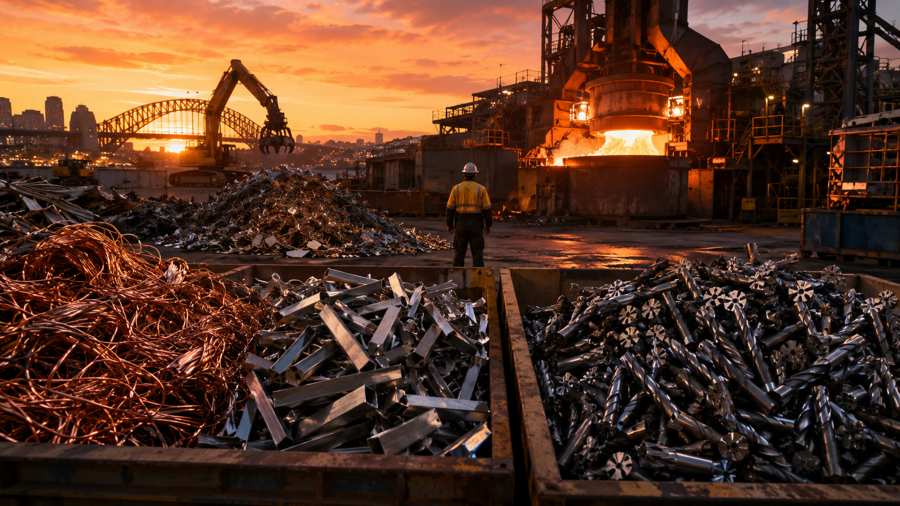
If you're sitting on piles of worn drill bits, off-cuts of copper wire, or stainless steel offcuts from your workshop floor, you're looking at cash. Not salvage money — real, strategic revenue that's growing faster than most people in the trade realise. The Australian scrap metal market in 2026 is no longer the rough-and-ready industry it once was. It has transformed into a regulated, globally connected, and genuinely lucrative sector, and the businesses that understand it are turning their waste streams into working capital.
This guide is written specifically for scrap sellers — workshop owners, mining operators, demolition contractors, manufacturers, and even small trades businesses — who want to understand what their material is actually worth, how to sell it smarter, and why now is one of the best times in recent history to be active in the secondary metals trade.
The Market Has Changed — And It's Working in Your Favour
A decade ago, scrap metal was an afterthought. You'd call a yard, they'd send a truck, you'd get a cheque for whatever they felt like paying, and that was that. Today, the dynamics are completely different.
Global supply chains for critical metals have tightened severely. China — which produces the overwhelming majority of the world's tungsten, a key ingredient in cutting tools and defence manufacturing — has been restricting exports and seeing declining ore quality in its domestic mines. The result? Prices for secondary metals have exploded. Ammonium Paratungstate (APT), the global benchmark for tungsten, traded at around $300 per metric tonne unit in early 2025. By early 2026, that same unit was fetching between $1,700 and $1,800 — a near sixfold increase in twelve months.
That's not a blip. That's a structural shift. And it means the worn-out tungsten carbide drill bits sitting in a bin in your workshop are worth considerably more than you might think.
Even everyday materials have seen strong pricing. Clean copper wire is trading between $11.00 and $14.00 per kilogram in Sydney. Grade 316 stainless steel commands $1.80 to $2.30 per kilogram. Even aluminium extrusion — one of the most common industrial offcuts — fetches $1.80 to $2.80 per kilogram depending on purity and location. For a business generating even moderate volumes of these materials, that adds up fast.
Know Your Material, Know Your Money
The single biggest mistake scrap sellers make is not knowing what they have. Yards price material based on grade, purity, and contamination — and the gap between a well-sorted load and a mixed, contaminated one can be enormous.
Copper is the most liquid and highest-value everyday non-ferrous metal in the Australian market. But not all copper is equal. Clean, uninsulated bright bare copper wire sits at the top of the pricing ladder. Once you introduce insulation, soldering residue, or mixed alloys — what the trade calls #2 copper — you're looking at a discount of 10% to 20% immediately. That discount exists because the yard has to do the separation work you didn't do. If you do it yourself, you keep that margin.
Stainless steel is another area where knowledge pays. Grade 316 stainless, which contains molybdenum and higher nickel content, commands significantly more than Grade 304. Many sellers mix the two without realising they're essentially giving away money. A simple magnet test and basic grade awareness before you load the ute can meaningfully change your payout.
Tungsten carbide deserves special attention if you work in mining, engineering, or manufacturing. Worn carbide drill bits, CNC inserts, milling cutters, and profile picks are not ordinary scrap. They contain high concentrations of tungsten — a critical mineral that is actively sought by specialist recyclers. Clean carbide inserts are fetching up to €60.00 per kilogram in European markets and up to $25.00 USD per pound in Western recycling circuits. In the Australian domestic market, sorted carbide drills with a minimum 88% tungsten content are commanding international benchmark prices. If you've been throwing these into a general metal bin, stop immediately.
High-Speed Steel (HSS) tools — drill bits, tap dies, milling cutters — are another undervalued category. These tools contain tungsten, vanadium, chromium, and cobalt, all of which are expensive primary materials. The manufacturing and automotive sectors alone account for nearly 50% of global HSS cutting tool demand, which means the recycling loop for these materials is active and well-funded. Your spent HSS drill bits are worth considerably more per kilogram than generic carbon steel scrap.
The core principle is simple: the more you know about what you're selling, the better price you'll negotiate.
How Sorting Changes Your Bottom Line
Think of sorting as the highest-return activity you can do before you ever leave your site. Every hour spent separating clean copper from insulated cable, or pulling carbide inserts out of mixed drill scrap, translates directly into a better payout at the yard.
Consider this in practice. A mixed, unsorted load of ferrous and non-ferrous metals might fetch somewhere around $0.25 to $0.36 per kilogram on average — because the yard is pricing in the cost of sorting it themselves and the risk of contamination. Break that same load into clean bright copper, clean aluminium, and separated ferrous, and you're suddenly looking at multiple streams each priced at their true market rate. The total payout on the same physical weight can be two to three times higher.
For businesses generating scrap regularly, it's worth building a simple sorting system on-site. Colour-coded bins for copper, aluminium, stainless, general steel, and a dedicated container for carbide and HSS tooling is all it takes. The setup cost is minimal. The return over a year can be significant.
If you're in mining or heavy engineering, it's worth contacting a specialist recycler directly rather than going through a general yard. Companies like Tungsten and Mining Scrap Pty Ltd operate nationally across Western Australia, Victoria, Queensland, New South Wales, South Australia, and the Northern Territory, and they specifically target high-value mining materials — rotary tricone bits, DTH drills, carbide inserts, nickel alloys, and titanium. They purchase directly from mine sites and offer point-to-point logistics. The prices they pay for sorted, high-grade material reflect the genuine international benchmark — not a general yard's conservative estimate.
The Compliance Side: What Every Seller Must Know
One of the most significant changes to the Australian scrap trade in recent years is the regulatory tightening around how transactions work. If you're not across this, you could find yourself in a difficult position even as a legitimate seller.
Across all major Australian states, paying cash for scrap metal is illegal. Every transaction must go through traceable electronic means — EFT or bank cheque. This isn't new, but enforcement has intensified considerably, and the rules around what yards are required to verify have become more detailed.
When you present material to a licensed yard, expect them to record your valid photo ID (driver's licence, passport, or proof of age card), your vehicle registration details, a full description of the material including weight and type, and the bank transaction reference. This data is retained for up to seven years and is available for police audit at any time.
This might feel like red tape, but it actually works in your favour as a legitimate business. The compliance burden has driven out the low-end, cash-in-hand operators who were undercutting the market and pushing prices down across the board. What remains is a more professional, transparent marketplace where a legitimate seller with sorted, documented material is in a genuinely strong position.
South Australia is in the process of rolling out its Scrap Metal Dealers Act 2025, which received assent in December 2025 and is expected to fully commence in 2028. WA Police conduct frequent logbook inspections, and NSW operates under the Scrap Metal Industry Act 2016, which even prohibits yards from advertising cash-for-scrap in any medium. Understanding your state's specific framework protects you and makes transactions smoother.
The practical takeaway: bring your ID, know what you're selling, and only work with licensed, compliant yards. It protects your business and ensures you're getting paid properly.
Why the Circular Economy Is Your Long-Term Opportunity
Here's the bigger picture that most scrap sellers aren't thinking about yet: the circular economy is being written into corporate supply chains as a legal and ESG obligation, and that creates long-term, structural demand for what you're selling.
Major industrial manufacturers — the kind that buy recycled copper, aluminium, and tungsten carbide — are under increasing pressure to demonstrate carbon reduction in their supply chains. Recycling secondary aluminium requires up to 95% less energy than smelting virgin bauxite ore. Reprocessing secondary tungsten carbide consumes up to 70% less energy than refining primary ore, and reduces lifecycle carbon emissions by approximately 40% to 64%. These are the numbers that corporate sustainability teams are putting in their annual reports.
What this means for you is that demand for clean, well-sorted, traceable secondary material is not going to soften. It's going to grow. Companies like Sandvik have already deployed closed-loop thermal extraction systems that recover carbide inserts from worn drill bits at scale — heating drill bodies to 850°C to release the inserts, then sending them to specialist refineries to be processed back into high-purity carbide powder. These systems exist because the economics work, and they work because secondary material is genuinely valued.
If you're a mining operator or large engineering contractor generating significant volumes of carbide and HSS scrap, it is worth exploring whether a formal buyback or exchange arrangement with a specialist recycler makes sense. Some programmes allow you to trade spent tooling directly against the cost of new tooling — effectively bringing your raw material costs down while keeping your scrap out of a general yard.
Practical Steps to Start Selling Smarter Today
You don't need to overhaul your operation to benefit from what's happening in the market right now. A few focused changes make a meaningful difference:
Identify your highest-value streams first. Walk your site and catalogue what you're currently generating. If you're in engineering or mining and you have carbide or HSS tooling going into a general bin, that's the first thing to fix.
Invest in basic sorting infrastructure. Labelled bins or skips for copper, aluminium, stainless, ferrous, and specialist alloys. The setup cost is low; the returns are immediate.
Shop your material. Don't default to the first yard you've always used. Get quotes from two or three buyers, including specialist recyclers for high-value materials. The difference in offers for the same material can be substantial.
Build a relationship with a specialist recycler if you regularly generate carbide, HSS, nickel alloys, or titanium. These businesses pay benchmark prices and often offer logistics support, especially for remote mine site pickups.
Stay compliant and documented. Keep your own simple records of what you sell, to whom, and at what price. Not just for tax purposes — it also gives you the data to understand your scrap revenue properly and negotiate better over time.
The Bottom Line
The scrap metal sitting in your yard, workshop, or mine site is not waste. In 2026, it is a commodity with real market value, sitting inside a well-regulated, internationally connected trading system that rewards sellers who understand what they have and how to present it.
The businesses growing their revenue through the scrap trade right now are not doing anything complicated. They're sorting their material, knowing their grades, working with the right buyers, and treating scrap as a revenue line rather than a disposal problem. The market is giving you the opportunity. The only question is whether you're organised enough to take it.