
Every old fridge, broken car part, or pile of copper wire you throw out doesn't just disappear. It enters a surprisingly organised and surprisingly lucrative supply chain.
Scraptrade.com.au - where everything has a value
You've probably seen the guys with utes cruising your street on hard rubbish day, or the scrap yard on the edge of town. But behind that familiar street-level scene is a multi-billion dollar global supply chain that keeps raw materials flowing back into the products we buy every day. Here's the full story.
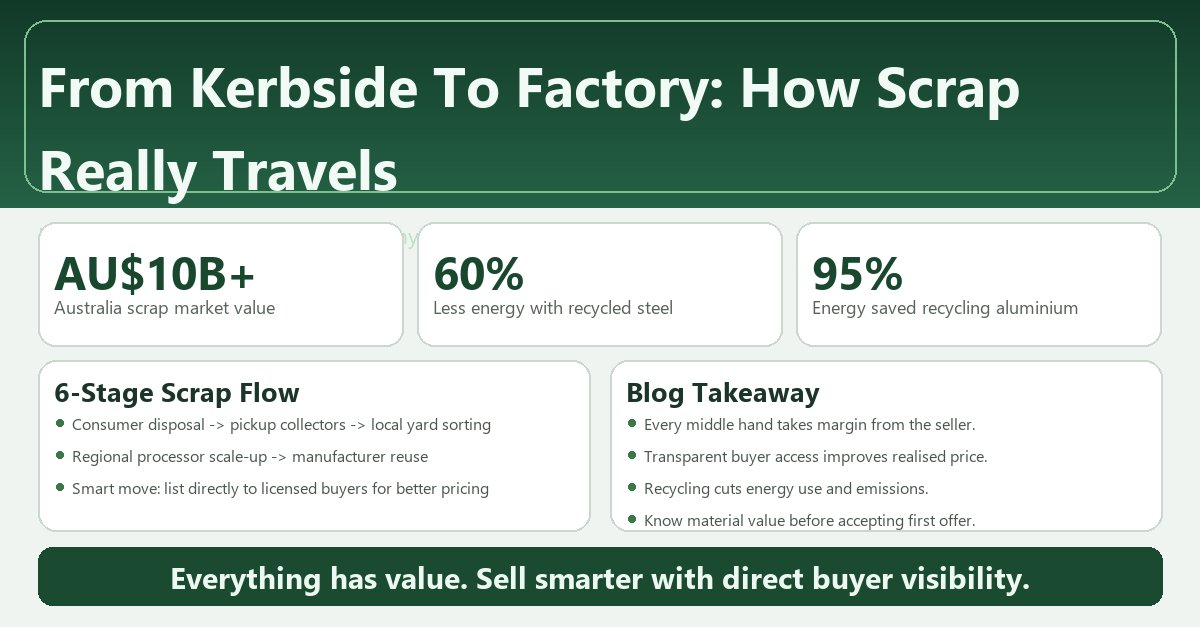
| $AU 10B+ Australia's scrap industry value | 60% Less energy to recycle steel vs smelt new | 95% Energy saved recycling aluminium |
The full cycle - a live example
Meet Dave. He just bought a new washing machine.
His old one is still sitting on the back porch. Here's every path it could take and what Dave gets for it.
Stage 1 — Consumer: The product reaches end of life
Dave's 10-year-old washing machine breaks down. Repair costs more than replacement. The machine contains around 15–20 kg of steel, a few kilos of copper wiring, aluminium parts, and plastic. To a scrap dealer, that machine isn't rubbish , it's raw material inventory walking out your door for free.
Real value: An average washing machine contains ~$8–$25 worth of recoverable metal at current scrap rates. Not a fortune on its own, but multiply it by millions of households and the numbers are enormous.
Stage 2 — The pickup guys: The kerb collectors & "scrappies"
The street-level operators, often solo owner-drivers with a ute or trailer, cruise suburban streets, respond to Facebook Marketplace posts, or get calls from people who just want the stuff gone. They collect for free, or sometimes charge a small pickup fee for large or heavy items. Their business model is pure margin on weight: collect as much as possible, sort it fast, and sell it to a local scrap yard.
Dave's options: He can call a local scrappie who takes the washer for free (or pays Dave $5–$15). Or he pays a "rubbish removal" service $80–$150 to take it away, now that guy then sells it to a scrap yard anyway and pockets the difference. Dave just funded someone else's profit.
Stage 3 — Local scrap yard: Sorting, weighing & grading
The street collectors unload at local scrap yards, the weighbridge operations you see on industrial estates and outskirts of town. Here, material is sorted by type (ferrous vs non-ferrous), graded by quality, and aggregated into volumes large enough to be worth trading. These yards buy low from collectors and sell at a markup to larger regional dealers or direct processors. They make money on the spread and on volume.
The washer's journey: At the local yard, the machine gets stripped. Steel body goes into one pile, copper wiring into another, aluminium pump parts into a third. Each material has a different price per kilo. The yard bought the machine (via the collector) for effectively $8 and will sell the sorted materials for $22.
Stage 4 — Large scrap dealer / processor: Aggregation, shredding & export
Small yards sell their sorted piles to large regional dealers who have the machinery, industrial shredders, balers, and metal separators to process material at scale. These operations produce standardised grades of scrap (e.g. "HMS 1&2", "Zorba", "Twitch") that match exactly what steel mills and smelters need. They're often export-licenced and ship containers directly to manufacturers in Australia, Asia, or Europe.
The copper from Dave's washer — now bundled with copper from thousands of other appliances across the region is baled into a tonne lot and shipped to a copper smelter. Price realised: ~$8,500/tonne vs the $15/kg Dave's street collector got for loose wire.
Stage 5 — Manufacturer: Melted down. Made new. Sold again.
Steel mills, copper smelters, aluminium processors, and plastics recyclers buy the processed scrap as a direct substitute for virgin raw materials — at a fraction of the cost and environmental footprint. The recycled steel gets rolled into new sheet metal. The copper is drawn into new cable. And the cycle completes: it gets manufactured into a new washing machine, which gets shipped to a retailer, which sells it to a consumer, possibly even back to Dave.
The full loop: The steel in Dave's old washer, once processed through the chain, could be back on a shop floor as part of a brand-new appliance within 6–18 months. Manufacturing using recycled steel produces up to 60% less CO₂ than using virgin iron ore.
Stage 6 — The smart move: Skip the middlemen. Sell directly.
Every hand the material passes through takes a cut. The collector takes one, the local yard takes one, the regional dealer takes one. By the time your material reaches someone who can actually pay market rate for it, you're getting cents on the dollar. The smarter option? Cut straight to the buyer who can pay the best price.
Dave lists his washing machine on scraptrade.com.au. Instead of getting $5 from a street collector, he's now visible to licensed scrap dealers and recycling companies who can pick up in bulk and pay properly. The platform connects individuals, businesses, and industrial sellers directly to the largest buyers, no middleman margin lost.
What can be traded?
Almost everything made of metal, wire, or recoverable material has value in the scrap market. Here's what's commonly traded:
- Steel & iron - ~$180–$300/t
- Copper wire - ~$8,000–$9,500/t
- Aluminium - ~$1,500–$2,200/t
- Batteries - Varies by type
- End-of-life vehicles - $200–$600 each
- Structural steel - ~$220–$350/t
- E-waste - Contains gold & silver
- Stainless steel - ~$700–$1,200/t
Why most people leave money on the table
The scrap market is opaque by design. Prices aren't posted. Buyers don't advertise what they pay. And most consumers or small businesses have no idea what their material is actually worth, so they accept whatever the first person offers, which is almost always the lowest possible price.
Why scraptrade.com.au changes the game
- Price transparency. When multiple buyers can see your listing, competitive pricing kicks in. You're not negotiating blind.
- Access to larger buyers. Industrial recyclers and large scrap processors normally only engage with commercial quantities. The platform levels the playing field.
- Works for everyone. Whether you're a homeowner with one old car battery, a tradesperson with offcuts from a job, or a factory with tonnes of industrial scrap, there's a buyer for you.
- Verified, licensed buyers. You're not dealing with random street collectors. Scrap traders on the platform are legitimate, licensed operators.
- Environmental impact. Every kilo of material that goes through a proper recycling channel instead of landfill is a direct reduction in mining, smelting, and CO₂ emissions.
Everything has a value. Most people just don't know what it is.
Scraptrade.com.au connects sellers from backyard clear-outs to industrial decommissions, directly with Australia's largest scrap yards and recycling companies. Skip the chain. Keep the margin.
Visit scraptrade.com.au → (https://scraptrade.com.au)
The circular economy isn't just good for the planet. It's good business. The smartest players in the scrap chain are the ones who know what their material is worth before they sell it. scraptrade.com.au because your scrap is someone else's raw material.