

Got copper wire, old aluminium, or a shed full of steel offcuts sitting around? You can turn that into real money without hauling it across town to a scrap yard. Selling scrap metal online has become one of the fastest-growing ways Australians clear out metal and get paid a fair price for it.
This guide walks you through exactly how it works, what's legal, what's not, and how to get the best return on your metal — whether you're clearing a garage or offloading a full trailer of construction offcuts.
Quick Answer
Yes, you can legally sell scrap metal online in Australia. You list your material with photos, weight and a description on a verified marketplace like ScrapTrade, receive competing offers from registered buyers, and get paid through a traceable method. Most states now require photo ID and ban cash payments for scrap metal transaction
Selling scrap metal online in Australia is legal and works by listing sorted, weighed metal with photos on a verified marketplace, receiving competing offers from registered buyers, and completing payment through a traceable method — cash is banned or restricted in most states, and photo ID is generally required.
Selling scrap metal online in Australia is legal nationwide but regulated at the state level — NSW, Victoria and South Australia all require dealer registration, seller photo ID, and cashless payment. Copper and brass command the highest per-kg prices; steel is lower-value but profitable in bulk. Online marketplaces increase buyer competition compared to a single local scrap yard.
Key Takeaways
- Selling scrap metal online is legal Australia-wide, but every state regulates who can buy it and how payment must be made.
- Cash payments for scrap metal are banned or heavily restricted in most states — expect bank transfer, not notes in hand.
- Copper and brass pay the most per kilo; steel pays the least per kilo but adds up fast in bulk.
- Online marketplaces let multiple verified buyers compete for your listing, which typically produces better offers than a single local yard.
- You'll almost always need valid photo ID to complete a sale, even online.
- Clean, sorted, contaminant-free metal earns more than mixed loads.
Is It Legal to Sell Scrap Metal Online in Australia?
Selling scrap metal online is legal everywhere in Australia, but the transaction itself is one of the more tightly regulated retail activities in the country. The rules exist because copper and other high-value metals are a common target for theft, particularly from telecommunications and construction sites.
In New South Wales, scrap metal dealing is governed directly by law. A person must not carry on a business of dealing in scrap metal unless the business is registered, and dealers must keep a record of transaction details including the seller's photo ID, description of the metal, and its weight. Under this system, sellers must provide current photo ID, be logged with the time, date and material description, and receive payment only by cheque or electronic transfer — cash payments are illegal.
Victoria takes a similarly strict approach. Scrap metal businesses there must register as second-hand dealers, and the state enforces a cashless policy alongside mandatory client record-keeping. South Australia has recently tightened its rules further. New legislation means businesses can no longer advertise or pay cash, gift cards or cryptocurrency for scrap metal, and they must keep records of customer identification and payment details.
In practice, this means:
- You will almost always need to show valid photo ID to sell.
- Payment will typically be bank transfer, not cash in hand.
- Reputable buyers keep transaction records — this protects you, not just them.
- Unregistered or unlicensed buyers offering cash "no questions asked" are a red flag, not a good deal.
Selling through a registered online marketplace is generally more compliant than an informal sale, because verification and payment tracking are built into the process rather than left to chance.
How Selling Scrap Metal Online Works
A direct answer: you create a free listing with photos, weight, and a description of your scrap, verified buyers bid or make offers, you accept the best one, and payment is arranged through a traceable method before pickup or drop-off.
Here's the step-by-step process:
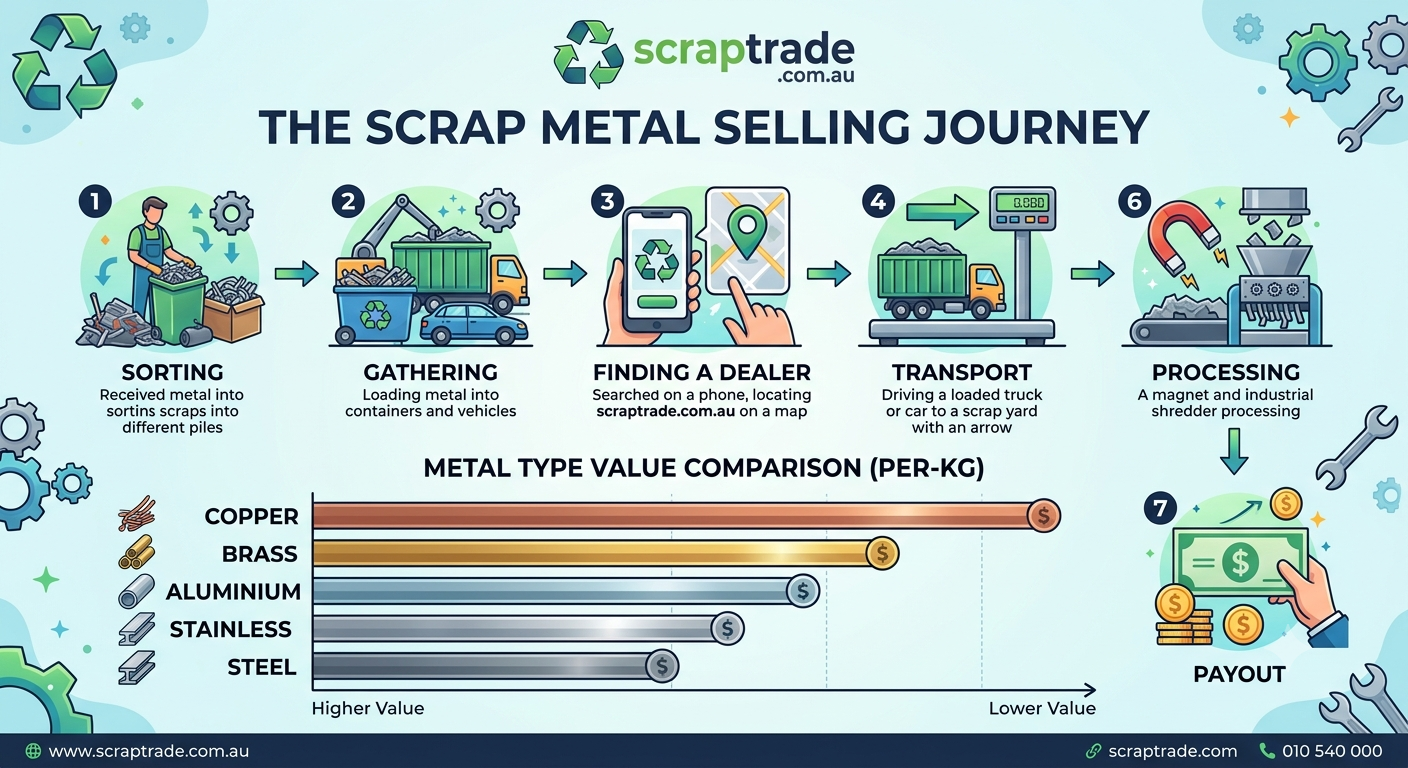
Step 1 — Sort and weigh your metal. Separate ferrous (magnetic, like steel and iron) from non-ferrous (copper, brass, aluminium, stainless steel). Mixed loads sell for less because buyers have to sort it themselves.
Step 2 — Take clear photos. Good lighting, multiple angles, and a sense of scale (next to a tape measure or known object) help buyers assess value accurately and bid with confidence.
Step 3 — Create your listing. Add the metal type, estimated weight, condition, and location. On a platform like ScrapTrade, sellers can post a listing in around three minutes and start receiving competing bids from verified buyers.
Step 4 — Compare offers. Because more buyers can see your listing than would ever walk into one local yard, competition among buyers typically results in higher returns for sellers.
Step 5 — Verify the buyer. Confirm they're registered and that payment terms are clear before agreeing to anything.
Step 6 — Complete the transaction. Payment is arranged through a secure, traceable method — bank transfer or an escrow-style service — with delivery or pickup arranged and tracked once payment is confirmed.
Step 7 — Arrange collection or drop-off. Depending on volume, buyers may collect on-site or you may deliver to a registered facility.
What Metals You Can Sell Online
Most online marketplaces and scrap buyers accept a broad range of ferrous and non-ferrous metals. This typically includes copper, brass, aluminium, stainless steel, iron and steel, with some buyers also purchasing automotive parts, electrical wiring, appliances and industrial offcuts depending on condition and volume.
Non-ferrous (higher value per kilo):
- Copper (wire, pipe, tubing, busbar)
- Brass (fittings, valves, tap ware)
- Aluminium (cans, extrusions, wheels, cladding)
- Stainless steel (sinks, appliances, kitchen equipment)
- Lead (batteries, sheeting)
Ferrous (lower value per kilo, high bulk volume):
- Structural steel and beams
- Cast iron
- Whitegoods and appliance shells
- Vehicle bodies and demolition steel
Other categories some marketplaces support: e-waste, circuit boards and components, alongside traditional metal categories.
Benefits of Selling Scrap Metal Online vs. Local Yards
A direct answer: selling online generally means more competing offers, better price transparency, and less time wasted driving between yards for quotes.
- Wider buyer pool. Traditional scrap trading often under-pays sellers because of limited buyer exposure, whereas an online marketplace broadens that pool so multiple buyers can compete for your material.
- Price transparency. Publishing prices and verifying participants reduces the information gap between buyers and sellers, helping both sides make better decisions.
- Live market pricing. Real-time prices linked to global commodity data help both parties make faster, more informed decisions rather than guessing at value.
- Convenience. List once from home instead of loading and driving to multiple yards for quotes.
- Records built in. Digital listings and messages create a natural paper trail that supports compliance.
How Scrap Metal Pricing Works
A direct answer: price is driven mainly by metal type, purity, weight, and how clean and sorted the load is — copper and brass pay the most per kilo, steel the least, but bulk volume matters more for low-value metals.
Key pricing factors:
- Metal type — copper and brass consistently deliver the highest per-kilogram rates, driven by strong industrial demand
Purity and grade — clean, unmixed copper wire outperforms insulated or corroded wire. - Contamination — removing contaminants like plastic or rubber and keeping materials clean and dry improves returns.
- Volume — clean steel has a lower per-kilogram value but generates significant returns in bulk, especially from construction and demolition projects.
Market conditions — global commodity prices for base metals shift daily and flow through to local offers. Buyer competition — real-time market insight lets you know what your scrap is worth before you trade it, so you're not relying on one buyer's word
Tip: Always compare more than one offer. Comparing multiple scrap metal merchants before selling helps secure better rates, especially for high-value metals like copper and brass.
Common Mistakes to Avoid- Mixing metals together. This forces buyers to price the whole load at the lowest common rate.
- Skipping ID. No ID typically means no sale in most parts of Australia — bring current, original identification, not a photocopy.
Expecting cash. Australia is moving toward a cashless scrap metal industry, so plan for bank transfer instead.
Accepting the first offer. A single quote rarely reflects true market value. - Ignoring buyer legitimacy. Selling to unregistered or unlicensed buyers can expose you to legal risk.
- Poor listing photos. Vague or dark photos lead to lowball offers or no bids at all.
Not weighing accurately. Guessed weights create disputes at collection.
Expert Tips for Better Offers- List during periods of stable or rising metal prices where possible.
- Strip insulation from copper wire where safe and practical — bare copper commands a premium over insulated wire.
- Separate stainless steel from regular steel; they're graded and priced very differently.
- Photograph your scrap next to a scale reading to build buyer trust instantly.
- Bundle small volumes over a few weeks into one larger listing — bulk lots often attract stronger bids.
Keep any purchase receipts or proof of ownership for high-value items like appliances or vehicle parts.
Industry Insights- Australia's scrap metal recycling industry is valued at over AUD $4.5 billion and includes more than 150 active businesses, with steady growth supported by rising metal prices and demand for sustainable building materials. At the same time, regulators across multiple states are moving toward national harmonisation of scrap metal rules, driven largely by a sharp rise in copper theft affecting telecommunications and infrastructure networks.
This shift matters for sellers: the industry is professionalising fast, and buyers who can't demonstrate registration, ID checks and traceable payment are increasingly the exception, not the norm.
State-by-State Compliance SnapshotState Key Requirement NSW Businesses dealing in scrap metal must be registered; dealers must record seller ID, transaction details, and material description VIC Registration as a second-hand dealer required; cashless payment policy enforced with full client records. SA New legislation bans cash, gift card and cryptocurrency payment for scrap metal and requires ID and payment record-keeping. QLD Tougher penalties and new criminal offences for handling suspected stolen metal NSW Police. WA ID checks enforced under metal theft legislation, with regular record inspections TAS/ACT Regulations are lighter than other states but moving toward tighter oversight South Australian Legislation
This table is a general summary, not legal advice — always confirm current requirements with your state regulator before selling.
Cost & Payout Guide
Selling scrap metal online is typically free to list — you're paid for your material, not charged a listing fee, on most reputable platforms. Payout depends on:
- Metal type and grade (copper/brass highest, steel lowest per kg)
- Total weight
- Contamination level
- Current market rate on the day of sale
- Whether pickup/logistics costs are factored into the offer
Expect payment via bank transfer, or an escrow-protected transaction that releases funds once the deal terms are confirmed, rather than cash on collection
Online Marketplace vs. Local Scrap Yard
| Factor | Online Marketplace | Local Scrap Yard |
|---|---|---|
| Buyer competition | Multiple verified buyers bid | Usually one quote |
| Price transparency | Live market pricing visible | Often opaque |
| Convenience | List from home | Must transport and queue |
| Payment | Bank transfer / escrow | Bank transfer or cheque (cashless in most states) |
| Best for | Medium-large loads, sorted metal | Small, immediate walk-in loads |
| Time to sell | Minutes to list, offers follow | Immediate but single quote |
Pre-Listing Checklist
- Sorted ferrous from non-ferrous metal
- Weighed material accurately
- Removed plastic, rubber and other contaminants
- Took clear, well-lit photos from multiple angles
- Have current, original photo ID ready
- Confirmed the buyer is registered/verified
- Confirmed payment method in advance (bank transfer, not cash)
Kept proof of ownership for higher-value items
Frequently Asked Questions- Is it legal to sell scrap metal online in Australia?
Yes. Selling scrap metal online is legal nationwide, but state laws govern how the transaction must happen — including ID checks and payment method. - Do I need ID to sell scrap metal online?
In most states, yes. Under NSW law, sellers must provide current photo ID, which is recorded as part of the transaction, and similar rules apply in other states.
Can I get paid in cash for scrap metal?
Generally no. Cash payments for scrap metal are illegal under NSW law, and Victoria enforces a cashless policy for scrap metal transactions.
What's the best metal to sell for money?
Copper and brass. They consistently deliver the highest per-kilogram rates due to strong industrial demand.
Does mixed scrap sell for less?
Yes. Separating metals by type and removing contaminants improves the price you receive.
How is scrap metal weighed and valued?
Metal is weighed on certified scales and priced per kilogram based on type, purity and current market rates. - Can businesses and individuals both sell online?
Yes, though businesses selling regularly may be legally considered to be "carrying on a business" and require registration in some states.
Is selling scrap metal online safer than a local yard?
It can be, since verified listings, tracked deals and secure documentation reduce the risk of disputes compared to informal cash sales.
How long does it take to sell scrap metal online?
Listings can typically be posted in around three minutes, with bids following soon after.
Do I need a business licence to sell scrap metal occasionally?
Occasional personal sales (like a renovation clean-out) usually don't require registration, but regular or high-volume sales may. - What happens if I can't prove where my scrap came from?
Dealers may refuse material if its origin can't be verified, as part of anti-theft compliance.
Can I sell old appliances as scrap metal?
Yes, most buyers accept whitegoods and appliance shells, though some parts may need to be removed first (e.g. compressors, refrigerant). - Is aluminium worth selling in bulk?
Yes — while it pays less per kilo than copper, aluminium in volume (cans, extrusions) can add up to a solid return. - Do online scrap buyers collect from my property?
Many do for larger volumes, particularly commercial or industrial quantities; smaller loads may need drop-off. - What documents prove I own the scrap I'm selling?
Purchase receipts, renovation invoices, or a written statement of ownership can help, especially for higher-value items.
Are there penalties for selling stolen scrap metal?
Yes, penalties are significant. Businesses that fail to register or breach the legislation face heavy penalties, and individuals selling material they can't account for risk legal consequences too.
Can I negotiate the price on an online listing?
Yes, most marketplaces allow negotiation, bidding, or counter-offers between buyer and seller. - Is copper theft affecting scrap metal laws?
Yes. A sharp rise in copper theft, especially targeting telecommunications infrastructure, has driven much of the recent tightening of scrap metal laws.
Do I need to keep records of my scrap metal sale?
It's wise to. While the legal record-keeping obligation sits mainly with registered dealers, keeping your own transaction confirmation protects you too. What's the difference between ferrous and non-ferrous scrap?
Ferrous metal (steel, iron) is magnetic and lower value per kilo. Non-ferrous metal (copper, brass, aluminium) is non-magnetic and typically higher value.
Conclusion- Selling scrap metal online in Australia is legal, increasingly popular, and — done right — more profitable than a single trip to your nearest yard. The key is understanding the rules: expect to show ID, expect cashless payment, and sort your metal before you list it. Do that, and an online marketplace puts more buyers in competition for your scrap than any single yard ever could.
- Ready to turn your scrap into cash? List your copper, aluminium, steel or brass on ScrapTrade in minutes and start receiving offers from verified Australian buyers today.