

"Do I pay tax on scrap metal?" has no single answer, because the Australian Taxation Office (ATO) treats a household clearing out a garage differently from someone who collects and sells scrap every week. This article sets out where the ATO draws that line, using its own pages, and what a scrap yard will ask you for either way: identification, sometimes an ABN, and in some cases a withholding of 47% of the payment. We have not found an ATO page that deals with household scrap specifically, and we say where we are reasoning from general rules. It is general information, not tax advice. Check with the ATO or a registered tax agent for your own case.
The short version
- A one-off sale of your own things is generally not a business. The ATO lists a one-off transaction, and a hobby you do not seek to profit from, among things that are not a business [1].
- Doing it repeatedly to make money points the other way. Continuous, repeated activity with a purpose of profit is how the ATO describes a business [1].
- Even a non-business seller may need to declare some payments, and the ATO says buyers and sellers of scrap are both required to report all sales and other sources of income [2].
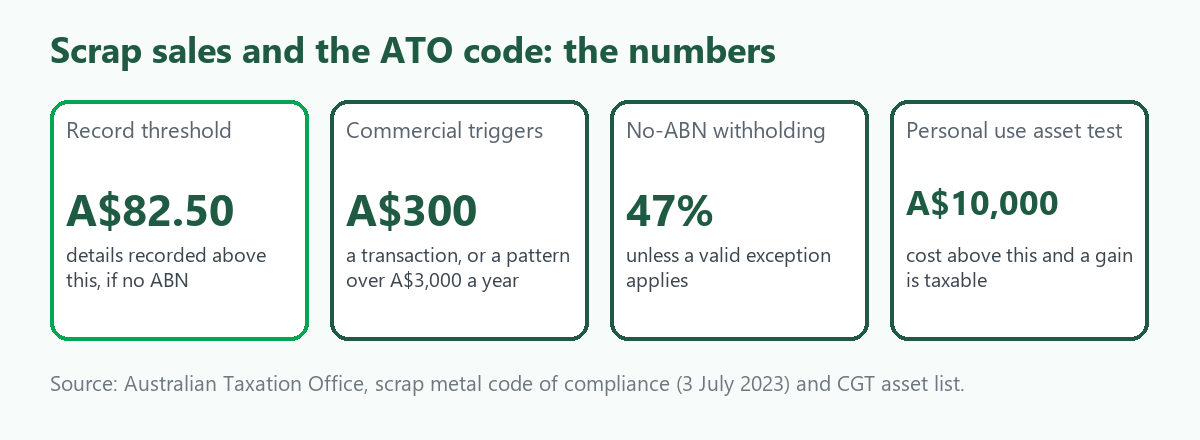
- Scrap yards must follow a code. Above A$82.50 with no ABN, the buyer records your details, and in many cases withholds 47% unless a valid exception applies [2].
Question 1: is this a one-off sale of things you own?
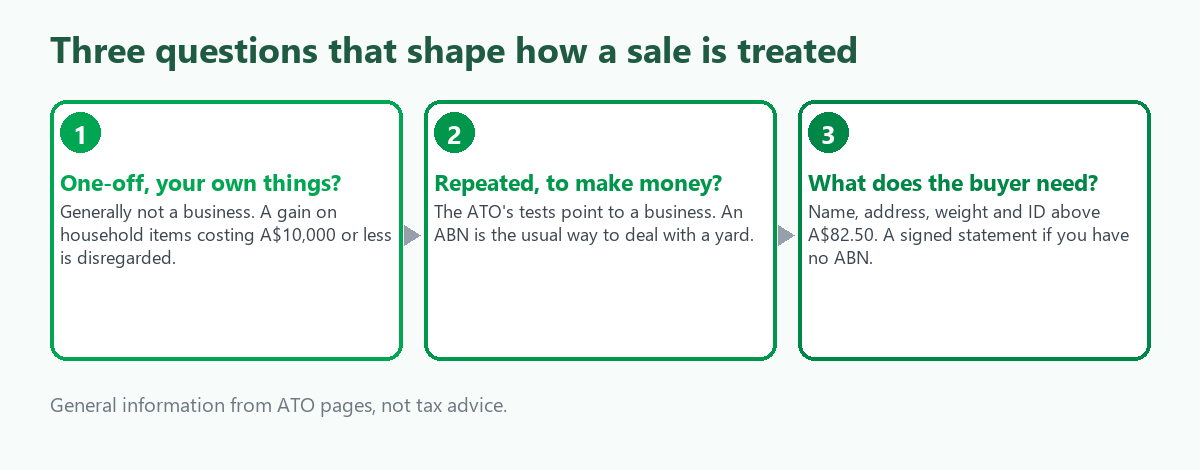
The ATO's page "Are you in business?" says your activity is not a business when it is a one-off transaction (unless it is the first step in a business or intended to be repeated), when it is done as an employee, or when it is a hobby or recreation from which you do not seek to profit [1]. It adds that even when you are not in business, you may still need to declare certain payments in your return, and its examples include payments from a one-off transaction [1].
For household scrap, the second layer is capital gains tax. The ATO says a capital gain on a personal use asset is subject to capital gains tax only if it cost you more than A$10,000 to acquire, and capital losses on personal use assets are ignored [3]. Its list of personal use assets includes furniture, electrical goods and household items, and cars are exempt [3]. Selling a worn-out washing machine, an old bath or the copper pipe from your own renovation for scrap is therefore unlikely to produce a capital gain, since the cost is usually far below the threshold. The ATO treats jewellery, coins and antiques as collectables with a lower A$500 threshold [3]. We do not cover precious metals here.
We stress "unlikely" because the ATO does not address household scrap specifically, and the facts matter. Material bought to sell, or taken from a job, is not a personal use asset.
Question 2: are you doing it repeatedly to make money?
The ATO's page poses a set of questions, and the more you answer yes to, the more likely you are in business [1]:
- Do you intend to be in business, and intend and have a prospect of making a profit?
- Is the scale of the activity enough to make a profit?
- Are the activities repeated and continuous?
- Are they planned and run in a businesslike way, with records, a separate bank account, advertising to the public, a business name or an ABN?
Someone who collects scrap each week, buys from others, drives a ute for the purpose and sells regularly is likely to answer yes to most of these [1]. The ATO says you must reassess if your activity changes in a major way, such as a hobby you start to monetise [1]. If you are in business, income tax rules for businesses apply, and an Australian Business Number (ABN) is the usual way to deal with a buyer.
What a scrap yard will ask for
The ATO's scrap code of compliance is written for GST-registered buyers [2]. When you sell, the buyer must capture your:
- full name and address
- payment amount
- quantity by weight and a description of the material
- proof of identity with a traceable identifier, ideally a driver licence number
- vehicle registration and type, if you delivered it
- signature [2]
A Statement by a supplier should be completed for all transactions over A$82.50 where no ABN is provided [4]. By signing it you declare the supply is not made in the course of carrying on a business [2]. Do not sign it if you are in business. The no-ABN withholding rule does not apply where the seller completes that statement, or where the amount is A$82.50 or less [2].
When the yard will treat you as commercial
The code lists circumstances where the buyer should not simply accept a statement and should withhold, unless a specific reason is documented and checked [2]:
- scrap delivered in commercial vehicles, including light trucks, tippers, trucks and semi-trailers (for transactions over A$82.50)
- scrap of an obvious commercial nature, including industrial by-products, decommissioned industrial equipment or quantities inconsistent with domestic output
- transactions over A$300, where breaking up transactions to avoid this limit is penalised at the highest rates
- any pattern of transactions exceeding A$3,000 a year [2]
This is why a yard may ask extra questions of a tradesperson with a ute full of offcuts, even if the load is household-sized to the seller. It is also why a pattern of small sales across weeks can count: the A$3,000 test is about the year, not the day, as we explain in A Scrap Yard CRM.
What 47% withholding means
If you sell as a business and give no ABN, the buyer must withhold 47% of the payment from 1 July 2017 [2]. The buyer gives you a payment summary, and you use it to claim the withheld amount as a credit in your next tax return [2]. The ATO is clear that the rule is not an alternative to having an ABN: a valid ABN is the easiest way to deal with these transactions [2].
Three invented examples
Priya clears her garage and sells an old fridge compressor and some pipe for A$120 (invented). It is her first sale in years, she is not in business, and the yard asks for her name, address and licence number and a signed statement because the sale is over A$82.50. Nothing is withheld.
Dev collects scrap on weekends in a ute, sells most weeks and aims to turn it into regular income (invented). On the ATO's questions he looks like a business. He should apply for an ABN. Without one, the yard should withhold 47%, so on a A$400 sale about A$188 is held back, and he can claim it as a credit.
Marco is an electrician who sells off-cuts from jobs (invented). The cable comes from client work, not his own things, so it is not a personal use asset. If he is in business, he should quote his ABN.
These examples show how the ATO's questions work. They are not tax outcomes. A registered tax agent should confirm yours.
Cash is a separate rule
Tax is not the only rule. Dealers cannot pay cash for scrap in NSW or Victoria, so you will be paid by bank transfer or cheque, which also makes a record. See Scrap Business Rules in Australia by State. For the wider picture of what changes when every deal is recorded, read What If Every Scrap Trade Were on the Books?.
What to keep
Our suggestions, not an ATO requirement for sellers:
- the buyer's name and ABN, the date, the weight and grade, and the amount paid
- the statement you signed, if any
- the payment summary, if tax was withheld
- a note of where the material came from, if you sell regularly
The ATO says a statement by a supplier must be kept for five years by the buyer [2]. A record of your own sales makes it easier to answer questions later.
Selling through ScrapTrade
ScrapTrade is a marketplace where you list material with photos and pricing preferences, review buyer offers and negotiate, as set out on How It Works. A written offer, with the date, weight and grade, gives you the kind of record described above. We cannot say how any buyer will treat your tax status, and the buyer's obligations under the ATO code depend on whether they are GST-registered. The Trust & Safety page says payment is held in escrow from the moment a deal is confirmed and released once pickup or delivery is confirmed. Create a free account to list a load. ScrapTrade has a commercial interest in the scrap trade.
What we could not verify
- An ATO ruling on household scrap. We reasoned from its general business and CGT pages.
- Whether the code has changed since its 3 July 2023 update.
- Your own case, which depends on facts we do not have.
- State requirements beyond cash, which we cover in the state rules article.
Frequently asked questions
Do I pay tax on scrap metal I sell?
It depends. A one-off sale of your own household items is generally not a business, and a capital gain on a personal use asset is subject to tax only if it cost over A$10,000 [1][3]. If you collect and sell repeatedly to make money, the ATO's business tests point to business income [1]. Check your case with the ATO or a tax agent.
Do I need an ABN to sell scrap?
Not for a sale of A$82.50 or less, and not if you sign a Statement by a supplier declaring that the supply is not made in the course of carrying on a business [2]. If you are in business, an ABN is the easiest way to deal with a yard [2].
Why does the yard want my ID?
The ATO's code asks the buyer to record your details, including proof of identity with a traceable identifier, for sales above A$82.50 where no ABN is given [2][4].
What happens if I have no ABN and I am in business?
The buyer should withhold 47% and give you a payment summary, which you can claim as a credit [2].
Sources
- Australian Taxation Office, Are you in business? (last updated 13 October 2026).
- Australian Taxation Office, GST and scrap metal: code of compliance (3 July 2023).
- Australian Taxation Office, List of CGT assets and exemptions.
- Australian Taxation Office, Statement by supplier, scrap metal industry (NAT 10210).
The three people and sales are invented. This is general information, not tax advice. ScrapTrade operates a scrap marketplace and has a commercial interest in the scrap trade.