

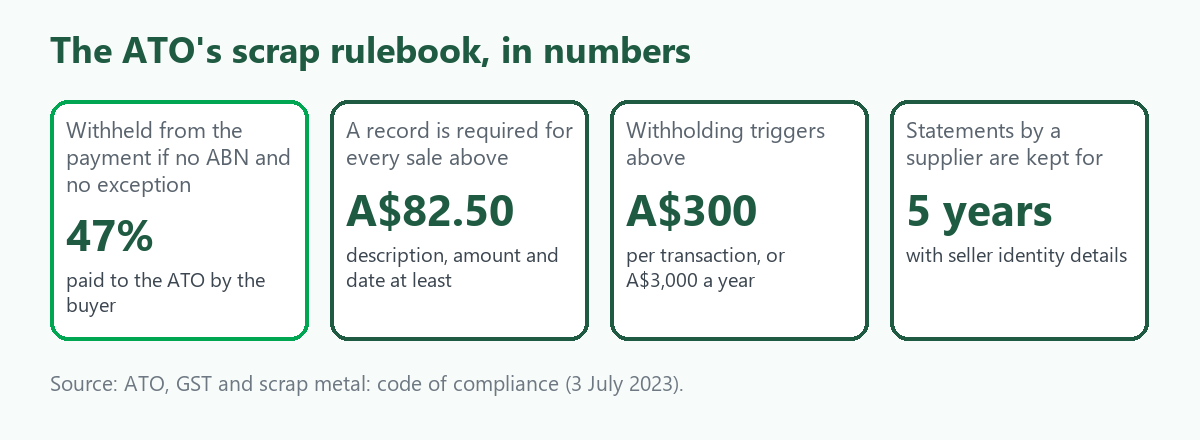
Australia's tax office already has a rulebook for buying scrap. It asks for an ABN, withholds 47% of the payment when there isn't one, and wants identity and vehicle details for every sale over A$82.50. So the question is less "what if we added tax rules to scrap" and more "what if every trade actually followed the ones we have". This article sets out what the rules say, who would feel full compliance most, and what we cannot know. We could not find any official estimate of how much scrap is traded outside the books, so everything about size is reasoning, not measurement. It is general information, not tax advice.
What the rules already say
The ATO's "code of compliance" for scrap metal is written for buyers who are GST-registered [1]. It opens with a plain statement: both buyers and sellers must report all sales and other sources of income [1]. The main pieces are below.
| Situation | What the ATO says |
|---|---|
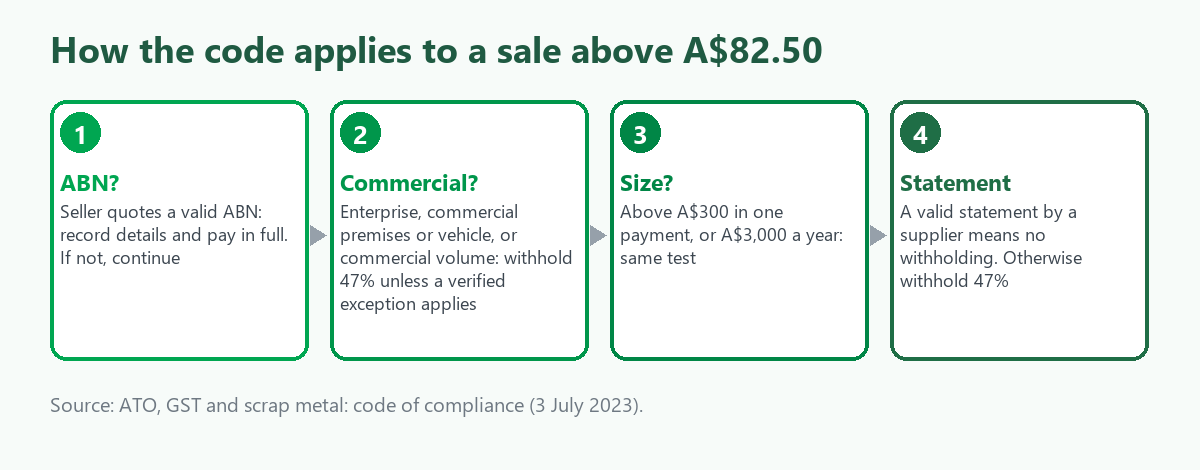
| Seller quotes a valid ABN | Buyer records the ABN, name, address, amount, weight, material, date, plus ID and vehicle details for deliveries [1] |
| Seller has no ABN | Buyer must withhold 47% and send it to the ATO, unless the seller gives a valid statement that an exception applies [1] |
| Payment of A$82.50 or less | No withholding, but buyer records the material, amount and date [1] |
| Seller is an enterprise, or the material is commercial in source, vehicle or volume | Withholding applies unless a specific, verified exception is documented [1] |
| Payment above A$300 in one transaction, or A$3,000 in a year | Withholding applies unless the exception is documented [1] |
| Statement by a supplier | Kept for 5 years. Accepted for commercial-type sales only "in exceptional circumstances" [1] |
| Recipient-created tax invoice (RCTI) | Buyer issues it when the weight is only known after sorting. Needs approval, and both sides must hold an ABN and be GST-registered [1] |
The ATO says the no-ABN rule is designed so that businesses not required to register for GST do not ask for cash in an attempt to avoid tax [1]. The rule that all payments over A$300 go by electronic transfer or a cheque to a named party is described as "frozen" while the ATO assesses improvements in industry compliance [1]. Cash itself is a state matter. NSW and Victoria ban it, South Australia's ban is not yet in force, and Queensland and Western Australia are unconfirmed, as set out in Scrap Business Rules in Australia by State. Victoria's government gave organised crime as a reason for its ban [5].
What full compliance would mean, party by party
Collectors
A collector who sells material from work sites, in a commercial vehicle, or in regular volumes is, on the ATO's tests, an enterprise. They need an ABN, which the ATO notes is not the same as GST registration. GST registration becomes compulsory at A$75,000 of annual turnover, with 21 days to register once you pass it [4]. Below that, a supplier can have an ABN and sell without charging GST.
The arithmetic is where the pressure lands. On a A$1,000 load with no ABN and no valid exception, 47% means A$470 is withheld and A$530 is paid [1]. The seller can claim the withheld amount as a credit in their tax return, using the payment summary the buyer must give them [3], but that is a long wait for money they may need now.
Householders are in a different position. The ATO's guidance says a person selling private or domestic items, with no business activity, can give a written statement and avoid withholding, and gives the example of a home owner selling personal furniture to a second-hand store [3]. The scrap code still wants a signed statement with identity details for sales above A$82.50 [1].
Yards and dealers
For a yard the biggest change is record-keeping at the weighbridge: name, address, ID, vehicle registration, weight, material and a signature for every sale above A$82.50 [1]. Many yards in NSW and Victoria already keep similar records under state law. What changes under full compliance is the 47% rule, which makes the yard the ATO's collection point and exposes it to a penalty equal to the amount it should have withheld if it does not [3].
GST credits are the other lever:
- Registered seller: a A$1,100 purchase that includes GST gives the yard a A$100 credit, which is 1/11, if it holds a tax invoice or RCTI [2].
- Unregistered seller, goods bought for resale in Australia: purchases of A$300 or less can be claimed in the period of purchase. Above A$300, the credit is claimed when the yard sells the goods, and is the lesser of 1/11 of the price and the GST payable on the sale [2].
- Unregistered seller, goods that are exported: no GST credit [2].
Recyclers, processors and exporters
Exports are GST-free, but exporters can still claim credits on purchases from GST-registered sellers [2]. That means an exporter pays GST on the way in and recovers it, a timing cost that grows with volume. Buying from unregistered sellers avoids the GST charge but loses the credit, so if the price before GST is the same the cost of a tonne is similar either way, and the difference is cash flow, paperwork and risk. That is our reading of the ATO's rules, not a figure the ATO publishes.
Processors and smelters would get a cleaner record of where material came from. We do not know how many already ask for it.
Everyone else
- ATO: more complete data. Withheld amounts go on the buyer's activity statement, and an annual report is lodged, so the ATO sees who withheld on whom [3].
- Police and state regulators: NSW and Victoria already require records and ban cash. Full tax compliance would add a second set of records that agree with the first.
- Building, demolition and civil contractors: the code specifically names factories, work sites and demolition sites as commercial sources [1]. A contractor who sells offcuts or stripped metal would need an ABN to avoid withholding.
- Banks: more sales would run through bank accounts. In NSW and Victoria that is already required, since cash is banned.
A scenario
Marco collects metal from small building sites around Newcastle (invented). He sells about A$1,000 of mixed metal each week to a yard and has never quoted an ABN.
- At the weighbridge, the yard sees a commercial vehicle and a site pick-up, so the "household" exception does not fit [1].
- With no ABN, the yard must withhold 47%. Over 52 loads that is A$24,440 held by the yard and sent to the ATO, with A$27,560 paid to Marco.
- Marco applies for an ABN, if he is entitled to one. Once he quotes it, the yard records it and pays the full amount [1].
- His turnover is about A$52,000, below the GST threshold of A$75,000 [4], so he is not required to register for GST and the yard cannot issue him an RCTI [1].
- If he grows past A$75,000, he must register within 21 days and start charging GST [4].
The withheld money is not forfeited, since he can claim it as a credit in his tax return [3]. What changes is that he can no longer take the whole payment up front without a record, and he waits for the refund if he doesn't sort out his ABN.
Who gains, who loses
This is our reading, not a forecast.
- Compliant yards gain if rivals that paid cash and asked few questions lose that edge. We cannot size this.
- Collectors who can get an ABN and keep records gain a clearer, safer way to sell.
- Casual and informal collectors lose most. Some would formalise, some would stop, some might look for buyers who ignore the rules.
- Total supply probably moves less than prices between buyers. In Do Scrap Export Volumes Follow Prices? we found no consistent positive link between value per tonne and tonnes, and the two studies we cited found low supply responses to price. Scrap comes mostly from products reaching end of life. That suggests who sells to whom could change more than how much scrap exists, but we did not test the effect of compliance on volume.
- Displacement is a risk. If the rules bite hard on one channel, trade can move to another state with weaker enforcement or to cash-only side deals.
What this means for you
- If you collect: get an ABN if you are entitled to one, keep your own record of every sale, and ask a registered tax agent whether GST applies to you.
- If you run a yard: check your intake sheet against the ATO's list, keep statements for 5 years, and ask your accountant how you are claiming GST credits on unregistered purchases.
- If you export: know which of your suppliers are GST-registered, because the credit depends on it.
- If you are a householder: a signed statement and ID will be asked for on larger sales. That is normal.
- If you buy from a collector, you can compare buyers on the marketplace or register. ScrapTrade has a commercial interest in a trade where records are kept, because a marketplace benefits from verified counterparties.
For how a deal runs after the yard, see How a Scrap Export Deal Works, Step by Step.
What we could not confirm
- How much scrap is traded outside the books. We found no official estimate of the cash or informal share, in ATO or state sources.
- How well sellers and buyers comply today. The ATO pages describe obligations, not compliance rates.
- The state reviews. We could not open NSW Police's statutory review of its Act, so we do not cite its findings.
- Whether the pages are current. The ATO pages on the no-ABN rule and GST credits show 2017 dates, and the code of compliance shows July 2023 [1][2][3]. Thresholds such as A$82.50 and A$300 should be checked with the ATO.
- Effects on theft, prices and volumes. The post is a thought experiment, and we found no study of what full tax compliance did to scrap volumes or prices in any state.
- Rules outside the five states we covered, and treatment of precious-metal scrap.
Frequently asked questions
Do I need an ABN to sell scrap in Australia?
If you are carrying on an enterprise, the ATO expects you to quote an ABN or the buyer must withhold 47%. Not everyone is entitled to an ABN, so check with the Australian Business Register or a registered tax agent [1][3].
What is the no-ABN withholding rule for scrap?
When a seller cannot quote an ABN, the buyer withholds 47% of the payment and sends it to the ATO, unless a valid exception applies. The seller claims it back as a credit in their tax return [1][3].
Can a yard claim GST on scrap from an unregistered seller?
Only for goods bought for resale, with records and a statement by a supplier on purchases above A$82.50. Credits above A$300 are claimed when the goods are resold, and none are available for goods that are exported [1][2].
Is cash banned for scrap in Australia?
In NSW and Victoria, yes. Other states differ or are pending [5].
When must a collector register for GST?
When GST turnover reaches A$75,000, or is likely to, with 21 days to register [4].
Sources
- Australian Taxation Office, GST and scrap metal: code of compliance (last updated 3 July 2023).
- Australian Taxation Office, Scrap metal: claiming GST credits (last updated 24 May 2017).
- Australian Taxation Office, Statement by a supplier not quoting an ABN (last updated 30 June 2017).
- Australian Taxation Office, Registering for GST (last updated 14 September 2026).
- Premier of Victoria, Cash for scrap ban comes into effect today (effective 30 May 2018). NSW rules as set out in our state rules article, which cites NSW Police and Consumer Affairs Victoria.
Figures are ScrapTrade calculations from ATO rules and are illustrations, not tax advice. The scenario is invented. This article is general information, not tax or legal advice, so confirm with a registered tax agent or the ATO. ScrapTrade operates a scrap marketplace and has a commercial interest in the scrap trade.