

A customer relationship system in most industries tracks leads and sales. In a scrap yard the same idea starts somewhere less glamorous. The people who sell to you are also the people the law asks you to identify, track and sometimes withhold tax from, so the record you keep on each of them is part of your compliance as well as your relationships. This article sets out what that record should hold, using the ATO's scrap code and state rules, why one rule in particular needs a per-supplier history that a docket book cannot give you, and when a spreadsheet stops being enough. We have not reviewed any CRM product. It is general information, not legal or tax advice.
Two kinds of contact
A yard deals with two groups. Suppliers sell material to you: households, collectors, tradespeople, demolition firms, manufacturers. Customers buy from you: processors, mills and exporters. They need different records. The supplier record carries most of the legal weight. The customer record carries credit, grades and contacts.
The supplier record
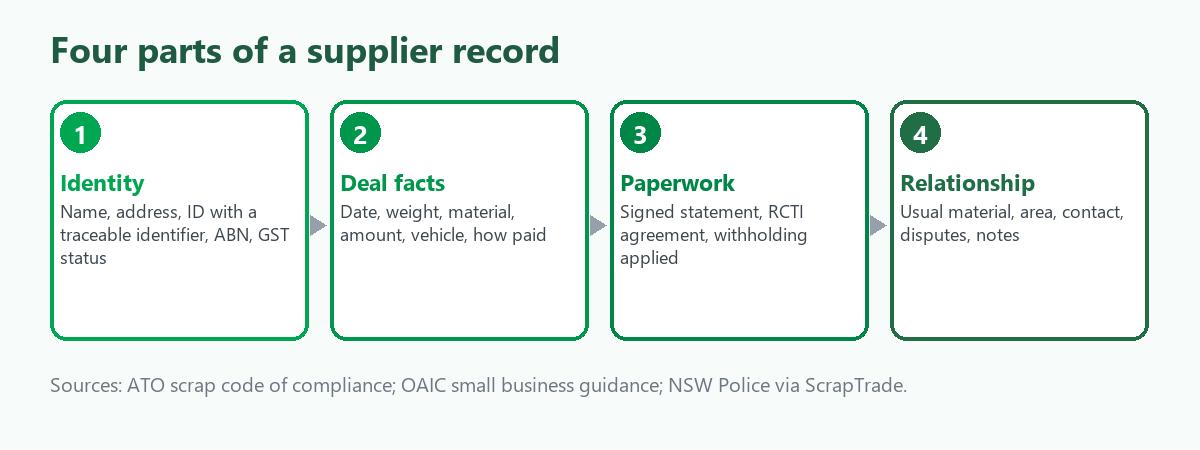
| Part | What to hold | Where it comes from |
|---|---|---|
| Identity | Full name and address, identification with a traceable identifier such as a driver licence number, ABN if any, GST status | The ATO code lists name, address and identification with a traceable identifier [1] |
| Deal facts | Date, amount, weight, material description, vehicle registration and type | The ATO code and Victoria's buying records add date and time, a copy of the payment and the name of any agent [1] |
| Paperwork | Signed statement by a supplier, RCTI agreement, whether 47% was withheld | The ATO keeps statements for 5 years [1], and an RCTI needs a written agreement [3] |
| Relationship | Usual material, usual area, preferred contact, disputes, notes | Not required by law. This is where a CRM goes beyond a docket book |
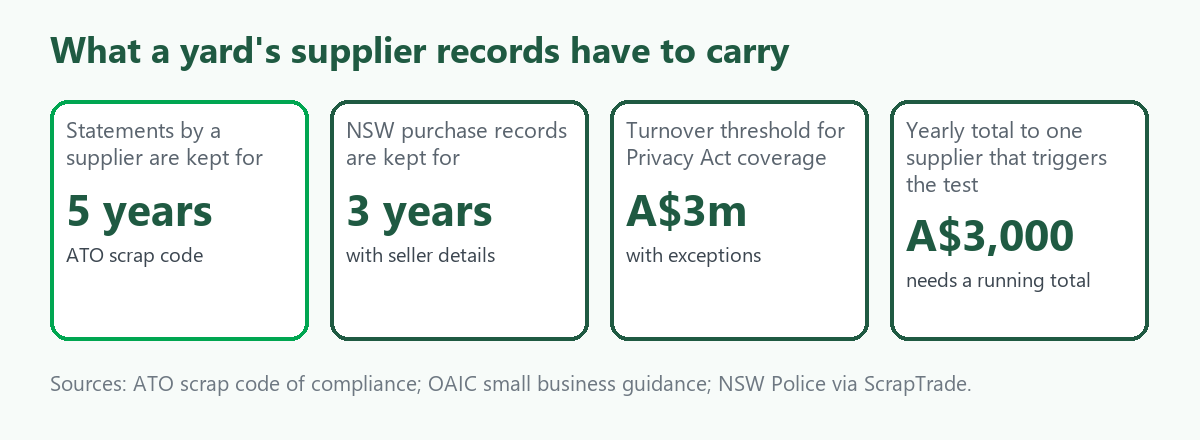
Victoria's rules, as set out in our state rules article, say items under A$100 can be logged as one entry while items of A$100 or more must be recorded individually. NSW requires a record of each purchase with seller details, kept three years, and a report of suspicious transactions. The ATO's code also says, for sellers with no ABN, that a signed statement should be kept for five years [1].
The rule that needs a history
One line in the ATO's scrap code cannot be followed with a docket book alone. It says withholding applies to "any pattern of transactions exceeding $3,000 annually", and that collusion to break up transactions to avoid the A$300 limit will be penalised at the highest rates [1]. To spot either, you need a running total for each supplier, for the year, across visits. A single docket never shows it.
Here is how that looks. Sam runs a yard (invented). A collector sells him A$290 of mixed metal every fortnight. Each docket is under A$300. After 11 visits the total is A$3,190, which passes A$3,000. A per-load check never fires, but a supplier record that adds up the financial year would flag it at visit 11. Whether the collector must then quote an ABN or have 47% withheld depends on the ATO's tests and the facts, and it is a question for a tax adviser, not for software [1][2]. The system's job is to make sure someone asks.
Other flags a supplier record can raise
- GST status changes. The ATO says the buyer should check a supplier's GST registration before the first RCTI and periodically after, and cannot issue RCTIs if registration lapses [3]. A record with the last checked date makes the check visible.
- Statements about to expire or missing, for suppliers who rely on one.
- Material unusual for that supplier, such as a householder suddenly selling commercial volumes. The ATO's tests include commercial premises, vehicles and volume [1].
- Disputes, such as a grading disagreement or a returned load, with the weight and photo that settled it.
The customer record
For buyers the record is simpler: business name and ABN, contacts, the grades they accept, payment terms and history, and which delivery terms were used. Terms such as FOB or CFR decide who bears cost and risk, and we explain them in Incoterms in Scrap Deals. If you sell to exporters, a note of the incoterm used on each deal belongs on the customer record.
Privacy: you are holding personal information
A supplier record with name, address and driver licence number is personal information. The Office of the Australian Information Commissioner says most small businesses, those with annual turnover of A$3 million or less, are not covered by the Privacy Act, but some are, regardless of turnover [4]. The categories it lists include businesses that trade in personal information, health service providers, credit reporting bodies and businesses that have opted in [4]. We cannot tell you whether your yard is covered. Check the OAIC's small business checklist or ask an adviser. Either way, good practice is the same: limit who can see identification details, store them securely and do not paste them into public tools, as we note in AI Tools for a Scrap Business.
Spreadsheet or CRM?
A spreadsheet is fine at the start. We would move off it when you cannot answer three questions in about a minute. This is our rule of thumb, not a standard:
- How much have we paid this supplier this financial year?
- Is their GST registration still current, and when did we last check?
- Do we hold a current signed statement or RCTI agreement for them?
If you cannot answer, the supplier history is not usable for the A$3,000 rule, the RCTI checks or a dispute. A purpose-built yard system or a general CRM can answer them. Which one depends on whether you also need dockets, invoices and stock, as discussed in Scrap Yard Billing: What the Software Must Do.
Where ScrapTrade's yard tools fit
Our yard management page says customers and suppliers are kept as separate records, distinct from marketplace buyers and sellers, with staff roles per yard. It does not describe follow-up reminders, GST checks or a running annual total per supplier, so ask any vendor, including us. ScrapTrade operates a scrap marketplace and has a commercial interest in yard software. You can register or browse the marketplace.
What we could not confirm
- What any CRM does. We reviewed rules, not products.
- Whether your yard is covered by the Privacy Act. The OAIC says it depends on turnover and other factors [4].
- How the A$3,000 pattern is applied in practice. The ATO's wording is short, and what counts as "a pattern" is for the ATO and your adviser.
- Record rules in Queensland, WA and SA, which are changing or unconfirmed, as in our state rules article.
- Benefits. We found no independent evidence on what a CRM does for a yard's margins or retention, and we claim none.
Frequently asked questions
Do scrap yards need a CRM?
Not by law. The law requires records, and a CRM is one way to hold them and to see history across visits.
What records must a yard keep about sellers?
Under the ATO's scrap code, name, address, amount, weight, description, identification, vehicle details, signature and date, with extra detail for sellers with no ABN. State rules add more [1].
How long must a yard keep supplier statements?
The ATO says a statement by a supplier must be kept for five years [1].
Is a supplier's driver licence personal information?
Yes. Whether the Privacy Act applies to your business depends on factors the OAIC sets out [4].
What is the A$3,000 rule?
The ATO's code says a pattern of transactions exceeding A$3,000 a year to one supplier triggers the withholding test, unless a valid exception applies [1].
Related reading and tools: Scrap Yard Automation: What to Automate First.
Sources
- Australian Taxation Office, GST and scrap metal: code of compliance (last updated 3 July 2023).
- Australian Taxation Office, Statement by a supplier not quoting an ABN (last updated 30 June 2017).
- Australian Taxation Office, Tax invoices (last updated 18 September 2026).
- Office of the Australian Information Commissioner, Small business.
The yard in the example is invented. This article is general information, not legal, privacy or tax advice, and we have not tested any software. ScrapTrade operates a scrap marketplace and has a commercial interest in yard software.