


"Become a scrap agent" sounds like a job title. In practice it is a small service: you help someone who has scrap, or wants scrap, with the work of listing, describing and handling the deal, and you are paid a commission for it. You do not need a yard, a truck or stock, because the material belongs to the person who hired you. What you need is some knowledge of scrap, a way of reaching people who need the help, and honesty about what you can and cannot do. This guide looks at six kinds of people who might be good at it, describes the first client each could approach, and ends with a four-week plan. It describes the role as ScrapTrade publishes it, and none of it promises income.
First, how the role works
The basics, from ScrapTrade's pages [1][2]:
- A scrap agent is hired by a seller or a buyer to create listings or run deals for them.
- The seller or buyer stays the party to the deal. The agent works for them under a hiring agreement.
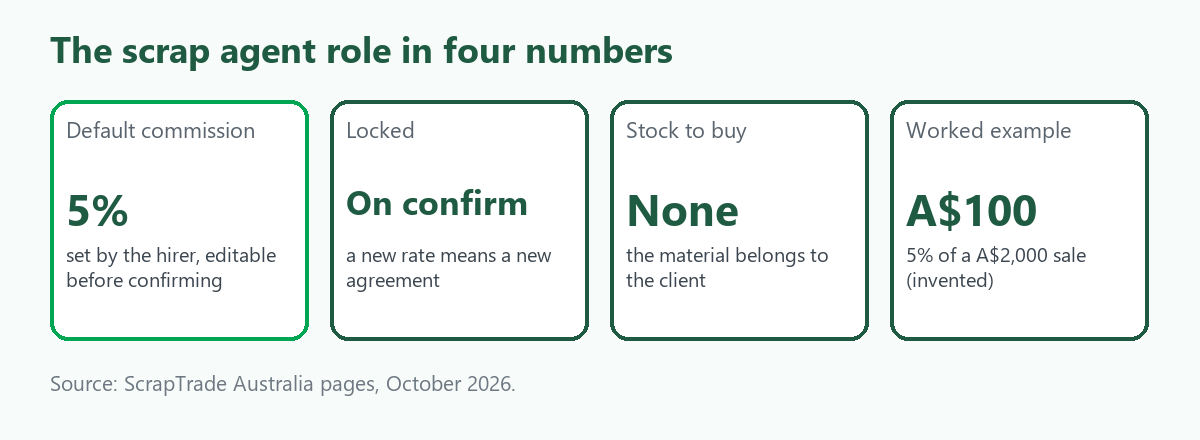
- The commission is set when the agent is hired, from a 5% default that the hirer can change before confirming. After confirmation it is locked.
- When a seller hires the agent, the commission is deducted from the seller's proceeds. When a buyer hires, it is added on top of the price, and the seller's price is not reduced.
- ScrapTrade calculates it and shows it in the payment breakdown.
Here is the arithmetic on an invented sale. A seller hires you to sell a lot, and a buyer pays A$2,000. At the 5% default, your commission is A$100, and the seller receives the rest, less platform fees. You did not buy or store anything. You are paid for the listing, the photos, the answers to the buyer and the follow-up. For the fuller picture of the role and its checklists, see Become a Scrap Broker or Agent in Australia and the hiring agreement checklist.
Six people who could be good at it
These people are invented. They show what different backgrounds bring, and they are not predictions.
1. The demolition or site labourer
Bring: daily contact with who has scrap and how much, and a good eye for what a pile of mixed metal is. First client: a small builder or a renovator who has a skip's worth of metal and no time to sell it. Learn: grades, photos and how to describe a load in words a buyer trusts. Watch for: describing what you have not seen. A listing should match the material.
2. The skip-bin or truck driver
Bring: you already carry loads and talk to site managers. First client: a factory or workshop that keeps getting scrap bins collected and does not know what is in them is worth. Learn: weights and how to ask a client for the details a buyer needs. Watch for: mixing the driver job and the agent job. Keep your commission separate from any collection fee.
3. The ex-counter hand from a yard
Bring: you know grades, prices on the day and what buyers reject. First client: a small business that has been getting a poor quote and wants help comparing. Learn: the platform side, such as how to create a listing and read a payment breakdown. Watch for: conflicts if you still have ties to your old yard. An agent should tell a client if they act for the other side of a deal.
4. The facilities or office manager at a small factory
Bring: you see the scrap, have the authority to sell it and know the paperwork. First client: your own employer, if they agree. Learn: the commission and how it is disclosed. Watch for: a conflict of interest. If you work for the company, get permission before you act as an agent for it.
5. The retired tradie
Bring: decades of knowing what metal is in a building and where. First client: former colleagues, neighbours and tradies who clear jobs and drop old fittings. Learn: the online side, with a short guide to listing. Watch for: the temptation to stick to what you know and describe it vaguely. Photos and weights beat memory.
6. The person with a spare hour and a network
Bring: relationships with property managers, strata committees and small businesses, and a willingness to follow up. First client: a strata manager clearing an old building. Learn: grading from scratch, starting with Scrap Metal Types and Grades. Watch for: promising prices. Say what you will do, not what it will fetch.
The four-week plan
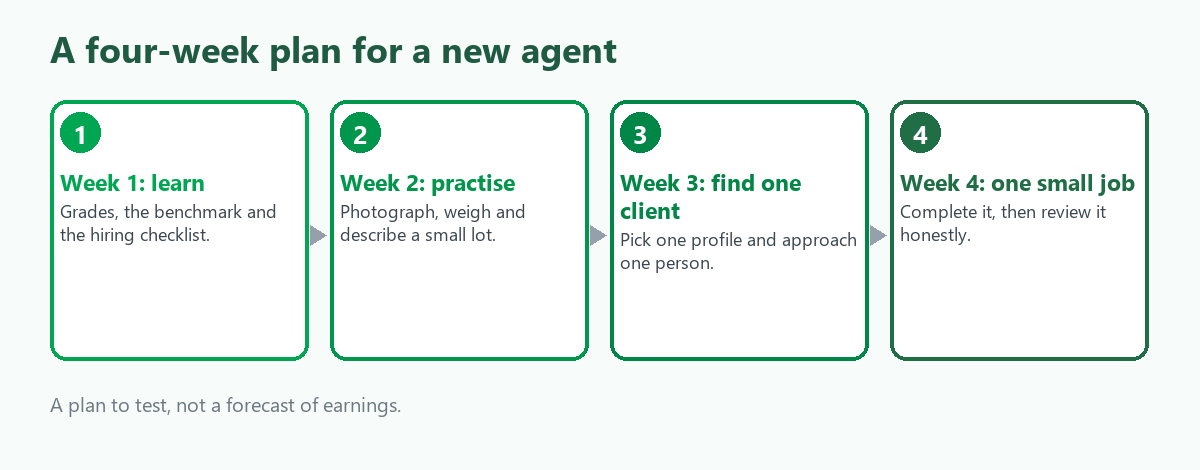
Week 1: learn the grades and the money. Read the grade guides and how a benchmark converts to Australian dollars in Scrap Metal Benchmark Prices in A$ per kg. Learn to describe copper, aluminium, stainless and brass in two sentences each. Read the agent page and the hiring checklist end to end.
Week 2: practise on something real. Photograph and weigh a small amount of your own scrap, or a friend's. Write the description a buyer would need: material, grade, weight, condition, location. Check it against the listing requirements on the marketplace. Create a free account to see how listing works.
Week 3: find one client. Choose one of the six profiles above and approach one person. Say what you do, what the commission is, who it is set by, and what you are not promising. For ideas on where to find clients and what to say, see Promoting Your Scrap Agent or Broker Business.
Week 4: do one small job and review it. Use a hiring agreement with a clear scope. After it, ask four questions: Was the listing accurate? Did the client get updates? Was the commission worth the work to them? Was it worth the work to you? ScrapTrade's own how to choose a scrap agent page suggests clients start with one lot, so expect the same of yours.
What it costs you
No stock and no yard, but not nothing. You use your own time, phone and internet, and sometimes travel to inspect material. ScrapTrade's pages do not say whether registration is free or give platform fee percentages, so check current fees. Most agents in Australia will need to think about an ABN to be paid, though not everyone is entitled to one, and state rules on dealing in scrap vary. See Scrap Business Rules in Australia by State and ask a registered tax agent. We could not verify whether an agent working for a commission counts as a dealer in a given state.
Where ScrapTrade fits
ScrapTrade is where the listing and the deal happen. You work for the hirer, who stays the party to the deal, and the hiring agreement records the hirer, the agent, the commission, the scope, the confirmation date and the status [2]. Its Trust & Safety page says payment is held in escrow from the moment a deal is confirmed and released once pickup or delivery is confirmed. To see the role on the platform, visit the become a scrap agent page. If you would rather hire an agent than be one, see hire a scrap agent. ScrapTrade has a commercial interest in the scrap trade.
What we could not verify
- What agents earn in practice. ScrapTrade does not guarantee any income, and we have no data on typical earnings.
- Whether registration is free and the exact fee rates.
- Whether your state treats an agent as a dealer.
- How long payment takes after delivery.
Frequently asked questions
How do I become a scrap agent?
Create a ScrapTrade account, read the agent page and hiring checklist, and find a seller or buyer who wants to hire you. The hirer sets your commission in the hiring agreement [1][2].
Do I need experience?
The pages do not set an experience requirement. In practice a client wants someone who can describe material accurately, so learn the grades first.
How much commission does a scrap agent get?
The hirer sets it. The default is 5%, editable before the agreement is confirmed and locked after [2]. Income is not guaranteed.
Can I be an agent and also buy scrap myself?
Those are different roles, and a broker who buys or sources material works differently from an agent. Say which role you are in on each deal. See Who Is Who in Scrap.
Sources
- ScrapTrade Australia, Become a scrap agent, as published in October 2026.
- ScrapTrade Australia, Scrap agent hiring agreement checklist, as published in October 2026.
The six people and the sale are invented. The commission arithmetic uses the published 5% default. This is general information, not legal, tax or financial advice. ScrapTrade operates a scrap marketplace and has a commercial interest in the scrap trade.