

Almost every scrap price in Australia starts from a number you can look up yourself: the London Metal Exchange (LME) price of the refined metal, in US dollars a tonne, converted to Australian dollars. Yards then pay a share of it for scrap, after grade and handling. This page puts six of those benchmarks side by side in Australian dollars a kilogram, shows the working so you can repeat it, and explains how to use the numbers to judge an offer. It is not a yard price list. We found no sourced Australian yard prices, so we do not print any, and we say what the benchmarks can and cannot tell you.
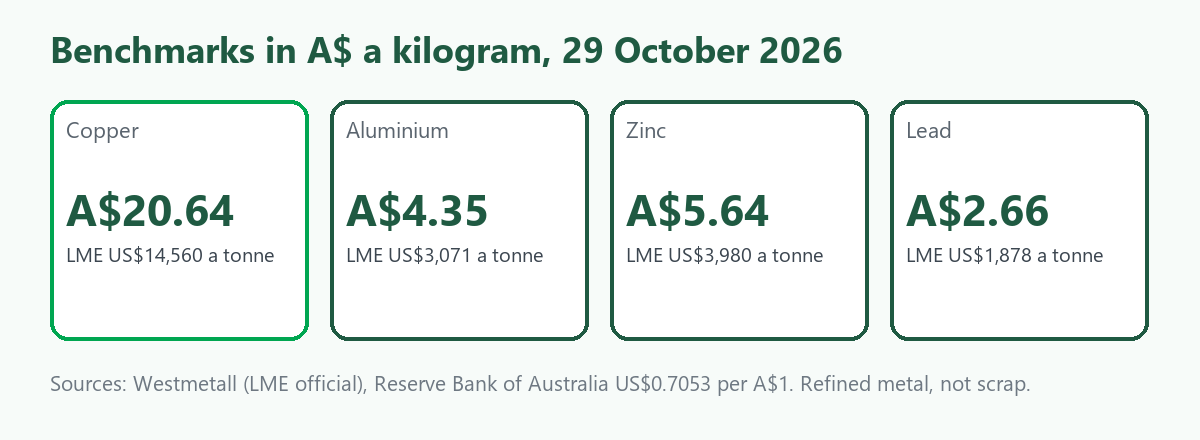
The benchmarks on 29 October 2026
These are the LME official cash settlement prices published by Westmetall on 29 October 2026, the latest available when we wrote this [1]. The Reserve Bank of Australia's rate that day was US$0.7053 per A$1 [2].
| Metal | LME cash, US$ a tonne | In A$ a tonne | In A$ a kilogram |
|---|---|---|---|
| Copper | 14,560 | 20,644 | 20.64 |
| Aluminium | 3,071 | 4,354 | 4.35 |
| Zinc | 3,980 | 5,643 | 5.64 |
| Nickel | 15,360 | 21,778 | 21.78 |
| Lead | 1,878 | 2,663 | 2.66 |
| Tin | 50,400 | 71,459 | 71.46 |
The working: divide the US dollar price by the exchange rate, then divide by 1,000 for a kilogram. For lead, 1,878 / 0.7053 = A$2,663 a tonne, or A$2.66 a kilogram.
These are prices for the refined or primary metal that the exchange trades, not for scrap. Scrap sells below them, and we found no sourced figure for how far below, which varies by metal, grade, buyer and day.
How much the exchange rate matters
Every figure above moves with the Australian dollar as well as the world price. One US cent on the exchange rate, from 0.7053 to 0.7153, lowers each A$ benchmark by about 1.4%. For copper that is about 29 cents a kilogram, and for lead about 4 cents. A metal can therefore get cheaper in Australia while its US price is flat, or dearer when the dollar falls.
A US$1,000 move in a tonne price is worth about A$1.42 a kilogram at the 29 October rate, whatever the metal. That is a large move for lead, which trades near US$1,900, and a small one for tin, which trades near US$50,000.
What each benchmark is good for
- Copper. The most useful benchmark for scrap sellers, because copper scrap in most grades is priced off it. We explain grades in Copper Scrap Price Per Kg: Grades Explained and the full conversion in Copper Price Today in A$.
- Aluminium. Australia exports far more aluminium scrap than any other non-ferrous scrap by weight, as the table below shows, so it is the benchmark most sellers will meet after copper. See Scrap Aluminium Price Per Kg in Australia.
- Zinc and lead. Smaller export volumes than copper or aluminium, and lead often comes from batteries. See Scrap Battery Prices and Lead Scrap Trading.
- Nickel and tin. Mostly relevant to stainless steel (nickel) and solder or plating (tin). The benchmark tells you the metal is valuable, but the scrap you hold usually contains only a small share of it. See Stainless Steel Scrap Price Per Kg.
- Brass. Brass is an alloy of copper and zinc with no benchmark of its own here. See Scrap Brass Price Per Kg in Australia.
- Steel and iron. Not on this list. We do not use an LME contract for ferrous scrap, and cover it separately.
What Australian customs data adds
Australia's export records show what scrap actually shipped for in 2025-26, as a declared value a tonne averaged over the year. These are not yard prices and are not comparable one for one with a single day's benchmark, so we do not divide one by the other.
| Scrap exported | Tonnes in 2025-26 | Declared value a tonne |
|---|---|---|
| Copper and copper alloys | 113,411 | A$10,806 |
| Aluminium | 377,501 | A$3,790 |
| Zinc | 2,660 | A$3,276 |
| Lead | 23,094 | A$2,917 |
| Nickel | 1,053 | A$6,975 |
| Tin | 255 | A$402 |
| Iron and steel | 2,547,805 | A$600 |
Source: DCCEEW waste exports data (ABS records), ScrapTrade calculations; 2025-26 figures are provisional [3].
Three cautions. First, each figure is an average over twelve months, over every grade, destination and shipment size. Second, lead's declared value is slightly above the A$2,663 benchmark above, which tells you the comparison breaks down: we have not checked the benchmark's average across 2025-26 or what mix the lead exports contained. Third, tin's declared value is tiny against its benchmark, and with only 255 tonnes shipped, the material is probably not high-tin scrap, though the data does not say what it was. Use the table for the scale of each trade, and for how much value Australia sends overseas, not to price your load.
How to use the benchmarks
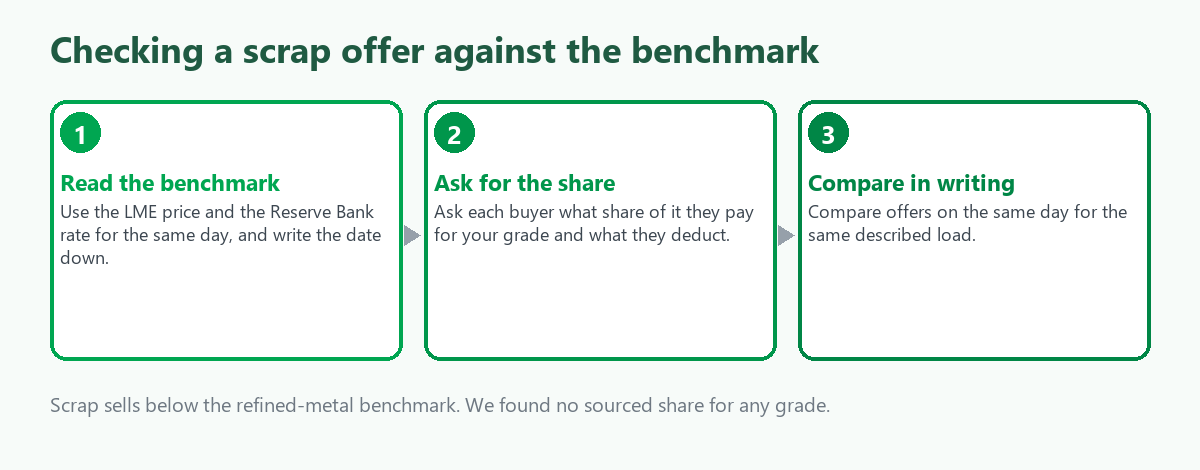
- Read the benchmark the day you sell, from the same sources, and write the date down.
- Ask each buyer what share of it they pay for your grade, and what they deduct for contamination or handling. A quote with no stated share cannot be checked.
- Compare offers on the same day, for the same described load, in writing.
The arithmetic for copper is worked through in How Much Is Your Scrap Copper Worth?. For why prices move, see Why Scrap Metal Prices Change and, for the long run, Do Scrap Export Volumes Follow Prices?.
How this page is kept up to date
We refresh this page by hand from the sources below, so the date in the heading of the table is the only date that applies. If it is more than a few days old, check the sources yourself: Westmetall publishes the LME settlements and the Reserve Bank publishes daily rates. The ScrapTrade index and the scrap calculator give indicative estimates, but when we checked on 30 October the index said live pricing was temporarily unavailable, so we do not print its figures here.
Selling through ScrapTrade
ScrapTrade is a marketplace where you list material with photos and pricing preferences, review buyer offers and negotiate, and buyers can post what they need, as set out on How It Works. The Trust & Safety page says payment is held in escrow from the moment a deal is confirmed and released once pickup or delivery is confirmed. Create a free account to list a load. ScrapTrade has a commercial interest in the scrap trade.
What we could not verify
- Sourced Australian yard prices for any metal or grade.
- How far scrap sells below each benchmark.
- Prices after 29 October 2026, which will have moved.
- Which customs mix sits behind each declared value.
Frequently asked questions
What is the scrap metal price in Australia per kg?
It depends on the metal, the grade and the buyer. As context, the LME benchmarks on 29 October 2026 were about A$20.64 a kilogram for copper, A$4.35 for aluminium, A$5.64 for zinc and A$2.66 for lead, and scrap sells below them [1][2].
Why are your numbers different from a yard's board?
A yard prices a grade, after deductions, and the benchmark is the refined metal. The gap is the share the yard pays, which we could not source.
Where can I check the benchmark myself?
The LME official prices are republished by Westmetall, and the Reserve Bank of Australia publishes the exchange rate. Both are listed below.
Is tin or nickel scrap worth the benchmark?
Rarely. Scrap containing nickel or tin usually holds only a small share of it, so the benchmark is a ceiling for the pure metal, not a price for your load.
Sources
- Westmetall, Official LME prices, 29 October 2026.
- Reserve Bank of Australia, Exchange rates, 29 October 2026 (US$0.7053 per A$1).
- Department of Climate Change, Energy, the Environment and Water, waste exports data (ABS records), HS 7404, 7602, 7902, 7802, 7503, 8002 and 7204, ScrapTrade calculations.
Figures are indicative and not an offer or advice. ScrapTrade operates a scrap marketplace and has a commercial interest in the scrap trade.