

People in scrap use the words "broker", "dealer", "agent", "trader" and "yard" loosely, and a newcomer can easily come away thinking they are all the same job. They are not. The difference decides who holds the material, who carries the risk, who gets paid and what rules apply. This guide explains each role in plain English by following one imaginary load of scrap from a bathroom to a buyer. The terms vary between people and between states, and the law has its own names, so treat our definitions as a guide to how the trade talks, and where ScrapTrade has defined a term on its own pages we say so.
The load
Rina is renovating her bathroom (invented). The old copper pipe, a hot-water cylinder and some brass taps come out, about 120 kg of mixed metal. She has no use for it, and she does not want it in a skip. That load is about to meet six different people. Here is each of them.
The collector
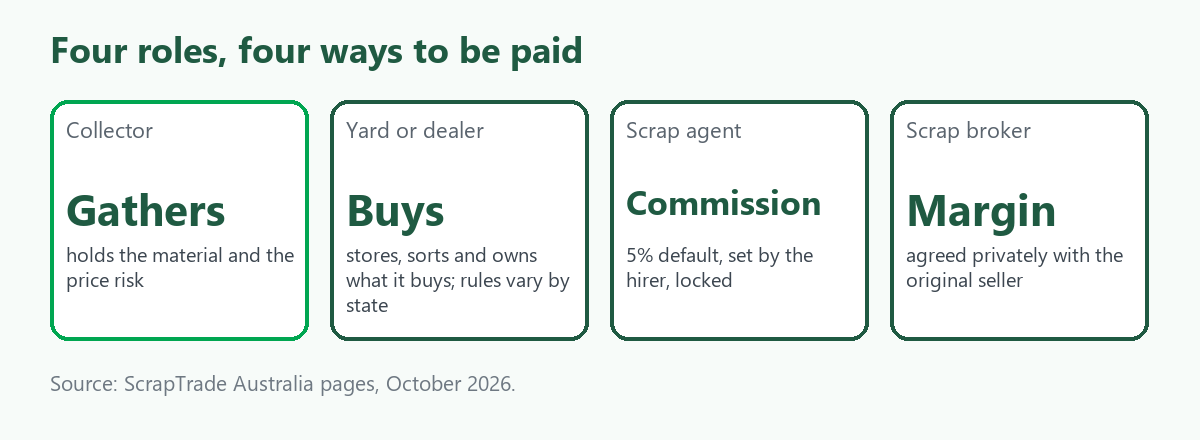
A collector gathers scrap from many small sources and takes it to a buyer. Rina's plumber might do this in a ute. The collector's income is the gap between what they are paid at the yard and what it cost them to gather it, minus petrol and time. A collector holds the material, so they carry the risk of a price fall, and they work alone. In Australia a person can be selling scrap often enough to be treated as running a business, which is where our tax guide begins.
The yard, or scrap dealer
A yard buys material from the public, collectors and businesses, stores it, sorts it and sells it on. The people running it are often called scrap dealers. Rina could drive her load straight to a yard. The yard weighs it, pays her and now owns it. It carries the stock risk, the site costs and the legal obligations that come with buying scrap. Those obligations differ by state. NSW requires a dealer's business to be registered with NSW Police, Victoria requires registration as a second-hand dealer, and both ban paying cash for scrap. We set them out in Scrap Business Rules in Australia by State.
The trader
A trader buys and sells scrap, often in large amounts and across borders, without necessarily running a yard. A trader may buy from several yards, aim at a specific buyer's need and arrange shipping. The trader owns the material while it moves, so they too carry the price risk. How an export deal works from the trader's side is in How a Scrap Export Deal Works, Step by Step.
The scrap agent
An agent works for someone else. On ScrapTrade, a scrap agent is hired by a seller or a buyer to do the listing and dealing work for them, for a commission [1]. Suppose Rina has no time and no idea how to describe mixed copper, and a friend who knows scrap says "I'll sort it, list it and handle the buyer." That friend is acting as an agent.
Three things define an agent on ScrapTrade [1][2]:
- The client stays the party to the deal. Rina still owns the load and sells it.
- The commission is set at hiring, 5% by default, editable before the agreement is confirmed and locked after.
- ScrapTrade calculates it and shows it in the payment breakdown.
An agent does not hold the material and does not buy it, so there is no stock risk, though time can go unpaid if a deal fails. The role is described on ScrapTrade's hire a scrap agent and become a scrap agent pages.
The scrap broker
A broker sources scrap from an original seller and resells it. On ScrapTrade a broker is the seller on the platform, with a broker classification and a reference to the original seller, and the margin is agreed privately with the original seller [3]. ScrapTrade does not calculate, deduct or distribute it [3].
Rina's plumber, Joe, might be a broker without knowing the word. If Joe agrees with Rina that he will sell her load for her at a price, keeping the difference, then lists it on a marketplace as the seller, that is brokering. Joe does not own a yard. He carries two things: the seller's responsibilities to the buyer, and the risk that a sale falls through after he has agreed terms with Rina. The broker pages say a broker must describe the material honestly, have written authority to sell it and settle with the original seller under their own agreement [4].
Agent or broker: the one question that tells them apart
Ask whose deal it is. If the client remains the party and you are paid a commission by them, you are an agent. If you are the seller on the platform, taking a position in the material and a margin, you are a broker.
| Agent | Broker | |
|---|---|---|
| Works for | A seller or buyer who hires them | Themselves, as the seller |
| Holds the material? | No | Possibly, or controls the sale |
| Paid by | Commission set at hiring | A margin agreed privately |
| Who calculates it? | ScrapTrade, in the payment breakdown | Nobody; ScrapTrade does not |
| Main risk | Unpaid time if a deal fails | A loss if a buyer cancels after the seller is paid |
For the longer comparison, see ScrapTrade's scrap agent versus scrap broker page and our guide, Become a Scrap Broker or Agent in Australia.
The buyer
At the other end sits the buyer: a processor, a mill, an exporter or a yard that needs more of what you have. Buyers can also be agents' clients. A buyer who needs a specific grade can hire an agent to search for it and post a request, as the agent page describes. Who actually buys Australian copper and aluminium scrap is covered in Who Buys Australia's Aluminium and Copper Scrap.
Following Rina's load
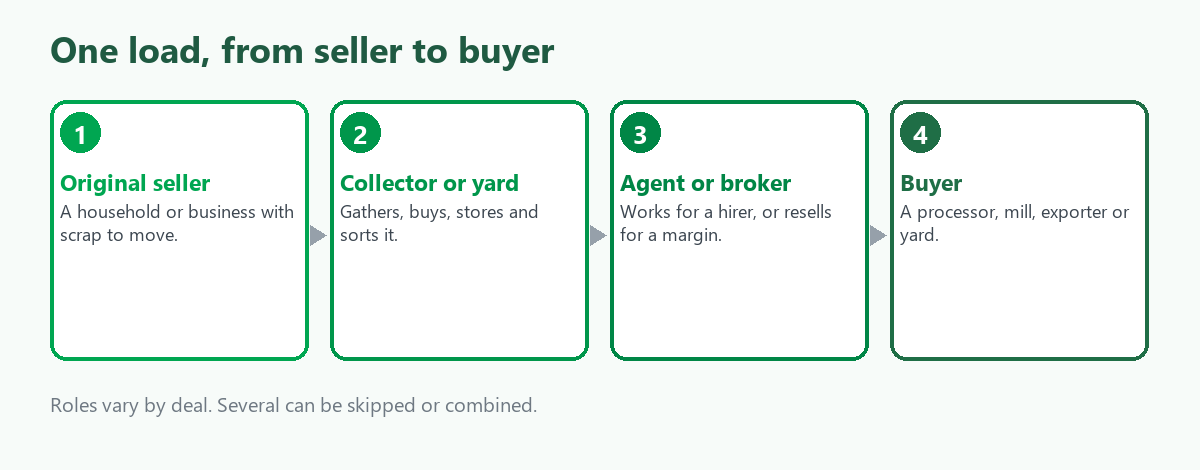
In one version, Rina drives it to a yard and is paid on the spot. In another, Joe collects it and sells it to a yard. In a third, Rina's friend lists it as her agent, and a buyer takes it. In a fourth, Joe brokers it, lists it as the seller and a buyer pays through the platform. Same 120 kg, four routes. The material is the same each time. What changes is who owns it along the way, who is paid, and who answers if something goes wrong.
Which role suits you?
- You like physical work and have a vehicle: collector.
- You can run a site and satisfy the licensing: yard. See Starting a Scrap Yard in Australia: A Checklist.
- You know scrap but have no capital: agent. You are paid for effort and do not buy material.
- You have a network of businesses that produce scrap and can take a position: broker. ScrapTrade's is brokering right for you page is a plain check.
What the law calls them
Australian law does not use "broker" or "agent" the way the trade does. Whether a broker who never holds the material, or an agent working for a commission, counts as a scrap dealer or second-hand dealer in a given state is something we could not verify, and our state rules guide says to ask your regulator. Do that before you start.
Where ScrapTrade fits
ScrapTrade is a marketplace where you list material, compare buyer offers and negotiate, and buyers can post what they need, as set out on How It Works. Its Trust & Safety page says payment is held in escrow from the moment a deal is confirmed and released once pickup or delivery is confirmed. Sellers, buyers, agents and brokers all use the same platform. Create a free account to start. ScrapTrade has a commercial interest in the scrap trade.
What we could not verify
- How each state classifies brokers and agents for licensing.
- How many people in Australia work in each role.
- How the platform's fees apply to your case. Standard fees apply to broker sales and to agent deals as usual, and we do not state a rate.
Frequently asked questions
What is a scrap broker?
Someone who sources scrap from an original seller and resells it, taking a margin agreed privately. On ScrapTrade a broker is the seller on the platform [3].
What is the difference between a scrap broker and a scrap dealer?
A dealer usually runs a yard and owns what it buys. A broker may never hold the material and is paid a margin on the resale. The line can blur, and your state's law has its own terms.
Is an agent the same as a broker?
No. An agent is hired by a seller or buyer and earns a commission. A broker sells as the seller and earns a margin [1][3].
What does a scrap trader do?
Buys and sells scrap, often at scale or across borders, owning it while it moves.
Sources
- ScrapTrade Australia, Hire a scrap agent, as published in October 2026.
- ScrapTrade Australia, Scrap agent hiring agreement checklist.
- ScrapTrade Australia, Scrap broker margin explained.
- ScrapTrade Australia, What a scrap broker is responsible for.
Rina, Joe and the load are invented. This is general information, not legal or tax advice. ScrapTrade operates a scrap marketplace and has a commercial interest in the scrap trade.