

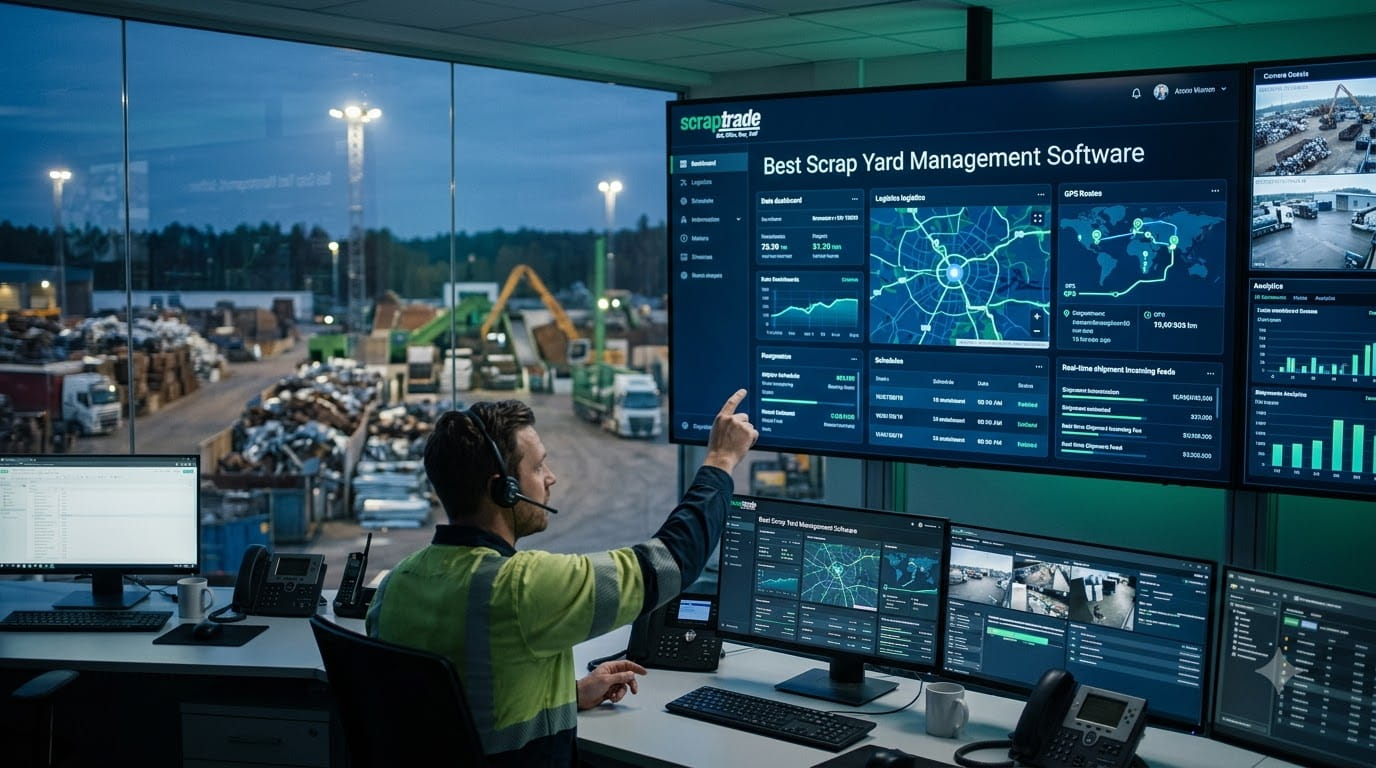
Running a scrap yard involves more than buying and selling recyclable materials. Dealers must manage incoming loads, weighbridge records, supplier payments, inventory, customer orders, dispatches, and invoices. When these activities are recorded in separate spreadsheets or disconnected systems, stock discrepancies, delayed transactions, and reporting errors can become difficult to control.
Scrap yard management software helps scrap dealers organize these operations through a central digital system. Depending on the platform, it can connect weighing, purchasing, inventory tracking, sales, invoicing, and operational reporting.
Whether you operate a small scrap yard or a multi-location recycling business, choosing the right software can improve visibility into daily operations and help staff maintain more consistent records.
This guide explains the essential features of scrap yard software, how it differs from inventory management tools, what affects implementation costs, and how digital scrap marketplaces can complement your existing systems.
What Does Scrap Yard Management Software Do?
Scrap yard management software is a digital system designed to coordinate the operational activities involved in receiving, processing, storing, purchasing, and selling scrap materials.
Unlike basic inventory software, a scrap yard digital management system may cover the entire material-handling workflow, from vehicle entry and weighing to stock updates, sales documentation, and dispatch.
For example, when a supplier delivers a load of aluminium scrap, the system may record the supplier, vehicle details, gross weight, tare weight, net weight, material grade, and purchase price. Once the load is accepted, the inventory record can be updated.
When the material is later sold, the software can record the customer, quantity dispatched, selling price, and associated documents.
The exact capabilities depend on the software selected. Some products specialise in weighbridge and yard operations, while others provide broader business management features.
Who Needs Scrap Yard Operations Management Software?
Scrap yard software can support several types of businesses:
- Scrap dealers: Manage daily purchases, sales, stock, and supplier records.
- Metal recycling yards: Track material grades, processing, and inventory movements.
- Automotive recyclers: Manage end-of-life vehicles, parts, and recoverable metals.
- E-waste recyclers: Record electronic scrap categories and material movements.
- Industrial recycling facilities: Coordinate incoming production scrap and outgoing recyclable materials.
- Large recycling groups: Standardise reporting and operational procedures across multiple locations.
Small businesses may need only purchasing, weighing, and stock tracking, whereas larger operations may require accounting integrations, advanced permissions, and multi-site reporting.
Essential Features of Scrap Yard Software
When comparing scrap yard management systems, focus on the features that directly support your operational workflow.
Incoming and Outgoing Material Management
A scrap yard receives material from suppliers and sells it to manufacturers, processors, exporters, and other buyers. Each movement should have a traceable record.
Useful features include:
- Incoming load registration
- Supplier and customer identification
- Material type and grade classification
- Quantity and weight recording
- Storage location tracking
- Purchase and sales order management
- Dispatch and delivery documentation
- Returns and stock adjustments
For example, a yard receiving three copper scrap deliveries in one day should be able to track each delivery separately while maintaining a consolidated copper stock balance.
This makes it easier to identify the source of a discrepancy and determine which material is available for sale.
Weighing and Transaction Records
Weighing is a core function for many scrap yards because purchases and sales are commonly calculated by weight.
Scrap yard automation systems may integrate with weighbridges, truck scales, or other weighing equipment.
A typical weighing record includes:
| Field | Example |
|---|---|
| Material | Aluminium scrap |
| Gross weight | 12,500 kg |
| Tare weight | 4,500 kg |
| Net weight | 8,000 kg |
| Supplier | Supplier A |
| Transaction date | Delivery date |
| Purchase rate | Agreed rate per kg |
The calculation is straightforward:
Net weight = Gross weight − Tare weight
In this example, the net material weight is 8,000 kg.
A suitable system should preserve the associated transaction record and support adjustments through a controlled process. If weighing equipment integration is important, confirm that the software supports your specific hardware and measurement requirements.
Buyer and Supplier Databases
Maintaining accurate supplier and buyer information helps reduce repetitive administration.
A scrap yard management system may store:
- Business names and contact details
- Supplier purchase history
- Customer sales history
- Material preferences
- Agreed commercial terms
- Credit limits, where supported
- Verification documents, where required
- Outstanding transactions
These records can help staff identify regular suppliers, review customer activity, and locate historical transaction information.
For larger operations, role-based access can help ensure that employees only access the records and functions relevant to their responsibilities.
Invoicing, Reports, and Performance Tracking
Scrap yard reporting software can turn transaction records into operational information.
Common reporting requirements include stock-on-hand reports, supplier purchase summaries, customer sales reports, weighbridge transaction histories, and inventory valuation.
Depending on the platform, businesses may also monitor:
- Daily inbound and outbound tonnage
- Purchase and sales values
- Material-level stock balances
- Gross margin by material category
- Unusual weight differences
- Supplier and customer activity
- Unprocessed or ageing inventory
For example, a monthly report may show that aluminium inventory is increasing faster than sales. Management can investigate whether purchasing volumes, customer demand, processing capacity, or selling prices need attention.
Accounting, tax, and financial reporting requirements vary by jurisdiction, so verify whether the software supports your business's specific requirements.
Scrap Yard Management Software vs Inventory Software
Although the two systems overlap, their primary purposes differ.
| Capability | Inventory Management Software | Scrap Yard Management Software |
|---|---|---|
| Stock quantity tracking | Core function | Core function |
| Material categories and grades | Often supported | Often supported |
| Incoming and outgoing stock | Usually supported | Usually supported |
| Weighbridge integration | Depends on the product | May be a specialised feature |
| Vehicle and load processing | May be limited | May be supported |
| Supplier purchasing | Varies by product | Often included |
| Customer sales and dispatch | Varies by product | Often included |
| Invoicing and reporting | Depends on the product | Often included |
| Yard-specific workflows | May require customisation | May be built in |
A business focused mainly on stock control may find inventory software sufficient. A yard that handles frequent vehicle movements, weighbridge transactions, purchasing, and dispatches may benefit from a more comprehensive operational system.
Before buying, compare actual product capabilities rather than relying on software category names alone.
Software Requirements for Small and Large Scrap Yards
The right scrap yard software depends on the scale and complexity of the operation.
Scrap Yard Software for Small Businesses
A small dealer may need an affordable system that handles daily purchases, material weights, stock balances, sales, and basic reports.
Important considerations include ease of use, low setup requirements, mobile access, staff training, and transparent subscription fees.
A small yard does not necessarily need advanced automation or complex enterprise integrations. Start with the workflows that create the most administrative work or inventory errors.
Software for Large Scrap Yards
Larger yards may require more advanced capabilities, including:
- Automated weighbridge integration
- Barcode or RFID tracking
- Multiple yard and warehouse locations
- Detailed user permissions
- Accounting and enterprise resource planning integrations
- Batch and processing records
- Advanced inventory valuation
- Consolidated reporting across locations
- Audit trails and data backups
For high-volume operations, implementation quality and system reliability can be just as important as the feature list.
How to Evaluate Scrap Yard Software
Choosing the best scrap yard management software requires a structured evaluation.
1. Map Your Existing Workflow
Document how materials move through your business, from supplier arrival to weighing, inspection, storage, processing, sale, and dispatch.
Identify where records are duplicated or where employees manually transfer information between systems.
2. Prioritise Essential Features
Separate must-have features from optional upgrades. For example, weighbridge integration may be essential for one yard but unnecessary for a dealer who purchases pre-weighed materials.
3. Request a Realistic Demonstration
Ask vendors to demonstrate a complete transaction using your actual workflow.
A useful demonstration should include an incoming load, weight recording, inventory update, customer sale, dispatch, and reporting.
4. Check Integration and Data Migration
Confirm whether the system integrates with existing accounting software, weighing equipment, or other operational tools.
Ask how supplier records, material categories, historical transactions, and stock balances will be migrated from spreadsheets or legacy systems.
5. Evaluate Support and Reliability
Review training, onboarding, support availability, system uptime commitments, backups, security controls, and data export options.
A system that staff cannot use consistently will not deliver its intended operational benefits.
Implementation Costs and Factors That Affect Pricing
There is no universal price for scrap yard management software. Costs depend on the vendor, deployment model, transaction volume, and required functionality.
The following table illustrates common pricing components rather than quoted market prices.
| Cost Component | What Affects the Cost |
|---|---|
| Subscription | Number of users, locations, or modules |
| Initial setup | Configuration and business workflow requirements |
| Data migration | Number and quality of historical records |
| Hardware | Weighbridges, scales, scanners, and terminals |
| Integration | Accounting, ERP, or equipment connectivity |
| Training | Staff numbers and operational complexity |
| Ongoing support | Service level and support package |
| Custom development | Specialised reports or workflows |
When comparing vendors, calculate the total cost of ownership, not just the monthly subscription.
A lower-cost product may require manual work or paid integrations, while a more comprehensive system may reduce administrative effort. Evaluate the total cost against measurable operational benefits.
For example, estimate the time spent correcting stock discrepancies, reconciling weights, preparing reports, and re-entering transaction data. These measurements can help establish whether a proposed system offers sufficient value.
How Digital Marketplaces Complement Scrap Yard Software
Scrap yard management software and digital scrap marketplaces solve different problems.
Operational software helps a business manage material already purchased, stored, processed, or sold. A digital marketplace helps businesses discover potential buyers and sellers and explore new trading opportunities.
Using both can support a more connected scrap trading workflow.
For example, a scrap dealer can maintain internal stock records in its management system while using ScrapTrade to explore potential buyers, list available materials, and compare commercial offers through a global online scrap marketplace.
The marketplace does not automatically replace internal inventory, accounting, or weighbridge software. Any data exchange between systems depends on available integrations or the business's own processes.
The scrap trading marketplace provides an additional channel for exploring scrap trading opportunities. Businesses seeking another digital sales channel can also visit the instant scrap selling platform.
FAQS
What is the best scrap yard management software?
The best system is the one that fits your yard's transaction volume, weighing equipment, inventory requirements, and reporting needs. Compare purchasing, sales, weighbridge integration, user permissions, support, and total ownership costs. Test the system with real operational scenarios before making a purchasing decision.
Is scrap yard management software suitable for small businesses?
Yes. Small scrap dealers can benefit from digital records for purchases, sales, material weights, and stock balances. A simple cloud-based system may be sufficient, provided it supports the essential workflows without unnecessary complexity or excessive implementation costs.
Can scrap yard software integrate with a weighbridge?
Some systems support weighbridge integration, allowing weight readings to be associated with transaction records. Compatibility depends on the software, weighbridge hardware, and communication interface. Confirm supported equipment and test the complete weighing workflow before implementation.
How much does scrap yard management software cost?
Pricing varies according to subscription plans, user numbers, locations, hardware, integrations, training, and customisation. Request a detailed quotation covering setup fees, recurring charges, support, and additional modules to compare the full cost of ownership.
Conclusion
The best scrap yard management software helps scrap dealers control incoming and outgoing materials, maintain accurate weighing records, organise supplier and customer information, and monitor operational performance.
Before choosing a system, assess your workflows, prioritise essential features, verify equipment compatibility, and compare total implementation and ownership costs.
Digital operations software can help manage the yard, while a marketplace can help expand the commercial side of the business. Explore ScrapTrade to connect with potential scrap buyers and sellers, list recyclable materials, and discover global B2B scrap trading opportunities.