

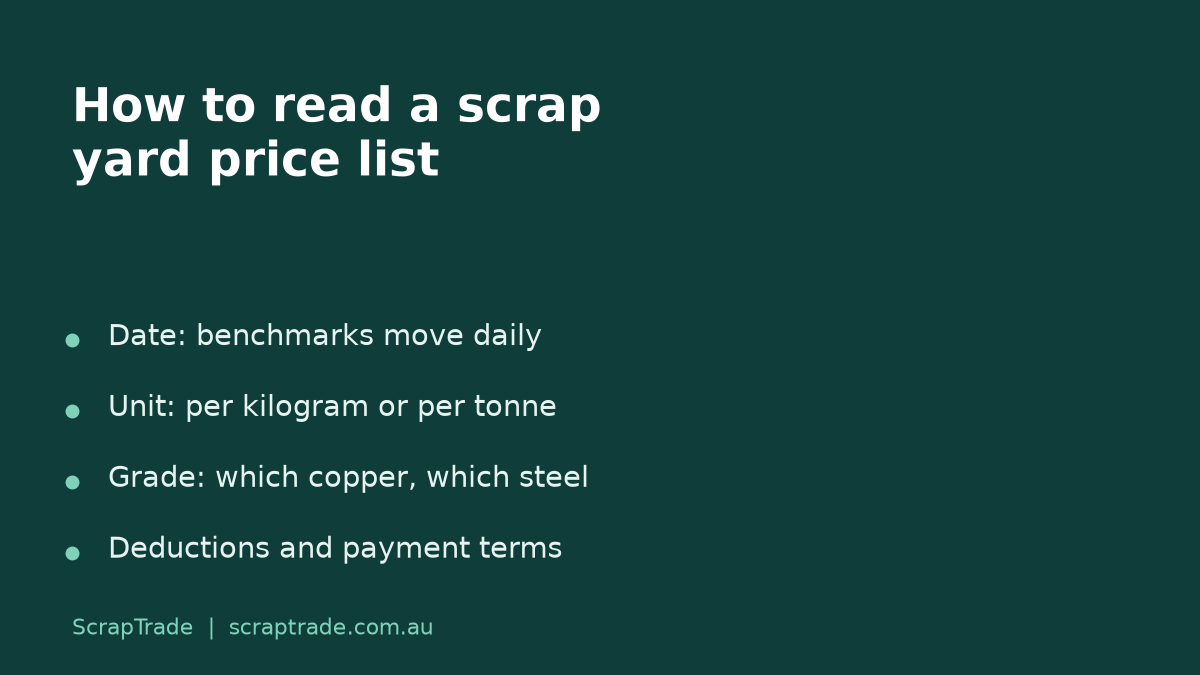
Short answer. A price list is a set of rates for named grades on a particular day. Before you compare two lists, check the date, the unit, the grade, what is deducted and how you are paid. A big number on a list tells you little until each of those matches.
Two yards can show different numbers for what looks like the same metal and both be honest, because the lists describe different things. This guide goes through a list one line at a time, using the 16 November 2026 benchmarks for copper, aluminium and lead as the yardstick. It lists no real yard prices, because we found no sourced current ones. The table below uses invented numbers, labelled as such. ScrapTrade is a scrap marketplace, so it has a commercial interest here.
1. The date
Scrap rates follow benchmarks that change every trading day. The London Metal Exchange (LME) cash settlement for copper was US$14,560 a tonne on 29 October 2026 and US$13,375 on 16 November [1], a fall of about 8%. In Australian dollars the fall was smaller, from about A$20.64 to A$19.79 a kilogram, about 4%, because the Reserve Bank's rate moved from US$0.7053 to US$0.6759 per A$1 [2]. A list printed a fortnight ago is a guide to the past. Ask when the list was set, and whether the yard will hold a price for your delivery. The benchmark logic is in Where Scrap Price Benchmarks Come From.
2. The unit
Lists may show a price per kilogram or per tonne. They are a factor of 1,000 apart: A$14 a kilogram is A$14,000 a tonne. Check which one the list uses before you compare. Also check what weight the price applies to. The weight is what the yard records on its scale, and for trade a weighbridge must be a type approved by the National Measurement Institute and verified [3].
3. The grade
A line that says only "copper" or "steel" is incomplete. Grades describe how clean and in what form the metal is, and a mixed lot may be priced at the lowest grade in it. Match your material to the yard's named grade, and ask what the names mean if they differ from the usual ones. The common copper, aluminium and steel grades are set out in Scrap Metal Grades Explained: Copper to Steel.
4. The word "up to"
A range or an "up to" price is the best case for the best material. We found no sourced rule on how yards word their lists, so treat the top of a range as what clean, sorted metal might earn, and ask for the price for your grade and quantity in writing.
5. Deductions and conditions
Check what the yard takes off for insulation, solder, paint, steel or dirt, whether there is a minimum quantity, and whether handling is charged. These are not always on the list. For copper, Scrap Yard Copper Prices: How to Check an Offer shows how the three parts of a payout (weight, a rate for the grade, deductions) fit together.
6. How you are paid
Payment terms are part of the price. In New South Wales and Victoria, scrap dealers cannot pay cash [4]. The Australian Taxation Office's scrap code asks buyers to record identification for sales above A$82.50, and says that without an ABN a business seller may have 47% withheld [5]. In Victoria, items worth A$100 or more must be recorded individually [4]. State rules differ, and they are set out in Scrap Business Rules in Australia by State.
A worked example with invented numbers
Here is a short list with made-up rates. The shares are each rate divided by the 16 November copper benchmark of A$19.79 a kilogram [1][2].
| Grade | Rate (invented) | Per tonne | Share of A$19.79 |
|---|---|---|---|
| Bare bright copper | A$14.50 / kg | A$14,500 | 73% |
| Copper No. 2 | A$13.00 / kg | A$13,000 | 66% |
| Insulated cable | A$6.00 / kg | A$6,000 | 30% |
None of these is a real offer. The lowest line looks poor, but cable is paid for the copper recovered, and the ScrapTrade index puts insulated cable at 60 to 70% copper recovery [6]. A yard paying a low rate for a low grade is not the same as a yard paying a low share for a high grade, so compare the same grade at each yard.
What to ask before you drive anywhere
- What date is this list for, and will you hold the price for my delivery?
- Is it per kilogram or per tonne, and on net weight?
- Which grade is my material, and what does the grade name mean?
- What do you deduct, and is there a minimum quantity?
- How do I get paid, and what identification and ABN details do you need?
Ask two or three yards the same questions and write the answers side by side. The benchmark for each metal is in Scrap Metal Benchmark Prices in A$ per kg, and the Scrap Metal Benchmark Note: November 2026 shows how the figures moved.
Where ScrapTrade fits
List your scrap on ScrapTrade for free: there is no commission, verified buyers bid, and the buyer's 5% deposit is held in escrow once you accept a bid. Businesses and individuals can sell after verification. Instead of driving to several yards, you post photos and a price, and buyers bid. How scrap pricing is worked out on the global side is covered on scrap.trade in How Scrap Metal Pricing Works: Grading, Weight, and Purity.
What we could not verify
- What Australian yards pay today for any grade.
- How yards word "up to" prices, minimums and handling charges.
- What typical share of the benchmark yards pay for each grade.
- Whether the payment rules for states other than NSW and Victoria require anything beyond the points above.
Frequently asked questions
What does a price per kg on a scrap list mean?
It is a rate for a named grade on a date. The payout is weight times that rate, less deductions.
Why do two yards show different prices for copper?
They may be listing different grades, different dates or different deductions. Compare the same grade on the same day.
Is the price on a list guaranteed?
We found no sourced rule. Ask the yard whether it holds the price for your delivery, and get it in writing.
How do I tell if an offer is good?
Divide the offer per kilogram by the day's benchmark in Australian dollars, then compare that share between two or three yards for the same grade.
Sources
- Westmetall, Official LME prices, cash settlements 16 November 2026 and 29 October 2026 (copper US$13,375 and US$14,560 a tonne).
- Reserve Bank of Australia, exchange rates, 16 November 2026 (US$0.6759 per A$1) and 29 October 2026 (US$0.7053 per A$1).
- National Measurement Institute, Weighbridges used for trade.
- Consumer Affairs Victoria and NSW Police, scrap metal dealer rules, as summarised in ScrapTrade's guide to scrap business rules by state, accessed November 2026.
- Australian Taxation Office, GST and scrap metal: code of compliance (3 July 2023).
- ScrapTrade Price Index grade definitions, accessed November 2026.
General information, not an offer or advice. All rates in the example table are invented. Benchmark figures are as at 16 November 2026.