

Short answer. Grades describe how clean and in what form a metal is. Buyers pay by grade, so a mixed lot may be priced at the lowest grade in it.
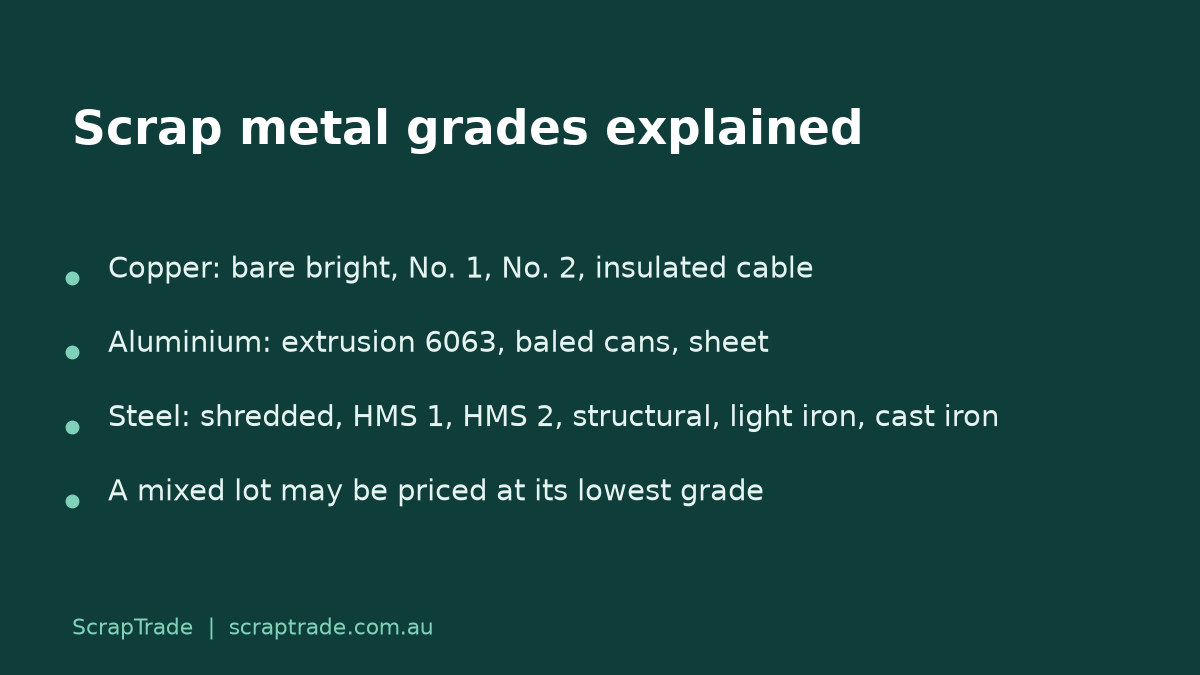
A price for copper or steel means little without a grade. The same metal can sit in several grades, and the difference between them is mostly what you can see and prove: clean or coated, loose or attached, one alloy or mixed. This page explains the main grades for the three metals people sell most, using the ScrapTrade index definitions. Yards may use their own names, so treat these as a common language, not a rulebook. No prices are given, because we could not source current ones. ScrapTrade operates a scrap marketplace, so it has a commercial interest in this trade.
Why grades exist
A buyer needs to know what it will melt. Clean, uncoated, single-alloy metal gives the remelter a predictable product, so it earns a higher share of the benchmark price. Coated, mixed or contaminated metal costs the buyer more to process, so it is marked down. In the United States the trade body ReMA publishes a Scrap Specifications Circular that many buyers and sellers use, which ReMA describes as guidelines and a starting point. Australian yards use similar ideas under their own names.
Copper grades
- Bare bright wire: clean, uncoated, unalloyed wire with no insulation. The top copper grade.
- Copper No. 1: clean tubing, bus bar and wire at least 1/16 inch thick.
- Copper No. 2: copper with some solder, paint or light oxidation.
- Insulated cable: mixed cable with insulation, with 60 to 70% copper recovery.
- Brass: clean yellow brass with no iron attachments, priced separately from copper.
- More on how copper is graded and priced: Copper Scrap Price Per Kg: Grades Explained.
Aluminium grades
- Extrusion (6063): clean, uncoated window and door extrusions.
- Used beverage cans (UBC): baled used cans.
- Sheet: clean aluminium sheet with no coating.
- Cast and mixed aluminium are not on the ScrapTrade index and are priced separately by yards. See Scrap Aluminium Price Per Kg in Australia.
Steel and iron grades
- Shredded steel: machine-shredded auto and appliance steel, clean and compact.
- HMS 1: clean heavy steel a quarter inch and over, with no tin, galvanised or coated material.
- HMS 2: mixed heavy steel that may include coated or painted material.
- Structural steel: beams, girders, columns, angles and channels.
- Light iron and sheet: thin sheet steel, pressed panels and appliance skins.
- Cast iron: engine blocks, pipes and machinery castings.
- Stainless steel is graded separately by type, such as 304, 316 and 430. See Stainless Steel Scrap Price Guide.
What drops a load to a lower grade
- Paint, coatings, solder or plating.
- Steel, rubber, plastic or glass still attached.
- Dirt, oil or moisture, which add weight you are not paid for.
- Mixing grades in one pile. A mixed lot may be priced at the lowest grade in it.
How to sort before you sell
- Use a magnet to split steel and iron from the rest. See How to Identify and Test Scrap Metal at Home.
- Separate non-ferrous metals by type.
- Remove attachments where it is safe to do so.
- Keep each grade in its own bin and weigh it.
- Describe each grade accurately when you ask for a quote, and photograph it.
Using grades to check an offer
Ask which grade the quote is for and what the buyer deducts. Then convert the rate to a share of the benchmark. The method is in Scrap Yard Copper Prices: How to Check an Offer. Payment and ID rules are in Scrap Business Rules in Australia by State.
Where ScrapTrade fits
List your scrap on ScrapTrade for free: there is no commission, verified buyers bid, and the buyer's 5% deposit is held in escrow once you accept a bid. Businesses and individuals can sell after verification.
What we could not verify
- How each Australian yard names and applies its grades.
- The share of the benchmark each grade earns at a given yard.
- Current rates for any grade.
Frequently asked questions
What is HMS 1?
Clean heavy steel a quarter inch and over, with no tin, galvanised or coated material, under the ScrapTrade index definition.
What is bare bright copper?
Clean, uncoated, unalloyed copper wire with no insulation.
Why does insulated cable pay less per kilogram?
A buyer pays for the copper recovered, which the index puts at 60 to 70% of cable weight.
Do all yards use the same grades?
No. Names and rules differ. Ask what grade you are being paid at.
Sources
- ScrapTrade Price Index grade definitions, accessed November 2026.
- ReMA, Scrap Specifications Circular update, described by ReMA as guidelines and a starting point for buyers and sellers.
General information only. Grade names and definitions differ between yards.