

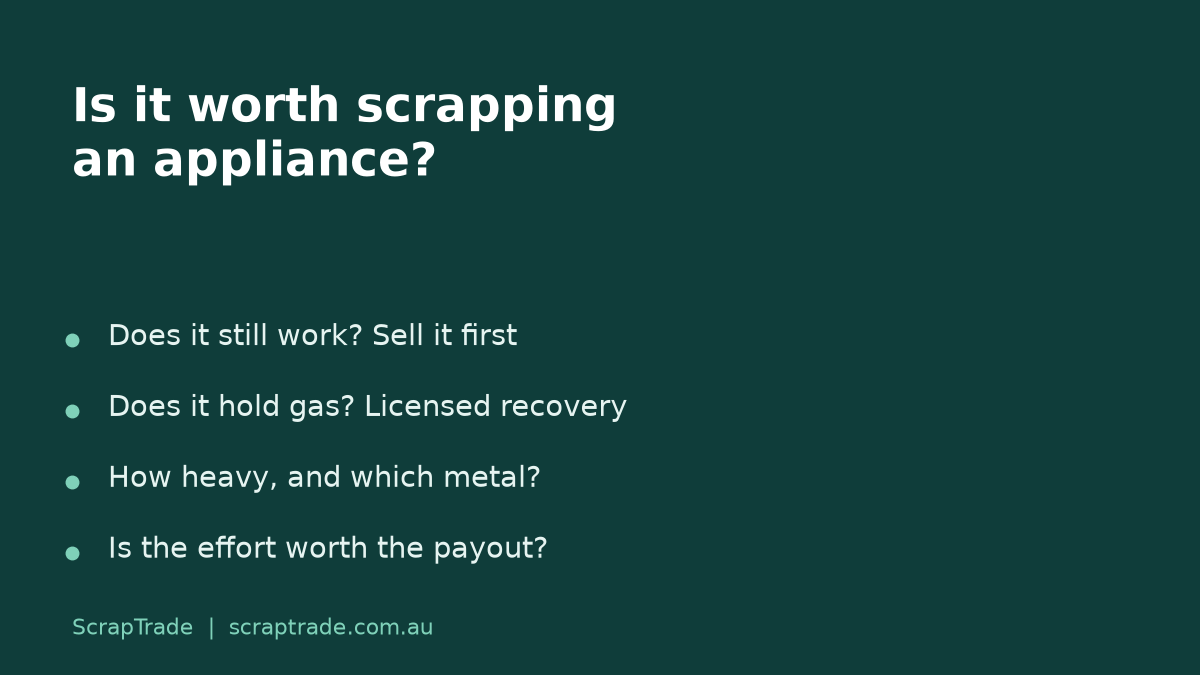
Short answer. Four questions decide it: does the appliance still work, does it hold a regulated gas, how heavy is it and which metal is it, and how much effort does the payout need. Most household appliances are mostly steel, so the metal pays modestly, and the gas, not the scrap price, is what makes a fridge or air conditioner a job for a licensed person.
People ask what an appliance is worth as scrap and expect one number. There is no honest single number: yards pay by weight and grade, and we found no reliable Australian price for a whole appliance. What can be sorted out is whether the job is worth doing at all. This guide pulls together what our appliance guides found on fridges, air conditioners, washing machines, hot water systems, microwaves and engines, and links to each. It gives no prices, and ScrapTrade is a scrap marketplace, so it has a commercial interest in this trade.
Question 1: does it still work?
A working machine is a used appliance, and a household sale usually beats the scrap yard. A faulty one is for a repairer, for parts or for scrap. Say honestly which it is. If the fault is unknown, sell it as for parts or scrap. For the selling side see Sell a Used or Broken Washing Machine or Fridge.
Question 2: does it hold a gas, or a hazard?
This is the question that changes the job. A fridge, freezer or air conditioner contains refrigerant, and in Australia recovering it is regulated. The Australian Refrigeration Council says anyone who wants to recover fluorocarbon refrigerant from end-of-life equipment needs a Restricted Refrigerant Recoverer Licence and a Restricted Refrigerant Trading Authorisation [1]. For most households that means a licensed technician, a council service or a recycler that arranges it. Recyclers often want proof the unit has been degassed, so do not release the gas or cut the pipework to speed things up. A council fact sheet dated 2026 says penalties may reach A$132,000 for individuals and A$660,000 for corporations, though those figures may have since been indexed [2]. The detail is in Air Conditioner Disposal and Refrigerant Rules.
A washing machine contains no such gas. A microwave has a different hazard: its high-voltage capacitor can hold a dangerous charge after it is unplugged, and sources differ on for how long. Do not open one. Hand it over whole, and see Scrapping a Microwave Safely: Do Not Open It.
Question 3: how heavy is it, and which metal?
The payout is weight times the rate for the grade, less deductions, so heavy items made of steel pay by weight and items with copper or aluminium recover more per kilogram. The main metals by appliance, as our guides report them:
- Fridge or freezer. A steel shell and a compressor. The refrigerant rule above applies first. See Sell a Used or Broken Washing Machine or Fridge.
- Air conditioner. Copper tubing and aluminium fins in the coils, plus steel casing, a compressor and a fan motor. A complete outdoor unit may be bought as mixed material at a lower rate than the copper, aluminium and motor sold separately, and we could not verify whether separating pays. See Scrap Air Conditioner: What It Is Worth.
- Washing machine. Mostly steel, with a copper-wound motor, a copper power cord and sometimes a stainless drum. Common 300 series stainless is usually non-magnetic, which a magnet can hint at but does not prove. See Stripping a Washing Machine: Motor, Cord and Drum.
- Hot water system. A tank that must be fully drained, and in our reading mainly steel, which we did not source. Some sources mention a copper coil inside older units, which we could not verify. See Old Hot Water System: Sell, Scrap or Recycle and How Much Scrap Metal Is in a Water Heater? Parts and Value.
- Engine. A cast iron block is treated as ferrous scrap and an aluminium block as non-ferrous, and buyers may price them differently. Completeness and reusable parts change the offer. See Scrap Engine Value: Cast Iron vs Aluminium, Running vs Not.
- Dryer. The metals inside are covered in How Much Scrap Metal Is in a Dryer?.
Question 4: is the effort worth the payout?
Stripping an appliance for its copper or stainless takes time, tools and some risk, and the extra over selling it whole may be small. We found no sourced figure for either. A rough check, using an invented example: if a yard paid A$0.30 a kilogram, which is not a real rate, a 60 kg appliance would return A$18 before any deductions. The rate and weight here are made up to show how small the sum can be next to an hour of work, a trip to the yard and a licensed technician's fee. Replace them with a real quote from your yard.
Collection can change the answer. The installer replacing a hot water system may take the old one away, a council may run a hard waste pick-up, and some recyclers collect fridges. Ask what each charges before you decide the scrap route is the cheap one.
A quick way to decide
- If it works, try a household sale or a repairer first.
- If it holds refrigerant, book a licensed person or a recycler that degasses and gives proof.
- If it is a microwave or other electronic item, do not open it.
- If it is a plain steel appliance with no gas, ask two or three yards what they pay for it whole and whether they take it at all.
- Only strip it if a yard confirms it pays more for the separated parts.
Where ScrapTrade fits
List your scrap on ScrapTrade for free: there is no commission, verified buyers bid, and the buyer's 5% deposit is held in escrow once you accept a bid. Businesses and individuals can sell after verification. For one appliance a household sale is simpler. ScrapTrade suits lots: a landlord clearing several units, a retailer's returns, a builder's strip-out or a repair shop's stock. How to sort and sell broken appliances in bulk is covered on scrap.trade in How to Sell Broken Appliances for Scrap.
What we could not verify
- What Australian yards pay for any whole appliance, or for stripped parts.
- The current refrigerant licensing rules and penalties. Our sources are dated fact sheets and a council page, and we did not read the legislation.
- Whether scrap yards may degas fridges themselves.
- Whether stripping pays more than selling whole.
Frequently asked questions
Is it worth scrapping an old fridge?
Only after the refrigerant is dealt with by a licensed person or a recycler. The metal pays modestly, and we found no sourced price.
Is a washing machine worth scrapping?
It is mostly steel, so the payout is by weight and modest. The copper motor and cord and a stainless drum are the parts that may pay more, if your yard buys them separately.
Can I take a microwave apart for the metal?
We advise against it. The capacitor can hold a dangerous charge after unplugging, and the metal is not worth the risk.
Does a yard pay by the item or by weight?
Usually by weight and grade. Ask the yard for its rate and what it deducts.
Sources
- Australian Refrigeration Council, refrigerant licensing fact sheets (dated 2017 to 2023), as summarised in ScrapTrade's refrigerant disposal guide.
- Council fact sheet on refrigerant penalties (2026), as summarised in ScrapTrade's guide to selling a used or broken washing machine or fridge.
- ACT Government recycling guide for hot water systems, as summarised in ScrapTrade's old hot water system guide.
- ScrapTrade appliance guides linked above, accessed November 2026.
General information, not legal advice. Refrigerant rules are set by law and by licensing bodies, so confirm the current position before you handle any appliance that holds gas.