

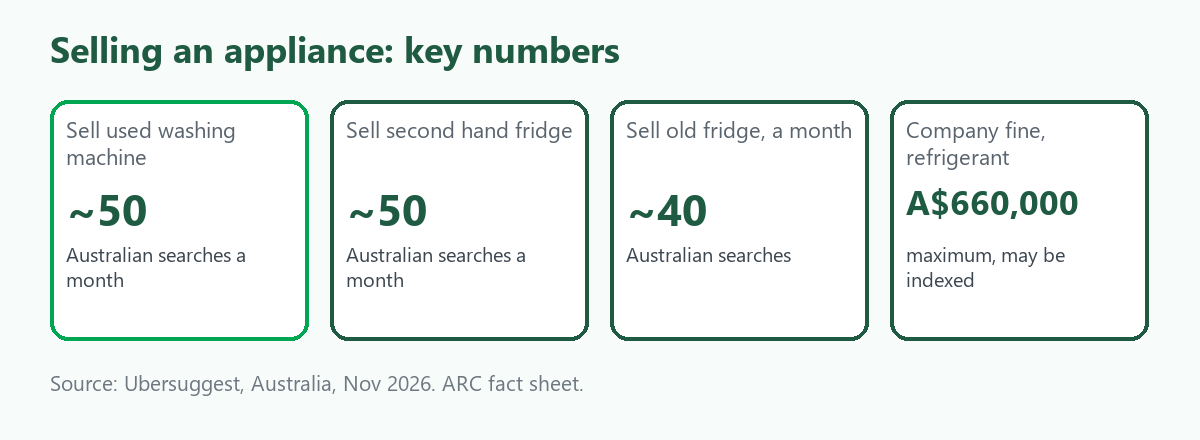
A washing machine or fridge is the one household item people try to sell before they pay someone to take it. In Australia, according to Ubersuggest, "sell used washing machine" and "sell second hand fridge" are each searched about 50 times a month, "sell old fridge" about 40, and "sell broken washing machine" and "sell broken fridge" about 10 to 20. The decision is different for each machine, because a working washing machine is simply a used appliance, while a fridge brings a regulated gas into the picture. This guide covers selling it working, selling it faulty, what the refrigerant rules mean and where scrap and trade routes fit. It is part of our guide to selling broken, faulty or old electronics. We give no prices, because we found no reliable source for current appliance prices, and ScrapTrade has a commercial interest in the scrap trade.
Used, second-hand, old or broken
If the machine works, it is a used appliance for a household buyer, and that is a retail sale. If it works but is old, a buyer may still want it, or it may be better donated. If it is faulty, it is for a repairer, for parts or for scrap. The words matter because each points to a different buyer. For the scrap side, see How to Sell Broken Appliances for Scrap.
Step 1: Does it work, and is it safe?
Test it. Run a washing machine through a short cycle to check it fills, spins and drains without leaks. For a fridge, check that it cools to temperature over several hours and that seals and shelves are intact. Be honest in the description. If the fault is unknown, say so, and sell it as for parts or scrap.
Step 2: Check your rights
If the appliance is recent, the fault may be covered by consumer guarantees. The Australian Competition and Consumer Commission says a major fault gives the consumer a choice of refund or replacement, a minor fault lets the seller choose, and consumer guarantees can outlast the manufacturer's warranty. The ACCC's guidance on who pays to return a bulky item is not consistent across its publications, so check the current wording. We are not lawyers, so confirm it for your case.
Step 3: Clean and prepare it
Empty it, clean it, remove loose parts and photograph it from several angles, including the model label. A clean machine sells and describes better. For a fridge, unplug it well before collection so it can drain and defrost.
Step 4: Fridges and the refrigerant rule
A fridge, freezer or air conditioner contains refrigerant, and in Australia recovering it is regulated. The Australian Refrigeration Council says anyone who wants to recover fluorocarbon refrigerant from end-of-life equipment needs a Restricted Refrigerant Recoverer Licence and a Restricted Refrigerant Trading Authorisation. A council fact sheet dated 2026 says the Ozone Protection and Synthetic Greenhouse Gas Management Act 1989 may apply, with penalties of up to A$132,000 for individuals and A$660,000 for corporations, though figures may have been indexed since. The National EPA says recyclers often require proof that a unit has been degassed before they take it.
In practice: do not release the gas or cut the pipework to speed things up, use a licensed person or a recycler or council service that arranges it, and keep proof. A washing machine or dryer contains no such gas, which is one reason they are easier to move. We did not find a source on whether scrap yards may degas themselves, so ask the buyer. If you are outside Australia, check your own rules.
Step 5: Where to sell
- To a household buyer. For working machines. Describe the brand, model, size, age and condition.
- To a repairer or parts buyer. For faulty machines of a common model.
- To a scrap yard. Yards accept white goods, and washing machines are mostly steel, so the payout is modest. We found no current price source. Ask what the yard pays and whether it takes fridges.
- To a council or recycler service. Many arrange fridge pick-up with degassing. Charges vary, so ask first.
Why use ScrapTrade for appliances
For one working machine, a household sale is simpler. ScrapTrade suits lots: a landlord clearing several units, a retailer's returns, a builder's strip-out or a repair shop's stock. The buyers are verified traders in more than 50 countries, and listing is free with no commission. Post photos and a price, negotiate in real time, and agree collection terms, which matters for heavy items. When you accept a bid, the buyer's 5 percent deposit is held in escrow. Businesses and individuals can sell after verification. Say how many of each appliance, the brands, how many work, whether fridges have been degassed and by whom, and where they are. The full process is in our pillar guide.
What we could not verify
- What used or broken appliances sell for. We found no reliable source.
- The current refrigerant licence rules and penalties. We relied on summaries of Australian Refrigeration Council fact sheets, and penalties may have been indexed.
- Whether scrap yards may degas themselves.
- ScrapTrade's verification steps. Ask support at cs@scraptrade.com.au.
Frequently asked questions
Can I sell a used washing machine?
Yes, to a household buyer if it works, or to a repairer or yard if it does not.
Can I sell a broken fridge?
Yes, but in Australia the refrigerant has to be recovered by a licensed person, and many recyclers want proof. Ask the buyer first.
What is an old washing machine worth as scrap?
Mostly steel, so a modest amount. We cannot give a price. Ask a yard.
Can individuals sell on ScrapTrade?
Yes, businesses and individuals can both sell, after verification. Contact cs@scraptrade.com.au for the process.
Sources
- Ubersuggest keyword data for Australia, queried November 2026.
- Australian Competition and Consumer Commission, consumer guarantee pages, as summarised in search results.
- Australian Refrigeration Council fact sheets (arctick.org); National EPA recycler guidance, as summarised in search results.
- Recycler and council descriptions of white goods recycling, as summarised in search results.
- ScrapTrade website, accessed November 2026.
This is general information, not financial or legal advice. Refrigerant rules are regulated and change, so check with the relevant authority. ScrapTrade operates a scrap marketplace and has a commercial interest in the scrap trade.