

A home or solar battery is a different disposal problem from a car battery or a torch cell. It is heavy, it is usually lithium, a damaged one can be dangerous, and the national battery scheme was built for small batteries. This guide sets out what we could find on where an old home or solar battery can go in Australia, and where our sources ran out, which was often. It is not instructions for handling a damaged battery, and if one is swollen, leaking, hot or smoking, keep away from it and call the installer or the emergency services. We give no prices. It sits beside our guides to selling an old car battery, which covers lead-acid batteries, and old solar inverters. ScrapTrade runs a scrap marketplace and has a commercial interest in the scrap trade.
What B-cycle covers
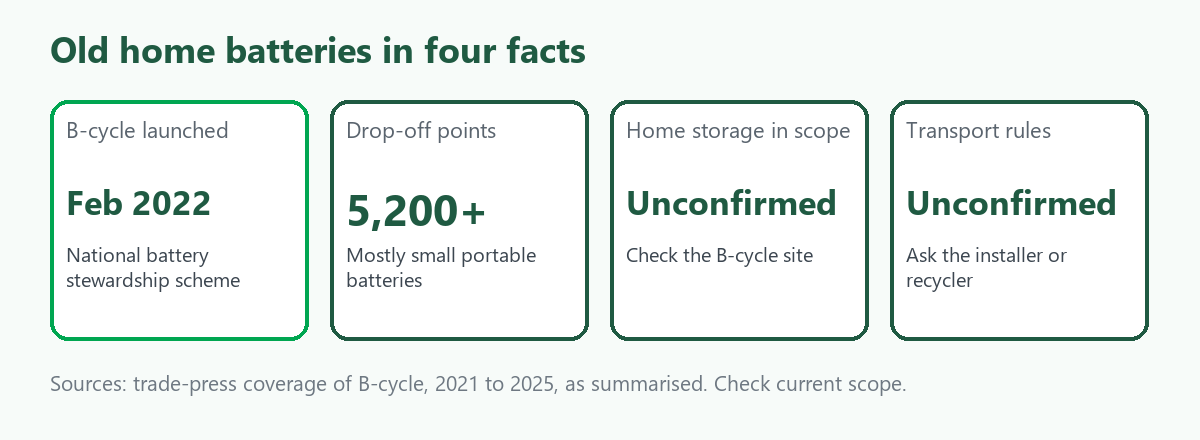
B-cycle is the national battery stewardship scheme, run by the not-for-profit Battery Stewardship Council and launched in February 2022 with federal government and industry funding. Its focus is small portable batteries, and its drop-off points are mostly in retail locations, more than 5,200 of them according to a recent report. One source says it plans to take more consumer and commercial batteries over time, including electric vehicle and energy storage batteries. That suggests home energy storage systems were not covered when those articles were written. The sources are from 2021 to 2025, so check the current B-cycle website before you rely on any of this. We did not find whether it accepts large stationary units or any weight threshold.
So where does a home battery go?
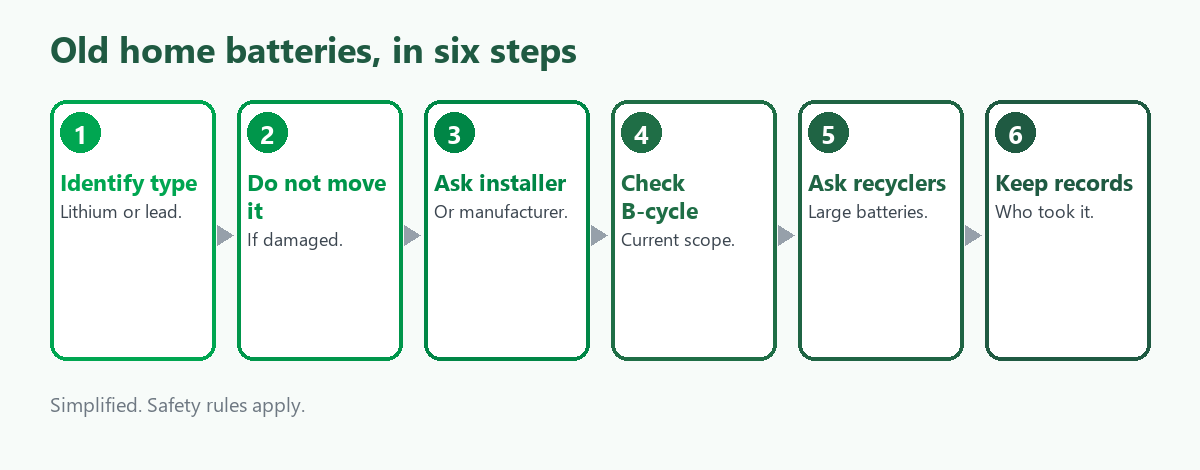
We did not find a source that settled it. In our reading, the likely routes are the installer or manufacturer, if they run a take-back, and a specialist lithium battery recycler, and we could not confirm either from the sources we found. Ask the installer who fitted it, because they know the product and may know what is available. Ask the manufacturer what it offers. Ask any recycler whether it takes large lithium batteries and what it charges.
Moving a battery
Transporting damaged or end-of-life lithium batteries is generally regulated as dangerous goods, but we could not confirm the Australian rules from the sources we found. Do not load a home battery into a car and take it to a transfer station on your own initiative. Ask the installer or recycler who collects it and how. A damaged battery needs more care still, and we did not research it.
Lead-acid banks
Some solar systems use lead-acid batteries, and those are a different market. An industry body says lead-acid batteries are among the most recycled products, and they have scrap value to yards and recyclers. Our guide to selling an old car battery explains how buyers think about them, and our global guide to lead-acid battery recycling covers the process. The 99 percent recycling rate quoted there is an industry-body figure for the United States, and we did not find an Australian one. Ask about the size and weight before you move a bank, because they are heavy.
Can an old battery be sold?
A working battery has a value as a battery, a different thing from scrap, and we found no source on second-hand home battery sales in Australia. A battery that has lost a lot of capacity may be worth little, and a lithium battery's condition is hard to judge without testing, so a seller would need a test and a clear description. Treat resale as unconfirmed, and do not sell a battery you think is damaged.
What to ask
- Installer or manufacturer. Do you take it back, and is there a charge?
- A battery recycler. Do you take large lithium or lead-acid batteries, and how do you collect them?
- The council. What does it say about large batteries, and does it have a hazardous waste day?
- B-cycle. Does the current scheme accept this size and type?
- Anyone buying. What do they need to know about condition and capacity?
Where ScrapTrade fits
ScrapTrade is not a battery recycler and does not collect or handle them, and a lithium home battery needs a specialist. Batteries is one of its twelve categories, and a solar installer, an electrician or a business with several lead-acid batteries, or a quantity of retired cells, may want to see whether it fits: listing is free with no commission, terms are agreed in chat and a bid that is accepted puts the buyer's 5 percent deposit in escrow. Businesses and individuals can sell after verification, and buyers in more than 50 countries bid. How the platform treats lithium batteries and transport is something we could not confirm, so ask cs@scraptrade.com.au before you list one.
For e-bikes and their batteries, see Sell an Old Bicycle or E-Bike in Australia.
What we could not verify
- Whether B-cycle accepts home energy storage batteries, and any weight limit.
- Take-back programs from installers and manufacturers.
- Australian dangerous goods rules for moving lithium batteries.
- What any home battery is worth, or costs to dispose of.
- How to handle a damaged battery.
- Whether ScrapTrade accepts lithium batteries.
Frequently asked questions
Can I take a home battery to a B-cycle drop-off?
B-cycle focuses on small portable batteries. We could not confirm it takes home storage units, so check its website.
Who takes an old home battery?
Possibly the installer, the manufacturer or a specialist recycler. We could not confirm any of them from our sources.
Can I move a lithium battery myself?
We could not confirm the rules. Ask the installer or recycler who collects it.
Is a lead-acid solar battery worth scrapping?
Lead-acid batteries have scrap value, and a bank is heavy. Ask a yard, as our car battery guide explains.
Can I list a battery on ScrapTrade?
Batteries is a category. Ask support about lithium and large units.
Sources
- B-cycle and Battery Stewardship Council coverage in trade press, 2021 to 2025, as summarised in search results.
- Ubersuggest keyword data, Australia, queried November 2026.
- ScrapTrade website, accessed November 2026.
General information only, not safety, legal or financial advice. If a battery is damaged, swollen or hot, keep away and seek professional help.