

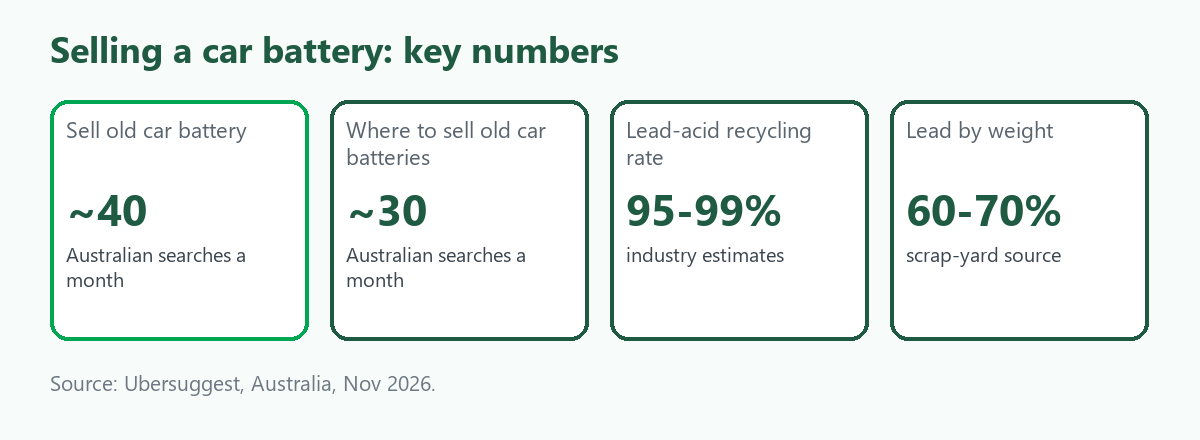
"Sell old car battery" and "sell old car batteries" are each searched about 40 times a month in Australia, and "where to sell old car batteries" about 30, according to Ubersuggest. The search terms are small and cheap to advertise on, about A$2 a click. Industry sources describe lead-acid batteries as among the most recycled products, and the question for the owner is whether to take a small payment, take nothing or hand it over for free. This guide explains who buys car batteries, what a lead-acid and a lithium battery mean for you and how a lot can be sold. It is part of our guide to selling an old, broken or unwanted car or its parts. We leave prices out, as no reliable source turned up. ScrapTrade is a scrap marketplace and benefits from scrap trading.
Lead-acid or lithium
Almost all conventional car batteries are lead-acid. They are collected and recycled in a mature loop, and the lead is smelted and reused. Lithium-ion batteries, which power hybrids and electric vehicles and many smaller devices, are a different problem, with different handling, fire risk and buyers. Check the label. If it is lead-acid, this guide applies. If it is lithium-ion or part of an EV pack, do not move or store it yourself, and talk to a specialist recycler. Our guide to EV battery recycling explains why.
What the scrap trade says about lead-acid batteries
Industry figures put Australia's lead-acid battery recycling at roughly 95 to 99 percent. One 2026 report cites about 95 percent from an industry body, and another source attributes 99 percent in 2021 to CSIRO data. These come from industry and scrap-yard pages, so the true rate is probably in the mid to high 90s, and we could not confirm the exact figure. The national B-cycle scheme does not cover automotive lead-acid batteries, so they are collected outside that scheme, mostly by the scrap industry. Scrap yards and auto shops pay for used lead-acid batteries, and recyclers can afford to because the process is straightforward. A scrap-yard source puts a car battery at 60 to 70 percent lead by weight, with the value depending on condition, volume and the LME lead price. For what happens next, see Where a Car Battery Goes After You Hand It In and Scrap Car Battery Price in Australia.
Step 1: Handle it safely
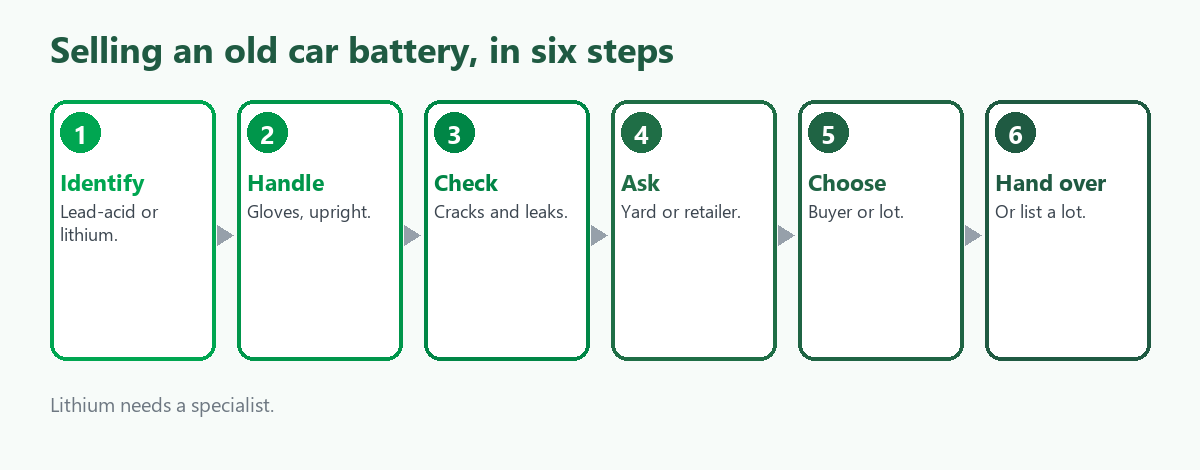
A car battery contains sulphuric acid and lead. Wear gloves and eye protection, keep it upright, do not drop it and do not let it leak onto skin or the ground. Cracked or leaking batteries need extra care, and many buyers will not take them loose. Do not store them near sparks, and do not put them in household bins. We are not a safety authority, so check your state's guidance.
Step 2: Choose where to take it
- A scrap yard or auto recycler. Often pays a small amount per battery or per kilogram, and some collect from commercial customers. Ask the yard, because rates move.
- A battery retailer or mechanic. Many accept an old battery when you buy a new one, and some give a credit. Terms vary.
- A council drop-off. Many councils accept car batteries at waste facilities, often for free. Check yours.
- A battery recycler. For larger quantities, and usually through the scrap industry.
We found no reliable source for current payments, so ask the buyer before you drive.
Where ScrapTrade fits
One battery is a drop-off job. ScrapTrade suits quantity: a mechanic or battery retailer with a growing pile, a fleet that changes batteries in bulk, a yard with a dedicated stack, or a business holding a pallet of spent batteries. Batteries are one of its twelve categories, and its verified traders in more than 50 countries are the audience for recyclers' supply. Listing carries no fee and no commission. You list the count, the type and condition, add photos, negotiate in real time and agree collection or shipping terms. After you accept a bid, the 5 percent buyer deposit stays in escrow. Both businesses and individuals can sell once verified. State clearly whether the batteries are lead-acid, whether any are damaged, and where they are. Dangerous goods rules apply to moving batteries, and we could not confirm how ScrapTrade handles them, so ask cs@scraptrade.com.au before listing.
What we could not verify
- What old car batteries pay. We found no reliable price source.
- The exact lead-acid recycling rate. Sources range from 95 to 99 percent.
- The 60 to 70 percent lead figure. It comes from a scrap-yard page.
- Dangerous goods rules for moving batteries.
- ScrapTrade's verification steps. Ask support at cs@scraptrade.com.au.
Frequently asked questions
Can I sell an old car battery?
Yes. Scrap yards, auto recyclers and some retailers pay or give credit, and many councils take them free.
How much is an old car battery worth?
We cannot give a price. It depends on condition, volume and the lead price, so ask the buyer.
Can I put an old car battery in the bin?
No. Take it to a collection point.
Can I sell lithium batteries the same way?
No. Lithium-ion batteries need specialist handling and recyclers.
Sources
- Ubersuggest keyword data for Australia, queried November 2026.
- Industry and scrap-yard pages on lead-acid battery recycling, B-cycle scope and lead content, as summarised in search results.
- A 2026 Resource Recycling report on the Australian battery recycling sector, as summarised in search results.
- ScrapTrade website, accessed November 2026.
This is general information, not safety or legal advice. Batteries are hazardous, so follow your state's guidance. ScrapTrade operates a scrap marketplace and has a commercial interest in the scrap trade.