

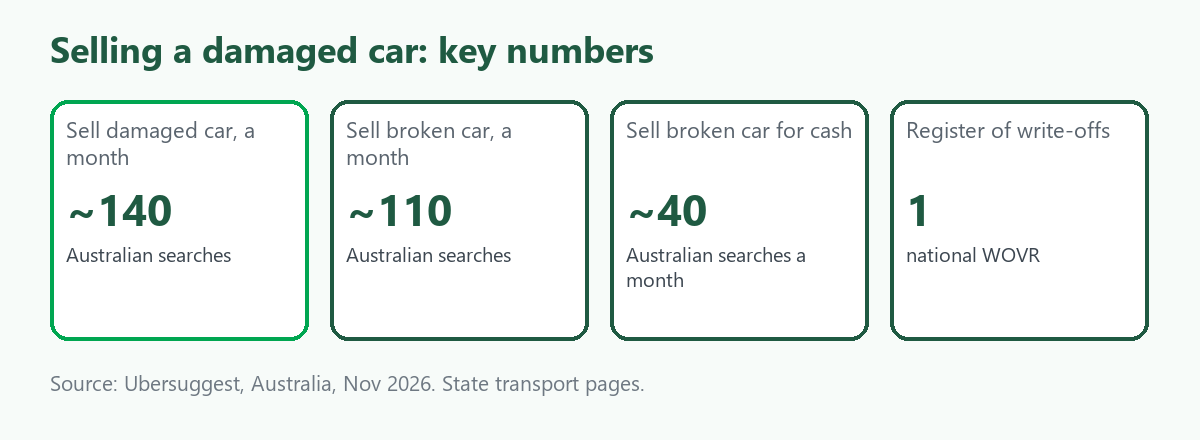
"Sell damaged car" is searched about 140 times a month in Australia, "sell broken car" about 110, "sell broken car for cash" about 40 and "sell damaged car for cash" about 20, according to Ubersuggest. The advertising cost of the broken-car terms is among the highest in the car family, about A$18 to A$20 a click, so buyers value these sellers. A damaged or broken car is not worth nothing, but the damage shapes who will pay and how much, and a legal status can follow the car. This guide covers grading the damage, how write-offs work, who buys and what to disclose. It is part of our guide to selling an old, broken or unwanted car or its parts. We name no prices, since damaged-car values are too variable for us to source. ScrapTrade is a scrap marketplace, so read our view with that in mind.
Damaged, broken or non-running
These words describe different problems. A damaged car has been hit, burnt, flooded or hit by hail. A broken car has a mechanical or electrical fault: an engine that will not start, a failed gearbox, a dead computer. A non-running car may be either. The distinction matters because a repairer or a buyer with a workshop will often take a mechanical fault, while heavy structural damage usually ends at a wrecker.
Step 1: Photograph and describe the damage
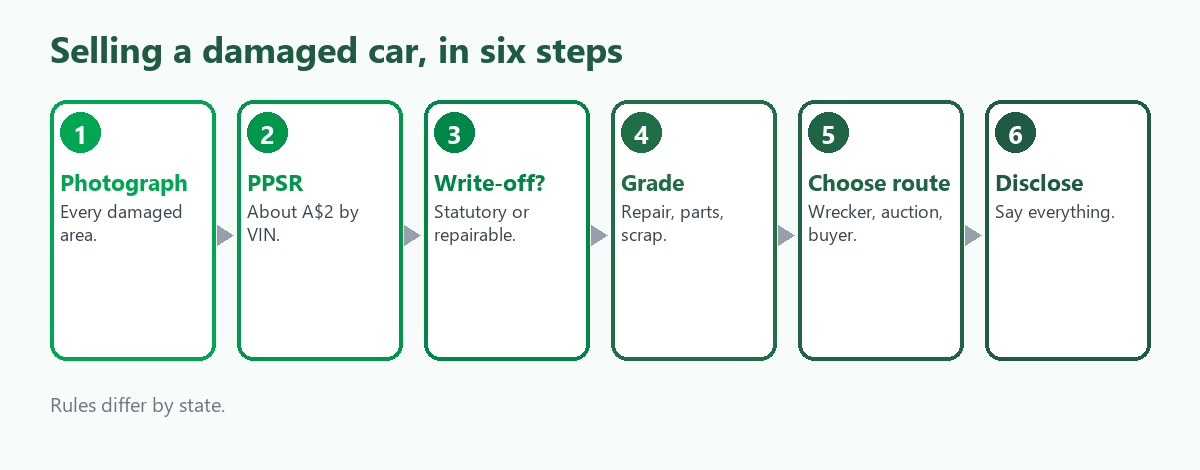
Take clear photos of every damaged area, the odometer, the VIN plate and the interior. Write down what you know: when it happened, what the fault is, whether it starts, whether airbags deployed and what has been done since. Do not guess at causes you cannot confirm, and say what you could not check.
Step 2: Check the write-off status
If an insurer judged the repair cost to be higher than the car's value, the car may be recorded as a write-off on the national Written Off Vehicle Register. A statutory write-off cannot be re-registered anywhere in Australia, and is generally used for parts or scrap. A repairable write-off can be repaired and re-registered, though the inspections and rules differ by state. Tasmania, for example, publishes three tiers of inspection. Sources disagree on the detail for some states, including New South Wales, so check your state's transport authority. A PPSR check, which costs about A$2, can also show whether the car has been written off, and it shows finance owing and stolen status.
Step 3: Disclose what you know
Selling a write-off is legal, but you must disclose its status, and a statutory write-off cannot be sold as a roadworthy, re-registrable car, according to industry guides. A write-off record stays with the car, so a buyer can find it. Queensland requires auctioneers to announce the write-off type before an auction. Disclose accident damage, flood or fire damage and any known faults in the same way. Honest descriptions cost you nothing and prevent disputes after the sale.
Who buys a damaged or broken car
- Wreckers and scrap yards. The default for statutory write-offs and cars that are beyond repair. They want photo ID and proof of ownership, and many collect for free. See Sell a Car for Parts or Scrap in Australia.
- Damaged-vehicle auctions. Repairable write-offs are usually sold this way, and insurers typically use them. A private seller normally sells to a dealer or via a broker.
- Repairers and enthusiasts. A common model with a known fault attracts people who want a project. Describe the fault precisely.
- Dealers and instant-offer services. Some will quote on damaged cars and many will not. Ask before you wait.
Where ScrapTrade fits
A single hail-damaged hatchback is a job for a local wrecker or auction. ScrapTrade is more useful when you hold damaged stock in volume: a rental or fleet operator with several accident cars, an insurer's repairer clearing write-offs, or a workshop with a yard of non-runners. Those lots go to traders who want the metals and parts and who can arrange collection. There is no listing fee or commission, and ScrapTrade reports verified trading partners in over 50 countries. You post photos with the damage clearly shown, add the VIN and write-off status, negotiate in real time and agree collection terms. Once you accept a bid, a 5 percent buyer deposit sits in escrow. Sellers, whether businesses or individuals, are verified first. We could not confirm whether whole vehicles can be listed, so ask cs@scraptrade.com.au before you plan on it.
What we could not verify
- What damaged or broken cars sell for. We found no reliable price source.
- State-by-state write-off rules. We relied on search summaries of state pages and industry guides, and the sources conflict on New South Wales.
- Whether ScrapTrade accepts whole vehicles.
- ScrapTrade's verification steps. Ask support at cs@scraptrade.com.au.
Frequently asked questions
Can I sell a car that does not start?
Yes, to a wrecker, a repairer or a buyer who wants a project, if you describe the fault honestly.
Can I sell a written-off car?
Yes, but you must disclose it, and a statutory write-off cannot be re-registered. It is generally sold for parts or scrap.
Do I have to tell the buyer about accident damage?
You should, and write-off status is recorded on a national register that buyers can check.
What is the best place to sell a damaged car?
A wrecker for heavy damage, an auction for repairable write-offs and a private buyer for cosmetic or mechanical faults.
Sources
- Ubersuggest keyword data for Australia, queried November 2026.
- Access Canberra, Transport Tasmania and Western Australian Department of Transport written-off vehicle pages, as summarised in search results.
- Industry guides to selling a repairable write-off, as summarised in search results.
- Industry guides to PPSR checks, as summarised in search results.
- ScrapTrade website, accessed November 2026.
This is general information, not legal advice. Write-off and registration rules differ by state. ScrapTrade is a scrap marketplace with an interest in the trade.