

A car at the end of its useful life has many names. It is old, used, unwanted, damaged, broken, written off, for parts or just scrap, and each word points to a different buyer, a different price and a different bundle of paperwork. A tidy 15-year-old sedan that runs, a hail-damaged hatchback, a wreck with a seized engine and a trailer of used tyres are four different jobs. This guide is the hub for all of them. It explains how to grade what you have, what paperwork matters, who buys, which parts are worth chasing and how selling on ScrapTrade works. It is written for households, mechanics, wreckers and small fleets in Australia. We publish no prices, because we found no reliable source for current car or parts prices, and we say where our evidence stops. ScrapTrade operates a scrap marketplace and has a commercial interest in the scrap trade.
What people are searching for
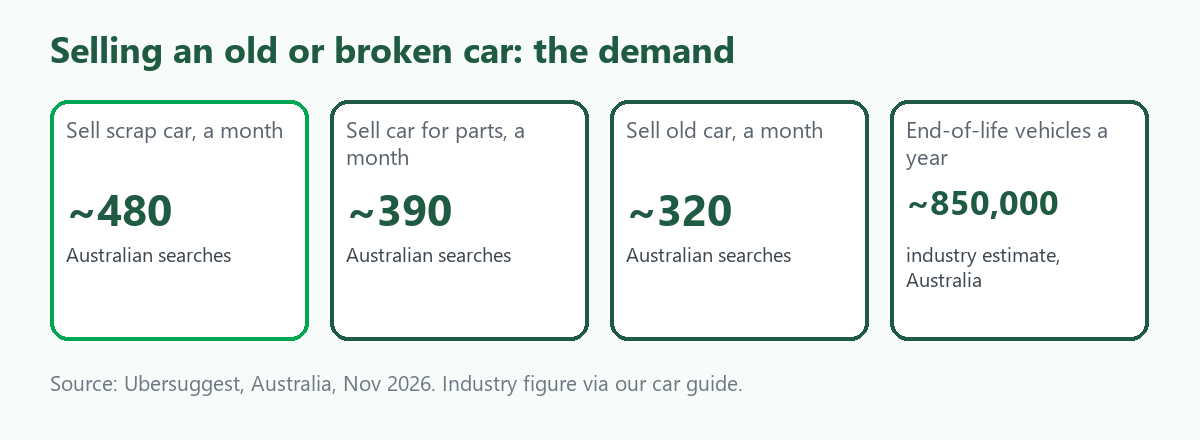
Interest is real and spread across many phrasings. Ubersuggest data for Australia, pulled in November 2026, shows that people trying to get rid of a whole car search far more than people selling parts.
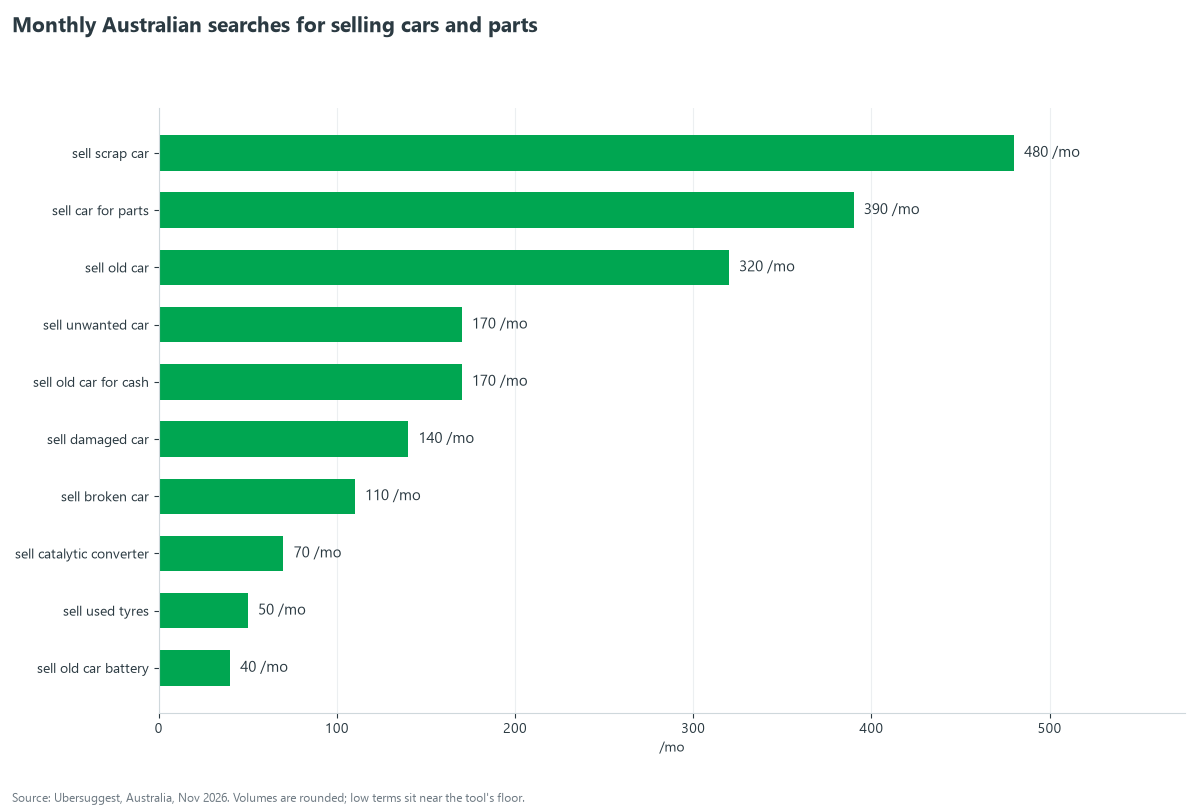
"Sell scrap car" is searched about 480 times a month, "sell car for parts" about 390, "sell old car" about 320, "sell unwanted car" and "sell old car for cash" about 170 each, "sell damaged car" about 140 and "sell broken car" about 110. Parts terms are smaller: "sell catalytic converter" about 70, "sell used tyres" about 50 and "sell old car battery" about 40. The advertising cost for the car terms is high, roughly A$8 to A$20 a click, which tells you buyers are paying to reach these sellers. Two lessons follow. First, most searchers want to get rid of a whole car, not parts. Second, the parts terms are small but have the clearest trade buyers, which is where a marketplace helps.
Step 1: Grade what you have
A car falls into one of four grades, and the grade decides the route:
- Roadworthy. It runs, is registered and can be driven. It can usually be sold to a private buyer, a dealer or a car-buying service.
- Repairable. A known, fixable problem such as accident damage, hail damage or a failed gearbox. Buyers price in the repair, and the car's history matters.
- Parts only. It does not run or is not worth repairing, but the engine, panels, wheels, electronics or interior may be sold. Wreckers want the exact make, model and year.
- Scrap. Crushed, burnt, flooded or very old. It is worth its metal, and the removal is often the value.
Be honest about the grade. A car described as running that does not run will cost you the sale or a dispute, and a write-off status cannot be hidden.
Step 2: Do the paperwork before you sell
Three pieces of paperwork matter on almost every sale. First, check whether money is owing. The Personal Property Securities Register, run by the Australian Financial Security Authority, is searched by VIN for about A$2 and shows whether a lender still has a claim, whether the car has been reported stolen and whether it has been written off. If there is finance, get a payout figure from the lender, because ownership generally cannot be finalised until it is cleared. Second, know whether the car is a write-off. Statutory write-offs cannot be re-registered anywhere in Australia and are generally sold for parts or scrap, while repairable write-offs can be repaired and re-registered under state rules. Third, tell the transport authority. VicRoads says a sold vehicle must be reported within 14 days through a notice of disposal, and other states have similar duties. The detail is in Sell an Old or Unwanted Car for Cash. These rules are summarised from state and industry pages, we are not lawyers, and they differ by state.
Step 3: Choose a route
- Private sale. Best for a roadworthy car, with the most effort and the most time-wasters to screen.
- Dealer or car-buying service. Convenient, with a lower price for the convenience.
- Wrecker or scrap yard. For parts-only and scrap cars. Most ask for photo ID and proof of ownership, according to wrecker websites. See Sell a Car for Parts or Scrap in Australia.
- Insurer or auction. For damaged and written-off cars. See Sell a Damaged or Broken Car in Australia.
- Part it out. More money in theory, with far more work, storage and risk.
- A trade marketplace. For lots, fleets and parts stock, as a later section explains.
For what happens to a car after the yard, see Where an Old Car Goes When It Is Scrapped.
The parts worth separating
Four parts are sold on their own more often than the rest:
- Tyres and rims. Used tyres can be sold if they meet legal tread depth, and alloy wheels have a scrap value of their own. See Sell Used Tyres, Rims and Wheels in Australia.
- The battery. Lead-acid car batteries are collected for recycling, and the scrap industry does most of the collecting. See Sell an Old Car Battery in Australia.
- The catalytic converter. It contains precious metals and has drawn thieves, so buyers ask where it came from. It is covered in the parts-or-scrap guide.
- The engine and drivetrain. A whole engine is valued by model, mileage and condition, which makes it a specialist sale.
Why sell on ScrapTrade
ScrapTrade is a marketplace for scrap and recyclable material, with batteries and precious metals among its twelve categories. It is built for sellers who have more than one thing to move, or something not worth a retail listing. The case for it is practical:
- The buyers are traders. ScrapTrade describes its buyers as verified traders and buyers in more than 50 countries. Wreckers, parts exporters and metal and battery recyclers look for exactly the lots that are hard to sell to a retail customer.
- Listing is free and there is no commission. You create a listing in minutes, add photos, set a price and use the built-in AI to help write the description.
- You keep control of price and terms. You chat and negotiate in real time and agree collection or shipping terms directly. Listings carry terms such as EXW and FOB, in Australian or US dollars.
- Payments are protected. After a bid, the buyer's 5 percent deposit is held in escrow, and it stays on hold once the bid is accepted. Payments are handled through Stripe.
- Sellers are verified. ScrapTrade runs identity and business verification on sellers, and both businesses and individuals can sell.
How it works, step by step
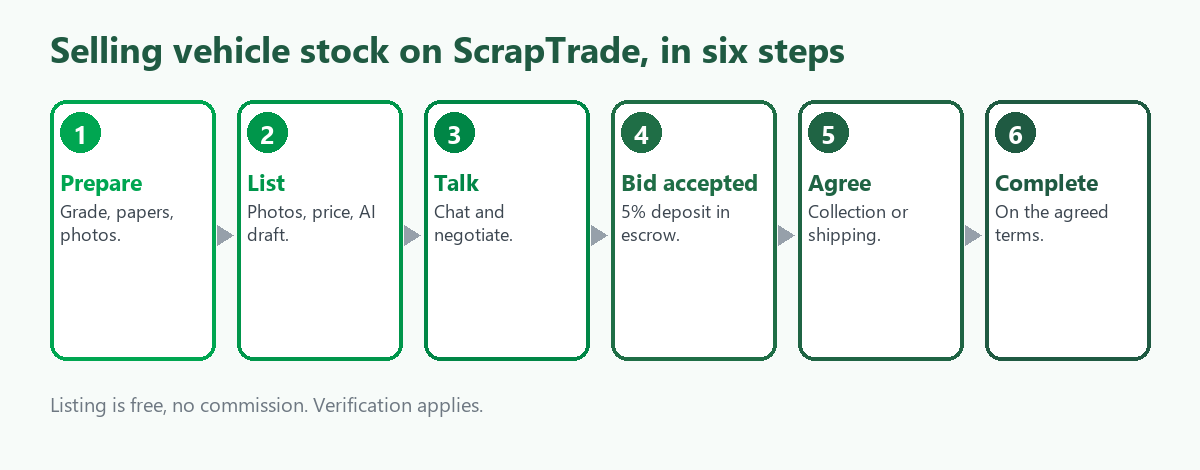
- Prepare. Grade the stock, collect the paperwork and take photos of the vehicle or parts.
- List. Create an account, complete verification, and create a listing with photos, price and description. The AI helper can draft the text, which you should check.
- Talk. Buyers send inquiries. You chat and negotiate in real time.
- Bid accepted. When you accept a bid, the buyer's 5 percent deposit is held in escrow.
- Agree logistics. You and the buyer agree collection or shipping terms.
- Complete. The sale is completed on the terms agreed.
Where it does not fit
Be realistic. A single car with a clean title and a working engine will usually do better with a private buyer or a dealer, and a single unwanted wreck is simplest with a local wrecker who collects it. ScrapTrade is a trade marketplace, so offers are trade offers. We could not confirm whether whole vehicles can be listed, only that batteries and metals are categories, so ask the team before you plan around it. The sweet spot is lots: a fleet's retired vehicles, a wrecker's surplus parts, a workshop's pile of wheels or a pallet of batteries. For any question not answered here, including verification steps, contact cs@scraptrade.com.au.
Which guide to read next
- Sell an Old or Unwanted Car for Cash for the routes, the PPSR check and the notice of disposal.
- Sell a Damaged or Broken Car in Australia for accident, hail and non-running cars, and write-offs.
- Sell a Car for Parts or Scrap in Australia for wreckers, scrap yards and catalytic converters.
- Sell Used Tyres, Rims and Wheels in Australia for tyres and alloy wheels.
- Sell an Old Car Battery in Australia for lead-acid and lithium batteries.
- Sell Broken, Faulty or Old Electronics for the same approach with devices.
Clearing business stock rather than household items? Our guide to selling used commercial and industrial equipment covers kitchens, machinery, fittings and the legal checks. Sell Used Commercial and Industrial Equipment.
Selling vehicle stock to buyers abroad? The international guide covers export rules for used cars, batteries and tires. Sell Scrap Cars, Parts and Used Tires Online.
What we could not verify
- What cars and parts sell for. We found no reliable price source, so we give none.
- State-by-state disposal and write-off rules. We relied on Victorian guidance and industry summaries, and the rules differ.
- Whether ScrapTrade accepts whole vehicles. Ask support at cs@scraptrade.com.au.
- ScrapTrade's verification steps. They are not public.
- How many ScrapTrade buyers want vehicle stock.
Frequently asked questions
How do I sell an old car in Australia?
Run a PPSR check, work out whether it is roadworthy, repairable, parts-only or scrap, then choose a private sale, a dealer or a wrecker. Tell your transport authority afterwards.
Can I sell a broken or damaged car?
Yes, to a wrecker, an auction or a buyer who wants a repair project, if you disclose the damage and any write-off status.
Can I sell a car for parts?
Yes. Wreckers buy cars for parts and scrap and usually ask for photo ID and proof of ownership.
Can I sell car parts on ScrapTrade?
Batteries and metals are among its categories. Businesses and individuals can both sell after verification, and listing is free with no commission.
Do I pay anything to list?
No. Listing is free with no commission. A buyer's 5 percent deposit is held in escrow after a bid is accepted.
Sources
- Ubersuggest keyword data for Australia, queried November 2026.
- Industry figures on end-of-life vehicles, as cited in our guide to where an old car goes.
- Australian Financial Security Authority PPSR guidance, as summarised in industry pages.
- VicRoads, "Selling a vehicle"; Access Canberra and Transport Tasmania written-off vehicle pages, as summarised in search results.
- Wrecker and car-removal websites on documents required, as summarised in search results.
- ScrapTrade website, accessed November 2026.
This is general information, not legal or financial advice. Registration, disposal and write-off rules differ by state, so check with your transport authority. ScrapTrade operates a scrap marketplace and has a commercial interest in the scrap trade.