

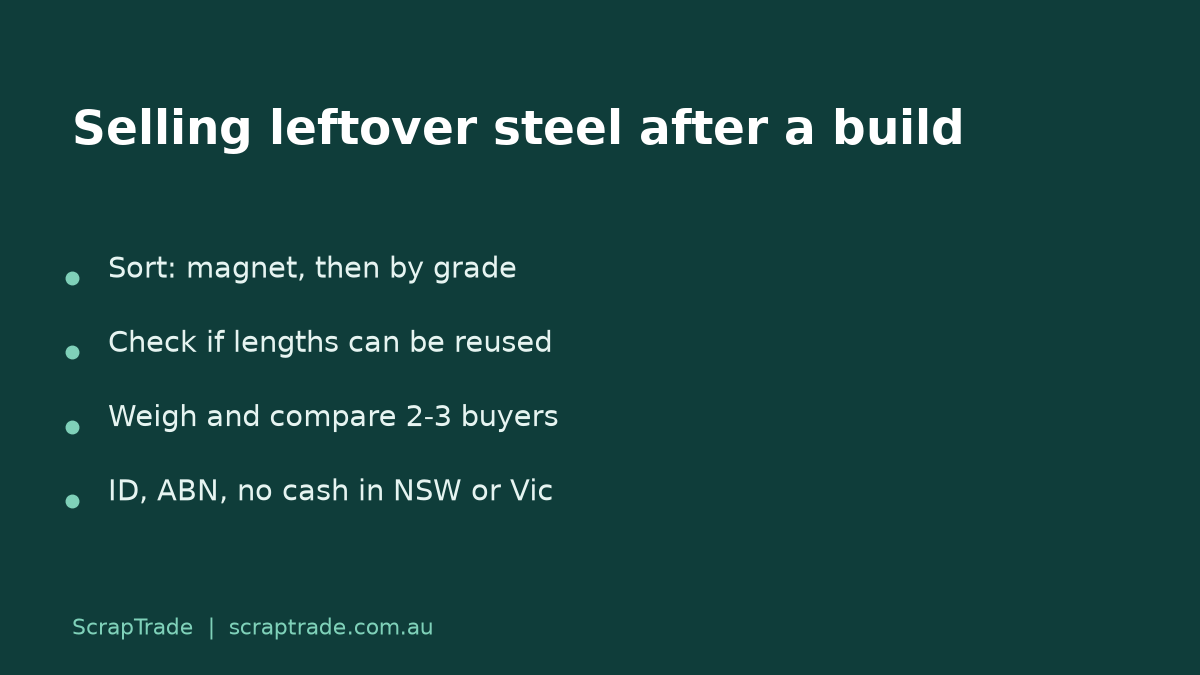
Short answer. Sort the steel, check whether any lengths can be reused, weigh the rest and compare two or three buyers. Steel is paid by weight and is the lowest-value common scrap, so volume and handling decide the result.
A build, renovation or fabrication job leaves steel behind: offcuts, reinforcing bar, beams, mesh and sheet. Steel is the heaviest and lowest-value scrap per kilogram, so the way to get paid fairly is to sort, weigh and compare rather than hand it to the first taker. This page covers that process. It gives no yard price, because we could not source a current one. We should say that ScrapTrade is a scrap marketplace with a commercial stake in the trade.
What the leftovers usually are
- Reinforcing bar and mesh.
- Structural offcuts: beams, angles and channels.
- Steel sheet and roofing, which may be coated or galvanised.
- Fixings and brackets.
- Stainless offcuts, which are graded separately.
Check for reuse first
Full lengths of beam or good plate may be reusable and are worth asking a steel supplier or a salvage yard about before you scrap them. We found no sourced figure for how reuse compares with scrap, so treat this as a question to ask, not a promise.
Sort for scrap
- Use a magnet to confirm steel and separate non-magnetic stainless.
- Split clean heavy steel from thin sheet and coated material. A mixed lot may be priced at the lowest grade in it.
- Remove timber, concrete and plastic where it is safe.
- Bundle long pieces so they can be weighed and loaded. See How to Identify and Test Scrap Metal at Home and Steel Scrap Metal Prices in Australia for grades.
What it is worth
Government export data put iron and steel scrap at an average declared value of about A$600 a tonne in 2025-26, which is 60 cents a kilogram. That is a border average, and a yard is paid less. As a labelled illustration only, at an invented 50 cents a kilogram a 2-tonne clean-up would be about A$1,000. See Scrap Steel Prices in Australia for the data and Scrap Steel Prices Per Kg and Per Tonne for units and weighing.
Weigh, compare and get paid
- Ask whether the quote is per tonne or per kilogram and for which grade.
- Ask about deductions for coatings or other material.
- Watch the weigh-in. For trade, a weighbridge must be a type approved by the National Measurement Institute and verified.
- Expect ID. The ATO's scrap code asks a GST-registered buyer to record identification for sales above A$82.50.
- If you sell as a business, supply an ABN or the buyer withholds 47%.
- Dealers cannot pay cash in NSW or Victoria. See Scrap Business Rules in Australia by State.
Large or regular volumes
A builder or fabricator with steady offcuts can agree a regular collection and keep the grades in separate bins. For a bulk lot, putting it in front of several buyers can lift the offers. ScrapTrade's global site has a guide to selling steel in bulk: Best Way to Sell Bulk Steel Scrap.
Where ScrapTrade fits
List your scrap on ScrapTrade for free: there is no commission, verified buyers bid, and the buyer's 5% deposit is held in escrow once you accept a bid. Businesses and individuals can sell after verification.
What we could not verify
- A current Australian yard price for any steel grade.
- How much reuse adds over scrap.
- Minimum loads and collection fees at particular buyers.
Frequently asked questions
Is leftover steel worth selling?
Yes in quantity. Steel is low value per kilogram, so a small amount may not cover the trip.
Do I need to remove the coating?
No, but coated or galvanised steel is graded lower than clean heavy steel.
Will the buyer pay cash?
Not in NSW or Victoria, where dealers cannot pay cash for scrap.
Sources
- Department of Climate Change, Energy, the Environment and Water, waste exports data, with ScrapTrade calculations. 2025-26 figures are provisional and are customs declarations, not prices.
- ScrapTrade Price Index grade definitions, accessed November 2026.
- Australian Taxation Office, GST and scrap metal: code of compliance (3 July 2023).
- National Measurement Institute, Weighbridges used for trade.
General information only. The 2-tonne example uses an invented rate and is not a price.