

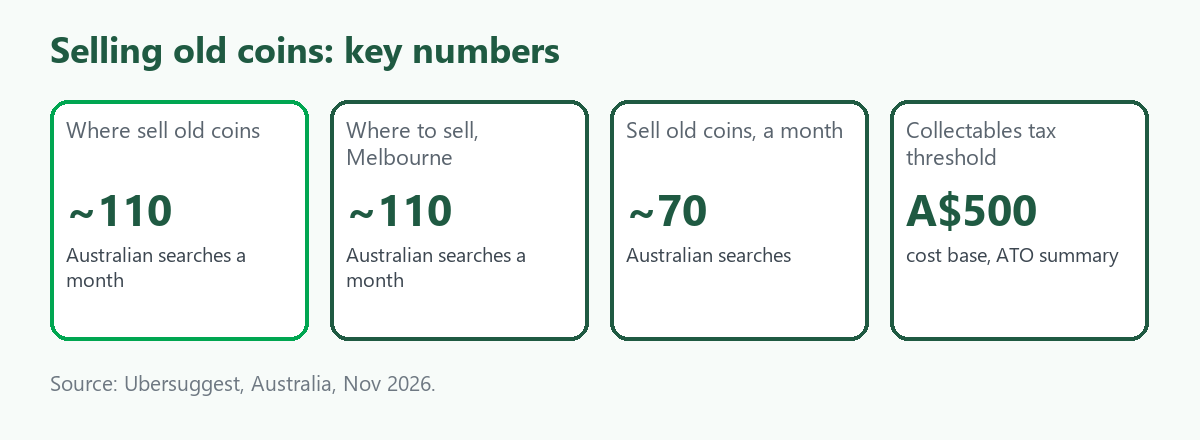
"Where sell old coins" is searched about 110 times a month in Australia, "where to sell old coins in melbourne" about 110, "sell old coins" about 70 and "where can i sell old coins near me" about 50, according to Ubersuggest. Searchers rarely say which coins they hold, and that is the problem: a tin of old coins can be worth its metal, worth far more to a collector or worth face value and no more. This guide explains how to sort a tin, why not to clean anything, how the melt-value and collector-value routes differ and what the tax position is. It is part of our guide to selling old gold, silver and jewellery. We quote no coin prices, because the values we found online varied widely, and ScrapTrade has a commercial interest in the scrap trade.
Two ways a coin is worth money
A coin has a melt value, set by the weight of precious metal in it and the spot price, and a collector value, set by rarity, date, condition and demand. For most circulated coins the melt value is the floor and the collector value adds nothing. For a scarce date or a coin in excellent condition, the collector value can be many times the melt. A coin dealer can tell the difference, and a melt buyer will not pay for it, so sell a coin to the wrong buyer and you lose the premium.
Which Australian coins contain silver
Australian pre-decimal coins issued before 1946 are described as sterling silver, about 92.5 percent pure, while coins from 1946 onwards were struck in a lower-silver alloy, which several sources give as 50 percent. Sources disagree on when silver ended, with some giving 1963 and others 1964 for the lower-grade series, and one source describes the early round fifty-cent coin as 80 percent silver. We could not reach official Royal Australian Mint specifications, so check the Mint's own pages for the weight and composition of any coin you plan to sell as silver. Melt-value calculators on coin websites gave very different figures for the same coin, because they use different silver prices and dates, so do the arithmetic yourself with a current Australian dollar spot price.
Step 1: Sort, and do not clean
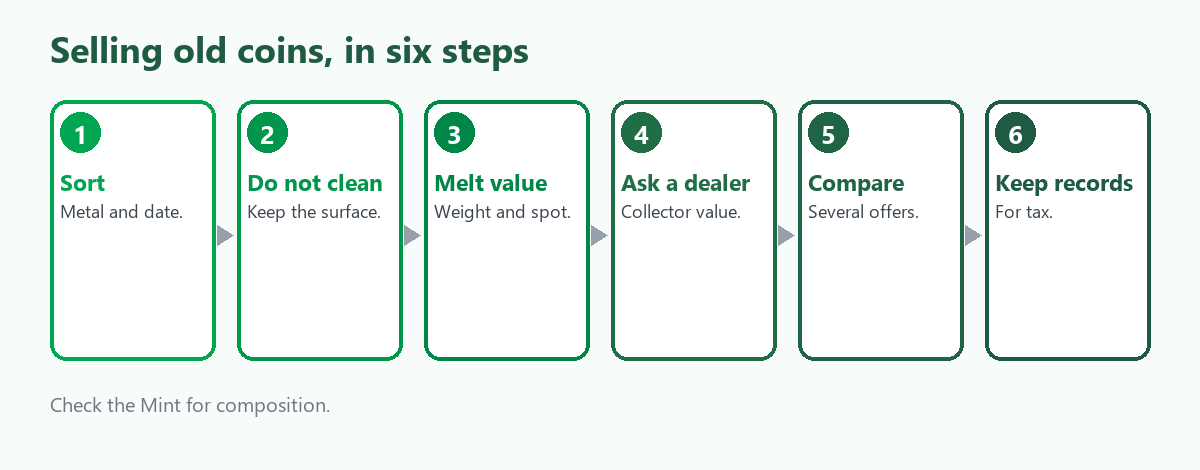
Separate coins by metal and country: Australian pre-decimal, decimal, foreign, gold and bullion rounds. Look at dates. Do not polish or scrub a coin. Cleaning can damage the surface and reduce a collector's interest, and a dealer would rather see it as it is. Handle coins by the edges, and keep them in a dry, soft container.
Step 2: Check the melt value
Weigh the coins, work out the silver or gold in them from the composition and apply the current spot price. This gives you a ceiling for a melt buyer and a floor for a collector. If the number is small, the coin is probably worth more to a collector, or only face value. If it is large, a bullion dealer or refiner will pay close to it.
Step 3: Ask a dealer about collector value
Take a sample to a coin dealer or a numismatic society meeting. Ask about rare dates and conditions before selling anything as metal. A dealer will quote on the coin, and may offer less than a collector would pay at auction, so compare. A major auction may suit a single valuable coin.
Tax and records
For tax, a coin counts as a collectable. The ATO's test uses what the coin was worth when you got it, so an inherited tin is measured at its value on the day it came to you. Under A$500 the gain is ignored; over it, a gain can be taxed, and losses only offset other collectable gains. Investment-form gold and silver coins that meet the purity thresholds are GST-free, while collector coins are taxable when a business sells them. Keep a note of what you inherited or paid and when. We are not tax advisers, and these points come from search summaries of ATO and legislation pages.
Where ScrapTrade fits
A coin tin is a local-dealer job, and we do not suggest ScrapTrade for a few coins. It becomes relevant when the volume is large and mostly metal: a bank or club clearing a quantity of old silver coin, a coin dealer with surplus junk silver, an estate with kilos of pre-decimal coin, or a refiner's supplier. Sellers of that kind describe a lot by weight and composition, and trade buyers price it that way. ScrapTrade lists precious metals as a category, has verified buyers in more than 50 countries, and charges no listing fee or commission. You list weights, mints and dates with clear photos, talk terms through in real time and settle logistics. Once a bid is taken, a 5 percent buyer deposit stays in escrow, and sellers of either kind pass verification first. Whether numismatic coins sell well there, or how collector premiums are valued, is unknown to us, so email cs@scraptrade.com.au before listing.
What we could not verify
- What old coins sell for. Calculators gave conflicting figures.
- Australian coin compositions and cutoff dates. We could not reach official Mint pages.
- How ScrapTrade treats collector coins.
- The detail of tax treatment for your case.
- ScrapTrade's verification process. It is not public.
Frequently asked questions
Can I sell old coins in Australia?
Yes, to coin dealers, bullion dealers, auctions or private buyers.
Should I clean old coins before selling?
No. Cleaning can reduce collector value, so show them as they are.
Are old Australian coins silver?
Some are. Coins before 1946 are described as sterling, and later coins have lower silver content in some years. Check the Mint's specifications.
Do I pay tax on selling old coins?
They count as collectables. Gains under A$500 on acquisition value are ignored, and larger ones need a tax agent's view.
Sources
- Ubersuggest keyword data for Australia, queried November 2026.
- Coin reference and melt calculator pages on Australian silver coin compositions, as summarised in search results.
- ATO collectables guidance and the Income Tax Assessment Act 1997, section 118-10, via search summaries.
- The ScrapTrade site, November 2026.
General information only, not financial or tax advice. ScrapTrade runs a scrap marketplace.