

A drawer of old jewellery, a tin of coins, a set of silver cutlery and a jeweller's tray of broken chain are all "gold and silver to sell", but they are not the same job. Some pieces are worth more as objects than as metal, some are worth only their metal, and a few are worth less than their owner hopes. This guide is the hub for the whole family. It explains how buyers price precious metal, how to sort what you have, who buys, what the identity, tax and reporting rules mean, and how selling on ScrapTrade works. It is written for households, jewellers, collectors and small businesses in Australia. We publish no prices, because spot prices move daily and the figures we found online conflicted, and we say where our evidence stops. ScrapTrade operates a scrap marketplace and has a commercial interest in the scrap trade.
What people are searching for
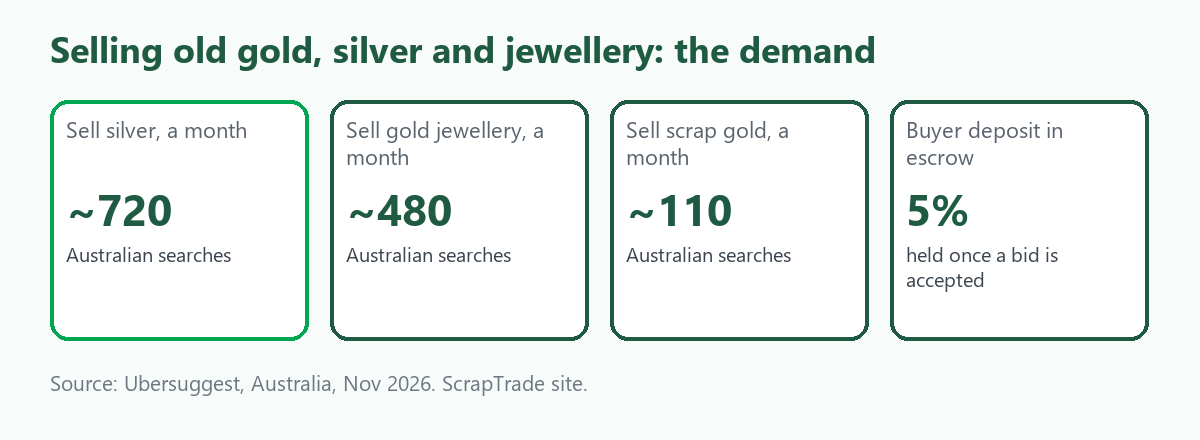
Precious-metal searches are bigger than most of the other families we have mapped, and many are local. Ubersuggest data for Australia, pulled in November 2026, shows silver and gold jewellery leading.
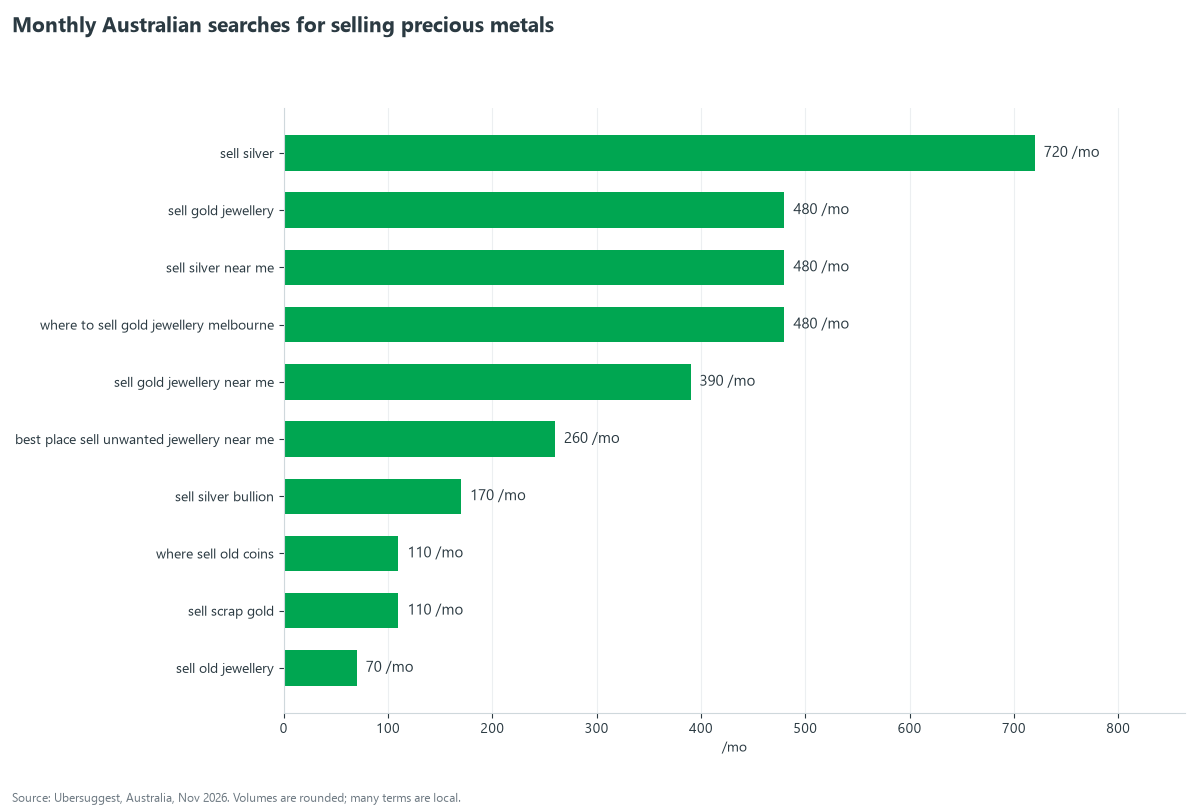
"Sell silver" is searched about 720 times a month, "sell gold jewellery" and "sell silver near me" about 480 each, "sell gold jewellery near me" about 390 and "best place to sell unwanted jewellery near me" about 260. City versions are large too: "where to sell gold jewellery in melbourne" is about 480 and "sell silver melbourne" about 320. Further down are "sell silver bullion" about 170, "where sell old coins" about 110, "sell scrap gold" about 110 and "sell old jewellery" about 70. The advertising cost is lower than for cars, about A$2 to A$6 a click. Two lessons follow. First, most searchers want a local shop they can walk into, which is a different product from a trade marketplace. Second, the searchers who hold a lot, such as a jeweller, a collector's estate or a business with scrap, have a problem a shop handles badly, and that is where ScrapTrade is relevant.
Step 1: Sort what you have
Four groups cover almost everything:
- Wearable jewellery. Pieces that are in good condition, signed or fashionable can be worth more as jewellery than as metal. A retail or consignment sale may beat a melt.
- Scrap gold and silver. Broken chain, single earrings, dental gold, bent rings and damaged items. These are priced on weight and purity.
- Coins and bullion. Bars, rounds and coins. Some are priced on metal, some on collector demand.
- Plated and mixed items. Silver-plated cutlery or gold-plated costume pieces carry only a thin coating, and a buyer may pay little for them.
Weigh each group in grams on a kitchen scale and note any stamps, such as 375, 585, 750, 916 or 925. Do not clean or polish valuable or antique pieces before a buyer sees them.
Step 2: Understand how buyers price metal
Scrap gold is generally priced as weight times purity times the spot price per gram times the buyer's payout percentage, according to Australian dealer sites. Spot is quoted per troy ounce and is divided by about 31.1 to get grams. Purity is the carat divided by 24, so 24 carat is pure, 18 carat is 75 percent, 14 carat is 58.5 percent and 10 carat is 41.7 percent. Dealers quote payout percentages that range widely, from about 70 to 95 percent of melt for dealers, and lower for pawn shops, but these come from dealer marketing pages, not an industry standard. Our guide to selling gold jewellery and scrap gold works through the method, and our guide to selling silver does the same for silver.
Step 3: Know the rules before you sell
Three sets of rules touch most sales. A buyer that is a licensed second-hand dealer has identity duties: Consumer Affairs Victoria says a dealer must ask every seller for proof of identity, refuse the goods if it is not produced and record the seller's name, address and the ID shown. New South Wales has comparable rules, though we could not confirm them from an official page. Our guide to unwanted or broken jewellery has the detail. Second, tax: the Australian Taxation Office treats jewellery and coins as collectables for capital gains tax, with a gain disregarded where the cost base is A$500 or less, and investment-form bullion is GST-free at set purities. Third, reporting: precious-metal dealers came under anti-money-laundering rules from 1 July 2026, according to compliance sites, with cash deals of A$10,000 or more reportable. We are not lawyers or tax advisers, and the sources are mostly commercial summaries, so confirm anything that matters.
Step 4: Choose a route
- A local gold buyer or jeweller. The most searched route, with the fastest payment and the usual dealer margin. Get more than one quote and ask how the figure is worked out.
- A pawn shop. Quick, and generally the lowest percentage of metal value, as one dealer site says.
- A coin or bullion dealer. For bars, coins and bullion, often with a published buy price.
- A private or consignment sale. For jewellery worth more than its metal. More work, more risk and a better price on the right piece.
- A trade marketplace. For lots and business stock, as the next section explains. See Sell Scrap Gold and Silver in Bulk.
For coins, see Sell Old Coins in Australia.
Why sell on ScrapTrade
ScrapTrade is a marketplace for scrap and recyclable material, with precious metals among its twelve categories. It is built for sellers with more than one thing to move. The case for it is practical:
- The buyers are traders. ScrapTrade describes its buyers as verified traders and buyers in more than 50 countries. Refiners, scrap traders and bullion buyers look for exactly the lots that a retail shop prices cautiously.
- Listing is free and there is no commission. You create a listing in minutes, add photos and weights, set a price and use the built-in AI to help write the description.
- You keep control of price and terms. You chat and negotiate in real time and agree collection or shipping terms directly. Listings carry terms such as EXW and FOB, in Australian or US dollars.
- Payments are protected. After a bid, the buyer's 5 percent deposit is held in escrow, and it stays on hold once the bid is accepted. Payments are handled through Stripe.
- Sellers are verified. ScrapTrade runs identity and business verification on sellers, and both businesses and individuals can sell.
How it works, step by step
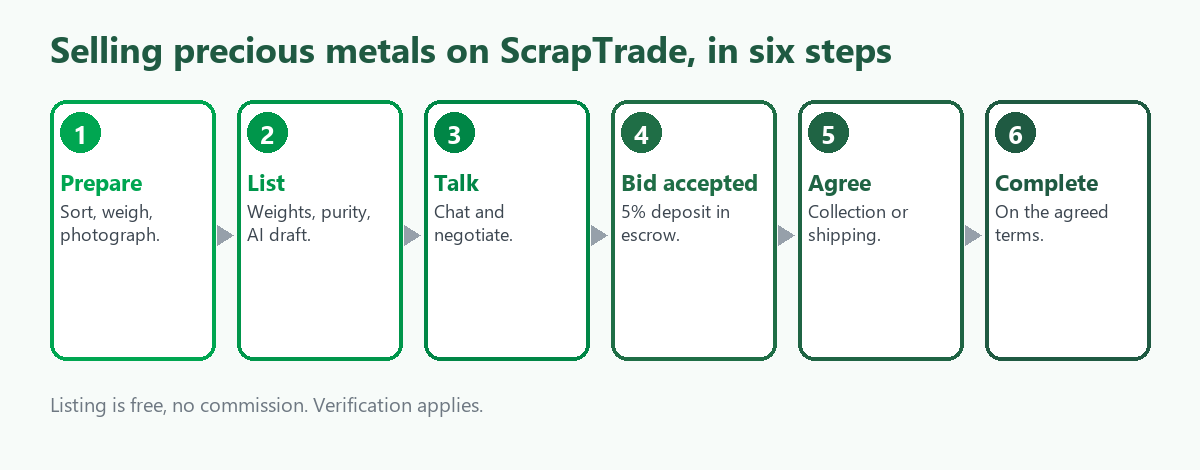
- Prepare. Sort the metal by type, weigh it and photograph it with the weights visible.
- List. Create an account, complete verification, and create a listing with photos, weight, purity and price. The AI helper can draft the text, which you should check.
- Talk. Buyers send inquiries. You chat and negotiate in real time.
- Bid accepted. When you accept a bid, the buyer's 5 percent deposit is held in escrow.
- Agree logistics. You and the buyer agree collection or shipping terms, including insurance for high-value parcels.
- Complete. The sale is completed on the terms agreed.
Where it does not fit
Be realistic. One wedding ring or a few coins is a job for a local buyer or a coin dealer, who can test, weigh and pay in front of you. ScrapTrade is a trade marketplace, so offers are trade offers, and a retail jeweller's price for a wearable piece may well be better. We could not confirm how ScrapTrade handles testing, assay or insurance for high-value parcels, or whether jewellery as a retail item suits its buyers, so ask the team before you plan around it. The sweet spot is lots: a jeweller's accumulated scrap, a workshop's filings and sweeps, e-waste with precious content or an estate's mixed metal. For any question not answered here, including verification steps, contact cs@scraptrade.com.au.
Which guide to read next
- Sell Gold Jewellery and Scrap Gold in Australia for pricing, carats and quotes.
- Sell Silver in Australia for bullion, coins, cutlery and scrap silver.
- Sell Old Coins in Australia for melt versus collector value.
- Sell Unwanted or Broken Jewellery in Australia for identity rules, pawn versus sale and tax.
- Sell Scrap Gold and Silver in Bulk for businesses, GST and reporting.
- Where an Old Catalytic Converter Goes and Where Old Electronics Go After You Hand Them In for where precious metals also come from.
Clearing business stock rather than household items? Our guide to selling used commercial and industrial equipment covers kitchens, machinery, fittings and the legal checks. Sell Used Commercial and Industrial Equipment.
Selling precious-metal scrap to refiners and traders abroad? The international guide covers refiner due diligence and cash rules. Sell Gold, Silver and Scrap Jewelry Worldwide.
What we could not verify
- What gold, silver and jewellery sell for. Spot figures we found conflicted and many were stale, so we give none.
- Buyer payout percentages. They come from dealer marketing pages.
- New South Wales dealer rules. We relied on a gold buyer's summary, not Fair Trading.
- The detail of the 2026 reporting rules. We relied on compliance-vendor pages, not AUSTRAC.
- How buyers test purity. We found no source.
- How ScrapTrade handles testing, assay and insurance. Ask support at cs@scraptrade.com.au.
- ScrapTrade's verification steps. They are not public.
Frequently asked questions
How do I sell old jewellery in Australia?
Sort it, weigh it, get at least two quotes from licensed buyers and bring photo ID. Pieces worth more than their metal may do better through a private or consignment sale.
Is selling gold jewellery taxable?
Jewellery is a collectable for capital gains tax, and a gain is disregarded where the cost base is A$500 or less. Confirm your case with a tax agent.
Can I sell gold or silver on ScrapTrade?
Precious metals are one of its categories. Businesses and individuals can both sell after verification, and listing is free with no commission.
Is it worth more to sell as scrap or as jewellery?
It depends on the piece. Wearable, well-made or signed pieces can be worth more as jewellery, and broken or unwanted ones are priced on metal.
Do I pay anything to list?
No. Listing is free with no commission. A buyer's 5 percent deposit is held in escrow after a bid is accepted.
Sources
- Ubersuggest keyword data for Australia, queried November 2026.
- Australian gold-dealer pages on pricing, purity and payout percentages, as summarised in search results.
- Consumer Affairs Victoria, second-hand dealers and pawnbrokers, evidence of identity; New South Wales gold-buyer guidance, as summarised in search results.
- Australian Taxation Office capital gains tax guidance and Income Tax Assessment Act 1997 s 118-10, as summarised in search results; ATO GST guidance on precious metals, as summarised in search results.
- Compliance-vendor summaries of AUSTRAC's rules for dealers in precious metals and stones, 2026.
- ScrapTrade website, accessed November 2026.
This is general information, not financial, tax or legal advice. Rules differ by state and change, so check with the relevant authority. ScrapTrade operates a scrap marketplace and has a commercial interest in the scrap trade.