

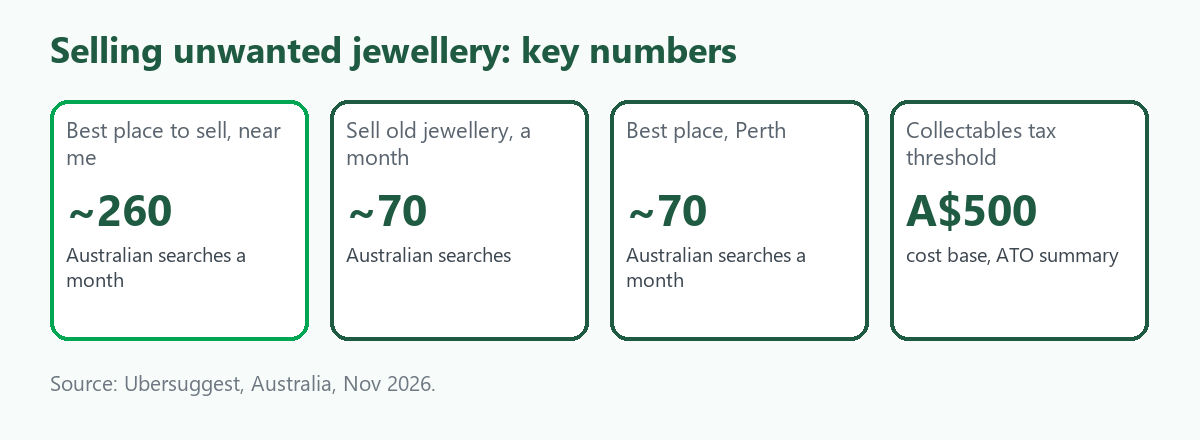
"Best place to sell unwanted jewellery near me" is searched about 260 times a month in Australia, according to Ubersuggest, "sell old jewellery" about 70, "best place to sell unwanted jewellery perth" about 70 and "best place to sell unwanted jewellery melbourne" about 50. These searchers hold jewellery they do not wear: an old chain, a ring from a former relationship, an inherited set, or a broken earring. They want a fair price and, often, to know they are safe. This guide covers what buyers ask for, the difference between a pawn and a sale, how to decide what to keep and how to avoid a poor quote. It is part of our guide to selling old gold, silver and jewellery. We give no prices, because the figures we found conflicted, and ScrapTrade has a commercial interest in the scrap trade.
What ID buyers will ask for
Jewellery buyers who are licensed second-hand dealers or pawnbrokers have identity duties. Consumer Affairs Victoria says a dealer must ask every person selling or pawning goods for proof of identity, must refuse the goods if none is produced, unless an exemption applies, and must record the seller's full name and address and details of the identification shown. The accepted forms of ID are set out in the Victorian Act and regulations. For New South Wales, a gold-buyer website describes the Pawnbrokers and Second-hand Dealers Act 1996, an Australian driver licence or passport as typical photo ID and records kept for three years, but we could not confirm these details from Fair Trading, so check there. A buyer that asks for ID is following the law, and one that does not is a warning sign. If you sell inherited jewellery, bring anything that shows it was yours, such as a will or a purchase receipt.
Step 1: Decide whether to sell
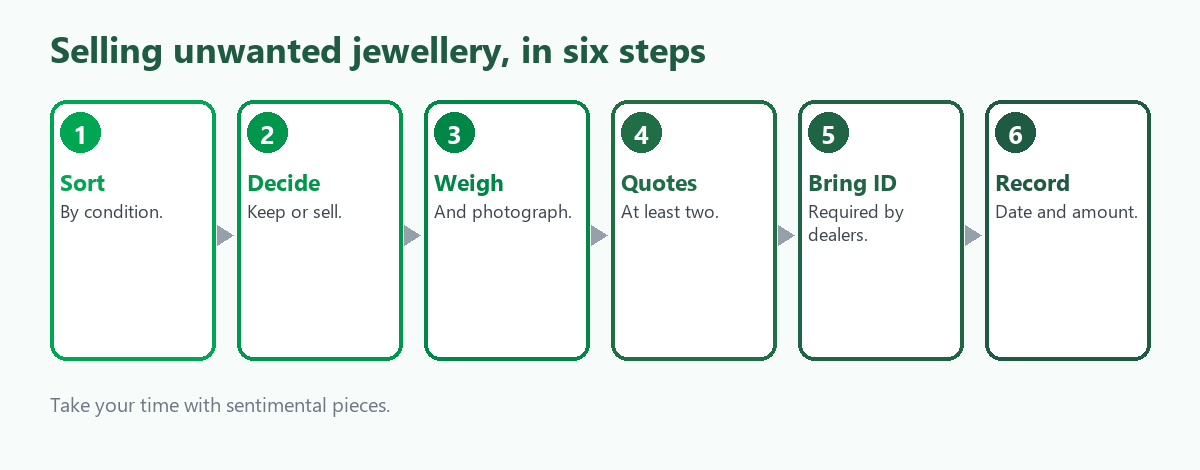
Jewellery with sentimental value is not a trade-off you can reverse, so give yourself time. Consider whether a family member would want it, whether it could be remade into something you would wear and whether it is worth getting a valuation. A formal valuer can give a written figure, which is also useful for insurance. If you are certain, continue.
Step 2: Sort and describe
Separate pieces by metal and condition: wearable, damaged but repairable, and scrap. Weigh each group, photograph the pieces, note any stamps and leave stones in place. Do not polish valuable or antique pieces. A wearable piece with a maker's mark can be worth more than its metal, so it should not go in the scrap pile.
Pawn or sell
A pawn is a loan secured on the item, and you get it back if you repay by the deadline, while a sale is final. One dealer source says pawn shops commonly pay 30 to 60 percent of the gold value, which is lower than the 70 to 95 percent that other sites quote for gold buyers. These numbers come from the dealers' own pages, so they are examples only. If you are not sure you will need the money, a sale to the buyer with the best quote is generally simpler, and a pawn suits a short-term cash need where you want the piece back.
Avoid a bad quote
- Get at least two quotes on the same day, from licensed buyers.
- Ask how the figure is worked out. The weight, the purity assumed and the payout percentage.
- Watch the weighing, and ask how purity was tested.
- Do not be hurried. A quote that is only good if you accept now is a red flag.
- Ask about deductions for stones, clasps and fees.
- Keep a record of the date, the buyer, the weight and the amount.
Tax
Jewellery is a collectable for capital gains tax, so a piece you bought for a few hundred dollars and sold for more usually produces no taxable gain, while a valuable one might. The A$500 line is measured on market value at acquisition, which matters for inherited pieces and for gifts. Ask a tax agent about a high-value or inherited item. These points come from search summaries of ATO pages and legislation, and we are not tax advisers, so check with a registered agent.
Where ScrapTrade fits
Most unwanted jewellery belongs with a licensed local buyer who can test it in front of you, and we would not send one ring to a trade marketplace. ScrapTrade is relevant when you hold a lot and mostly metal: a jeweller or repairer with a jar of broken pieces, an estate with several kilos of mixed scrap, or a business that buys jewellery and needs somewhere to sell what it cannot retail. Listing is free and takes no commission, precious metals are one of its categories and its buyers are verified traders in more than 50 countries. You post photos and weights, negotiate in real time and agree logistics. When a bid is accepted, the buyer's 5 percent deposit is held in escrow. Both individuals and businesses can sell after verification. We could not confirm whether a licensed-dealer seller on ScrapTrade has extra obligations, or how retail pieces are handled, so ask cs@scraptrade.com.au first.
What we could not verify
- What jewellery sells for. We found no reliable price source.
- New South Wales dealer rules. We relied on a gold buyer's summary.
- Pawn and buyer payout percentages. They come from dealers' own pages.
- How ScrapTrade treats dealer sellers or retail pieces.
- ScrapTrade's verification steps. Ask support at cs@scraptrade.com.au.
Frequently asked questions
What ID do I need to sell jewellery?
Photo ID such as a driver licence or passport, according to the buyer sites we found. A Victorian second-hand dealer must ask for identity from every seller.
Where is the best place to sell unwanted jewellery?
A licensed local buyer or jeweller, after comparing at least two quotes. Pieces worth more than their metal may do better through an auction or consignment.
Is it better to pawn or sell jewellery?
A pawn is a loan and you get the piece back if you repay. A sale is final and usually pays a higher share of metal value.
Is money from selling jewellery taxable?
Jewellery is a collectable, and a gain is disregarded where the cost base is A$500 or less. Check your case with a tax agent.
Sources
- Ubersuggest keyword data for Australia, queried November 2026.
- Consumer Affairs Victoria, second-hand dealers and pawnbrokers, evidence of identity and keeping records.
- New South Wales gold-buyer guidance on ID and record-keeping, as summarised in search results.
- Australian Taxation Office capital gains tax guidance and Income Tax Assessment Act 1997 s 118-10, as summarised in search results.
- ScrapTrade website, accessed November 2026.
This is general information, not financial, tax or legal advice. ScrapTrade is a scrap marketplace.