

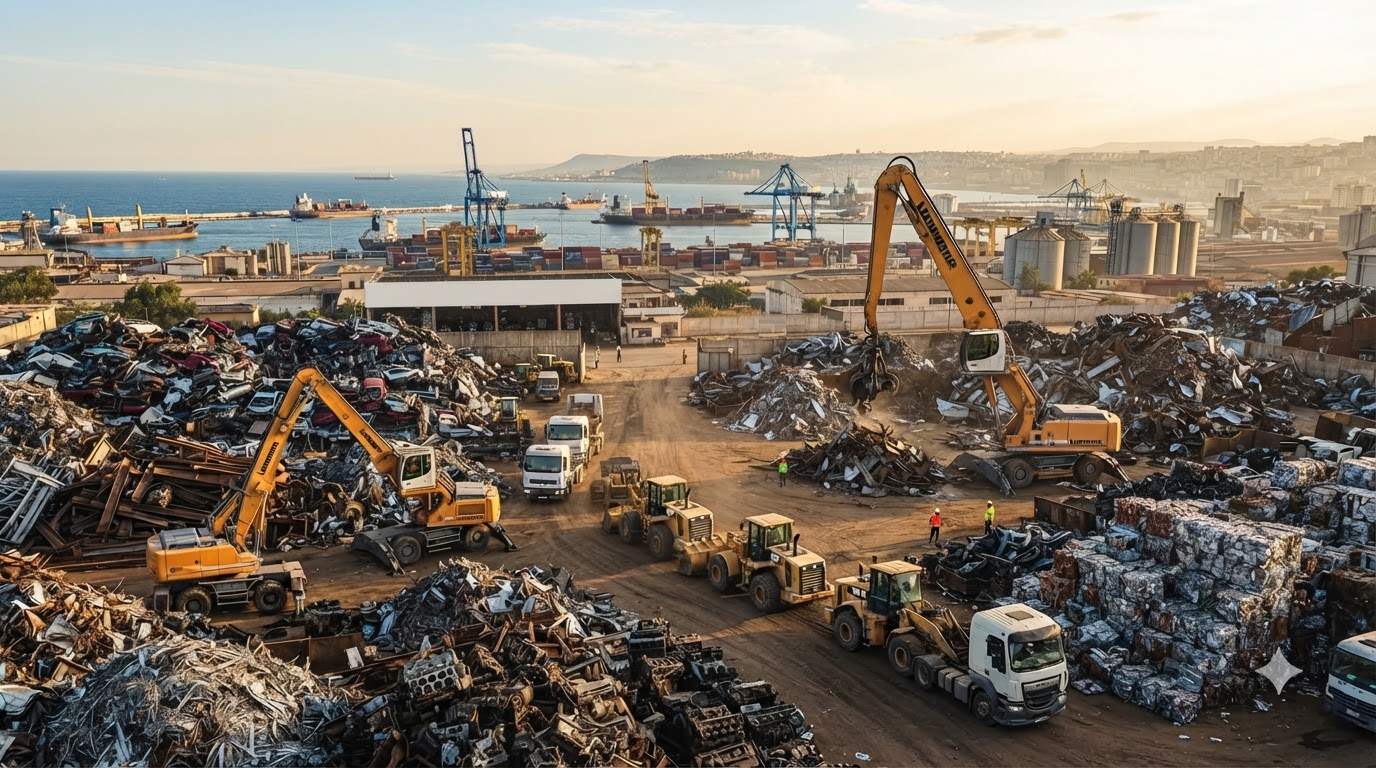
Algeria Scrap and Secondary Material Market: Regulatory Export Bans, Domestic Metallurgical Integration, and Circular Economy Strategy
Executive Summary and Market Landscape
The scrap and secondary metal recycling market in Algeria operates under a highly protective regulatory framework designed to retain industrial raw materials within the national economy. Unlike open export-oriented regional markets, Algeria has strategically decoupled its domestic scrap generation from global scrap trade flows. Following years of progressive trade restrictions dating back to the 2014 Finance Law, the Algerian government enacted a definitive ban on the export of raw ferrous and non-ferrous scrap metal, lead debris, and used batteries in March 2022.
This regulatory intervention aims to guarantee a steady, low-cost supply of secondary metallic feedstocks to fuel Algeria’s expanding domestic steel industry. Anchored by mega-industrial complexes such as Tosyalı Algérie in Oran and the state-owned Sider El Hadjar in Annaba, domestic demand for ferrous scrap is tightly integrated with Electric Arc Furnace (EAF) and Direct Reduced Iron (DRI) steelmaking. By prohibiting raw scrap exports while promoting the export of fully processed, high-value-added semi-finished and finished recycled products through platforms like the "Algeria Metal Exchange," Algeria is transforming its scrap sector into a key pillar of national industrial self-sufficiency and circular economic development.
| Market Dimension / Regulatory Metric | Status / Value | Context & Strategic Significance |
|---|---|---|
| Raw Scrap Export Policy | Definitive Ban (Enacted March 2022) | Prohibits raw export of ferrous/non-ferrous scrap, lead, and used batteries. |
| Recycled Product Export Status | Open for Transformed / Semi-Finished Goods | Managed via the "Algeria Metal Exchange" digital platform. |
| 2024 Raw Scrap Exports (HS 7204) | $1.23 Million | Minimal symbolic volume (primarily to Netherlands) prior to total enforcement. |
| 2024 Raw Scrap Imports (HS 7204) | $172,000 | Highly restricted import reliance (primarily from Italy). |
| Primary Industrial Scrap Consumers | Tosyalı Algérie, Sider El Hadjar (IMETAL) | Major integrated EAF and DRI steelmaking complexes. |
| Primary Domestic Recyclers / Processors | Tosyalı Harsco, Balser Steel, Local Aggregators | Industrial processing, slag metal recovery, and ISO-certified collection. |
Regulatory Architecture and Trade Control Framework
The structural evolution of the Algerian scrap metal market is defined by executive trade controls designed to eliminate raw material flight. Historically, large volumes of unrefined metal scrap were exported to overseas buyers, starving local foundries and steel mills of secondary raw materials.
Progression of Scrap Export Restrictions
- Finance Law 2014 (Article 75): Initial suspension of exports covering waste and scrap of ferrous and non-ferrous metals, lead scrap, and spent lead-acid batteries.
- Interim Authorization Phase (2014–2021): Raw scrap exports were placed under strict prior authorization regimes managed directly by the Ministry of Commerce.
- Definitive Export Ban (March 2022): Decreed by President Abdelmadjid Tebboune, halting all exports of raw ferrous scrap metal to secure national industrial feedstock reserves.
Value-Addition Mandate and Digital Platforms
To prevent the domestic market from becoming saturated with low-grade waste while incentivizing industrial modernization, the Ministry of Commerce opened export channels exclusively for transformed products. Recyclers and industrial processors can export finished and semi-finished goods derived from recycled ferrous and non-ferrous waste.
To regulate this trade, the government launched the "Algeria Metal Exchange" electronic platform. This portal registers certified local recyclers, tracks domestic scrap supplies, matches scrap generators with steelmakers, and grants export permits for value-added processed products.
| Regulatory Framework | Target Commodity Stream | Legal Mechanism & Objective |
|---|---|---|
| March 2022 Presidential Decree | Raw Ferrous & Non-Ferrous Scrap, Lead, Spent Batteries | Complete export prohibition to retain raw materials domestically. |
| Algeria Metal Exchange Platform | Transformed Semi-Finished & Finished Recycled Metals | Digital tracking, supply allocation, and export licensing for value-added goods. |
| Steel Import Substitution Directives | Galvanized Flat Steel, Long Steel Products | Import bans on select finished steel to force local mills to use domestic scrap/DRI. |
Domestic Metallurgical Industry and Major Scrap Consumers
Because raw scrap cannot leave the country, domestic steel producers act as the primary buyers for collected ferrous materials. The Algerian steel sector relies heavily on Electric Arc Furnace (EAF) technology paired with Direct Reduced Iron (DRI) units, which require consistent charges of high-quality scrap.
Tosyalı Algérie (Bethioua, Oran)
Located in the Bethioua industrial zone near Oran, Tosyalı Algérie (a subsidiary of Tosyalı Holding) is one of the largest integrated steel complexes in the Mediterranean and Africa, with a crude steel capacity exceeding 6.2 million tonnes annually.
- Scrap Consumption: Tosyalı Algérie sources ferrous scrap from across all 58 provinces of Algeria. Scrap metal is mixed with Hot DRI (HDRI) and Cold DRI (CDRI) in its high-capacity EAF melt shops to produce billets, rebar, wire rod, spiral pipes, and hot-rolled coils.
- Slag and Metal Recovery: Through its joint venture Tosyalı Harsco, the complex operates dedicated slag processing and metal recovery facilities in Oran. These facilities extract residual metallic iron from steelmaking slag, reintroducing recovered metal back into the EAF charge.
Sider El Hadjar (Annaba)
Located 12 km from Annaba, Sider El Hadjar (a subsidiary of the state-owned IMETAL group) covers 832 hectares and represents Algeria's historic steelmaking hub. The plant utilizes a combination of blast furnace (BF-BOF) and electric furnace routes, consuming substantial volumes of heavy industrial, structural, and rail scrap collected across eastern Algeria.
Algerian Qatari Steel (AQS - Bellara, Jijel)
The AQS integrated complex at Bellara utilizes MIDREX DRI technology paired with EAF melt shops. AQS is another major consumer of local industrial scrap, using secondary iron to supplement DRI production and reduce overall energy consumption during melting operations.
| Steelmaking Complex | Location | Technological Route | Primary Scrap Procurement Channels |
|---|---|---|---|
| Tosyalı Algérie | Bethioua, Oran | DRI (Midrex) + EAF Melt Shops | Nationwide collection networks, Tosyalı Harsco slag recovery. |
| Sider El Hadjar (IMETAL) | El Hadjar, Annaba | Blast Furnace + EAF Routes | Regional industrial, rail, and demolition scrap in Eastern Algeria. |
| Algerian Qatari Steel (AQS) | Bellara, Jijel | DRI + EAF Steelmaking | Secondary industrial offcuts and heavy melting scrap from domestic dealers. |
Domestic Collection Infrastructure and Private Sector Recyclers
The collection and processing of scrap metal in Algeria is managed by state-owned industrial entities, private recycling enterprises, and an informal collection workforce.
Private Sector Recyclers: Balser Steel
Firms such as Balser Steel (a division of the Balser Group) represent the formalization of Algeria’s metal recycling industry. Operating ISO 9001 (Quality) and ISO 14001 (Environmental) certified facilities, Balser Steel collects, sorts, shears, and processes ferrous and non-ferrous metals, alongside industrial motor oils and waste liquids across national logistics platforms. The company buys scrap from local tradesmen and large industrial manufacturers (e.g., automotive, home appliances, mechanical engineering), supplying processed scrap to domestic steel mills.
Sectoral Generation Streams
- Prompt Industrial Scrap: High-purity scrap generated by automotive assembly plants, appliance manufacturers, and structural fabrication workshops in major industrial hubs like Algiers, Oran, Constantine, and Sétif.
- Obsolete Structural Scrap: Generated through civil infrastructure dismantling, energy sector equipment decommissioning (Sonatrach oil and gas fields), maritime ship breaking, and railway maintenance.
- Non-Ferrous Streams: Copper, aluminum, and brass scrap are collected and directed toward local secondary foundries and transformer repair workshops, as raw non-ferrous exports remain prohibited.
Strategic Outlook and Market Insights
Algeria’s scrap metal sector has transitioned from an unregulated export market into a controlled, domestic secondary supply chain.
Key Market Opportunities
- Industrial Equipment Upgrading: With raw scrap confined to the domestic market, processing yards must invest in heavy hydraulic shears, balers, and shredders to process bulky structural scrap into dense EAF charges required by Tosyalı and Sider El Hadjar.
- Value-Added Processing Exports: Companies that establish downstream manufacturing facilities such as copper ingot casting or secondary aluminum alloy production can leverage the "Algeria Metal Exchange" to export finished products globally, capitalizing on low domestic raw material costs.
Strategic Challenges
- Domestic Price Distortions: The export ban artificially suppresses domestic scrap prices relative to international benchmarks. While this benefits domestic steelmakers, it compresses profit margins for independent collectors and limits capital available for automated sorting technology.
- Supply Chain Transparency: Expanding formal collection networks across southern energy regions and rural provinces remains necessary to prevent scrap leakage and supply expanding steel mill capacities.
Summary
Algeria’s scrap market is defined by national resource preservation. Supported by a definitive export ban on raw scrap, rising domestic EAF steel production, and government oversight via the Algeria Metal Exchange, the sector is set to remain a key source of secondary feedstock for the nation's industrial economy.