
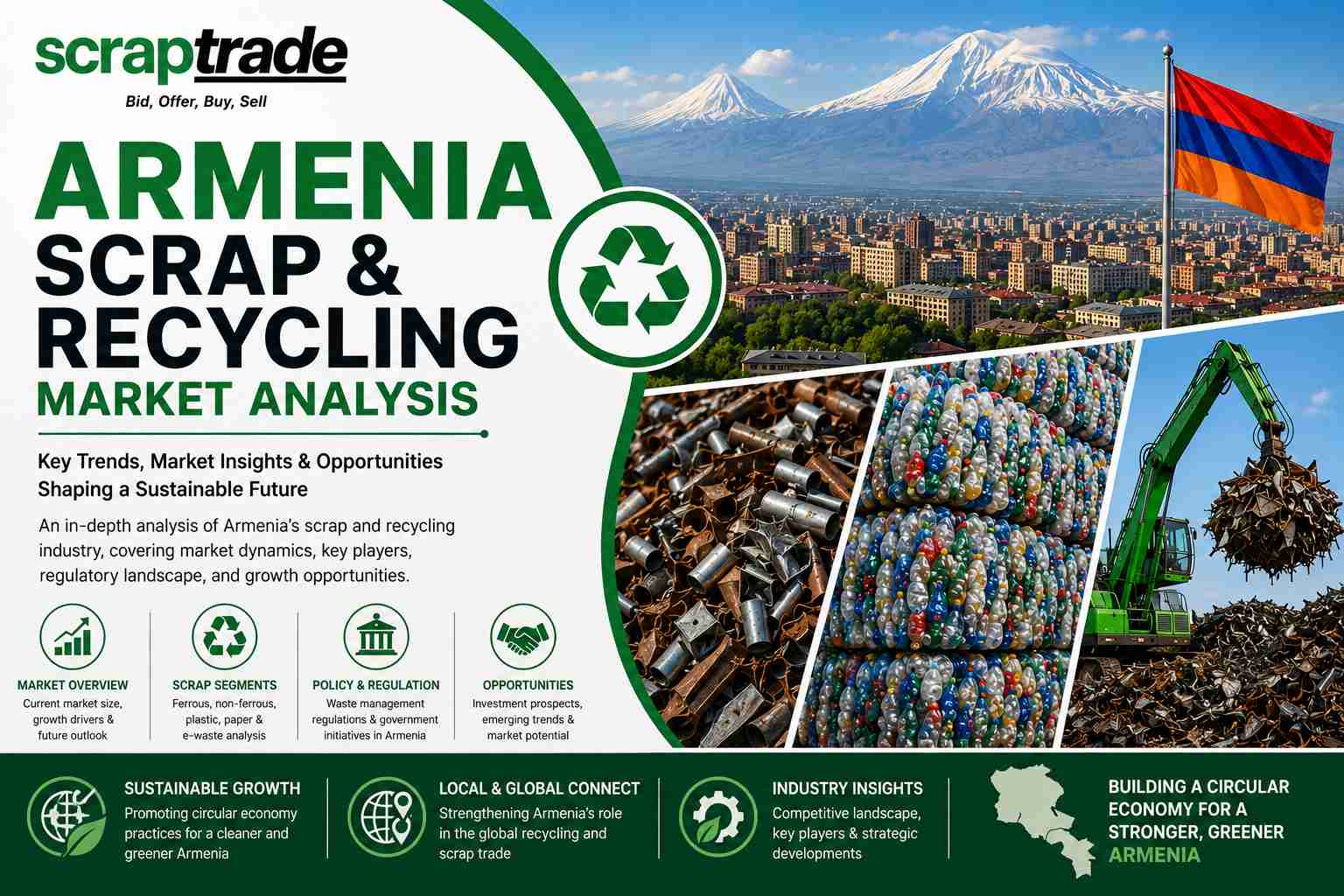
Economic Dynamics and Regulatory Architecture of Armenia's Scrap Recycling Market
Macroeconomic Context and Supply Chain Vulnerabilities
Armenia's metallurgical and recycling sectors operate within a distinct set of geographical, geopolitical, and structural constraints. The national industrial baseline is characterized by a complete absence of economically viable primary ferrous metal deposits and a lack of primary copper refining capabilities. Consequently, domestic metalworking, construction material, and wire or cable manufacturing enterprises are fundamentally reliant on secondary raw materials—specifically scrap and metal waste generated within national borders—to maintain industrial output.
This reliance on domestic scrap is exacerbated by severe cross-border logistics bottlenecks. Armenia’s landlocked geography and restricted direct rail freight connections with primary regional trading partners significantly elevate the transit costs associated with importing bulk raw materials. Importing ferrous or non-ferrous scrap metal from Eurasian Economic Union (EAEU) partner states or third-party countries remains economically unfeasible due to high global scrap pricing, substantial transport overheads, and complex multimodal shipping routes. Local manufacturers attempting to utilize imported scrap face elevated input costs, rendering their downstream finished goods—such as rebar, structural steel, hollow sections, and aluminum castings—uncompetitive against imported finished goods in the domestic marketplace.
To mitigate these systemic vulnerabilities, scrap metal is treated by the Armenian government as a strategic commodity vital to national security, defense capabilities, and domestic industrial stability. Unrestricted market forces historically caused significant volumes of domestic scrap to be exported during periods of elevated global metal prices. This outflow drained raw materials from the domestic economy, threatening to force local metallurgical mills into operational halt or total reliance on uncompetitive foreign inputs. In response, state interventions have reshaped the market through continuous protective measures designed to secure domestic feedstock for local processing assets.
Regulatory Architecture and Trade Export Bans
To prevent raw material depletion and protect local manufacturing value chains, the Cabinet of Ministers of Armenia instituted a regulatory policy centered on periodic, comprehensive export bans covering ferrous and non-ferrous scrap, waste, and selected used metal products. Initially enacted in 2020, this temporary export ban regime has been continuously extended through successive six-month executive decrees.
The regulatory framework applies restriction controls to the movement of covered goods both to EAEU member states and to third countries. Following decrees enacted in December 2023 and May 2024, the Cabinet executed a decision on October 30 extending the legal export prohibition through August 2, 2026—specifically enforcing a renewed six-month ban from February 2, 2026, to August 2, 2026.
| Regulatory Milestone | Effective Dates | Core Objective & Legal Scope | Impacted Freight & Destinations |
|---|---|---|---|
| Initial Export Ban | Enacted 2020 | Restrict raw metal outflow; build domestic processing base. | Ferrous/Non-ferrous scrap to all international destinations. |
| Intermediate Extensions | Dec 2023 – Nov 2024 | Maintain captive domestic scrap pool amid volatile global pricing. | EAEU Member States & Third Countries. |
| Extended Ban Decree | May 2024 – Nov 2024 | Sustain raw material flow for ongoing steel plant investments. | Ferrous/Non-ferrous scrap, waste, and used metal goods. |
| Current Extension Decree | Feb 2, 2026 – Aug 2, 2026 | Preserve local raw materials for $100M industrial expansion. | Comprehensive prohibition across all outward trade vectors. |
This protectionist stance aligns with regional trends across the Eurasian landmass, where sovereign states have enacted parallel trade interventions. For instance, Kazakhstan has maintained multi-year bans on the outward shipment of scrap metals. By aligning its trade policy with broader EAEU defensive measures while closing regional export loopholes, the Armenian Ministry of Economy has decoupled local industrial input costs from international market shocks.
Downstream Industrial Expansion and Production Metrics
The implementation of export restrictions on scrap metal has fundamentally altered domestic manufacturing volume, downstream product diversification, and capital investment inflows. Deprived of foreign export outlets, local scrap aggregators must deliver collected volumes to domestic foundries and rolling mills, driving up industrial capacity utilization.
Following the introduction of the initial export ban in 2020, domestic rolled steel output expanded 8.4-fold in 2021, exceeding 115,200 metric tons. Volume further expanded in 2022 to reach 119,600 metric tons (+3.9% year-over-year). In the first half of 2023, domestic production of steel pipes, hollow profiles, and pipe fittings jumped by 56% year-over-year, reaching 52,200 metric tons. Continued momentum into 2024 yielded a 2.4-fold expansion in unalloyed cast steel output, a 10.8% increase in steel pipes and hollow sections, a 19% increase in structural metal components made of iron, steel, or aluminum, and a 5.8% increase in household aluminum castings.
| Metallurgical Indicator | Historical Baseline | Peak / Recent Volumetric Output | Relative Growth Metric |
|---|---|---|---|
| Rolled Steel Volume | Pre-2020 low volume baseline | 115,200 tons (2021) / 119,600 tons (2022) | +8.4x in 2021; +3.9% y/y in 2022 |
| Steel Pipes & Hollow Profiles | ~33,400 tons (H1 2022 baseline) | 52,200 tons (H1 2023) | +56.0% in H1 2023 |
| Unalloyed Cast Steel | 2023 baseline output | 2024 expanded output | +2.4x expansion in 2024 |
| Steel Pipes & Fittings (2024) | 2023 baseline output | 2024 expanded output | +10.8% growth in 2024 |
| Structural Metal Components | 2023 baseline output | 2024 expanded output | +19.0% growth in 2024 |
| Household Aluminum Castings | 2023 baseline output | 2024 expanded output | +5.8% growth in 2024 |
This surge in available secondary feedstocks incentivized substantial capital deployment into domestic melting and processing infrastructure. Between 2022 and 2025, foreign and domestic direct investments targeting the industrial sector are projected to total approximately $100 million. Key industrial enterprises driving this expansion include GTB Steel, Aske Group, Karakert Stone Smelter, Dzulakentro, Edmet, and Asedl. These modernization programs aim to expand Armenia's domestic scrap processing capacity by 65% to 70%, pushing annual domestic scrap consumption to approximately 250,000 metric tons while generating between 550 and 750 high-skill industrial jobs.
Non-Ferrous and Solid Waste Recycling Ecosystem
Beyond heavy industrial ferrous metals, Armenia's broader circular economy covers non-ferrous metals, plastics, paper, and municipal solid waste (MSW). Total municipal solid waste generation in Armenia is estimated at approximately 700,000 metric tons per year, with individual annual waste production in the capital city of Yerevan averaging 300 kilograms per capita.
| Waste Category | MSW Weight Share (%) | Estimated Annual Volume | Primary Recycling Channels & Dynamics |
|---|---|---|---|
| Kitchen Organic Waste | 46.0% | ~322,000 tons | Highly unmanaged; minor pilot vermi-composting using manure/straw. |
| Plastics (PET, PE, PP) | 13.0% | ~91,000 tons | ~6,000 tons recycled annually; 350 tons/mo PET generated vs 150–200 tons recycled. |
| Garden / Organic Waste | 10.0% | ~70,000 tons | Landfill-bound or localized agricultural reuse. |
| Textiles | 7.0% | ~49,000 tons | Landfill disposal; negligible industrial recovery. |
| Paper & Cardboard | 6.0% | ~42,000 tons | Processed by ~10 domestic mills into wrapping paper, cardboard, and tissue. |
| Glass | 4.0% | ~28,000 tons | Domestic processing by 4 specialized glass recycling facilities. |
| Metals (Ferrous/Non-Ferrous) | 2.0% | ~14,000 tons | High collection efficiency; diverted directly to domestic EAF steel foundries. |
| Other / Diapers | 12.0% | ~84,000 tons | Unrecoverable municipal refuse; directed to open municipal dumpsites. |
Collection and recovery mechanisms operate through three primary structural pathways: manual and semi-mechanical extraction from mixed landfill streams, municipal sorting programs, and private business-to-business collection networks. Municipal sorting initiatives, such as the Yerevan Municipality's placement of over 400 recycling containers across 135 locations, provide direct urban drop-off access, though collection infrastructure in smaller municipalities remains limited. Non-governmental organizations and private operators—including ISSD ("Recycle It"), Smart Apaga, Eco Aghb, CleanLand LLC, Tapon.am, Clean Goris, and Vazgen Abgaryan LLC—manage corporate pickup subscriptions, sorting centers, and community drop-off stations.
| Industry Sector | Primary Active Corporate Players & Entities | Operational Characteristics |
|---|---|---|
| Ferrous Metallurgy & Smelting | GTB Steel, Aske Group, Karakert Stone Smelter, Dzulakentro, Edmet, Asedl | Electric Arc Furnace melting, steel rebar, pipe extrusion, and casting. |
| Paper & Cardboard Recovery | ISSD ("Recycle It"), Eco Aghb, Smart Apaga, CleanLand LLC, Vazgen Abgaryan LLC | Collection, repulping, production of corrugated packaging, board, and tissue paper. |
| Plastics & Polyethylene | CleanLand LLC, ISSD, Smart Apaga, Clean Goris | Flaking, pelletizing, PET sorting (350 t/mo supply base), industrial packaging. |
| Glass Processing | 4 Domestic Commercial Operators | Crushing, cullet washing, remelting for container glass and bottling industries. |
In the plastic recycling segment, Armenia processes approximately 6,000 metric tons of plastic waste per year out of a total plastic waste stream exceeding 90,000 tons. For example, the country generates roughly 350 metric tons of post-consumer PET bottles monthly, but current collection infrastructure recovers only 150 to 200 metric tons per month for domestic reprocessing. In paper recycling, approximately ten domestic companies process recovered fiber into wrapping paper, industrial cardboard, and sanitary tissue products, though sanitary compliance remains variable across smaller market participants.
Macro-Level Structural Insights
The interplay between Armenia's regulatory policies, domestic logistics realities, and industrial investments highlights several broader market dynamics. By enforcing comprehensive export bans, the Armenian government has effectively decoupled domestic scrap metal prices from global market fluctuations. This protective insulation provides domestic Electric Arc Furnace operators with stable raw material costs below international market rates. The resulting margin security has made secondary steel manufacturing commercially attractive within national borders, successfully directing $100 million in foreign and domestic capital investments into expanding production infrastructure.
However, while trade protections secure captive raw materials, Armenia's long-term industrial expansion faces a structural constraint tied to domestic scrap generation limits. Given the country's population size and industrial output, annual post-consumer and industrial scrap generation is naturally capped. As new processing facilities push annual consumption capacity toward the targeted 250,000-metric-ton threshold, domestic scrap supply will eventually reach a plateau. Because importing raw scrap remains cost-prohibitive due to transit bottlenecks and rail deficits, local steelmakers will ultimately encounter a domestic scrap availability ceiling.
In contrast to the heavy metal sector, where industrial processors efficiently absorb available feedstock, non-ferrous and municipal waste recovery remains institutionally fragmented. The persistent gap between plastic generation exemplified by monthly PET generation of 350 tons against recovery rates of 150 to 200 tons—underlines the operational limits of current collection infrastructure. Non-metal circular initiatives remain largely reliant on civic organizations and private subscription models to bridge gaps in municipal waste management systems.
Conclusions and Industry Outlook
The structural evolution of Armenia's scrap market demonstrates how targeted trade policy can stimulate domestic industrial manufacturing. By restricting raw scrap exports, the state has addressed long-standing supply vulnerabilities caused by a lack of primary ore reserves and elevated import freight costs. This regulatory environment has transformed the domestic industrial landscape, attracting $100 million in direct investment, creating hundreds of specialized industrial jobs, and driving substantial output growth across rolled steel, cast steel, and pipe manufacturing.
To sustain this growth beyond the August 2026 regulatory horizon, Armenia's metallurgical and recycling sectors must navigate key structural transitions. As domestic melting capacity approaches the 250,000-ton annual scrap consumption mark, local processors will eventually outpace national scrap generation. Maintaining industrial expansion will require establishing direct rail and multimodal shipping corridors, securing raw material agreements within the EAEU, or importing Direct Reduced Iron (DRI) and primary inputs. Simultaneously, closing the recovery gap in high-value plastics, aluminum packaging, and paper requires transitioning from informal landfill extraction to systematic municipal source-separation infrastructure. Modernizing sorting technologies and enforcing standardized environmental compliance across reprocessors will ensure that Armenia's circular economy continues to support its national industrial strategy.