

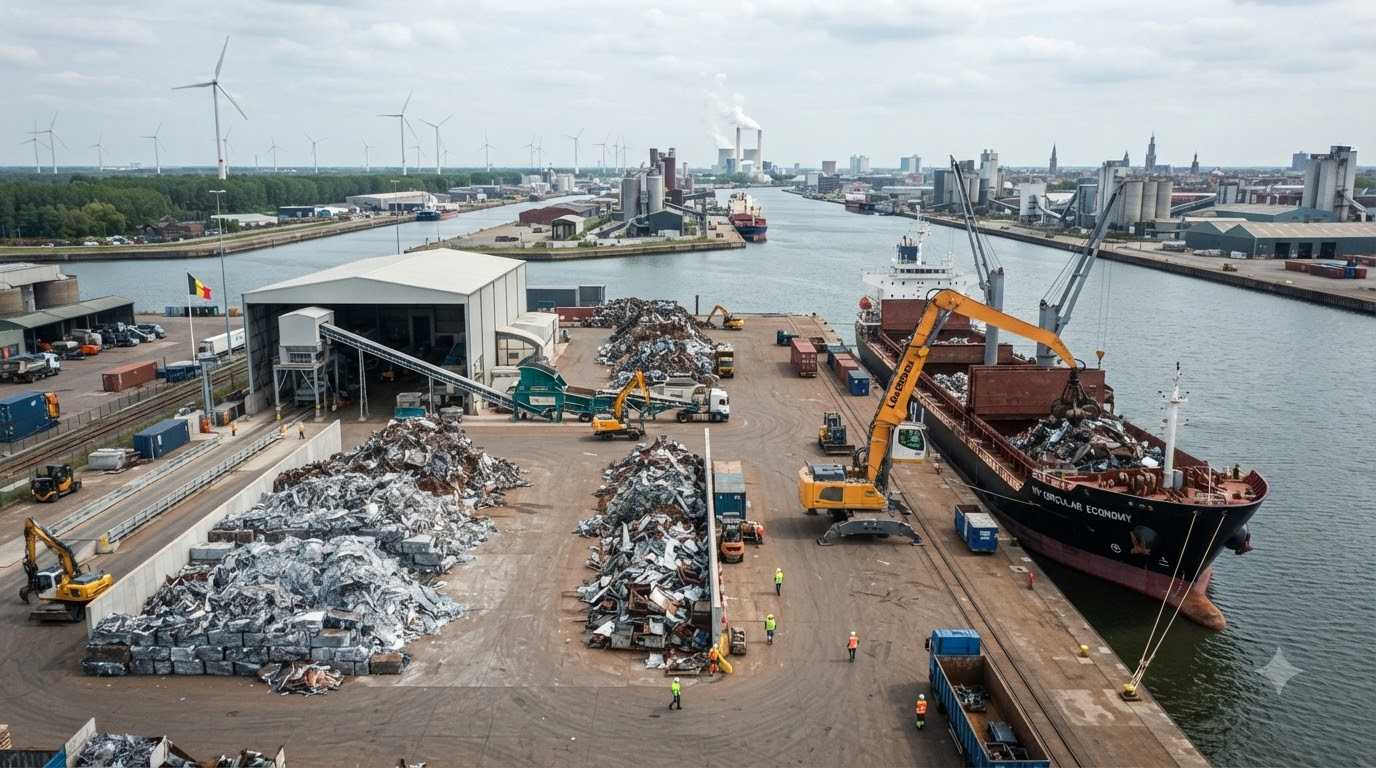
Belgian Scrap Metal Market Analysis: Industrial Structure, Regulatory Dynamics, and Strategic Outlook
Market Context and Macroeconomic Footprint
The scrap metal recycling market in Belgium operates at the center of the Western European circular economy. Positioned at the industrial crossroads of Europe, Belgium functions as a primary hub for cross-border scrap collection, high-grade sorting, metallurgical processing, and maritime export. The European metal recycling market was valued at $147.59 billion in 2024 and is projected to expand to $164.63 billion by 2029, representing a compound annual growth rate (CAGR) of 2.2%. This growth rate reflects a mature, highly regulated, and infrastructure-dense market where volume expansion is constrained compared to emerging economies, but value creation is heavily driven by technology-driven material purity upgrades, decarbonization mandates, and extended producer responsibility (EPR) schemes.
On a global scale, the scrap metal recycling market is expanding from 567.98 million tons in 2026 to 764.39 million tons by 2031 at a CAGR of 6.12%, while broader market value projections estimate global revenues rising from $441.1 billion in 2025 to $584.4 billion by 2032. Within this global dynamic, Belgium's market significance is disproportionate to its geographic size. Supported by deepwater port infrastructure in Ghent and Antwerp-Bruges, alongside extensive inland waterway networks connecting to France, Luxembourg, and Germany, Belgian processors serve as the central clearinghouse for secondary metals across Western Europe.
In the Flemish region alone, total exported waste reached 2.4 million tonnes in 2021, underlining the country’s structural orientation toward transboundary waste shipping and material trading. Belgium's processing capability extends into advanced metallurgy; of the 34 critical raw materials (CRMs) identified by the European Union, approximately 15 are produced or refined within Belgium through advanced recycling and secondary refining processes.
Corporate Landscape and Key Processing Infrastructure
The Belgian scrap metal landscape is dominated by a mix of specialized regional family-founded multinationals, integrated scrap processors, and world-class non-ferrous refiners. These entities manage high-volume throughput via heavy shredding infrastructure, sensor-based sorting lines, and direct deep-sea loading terminals.
Belgian Scrap Terminal (BST) is one of the largest metal processing operators in the Benelux region, handling approximately 1.5 million metric tonnes of metal scrap annually across eight strategic facilities located in Belgium, France, and Luxembourg. A defining operational characteristic of BST is its heavy export orientation, with over 90% of its total processed output exported to steel mills and industrial end-users outside the European Union. This reliance on non-EU trade links makes BST highly sensitive to shifts in international trade policy and international scrap quality specifications.
Founded in 1939 in Menen, Belgium, the Galloo Group has grown into one of Western Europe’s dominant circular economy enterprises specializing in both ferrous and non-ferrous metals. The group processes over 1.0 million tonnes of metal per year, generating annual revenues between €600 million and €700 million. Galloo employs more than 750 personnel across an integrated footprint of roughly 40 operational sites, including 25 facilities in northern France and operations in Zeeuws-Vlaanderen in the Netherlands. Galloo has consistently invested in post-shredder technology; recent capital allocations include a €28 million investment in the Hauts-de-France region targeting advanced plastic separation and non-ferrous fine recovery to achieve complete resource circularity.
Comet Group, through its primary operating arm Cometsambre, represents another cornerstone of the Belgian ferrous scrap ecosystem. The group processes an annual volume of approximately 850,000 tonnes of ferrous scrap. Operating high-capacity mega-shredders, Comet acts as a critical supplier to steelmakers within Belgium, across continental Europe, and globally. Its deepwater maritime export facility in the Port of Ghent enables direct bulk vessel loading, linking domestic collection networks to international ocean freight routes.
In the non-ferrous and high-value precious metals segment, Belgium hosts major industrial refiners including Aurubis AG and Umicore. These facilities operate closed-loop recovery operations capable of extracting copper, nickel, cobalt, platinum group metals, and rare earths from complex industrial residues, end-of-life electronics, and automotive catalysts.
| Enterprise | Annual Processing Volume | Key Operational Focus | Geographic Footprint & Export Channels | Primary Reference |
|---|---|---|---|---|
| Belgian Scrap Terminal (BST) | 1.5 Million Metric Tonnes | Ferrous & Non-Ferrous Scrap Processing; Deep-sea Export | 8 facilities across Belgium, France, Luxembourg; >90% exported outside EU | |
| Galloo Group | >1.0 Million Metric Tonnes | Post-shredder separation, Ferrous/Non-Ferrous, Plastics | Headquartered in Menen (BE); ~40 sites in BE, FR, NL; Revenue €600M–€700M | |
| Comet Group (Cometsambre) | ~850,000 Metric Tonnes | Heavy Ferrous Shredding & Industrial Steel Supply | Operational facilities across Belgium; Major export port terminal in Ghent | |
| Umicore / Aurubis AG | High-value refined output | Complex Non-Ferrous Recycling, Precious Metals, CRMs | Smelting/Refining complexes in BE; Global supply chains for 15 EU CRMs |
Material Segment Dynamics: Ferrous vs. Non-Ferrous Metals
The Belgian scrap market is structurally bifurcated into high-volume ferrous operations and high-margin non-ferrous recovery streams, each driven by distinct end-use demand vectors and processing technologies.
Ferrous scrap accounts for the dominant share of total physical volume in the market, holding approximately 70.82% of total scrap metal recycling volume globally. In Belgium and the wider EU, demand for ferrous scrap is increasingly shaped by the decarbonization mandates of the European steel industry. Currently, electric arc furnace (EAF) steelmaking accounts for 48% of total EU steel production, a figure projected to rise substantially as primary blast furnace/basic oxygen furnace (BF-BOF) routes are phased out in favor of low-carbon hydrogen and scrap-based steelmaking.
Because EAF operations rely heavily on recycled scrap as their primary feed, the requirement for chemical scrap purity has intensified. Contaminants such as copper, tin, and nickel cause tramp element accumulation in recycled steel, limiting its applicability in high-grade automotive and engineering applications. Consequently, Belgian processors are witnessing a structural divergence in market pricing based on scrap quality. Certified low-copper ferrous scrap commands grade premiums of up to $50 per ton over mixed industrial scrap. To capture these premiums, scrap yards across Belgium are deploying sensor-based sorting technologies, including Laser-Induced Breakdown Spectroscopy (LIBS) and hyperspectral imaging, which can lift material recovery yields above 98%.
Non-ferrous metals specifically copper, aluminum, zinc, and lead are projected to expand at a higher global growth rate (6.22% CAGR through 2031) than ferrous streams. Non-ferrous materials generate superior profit margins per ton, driven by secular demand from energy grid expansion, electric vehicle (EV) manufacturing, and industrial electrification. Copper scrap trends demonstrate extreme sensitivity to primary market deficits. Shortfalls in global copper mining capacity have pushed spot price premiums higher, with mill-grade recycled aluminum trading at a $150 per ton premium over unsegregated turnings, and No. 1 copper scrap retaining a steady 4% spot premium over lower-grade No. 2 copper scrap.
Belgium’s domestic collection infrastructure achieves exceptionally high recovery yields for non-ferrous and ferrous packaging waste. Under the municipal and commercial regulatory frameworks managed by the Flanders Public Waste Agency (OVAM), Belgium recorded a 97% recycling rate for metal packaging in 2021. This systemic collection efficiency provides a stable secondary feed stock for regional scrap shredders and advanced refiners.
| Material Stream | Market Volume Share / Growth Rate | Key Quality & Grade Premiums | End-Use Demand Drivers | Regional Context |
|---|---|---|---|---|
| Ferrous Metals (Iron & Steel) | 70.82% of global market volume; expanding via steel decarbonization | Certified low-copper scrap fetches up to +$50/ton over standard grades | EAF steelmaking conversion, infrastructure renewal, structural dismantling | Primary feed for EAF mills; EU output relies on scrap for 48% of production |
| Non-Ferrous Copper | Global Segment CAGR ~6.22%; High value per ton | No. 1 copper fetches 4% spot premium over No. 2 copper during deficits | Grid modernization, EV traction motors, data center power systems | Crucial input for Belgian metallurgical refiners; essential CRM node |
| Non-Ferrous Aluminum | High growth in automotive and building materials | Mill-grade aluminum trades +$150/ton over mixed industrial turnings | Vehicle lightweighting, secondary extrusion, green building profiles | Closed-loop OEM recycling contracts driving targeted yard collection |
| Metal Packaging Waste | High statutory compliance (>95% domestic recovery) | High purity packaging scrap sorted via automated eddy-current systems | Can-to-can recycling loops, secondary smelting feed | Belgium achieved a 97% metal packaging recycling rate in 2021 under OVAM |
Regulatory Framework and Cross-Border Trade Dynamics
The Belgian scrap metal market operates under strict multi-tiered governance comprising regional environmental decrees, federal transport rules, and European Union environmental regulations. Because environmental and waste policies in Belgium are regionalized competencies, the Flemish region through OVAM, Wallonia through SPW Agriculture, Ressources Naturelles et Environnement, and the Brussels-Capital Region maintain separate administrative oversight over scrap collection, yard licensing, and waste transport. In Flanders, OVAM enforces high recovery targets pursuant to the EU Waste Framework Directive (2008/98/EC). These authorities enforce stringent storage norms to prevent soil contamination, monitor run-off water treatment at shredder sites, and regulate transboundary waste shipments through notification protocols.
The strategic environment for Belgian scrap exporters is undergoing substantial friction due to proposed and implemented revisions to the EU Waste Shipment Regulation (WSR). Historically, the European Union has been a massive net exporter of ferrous scrap, shipping 19.5 million tonnes abroad in 2021, which accounted for 48% of all exported recyclable materials from the bloc. Turkey represents the primary destination, absorbing 13.1 million tonnes of EU ferrous scrap exports in 2021.
European steel producers, represented by the European Steel Association (EUROFER), have aggressively advocated for restrictions on scrap exports to non-OECD nations that do not enforce environmental and labor standards equivalent to those of the EU. EUROFER argues that exporting millions of tonnes of secondary raw materials undermines the EU Green Deal by depriving domestic steelmakers of the scrap required to transition from blast furnaces to low-emission EAF operations.
Conversely, major Belgian scrap aggregators and terminal operators most notably those exporting over 90% of their volumes outside the EU face significant commercial risk from export restrictions. They argue that unilateral export bans artificially depress domestic scrap prices, disincentivize private investment in sorting infrastructure, and create localized scrap gluts if regional steel industry demand cannot absorb total scrap generation. Furthermore, all transboundary waste shipments originating from or transiting through Belgium must comply with strict Basel Convention export ban protocols, which prohibit the export of hazardous metal wastes and specific electronic scrap streams to non-OECD countries.
Strategic Analysis and Future Market Evolution
Synthesizing corporate operations, material dynamics, and regulatory forces yields several critical structural realities regarding the future trajectory of the Belgian scrap metal market. The tightening of the EU Waste Shipment Regulation represents a fundamental realignment for export-heavy operators like Belgian Scrap Terminal. As non-OECD export channels face rising regulatory barriers, scrap processors will be forced to reorient their commercial strategies toward intra-European supply chains. To maintain profitability in a captive or restricted European market, operators must reallocate capital toward secondary separation technologies. Investments like Galloo’s €28 million post-shredder facility demonstrate how processors are moving up the value chain transitioning from volume scrap exporters to producers of ultra-pure secondary raw materials tailored for European EAF steel mills and specialized non-ferrous smelters.
As European steelmakers accelerate the decommissioning of blast furnaces in favor of EAF technology, regional demand for scrap will shift from a general volume requirement to an acute search for high-purity, low-residual scrap grades. This structural shift will widen the price gap between unsorted bulk scrap and certified low-copper scrap. Belgian processors equipped with advanced shredding, heavy-media separation, and sensor sorting will capture expanding EBITDA margins, whereas basic collection yards relying purely on mechanical shearing will face compressed margins and shrinking buyer networks.
Belgium’s ability to extract and process 15 out of 34 EU Critical Raw Materials positions the nation as a central pillar of European raw material security. With primary mining shortfalls accelerating globally and geopolitical tensions threatening metal import lines, Belgian urban mining extracting metals from e-waste, end-of-life vehicles, and industrial demolition will become increasingly integrated into sovereign industrial planning. Closed-loop recycling contracts between Belgian scrap processors and original equipment manufacturers (OEMs) in the automotive and electronics sectors will become standard operational policy, securing high-purity scrap feedstocks prior to open-market trading.
Synthesis and Strategic Outlook
The scrap metal market in Belgium is transitioning from a traditional export-driven commodity handling sector into a technology-intensive secondary raw materials industry. While total European volume expansion remains moderate at a 2.2% CAGR, the value density of the Belgian market is expanding rapidly. Driven by stringent regional oversight from OVAM, aggressive European steel decarbonization targets, and impending trade restrictions under the revised EU Waste Shipment Regulation, market leadership will consolidate around integrated operators capable of processing complex scrap streams into certified, high-purity secondary metals. Key industrial players that balance deepwater maritime export capability with advanced sensor-based sorting will lead Belgium's transition toward absolute resource circularity.